To pay off a personal loan without making the rest of your budget brittle, keep the required payment current, set aside money for bills that do not arrive monthly, then send only the remaining planned surplus toward the loan. An extra payment can reduce principal sooner when the lender applies it to the balance, as the FDIC explains; your contract controls fees and payment handling. Start with your cash flow and the loan’s actual terms, not a payoff date guessed from the monthly payment.
Start with the loan’s current numbers
Use the latest statement or account record to write down the balance, annual percentage rate (APR), required payment, due date, and remaining term. Add any fee or prepayment language from the agreement. The balance on a statement is not always the amount needed to close the loan on a chosen day: the Consumer Financial Protection Bureau (CFPB) explains that a payoff amount can include interest through the payoff date and unpaid fees. Its explanation is for mortgages, so for a personal loan ask the lender for a dated payoff quote before sending a final lump sum.
Separate the scheduled payment from an extra principal payment in your notes. The scheduled payment keeps the account on its contract schedule. The extra is money above that amount, and its effect depends on how the lender records it. The FDIC says borrowers who prepay should direct the extra amount to the outstanding balance; CFPB guidance for student loans also warns that a servicer may credit extra money toward a future bill instead. That student-loan example is not a rule for personal loans, but it shows why you should confirm the application method with your own lender.
Check the agreement for a prepayment charge and ask whether partial extra payments and full payoff are handled differently. The FDIC notes that some loans have prepayment penalties and that terms vary by loan. CFPB’s Truth in Lending regulation calls for a disclosure stating whether a charge may apply to paying all or part of principal early for covered credit. Read the disclosure and contract together; do not assume that a zero balance estimate from a budgeting worksheet is a final payoff quote.
Give the monthly budget a safe order
Build the month in this order: take-home income, core bills, required debt minimums, known irregular expenses, a checking cushion, then planned extra principal. This order makes the extra payment a budget decision rather than a bill that competes with rent, utilities, groceries, insurance, or an upcoming car repair. The cushion is your own chosen amount based on pay timing and bills, not a universal target.
Use recent bank and card records to estimate variable costs. Separate predictable but nonmonthly expenses—such as annual renewals, school costs, or routine car maintenance—into monthly set-asides. If a bill changes by season, look at a full year of statements when available and use the next due amount for near-term planning. Do not use a national “average” to fill in a line you can read from your own records.
Here is an illustrative monthly worksheet, not a spending benchmark. Suppose take-home income is $4,200; rent is $1,600; utilities are $230; groceries are $500; transportation is $390; insurance is $180; the personal-loan minimum is $260; and set-asides for irregular bills total $300. Those planned items use $3,460, leaving $740 for other spending, a cash cushion, and any extra loan payment. If you assign $500 to other spending and $150 to the cushion, $90 remains as a possible extra payment. The example uses the FDIC’s distinction between a regular payment and extra money directed to the outstanding balance; the household amounts are invented to show the arithmetic. If an expense rises, revise the extra first instead of silently borrowing from a bill due later.
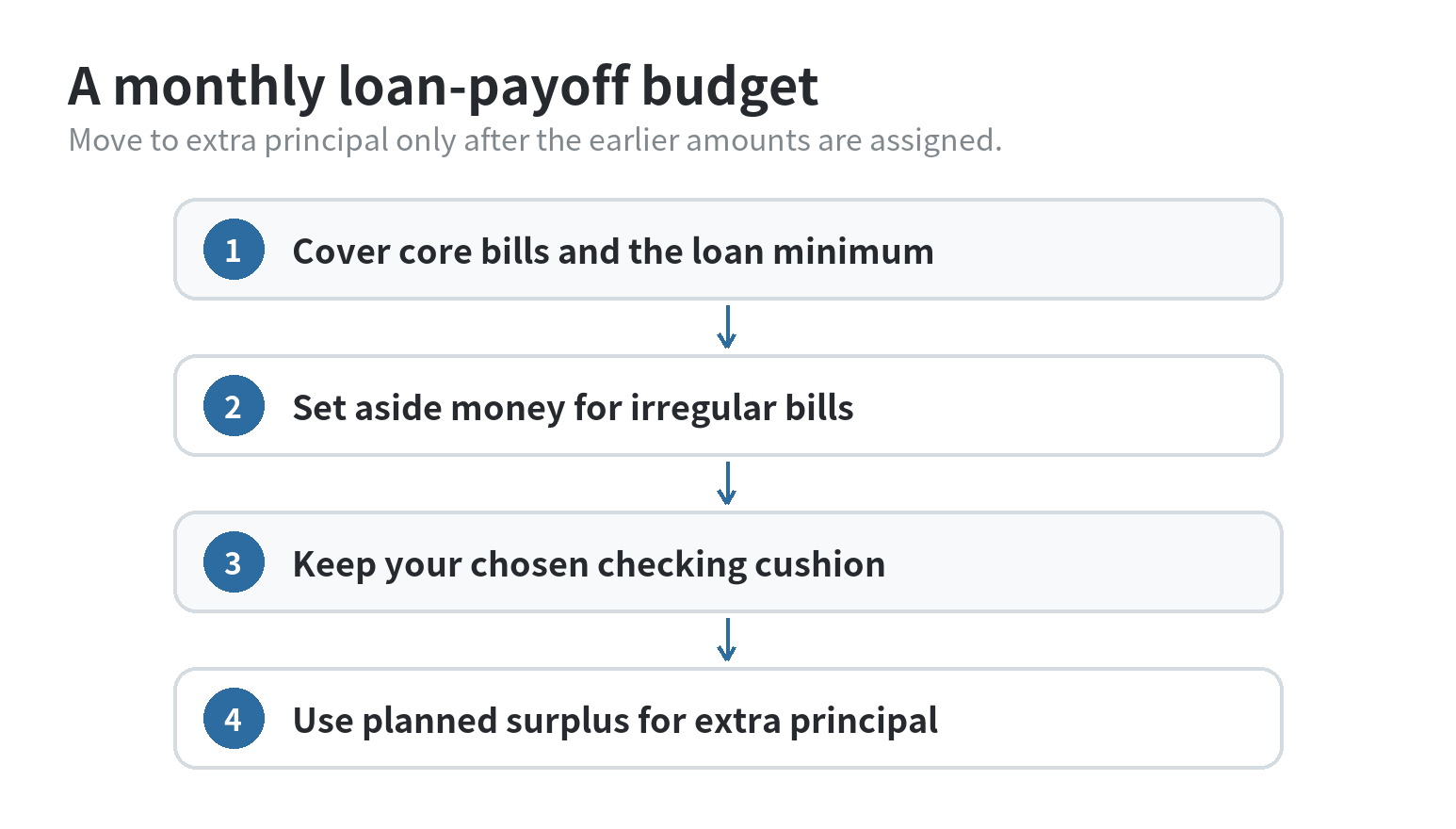
Choose an extra amount you can repeat
Set the extra amount after you have assigned the rest of the month. A fixed monthly amount is simple to plan; a variable amount can fit income that changes. For variable income, make the required payment part of the baseline budget and wait until income is received before setting the extra. This avoids committing money that has not arrived.
A one-time surplus can also go toward the loan, but first list the next bills and costs that are not monthly. A tax refund, work bonus, or gift may feel separate from ordinary income, yet upcoming expenses still draw from the same checking account. Decide in advance what portion, if any, is available after those obligations and your cushion. There is no required percentage to use.
Compare the extra payment with what it would otherwise do in your budget. If it would leave you short before payday, reduce it or skip it for that month. If you are carrying other past-due bills or higher-cost debts, put all required payments into the budget and compare their rates and terms before deciding where surplus goes. A loan example alone cannot determine which debt should come first for every household.
See how an extra payment changes the balance
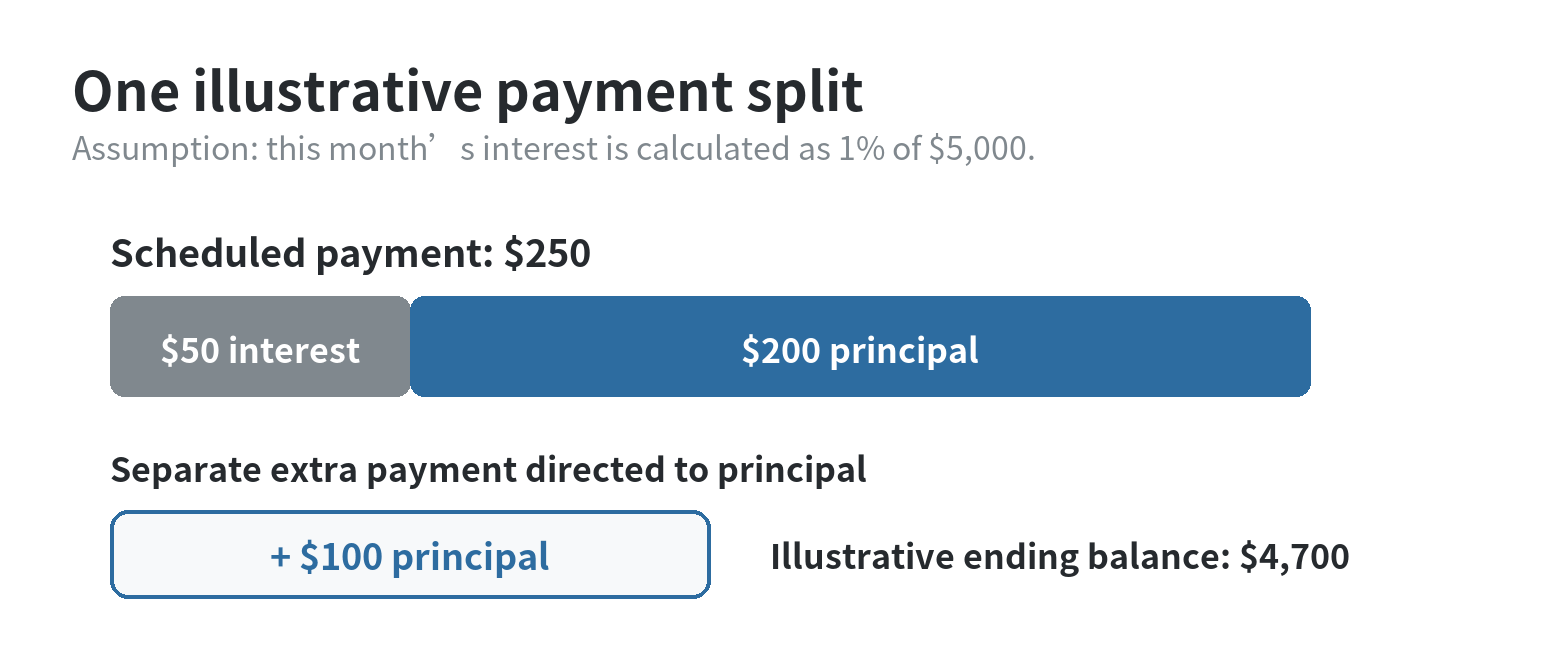
For a simple arithmetic illustration, imagine a $5,000 balance with a contract that calculates one month’s interest as 1% of the opening balance. That month’s interest would be $50. If the scheduled payment is $250 and the lender applies it first to that interest, $200 reduces principal. If a separate $100 extra payment is then applied to principal, as the FDIC describes for loan prepayment, the balance after those transactions would be $4,700, before any other charges. The figures illustrate the payment math; an actual loan’s calculation method and timing come from its contract.
The key question is where the additional dollars land. The FDIC’s consumer loan guide describes prepayment as paying more than the regular amount and applying the extra to the outstanding balance. CFPB’s student-loan guidance describes payment order as fees, then interest, then principal, and says borrowers can instruct the servicer to apply extra to principal. Because that second source concerns student loans, ask your personal-loan lender how to designate an extra payment and check the next statement for the result.
Do not multiply the scheduled payment by the number of payments left and treat the result as an exact payoff amount. Interest accrues according to the loan’s terms, a payment may post on a different date than you expect, and fees can change what is due. The CFPB payoff explanation describes this distinction for mortgages; use a payoff calculator only as a planning estimate, then ask the personal-loan lender for the official amount and date before paying in full.
Make the plan easy to maintain
Put the minimum payment and due date on the budget calendar, then schedule or make the extra separately if the lender supports that distinction. Leave enough time for the payment to reach the account by its due date; check the lender’s stated processing instructions rather than assuming that a bank transfer posts immediately. After an extra payment, compare the statement’s principal balance with the prior one and confirm that no future-payment credit replaced the principal reduction you intended.
Review the plan when income, housing costs, insurance, or other recurring bills change. You do not need to rebuild the entire budget for every small purchase. Recalculate the monthly surplus when a major bill changes or a new obligation begins, then set the extra amount from the revised figure. If the plan only works when every month goes perfectly, it is too aggressive for that budget.
When the remaining balance is close to what you can pay, stop using the worksheet as the final number. Request a payoff quote for a specific date and ask how to submit it, whether any fee applies, and how the lender confirms the account is paid. Keep the confirmation with your records and check a later statement or account notice for a zero balance. That final check closes the loop between a budget plan and the lender’s account.
FAQ
Should I keep saving while paying extra on a personal loan?
Include near-term bills and a cash cushion in the budget before choosing an extra payment.
Can I make an extra payment before the due date?
Ask the lender how it will apply an early or additional payment. The contract and payment instructions determine whether it reduces principal, satisfies a future installment, or triggers a fee.
Does paying extra lower my required monthly payment?
Do not assume it does. A principal reduction may shorten repayment while the scheduled installment stays in place; ask the lender whether it recalculates the payment or simply changes the balance and payoff timing.
What should I do after sending the final payment?
Keep the dated payoff quote and payment confirmation, then check the account for a zero balance or paid-in-full notice. Contact the lender if a remaining amount appears.
Last updated: 2026-10