Plan from combined take-home pay, assign each shared bill once, and agree on what stays personal.
Start with money that reaches your accounts. Then match bills to pay dates so a balanced month does not hide a cash-short week.
Begin with the deposits, not salary offers
Write down each person’s net pay: the amount deposited after taxes and deductions.
If pay varies, use a cautious figure supported by recent pay stubs. Leave anything above it unassigned until it arrives.
Do not build a checking-account plan from gross salaries.
For a worked example, Partner A brings home $2,800 and Partner B brings home $2,200, for $5,000 to plan with.
The consumer.gov worksheet uses after-tax wages as a budget input (checked September 30, 2026: budget worksheet).
These are sample figures, not a national average. Replace them with deposits from your own pay records.
The CFPB cash-flow calendar maps income and bills by date (checked September 30, 2026: CFPB cash flow calendar).
Keep a separate note for reimbursements, bonuses, or side work.
Add variable income after it arrives. Use it earlier only when you have a dependable schedule and a way to cover delays.
Health coverage, retirement contributions, withholding, and benefit elections can change the amount deposited.
If one deposit changes, update the plan from the new pay stub. Do not ask the other person to quietly absorb the difference.
Choose what “shared” means before splitting bills
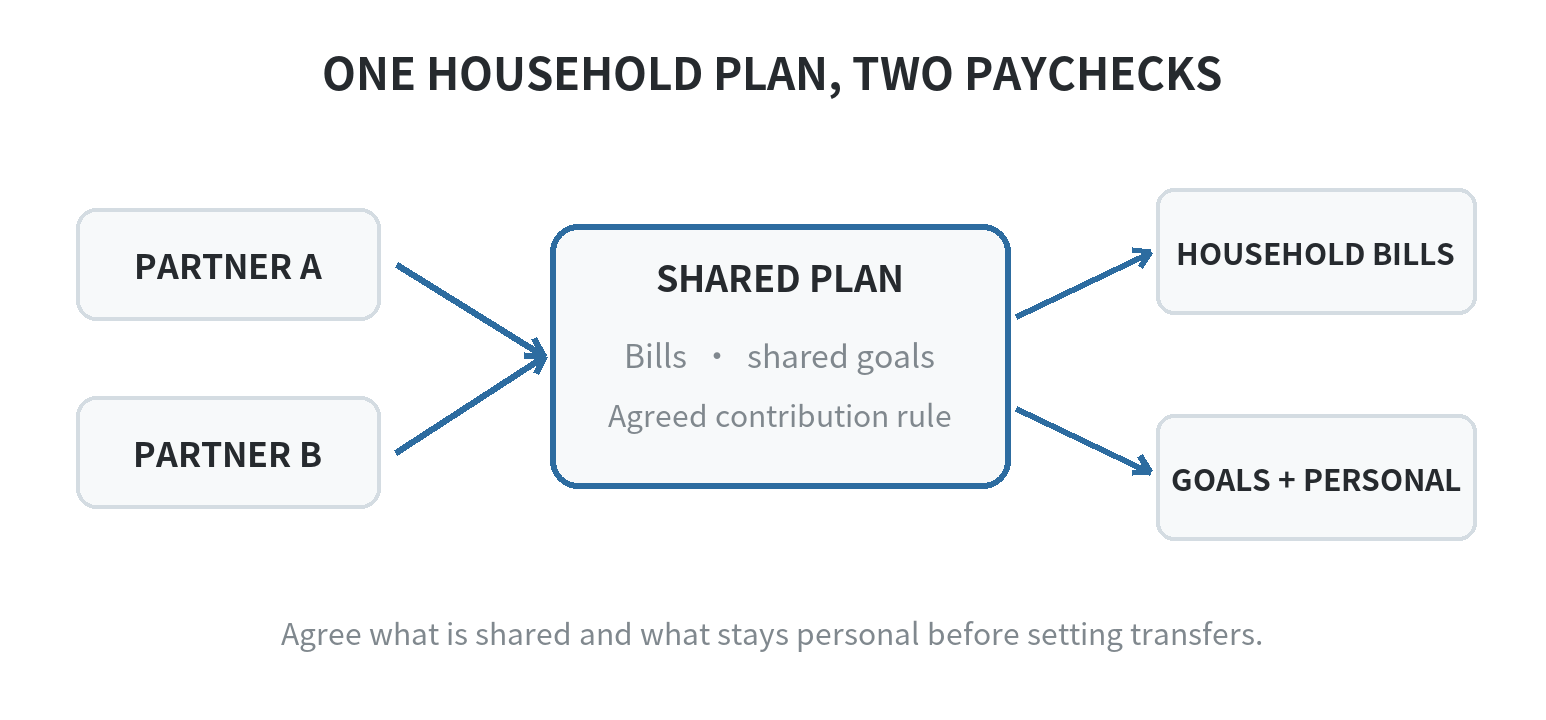
Couples do not need identical bank accounts to share a budget.
Choose a setup you can both follow: one joint bill account, transfers from separate accounts, or a shared ledger.
Name the payer or funding account for each shared bill. That keeps it from appearing twice in the plan.
- Equal contributions: each person transfers the same agreed amount. This is simple when take-home pay and personal obligations are close.
- Income-based contributions: sample shares are 56% and 44%, based on after-tax pay in the consumer.gov worksheet.
- Bill-by-bill split: assign and total specific bills. Check that one person is not left covering a larger share.
Whichever split you choose, agree on the transfer date as well as the amount.
If one person pays a shared bill directly, record the payment before the other person transfers money.
After contributions, compare what each person has left for personal costs. Adjust the split together if the result feels lopsided.
The example’s $2,800 and $2,200 deposits total $5,000; the consumer.gov worksheet lists income minus expenses (checked September 30, 2026).
Those proportions are not a rule for couples.
Before calculating contributions, decide how to handle personal debt, child-related costs, or support for relatives.
Decide how to classify costs that affect one person more directly, such as commuting or a professional license fee.
You can keep that cost personal, call it a household need, or split the portion you both agree is shared.
Write the choice beside the budget line. This prevents counting the same bill as both a shared expense and personal allowance.
Give every shared dollar a job
List required bills, flexible spending, and goals you chose together.
Use bank and card statements instead of memory to set the amounts.
The CFPB says to review several months of history and include less frequent costs (checked September 30, 2026: spending assessment).
Its examples include insurance, gifts, travel, and seasonal expenses.
For a yearly bill, note its due date and total; the CFPB spending assessment includes less frequent expenses.
Reserve part of that bill from each month’s plan.
Divide the charge across monthly budgets before it is due. For a sooner bill, divide by deposits left, as the CFPB cash-flow calendar shows.
This keeps a predictable large bill from landing as a surprise in the month it is paid.
The CFPB also names school costs as a less frequent expense to include (checked September 30, 2026: CFPB spending assessment).
Agree how to record shared purchases made on one person’s card.
Log the transaction in the shared category and note who paid. A transfer then reduces the shared balance instead of creating a second expense.
If a grocery run includes personal items, mark that portion separately before comparing the total with the shared plan.
Here is a sample $5,000 allocation using categories in the consumer.gov budget worksheet.
The amounts are placeholders to demonstrate a complete plan, not suggested targets.
| Shared plan line | Example amount | What to enter |
|---|---|---|
| Housing and utilities | $1,900 | Rent or mortgage, power, water, internet |
| Food and household supplies | $800 | Grocery and household transactions |
| Transportation | $600 | Car, transit, fuel, parking, or rides |
| Debt and insurance | $650 | Required payments and premiums |
| Shared savings goals | $500 | Goals you both named |
| Personal spending, $275 each | $550 | Agreed amount each can use independently |
| Total assigned | $5,000 | Matches the sample deposits |
If the total is higher than your deposits, write down the gap before cutting a category.
Separate a timing problem from a monthly shortfall. Moving a due date may help with timing; it does not remove an expense.
If money remains, decide whether to assign it to a shared goal, leave it as a cushion, or divide it between both.
Write that choice into the plan so both people know whether the remainder is available to spend.
If your expense lines exceed take-home pay, mark the gap before assigning optional spending.
Check for duplicate subscriptions, forgotten annual bills, and categories where actual spending differs from the plan.
A zero remainder does not prove the plan fits. Add an “unplanned” line if your records show uncategorized costs.
If a phone-based tracker would make shared spending easier to see, our guide to budgeting apps for your phone covers that separate choice.
Match the plan to the paycheck calendar
A balanced monthly budget can still leave checking short before payday.
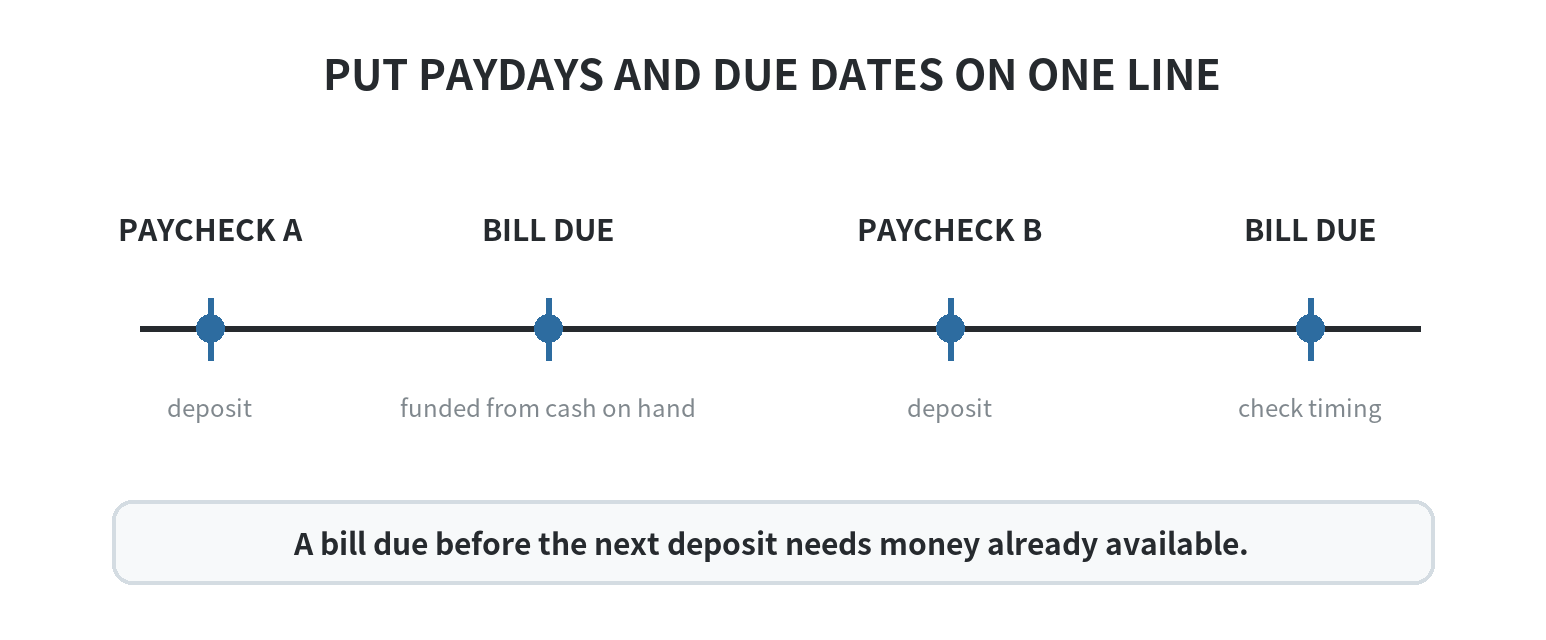
Put deposit dates and due dates on one calendar, then assign each bill to the paycheck funding it.
Keep the bill money in the account until the payment clears.
Do not read the checking balance as free money without subtracting bills already assigned to it.
For card purchases, track the spending when it happens and the card payment when it is due.
If a paycheck arrives after a large bill is due, ask the company about a different due date or split payment.
If rent is due before the next deposit, fund it with money on hand; the CFPB cash-flow calendar maps timing.
The CFPB budgeting guide says timing mismatches can leave someone short at month-end (checked September 30, 2026: budgeting guide).
If reminders on a shared calendar are part of your setup, our guide to tracking bill due dates by phone discusses that task.
Review the plan as a team, not as a scorecard
Set a check-in after you both can see recent transactions.
Compare planned and actual amounts, confirm upcoming bills, and decide what to adjust.
Bring the statement or transaction list, plus the next set of due dates, so the discussion stays concrete.
Keep it about the shared plan: “The electric bill is higher than our entry; which line should change?”
Agree in advance how to handle a surprise expense, missed shift, or change in pay.
Decide which costs pause, who contacts a biller, and whether personal spending limits change.
Write that decision down so you do not need to settle the same question again.
If combining money feels uncomfortable, keep separate accounts and share a bill list.
If one person manages payments, both people should be able to see balances, due dates, and the plan.
A budget coordinates the work. Both partners need access to its details.
FAQ
Should couples combine bank accounts to budget two incomes?
No. You can use joint or separate accounts, or a shared ledger.
Choose the arrangement that makes bill ownership and balances clear to both people.
How do you budget together when one income changes each month?
Build the core plan from a cautious amount supported by recent deposits. Assign extra income after it arrives.
Keep variable pay separate from bills due before the next deposit.
What if one partner earns much more than the other?
Agree on a contribution method before transfers begin.
Compare equal amounts, income-based shares, and bill-by-bill assignments by their effect on each person’s personal money.
How often should a couple review a shared budget?
Pick a check-in rhythm that matches your pay and bill dates.
Confirm upcoming obligations and make adjustments together. Change the schedule if it is not catching problems in time.
Last updated: 2026-09