Build your freelancer budget from cash that has cleared, then give each client payment a job: business costs, a tax reserve based on a current estimate for your situation, household pay, and a buffer for lean weeks. This keeps a delayed project from quietly becoming rent money.
Freelance budgeting needs two views at once: a monthly plan for bills and a payment calendar for the dates money lands. The CFPB explains that cash-flow budgets track both amounts and timing, especially when income is irregular (checked September 30, 2026). Consumer.gov recommends listing monthly income and expenses, then comparing the two (checked September 30, 2026). Use those views together.
Start with deposits, not invoices
Keep a simple list of invoices with the client, amount, sent date, due date, and paid date. An invoice tells you what a client owes; it does not tell you what you can spend today. Put unpaid invoices in a forecast column, separate from your available balance.
Use your last three bank statements to total deposits that cleared. If freelance work is your only income, Consumer.gov suggests using last year’s total income divided by 12 as a monthly estimate when pay does not arrive every month (checked September 30, 2026). Treat that as a planning reference, then compare it with cash received this month and the work already booked. If you just started, use deposits to date and build the plan around the lower amount you can reliably cover.
For a worked example, imagine a freelancer whose cleared deposits vary between $2,400 and $4,200, with $3,000 received in a planning month. These are made-up placeholder amounts. If a $900 invoice is still unpaid, it stays outside the spendable $3,000 until the deposit appears in the account.
Give every cleared payment four jobs
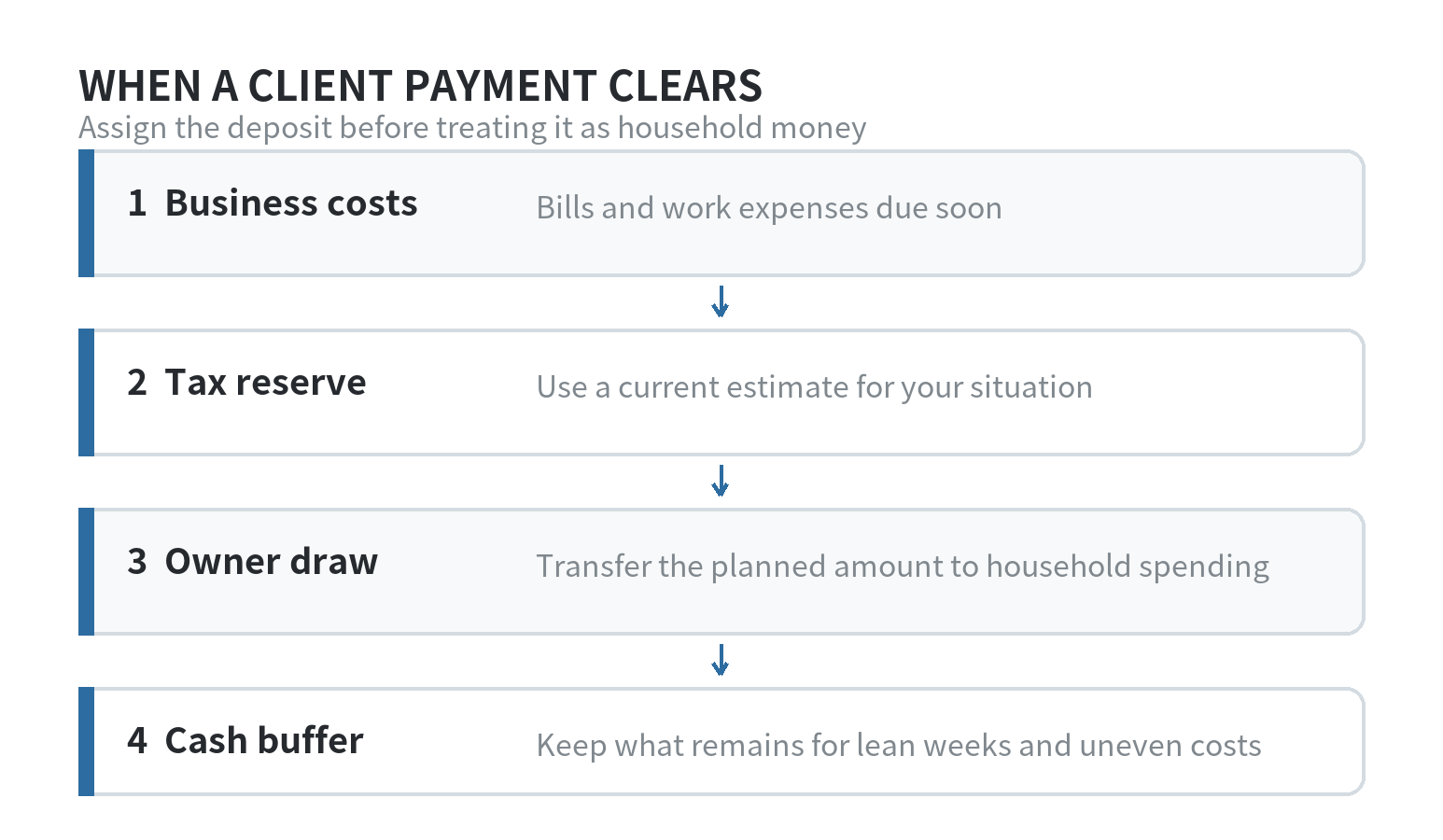
As a deposit arrives, record it and divide it into separate budget lines. First cover direct business costs already due, such as software, materials, or subcontractor invoices. Next move the amount set aside for taxes using an estimate prepared for your own circumstances. The IRS says federal income taxes are paid as income is earned, through withholding or estimated tax payments; self-employed people generally use estimated payments (checked September 30, 2026). Check current IRS instructions against your own records to set the amount.
Give recurring business bills their own list, separate from costs tied to a specific job. A monthly software charge belongs on the recurring list; supplies for a signed project belong with that project. Check statements and receipts so annual renewals, transaction charges, and replacement equipment do not disappear between months. This also shows how much cash needs to stay in the business before you decide the owner draw.
Then move a planned owner draw to personal checking. Give yourself a repeatable amount based on a conservative month, rather than taking more just because a large client paid early. In the example, the $3,000 deposit might be assigned as follows after checking the freelancer’s real costs and estimate:
| Bucket | Example assignment | Use |
|---|---|---|
| Business bills | $450 | Known operating costs due soon |
| Tax reserve | $600 | Placeholder pending a current personal estimate |
| Owner draw | $1,500 | Household plan and personal bills |
| Business buffer | $450 | Late payments and irregular costs |
The assignments add up to $3,000 as a sample split. Replace each line with your own operating bills, tax estimate, household needs, and available cash. The tax reserve stays a placeholder until you apply an estimate for your situation. For a fuller look at separating business cash from household spending, see the self-employment budgeting article.
Set household spending from a cautious draw
Build the household budget around the owner draw you can support in a slower month. List rent, utilities, groceries, insurance, debt payments, and other commitments with their due dates. Include irregular household costs, such as annual renewals or equipment replacement, as their own monthly saving lines. A bill that arrives once a year still needs a place in the monthly plan.
In the example, suppose the freelancer chooses a $1,500 draw for the month. They could map $900 to fixed bills, $350 to groceries and transportation, and $150 to a scheduled annual expense, leaving $100 unassigned. These example amounts show how the lines can fit together; replace them with your own figures. If the listed needs exceed the draw, the gap is visible before discretionary purchases happen. The next decision is to adjust a flexible category, reduce a future commitment, or plan additional income; an unpaid invoice should not fill the gap on paper.
If a larger payment arrives than the amount used for the household plan, first compare it with upcoming work costs and bills. The extra can stay in the business buffer until you see the next low-cash date on the calendar. Raising household spending immediately turns a single strong deposit into a commitment that the next month may not support.
Separate personal and business records where practical, and label transfers clearly. The IRS says keeping income and expense records helps identify income, track expenses, and support tax return entries (checked September 30, 2026). The Small Business Administration’s freelancer tax overview also recommends recording profits, losses, and expenses and setting money aside regularly (checked September 30, 2026). A short monthly review of bank activity, invoices, receipts, and transfers makes it easier to see whether your planned draw matched cash received.
Use a calendar to find the short week
A monthly total can look balanced while rent is due before a client pays. Put cleared deposits, expected deposits, and bill due dates on one calendar. Mark expected money differently from available money. Then write a running balance after each confirmed deposit and required bill; the lowest point shows when timing is tight.
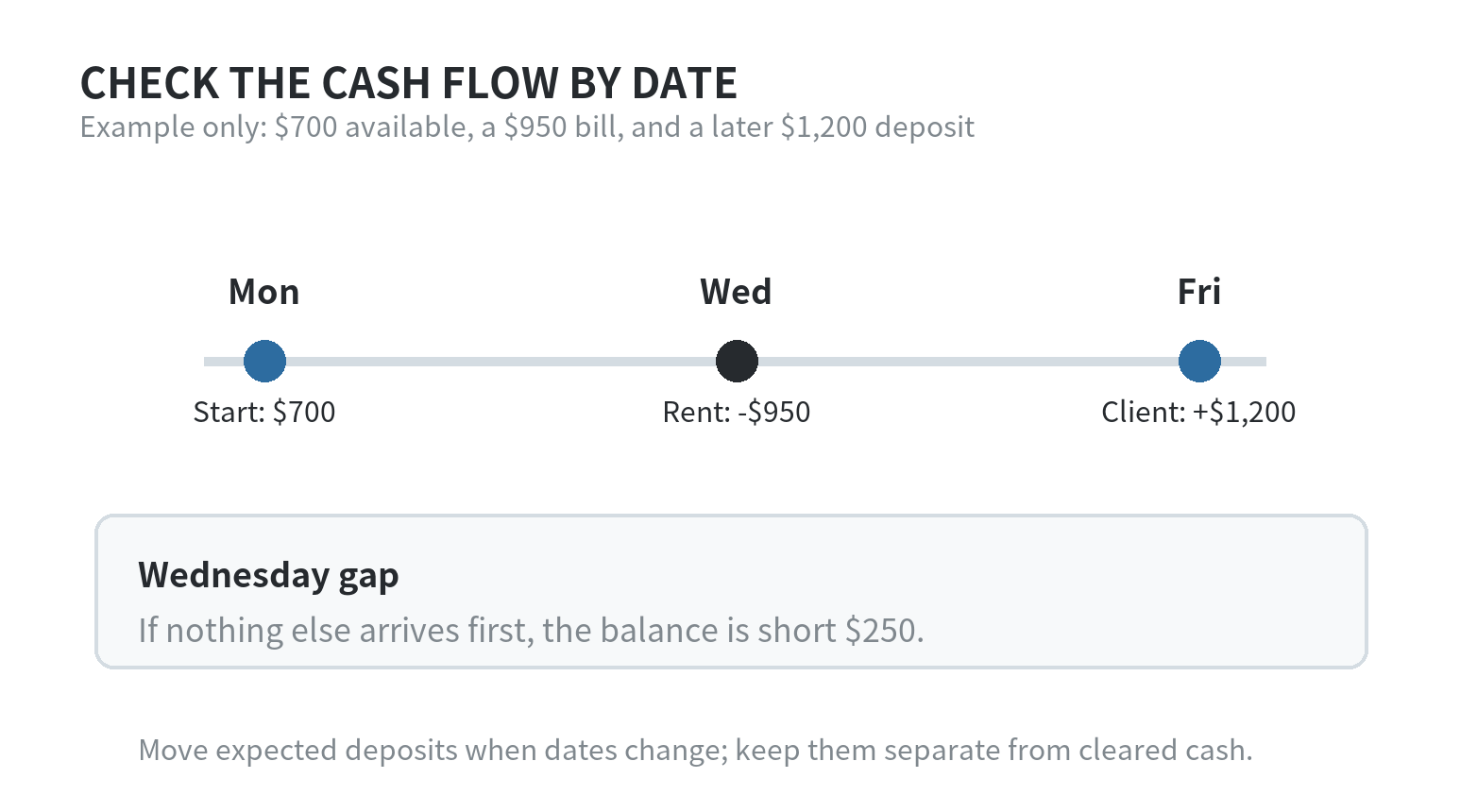
For example, start the week with $700 available, schedule a $1,200 client payment for Friday, and list $950 rent due Wednesday. The Wednesday balance would be negative $250 if no other money arrives first. The Friday payment may restore the balance, but it does not solve Wednesday’s timing gap. Contacting a biller about a different due date, holding back more from an earlier deposit, or arranging a smaller owner draw are concrete changes to consider. The CFPB’s cash-flow worksheet uses a week-by-week balance for this reason.
Keep a separate running balance for business cash and the household account. A business payment due before a client deposit can create the same timing problem as rent. Recheck expected dates when a client changes a deadline; revise the calendar instead of quietly spending the buffer twice.
Review the plan when work changes
At month end, compare cleared deposits with the forecast, then compare actual spending with each budget line. Note which invoices moved, which costs were one-time, and whether the owner draw left enough for personal bills. Consumer.gov advises making a plan, tracking spending, and using the month’s results to shape the next budget. That gives you a repeatable review without treating one unusually busy month as the new baseline.
If income swings sharply, make a low, middle, and high cash scenario from your own records. Assign essential bills first in each one, then see whether the planned draw works in the low scenario. Keep optional spending linked to money already received. For more detail on shaping a plan around changing deposits, see the irregular-income budgeting article.
Revisit the tax reserve when the work mix, income forecast, or household situation changes. The IRS says estimated tax calculations use expected income and other tax inputs, and that an estimate can be recalculated as earnings change (checked September 30, 2026). Use current IRS materials or a qualified tax professional to calculate the amount for your situation.
Last updated: 2026-09
FAQ
Should a freelancer count an invoice as income before it is paid?
No. Keep unpaid invoices in a forecast, and use cleared deposits for spending decisions. This separates expected cash from money available in the account.
How can I budget when a client pays late?
Move the expected deposit date on your cash-flow calendar and recalculate the balance before each bill due date. Use the buffer or adjust a planned transfer only after checking which costs must be paid first.
How often should I review a freelance budget?
Review it at month end and whenever a major deposit date, business cost, or household commitment changes. Compare actual cleared income and spending with the plan, then update next month’s amounts.
Can I use one bank account for client money and personal bills?
You can track a budget in one account, but clear labels for business income, business costs, tax reserves, and personal transfers make the records easier to review. Check the account terms and recordkeeping needs that apply to your business.