A workable budget for a $4,000 monthly income starts with the amount that reaches your bank account, then assigns that money to bills, day-to-day spending, and less frequent costs. Use the same method for $1,500 or $7,000: your own take-home pay and bill history set the amounts, not a universal percentage.
The CFPB’s monthly budget worksheet separates income from expenses, while its guidance on assessing spending says to include irregular costs and compare the result with take-home pay (checked September 2026). That is a useful starting point whether you are paid hourly, salaried, or on an uneven schedule.
Start with the money you can actually spend
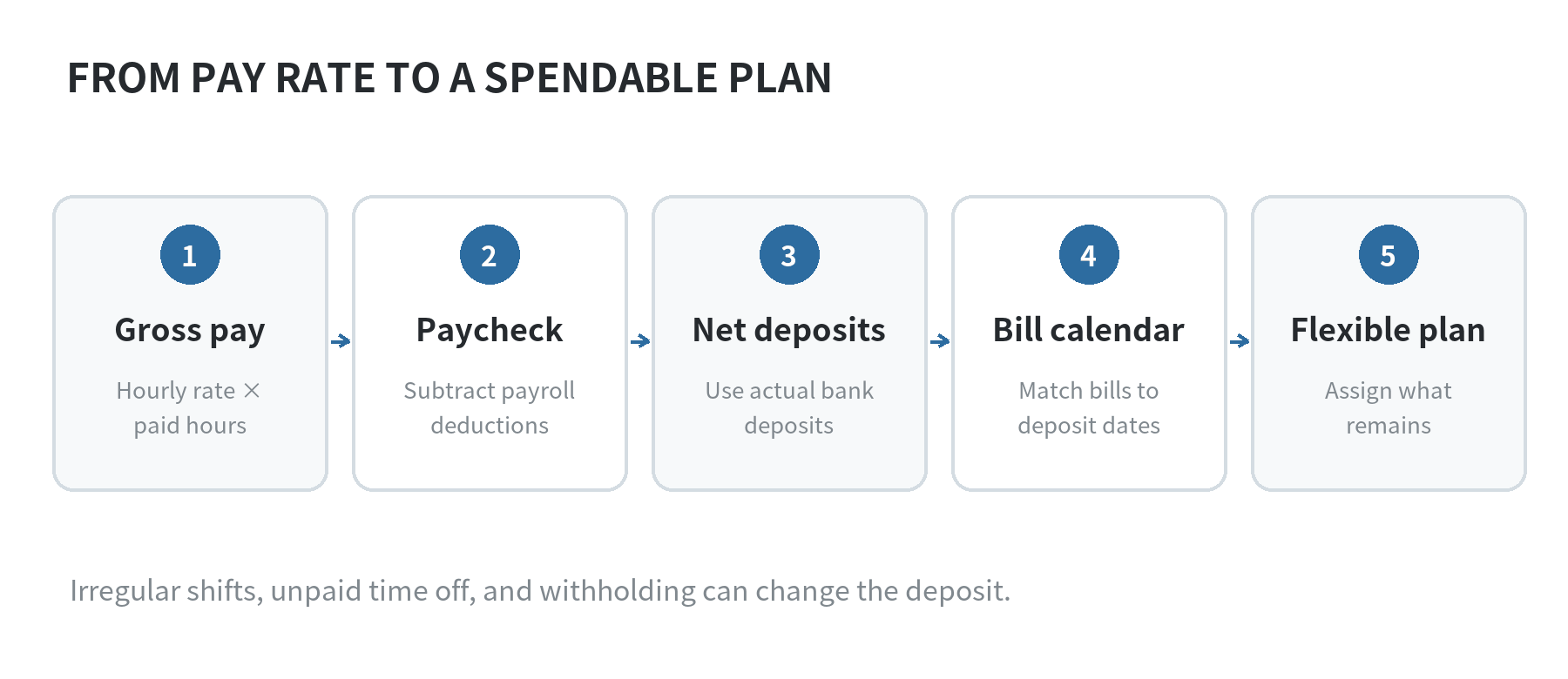
Write down net pay: the amount deposited after payroll deductions. Do not budget from gross pay just because that is the number in a job offer. The CFPB paycheck guide defines net income as pay after taxes and other deductions. The IRS and USAGov withholding guidance explain that federal withholding depends on earnings and the information on Form W-4 (checked September 2026). Check a recent pay stub for the deposit amount you can actually use.
If your hours or commissions change, build the fixed-bill plan from deposits you can count on and keep variable pay out until it arrives. For freelance or contract work, budget from the amount you transfer to personal use after business expenses, rather than the invoice total.
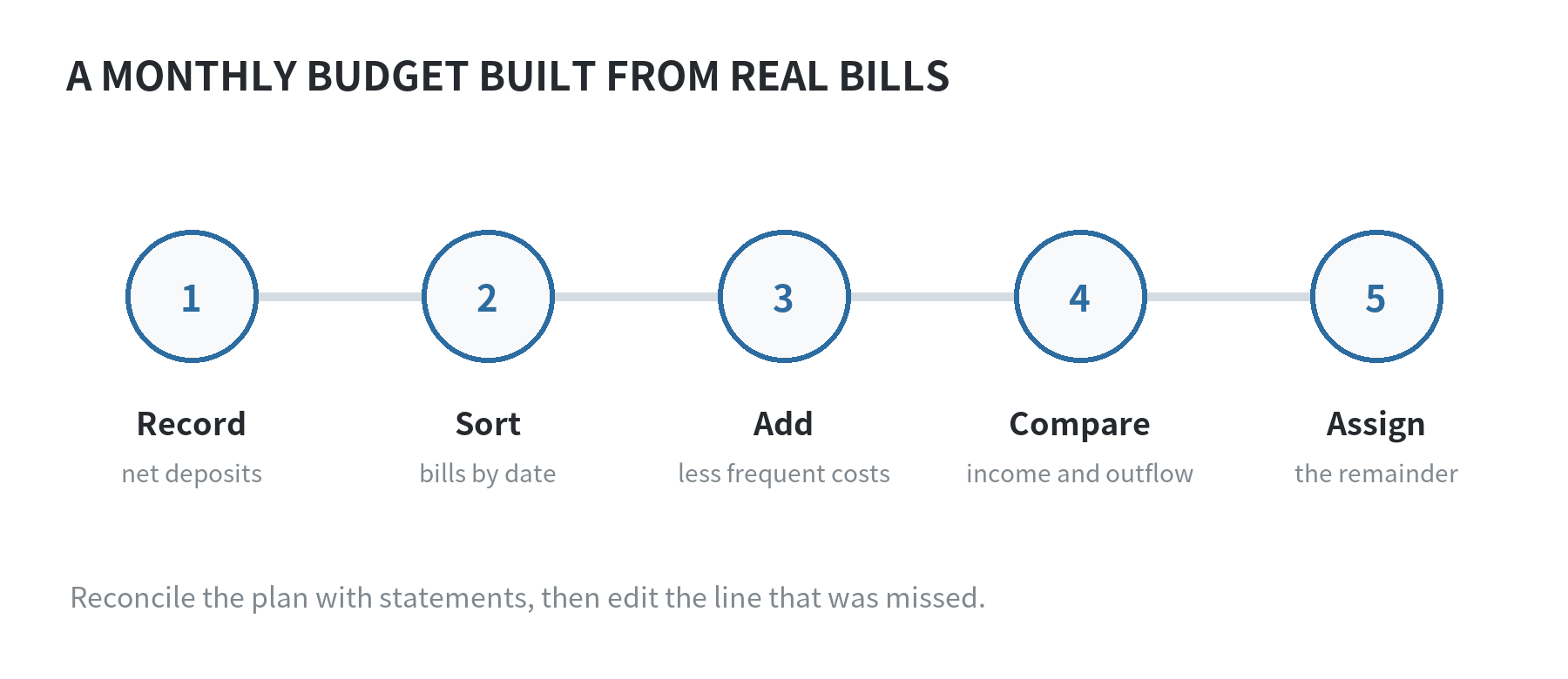
List the bills by due date, not only by category. A rent payment due before the second paycheck can create a cash-flow gap even when monthly income is enough on paper. The FDIC’s Money Smart spending and saving plan compares net income with expenses and notes that nonmonthly schedules may need monthly conversion; the CFPB’s cash-flow budget tracks income and expenses by week so their timing is visible (checked September 2026).
What the income levels change
The figures below are a made-up planning exercise, not national spending averages or recommended caps. They assume each listed amount is monthly take-home pay for one adult. Replace the lines with your own rent, utilities, food, transport, debt minimums, and goals; the CFPB monthly worksheet and the FDIC spending and saving plan both begin with income and actual expenses rather than a fixed dollar template (checked September 2026).
| Monthly take-home example | First budget question | What to plan before flexible spending |
|---|---|---|
| $1,500 | Can housing and utilities fit alongside food and transport? | List essential bills and minimum debt payments; identify any shortfall before assigning optional spending. |
| $2,000 | Which bill date falls before the next deposit? | Set aside each bill from the paycheck that arrives before its due date; include phone, transit, and recurring charges. |
| $3,000 | What irregular costs are missing from a normal month? | Review insurance, repairs, annual fees, and gifts, then divide planned costs by the months remaining until they are due. |
| $4,000 | What amount remains after the real bill list? | Give the remainder named jobs: near-term expenses, savings goals, and flexible spending. |
| $5,000 | Did recurring costs rise along with income? | Check new subscriptions, housing, vehicle, and debt commitments before expanding flexible categories. |
| $6,000 | Which goals are competing for the same dollars? | Rank planned expenses by date and importance; assign amounts only after fixed obligations are covered. |
| $7,000 | Is the surplus already spoken for? | Separate near-term goals, irregular bills, debt payments, and discretionary money so one large category does not hide the rest. |
For example, a $4,000 take-home plan might start with $1,600 for housing and utilities, $600 for groceries and household supplies, $400 for transportation, $350 for debt and recurring bills, $400 for irregular costs and savings goals, and $650 for flexible spending. Those are sample inputs, not a claim about what housing or food should cost. The CFPB worksheet and FDIC plan provide the income-versus-expenses structure; the dollar amounts here are invented to demonstrate totaling the lines (checked September 2026). If your rent alone is higher, use the real figure and see what remains; do not force the example to balance by pretending a bill is lower.
At $1,500, the useful result may be a clear shortfall rather than a neat allocation. Put housing, utilities, food, transportation needed for work, and required payments on the page first. If they exceed income, the CFPB worksheet identifies the difference as a shortfall; address it through a bill review, income change, benefit screening, or local nonprofit counselor rather than erasing the numbers.
For the $5,000 to $7,000 examples, check whether recurring commitments rose with income; the CFPB recommends comparing spending categories with take-home pay. Before increasing a monthly payment, write down the full cost and the date it starts. Keep a one-time bonus outside the base monthly plan, then assign it to costs or goals that do not require a new monthly commitment.
Turn hourly pay into a monthly starting point
Hourly rates are gross pay rates, not monthly take-home amounts. To make a rough comparison, assume 40 paid hours each week and 52 paid weeks in a year, then divide annual gross pay by 12. Under that stated assumption, $15 an hour is about $2,600 gross per month, $20 is about $3,467, and $25 is about $4,333. The math is illustrative, not a standard schedule; the CFPB paycheck guide defines gross income as pay before deductions and net income as take-home pay after deductions, and the IRS withholding guidance explains that federal withholding depends on earnings and Form W-4 information (checked September 2026).
| Hourly rate | Example gross monthly math | Budgeting next step |
|---|---|---|
| $15/hour | $15 × 40 × 52 ÷ 12 = $2,600 | Replace gross with a normal paycheck deposit before assigning bills. |
| $20/hour | $20 × 40 × 52 ÷ 12 = $3,466.67, or about $3,467 | Use actual hours if your schedule is not consistently 40 paid hours weekly. |
| $25/hour | $25 × 40 × 52 ÷ 12 = $4,333.33, or about $4,333 | Keep overtime separate until it appears on the pay stub. |
To replace the estimate, add the net deposits from a representative month. If you are paid weekly or every other week, do not treat an extra-paycheck month as ordinary monthly income. Build routine bills around the deposits you expect in a standard month, then give an additional paycheck a job when it arrives. If shifts vary, total documented net deposits from past months and use a planning amount you can support from your records.
Catch the expenses that arrive out of season
Scan bank and card statements beyond the current month. The CFPB advises looking back over several months for expenses that occur less often, including insurance, medical bills, school costs, seasonal spending, gifts, and vacations. The FDIC spending plan also records past monthly amounts before setting a planned month. Add expected costs to a calendar. If a $600 annual bill is due in six months, a simple planning amount is $100 per month for those six months; the example is arithmetic, not a forecast of your bill.
Separate the plan into four buckets: bills with set due dates; essentials that change, such as groceries; known future costs; and flexible spending. For each irregular item, write the total and due date. Divide by the number of deposits before that date, then reserve that amount from each deposit. This makes an annual bill visible before it competes with rent or groceries.
When money runs short, compare the planned amounts with statements and receipts. CFPB recommends checking whether the leftover amount in your bank account matches the budget’s leftover amount. If it does not, look for omitted cash spending, automatic renewals, fees, or a bill charged to a different account. Update the line that is wrong instead of adding a vague “miscellaneous” cushion that hides the cause.
Use the next paycheck as a reset point
Keep a simple list with four columns: deposit date, net amount, bills due before the next deposit, and amount left for food and other spending. After the deposit arrives, mark paid bills and update the remaining balance. A calendar or spreadsheet is enough; the method matters more than the tool.
If you want a phone-based method for recording expenses, see the site’s budgeting app overview and its guide to tracking freelance income. For an app-neutral plan, the CFPB and FDIC worksheets let you list income, spending, and savings without adopting a monthly percentage rule.
At month-end, keep the categories that matched your statements and adjust the ones that did not. If essential bills exceed take-home pay, preserve that gap in the plan and decide which call, due-date request, income step, or support resource to pursue next. If money remains, assign it deliberately rather than assuming the balance will still be there after the next irregular bill.
FAQ
How can a weekly cash-flow budget help when rent is due before payday?
Track the starting balance, deposits, and bills week by week, then carry each week’s ending balance into the next. The CFPB cash-flow budget uses this sequence to make the timing of income and expenses visible.
Should I include the money already in checking when I plan the month?
Include the balance that is available for bills, but do not count it again as new income. A weekly cash-flow sheet can begin with that balance, add deposits as they arrive, and subtract expenses by date, as shown in the CFPB cash-flow budget.
How should roommates track a bill when one person pays it up front?
List the full bill once in the household plan, then record the other roommate’s share as a transfer on the date it is expected. In your personal budget, count only the share you are responsible for and the money you actually receive; this keeps the shared expense from appearing twice as a full bill.
Last updated: September 2026
Last updated: 2026-09