To split grocery costs with roommates, decide which items are shared before anyone shops, keep personal purchases separate, and settle from a simple receipt log. An equal split works when everyone agrees to share the same basket; if meals or diets differ, split only the items everyone agreed to use. Your own receipts—not a national average—show what the arrangement costs your household.
Start with one conversation about food that goes into the shared kitchen. Are coffee, cooking oil, condiments, and bulk staples communal? What about snacks, specialty ingredients, or takeout? Set those boundaries first. The Consumer Financial Protection Bureau’s monthly budget tool groups groceries with other household spending, while its spending tracker recommends recording purchases to see where money goes (checked September 2026). That is useful for your shared grocery line too: track the actual basket before choosing a monthly cap.
Choose what counts as a shared grocery
Make a short shared list of items that anyone in the household may use, such as rice, eggs, or milk, if all roommates agree. Keep each person’s preferred brands, dietary substitutes, snacks, and individual meals on a personal list unless the group explicitly opts in. A label on the shelf or a separate pantry bin can make the boundary visible.
Groceries and household supplies are easy to mix up on a store receipt. Decide whether dish soap, trash bags, and paper towels belong in the grocery pool or a separate household-supplies pool. If one roommate buys both, mark the shared items and leave personal products out before calculating anyone’s share.
Use a shared note or spreadsheet with four fields: purchase date, store total, shared items, and who paid. Add a photo of the receipt when the line items are hard to read. The CFPB’s spending tracker asks people to record expenses and review them; the FDIC’s Money Smart materials separately cover tracking income and expenses and making a spending plan (checked September 2026). Those records make the household total visible without guessing what each person bought.
Pick a split that matches how you eat
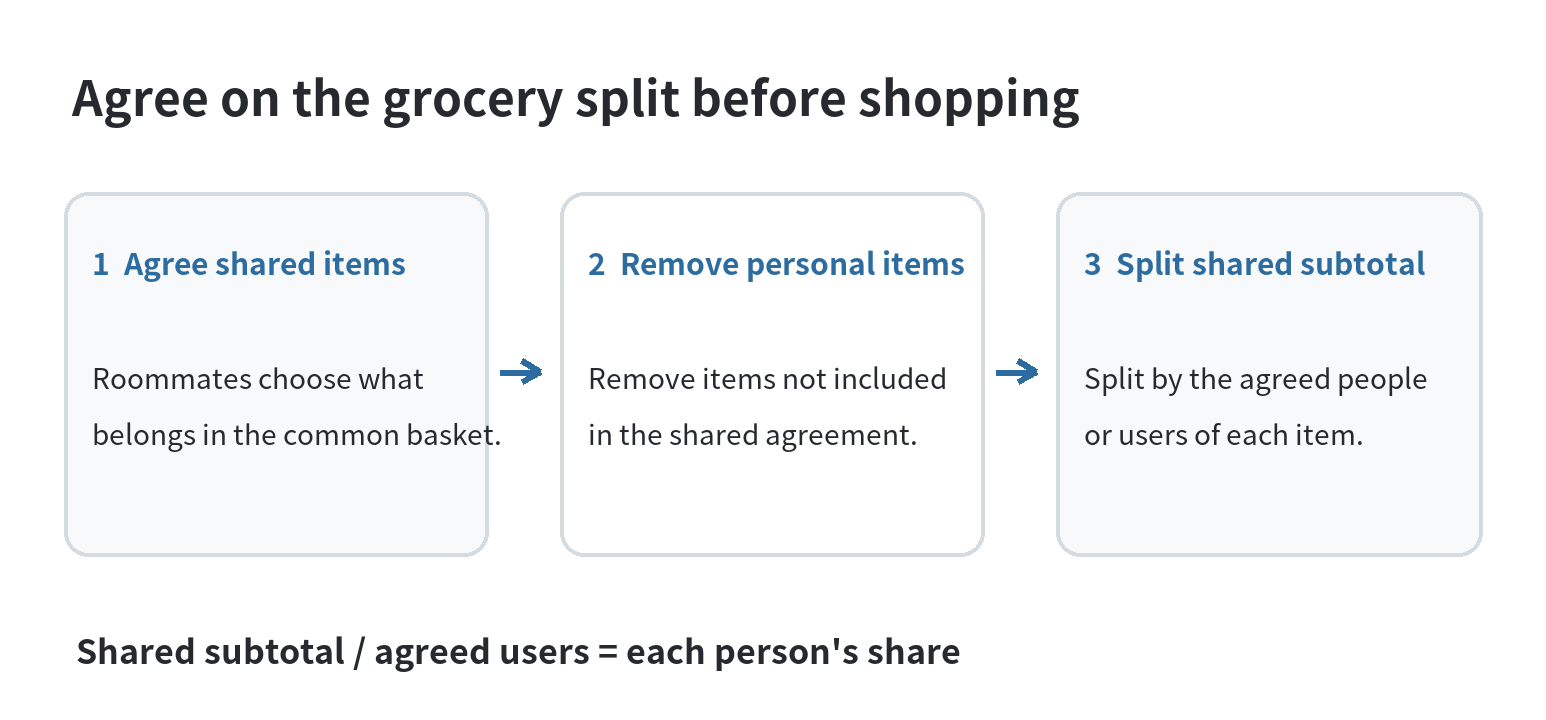
An equal split is simplest when every listed item is communal and everyone has agreed to pay the same share. For example, if three roommates approve a $360 shared grocery basket for the month, each person’s share is $120. That figure is an illustration, not a suggested budget. Substitute the total from your own receipts and the number of people who agreed to share it.
When some items are personal, do not divide the whole receipt evenly. First total the agreed shared items, then split that subtotal. Each shopper pays for their own excluded items. If the receipt does not show item-level prices, mark personal items before checkout or keep them on a separate transaction so no one has to reconstruct the total later.
A per-person split may also need adjustment when someone is away for a long stretch or does not use a specific shared item. Agree in advance whether that person still contributes to pantry staples, or whether the group will exclude those items for that period. Avoid changing the rule after a large shop; that turns a predictable calculation into a dispute about past meals.
Work one receipt through the ledger
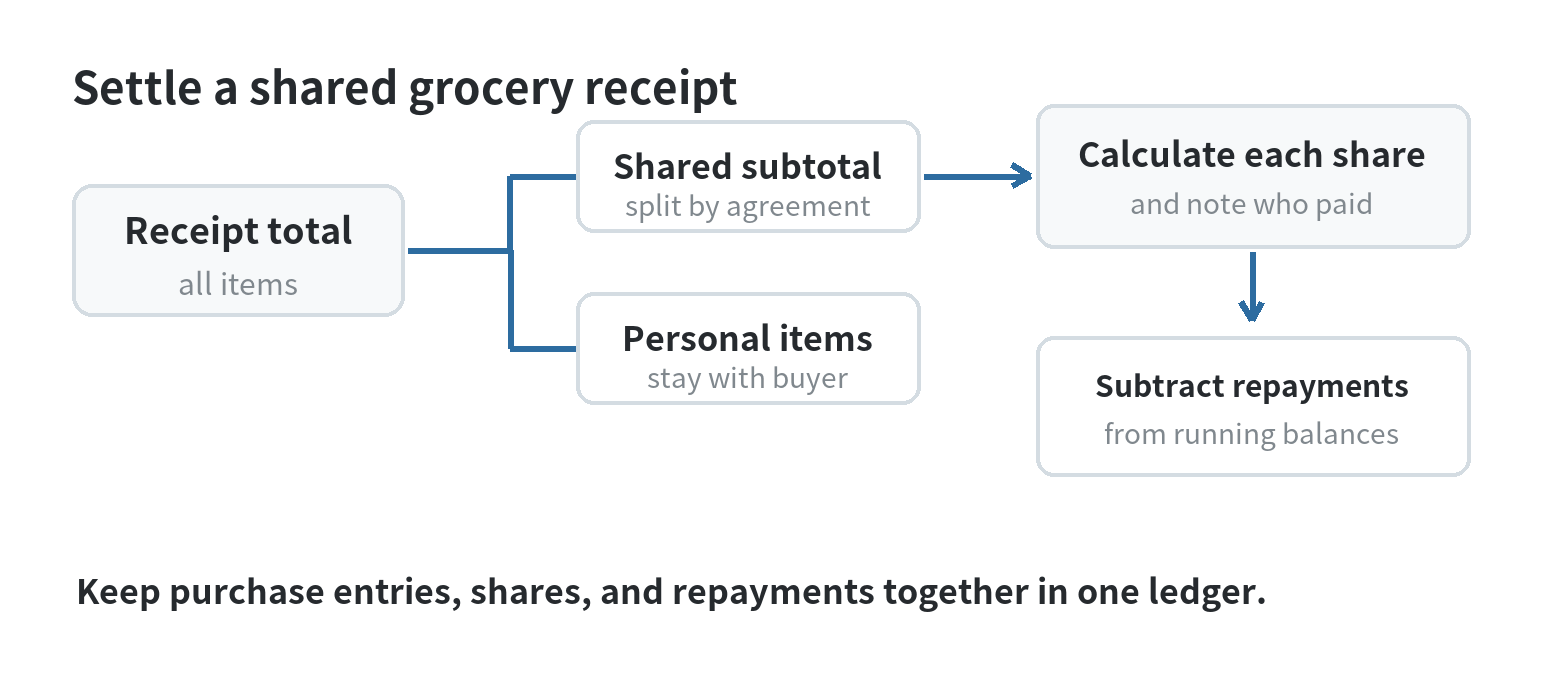
Suppose a receipt totals $148. The roommates marked $112 as shared groceries, and one shopper’s personal coffee and snacks account for the other $36. With three roommates in the shared pool, the common portion is $112 ÷ 3, or $37.33 each after rounding. The shopper who paid the receipt records the $112 shared subtotal; the personal $36 stays with that shopper.
If the person who paid is one of the three roommates, they have already covered their own $37.33 share. The other two each owe about $37.33 to that shopper, with a one-cent rounding adjustment assigned by agreement. If a different roommate pays next time, record that separately. The aim is to compare everyone’s total contributions over the same period, rather than request money every time someone picks up one item.
For a more varied basket, calculate item groups separately. If all three share pantry staples but only two share a particular beverage, split each subtotal among the people who opted in. Keep the receipt line or a note explaining the grouping, and add the amounts. This avoids making one roommate subsidize food they did not agree to share.
Settle on a schedule and keep the record easy
Pick a regular settlement point, such as the end of the month or after a planned group shop. One person can enter purchases as they happen; another can check the receipt photos before balances are settled. This gives roommates a defined time to flag a missed personal item or duplicate entry while the receipt is still easy to find.
A basic ledger can show the date, payer, shared subtotal, split rule, each person’s share, and amount already paid back. Keep reimbursements in the same record as the purchases. If someone pays $80 toward their balance, subtract it from that person’s running amount rather than adding a separate note that could be forgotten.
For a shared monthly budget, add only the common grocery portions from the ledger. CFPB’s monthly budget worksheet lists groceries as an expense category and subtracts total spending from income; MyMoney.gov also recommends tracking spending and making a spending plan (checked September 2026). Your apartment can use the same idea at a smaller scale: set a cap from recorded shared purchases, then compare the next month’s shared subtotal with that cap.
If the total is higher than expected, inspect the receipt categories before cutting the budget. The cause may be a one-time pantry restock, personal items accidentally counted as shared, or a group choice to add more common meals. Agree on which change to make next month and write it beside the ledger rule. This keeps the budget tied to a decision everyone can see.
Handle different schedules without reopening every receipt
Roommates with different work hours may rarely eat together but still share basic ingredients. Keep shared staples separate from planned shared meals: the staples can follow the regular split, while a meal’s ingredients can be divided among the people who plan to eat it. Write down who opted in before the shop.
If a roommate travels or moves out mid-cycle, use the date and rule the household agreed on rather than estimating meals after the fact. A group might decide that the person contributes to purchases made before departure, while later shopping is split among those remaining. Record that adjustment as a dated note so the math is clear to everyone.
For roommates who prefer not to share food at all, keep separate grocery purchases and share only the supplies the household has explicitly agreed to pool. A shared list can still help people avoid duplicate purchases; see how shared phone lists can organize household tasks. If you also want to fit the common grocery amount into an individual monthly plan, the site’s monthly budget and tracking overview covers the broader budget side.
Before the next shop, settle three decisions together: the shared-item list, the split for each category, and when balances are reviewed. Then keep receipts and use the same rule for the full period. A clear list and a small running ledger turn “who owes what?” into arithmetic everyone can check.
FAQ
Should roommates split groceries if one person eats out more often?
Split only the groceries the group agreed are shared. Eating out does not change someone’s share of communal items unless the roommates agreed to account for usage or absence in advance.
How should roommates divide groceries when one person has dietary restrictions?
Keep individual substitutes or specialty foods outside the shared subtotal unless everyone chooses to share them. For common ingredients, list who uses them and divide that category among those roommates.
What if one roommate pays for all the shared groceries?
Record each shared subtotal and payer, then subtract the payer’s own share from the amount owed by the others. Include reimbursements in the same ledger so the balance reflects payments already made.
Can roommates use a monthly grocery fund instead of settling each receipt?
Yes, if everyone agrees on the contribution and what the fund covers. Keep receipts and compare the shared subtotal with the fund balance so personal items or unapproved purchases do not get charged to the group.
Last updated: 2026-09