
Braces are easier to fit into a family budget when you start with a written estimate for each person, confirm what dental benefits will actually pay, and turn the remaining balance into a monthly amount your household can carry. There is no single national price that can stand in for your own quote: the American Association of Orthodontists (AAO) says costs depend on treatment type, complexity, and duration, (checked September 30, 2026).
Ask the orthodontic office for the full fee, the amount due at the start, the payment schedule, and what the fee includes. Then use the confirmed out-of-pocket balance—not an online average—as the number in your plan.
Start with a written, all-in estimate
Request an estimate that names the patient and describes the services included. Ask whether the quoted total includes records, scheduled visits, replacement appliances, retainers, and any charges that could be billed separately. The AAO recommends asking what an all-inclusive quote covers and what it leaves out; its cost page says the quote should come from an orthodontist who can evaluate the individual case.
For a family, request a separate estimate for each person. A child’s plan and an adult’s plan may not share the same insurance rules, payment schedule, or start date. Keeping the paperwork separate prevents one person’s expected benefit from being counted against another person’s bill.
Write down four figures for each estimate: total fee, first payment, confirmed insurance benefit, and remaining balance. Also note the date the office prepared the estimate and the date the insurer confirmed its benefit. Those dates make it easier to tell whether an old number needs to be checked again before you commit it to a future month.
Compare estimates line by line, not just by headline total. One office may bundle more services into its fee while another lists them separately. Ask each office the same questions so you can compare what your family would owe and when each payment would be due.
Turn the balance into a monthly budget line
First subtract only the insurance amount the plan has confirmed. Then subtract any initial payment that your family can cover from cash already set aside. Divide the remaining balance by the number of monthly payments in the written schedule. The result is a planning figure; use the office’s actual due dates and amounts for the final calendar.
For example, suppose a hypothetical family receives a written total of $5,400, expects a confirmed benefit of $1,000, and plans a $800 initial payment. The remaining $3,600 divided across 18 equal monthly payments is $200 per month. These figures are made-up arithmetic for showing the method, not a typical braces price or a reported national average.
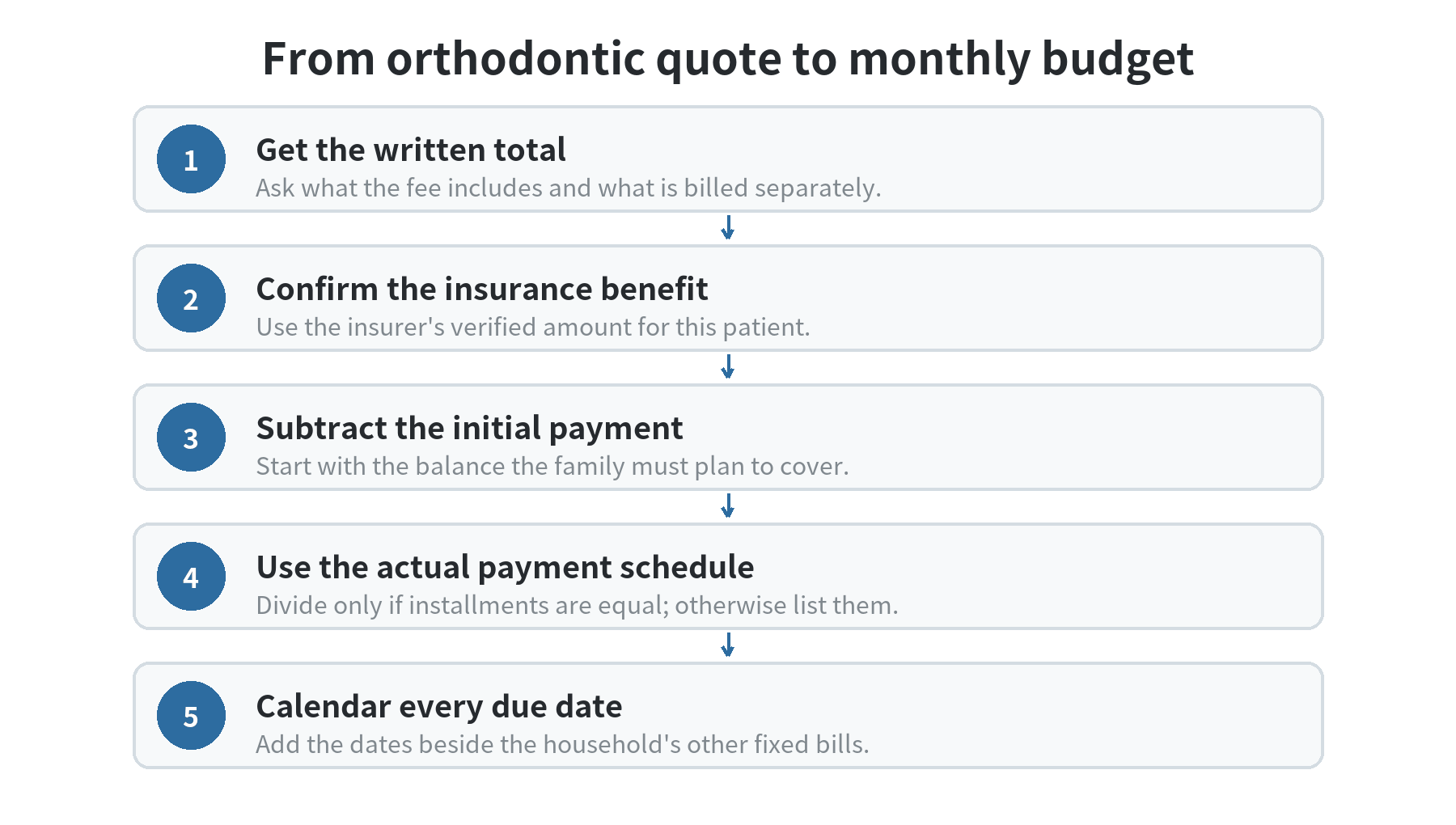
If the schedule uses different payment amounts, list each due date instead of dividing by an average. Put the first payment and recurring installments on the calendar alongside rent, utilities, and other fixed bills. If you need a way to map all household income and expenses, see this iPro household budget planning article and the site’s budget tracking worksheet guide.
Check insurance before counting it as money available
Orthodontic coverage depends on the specific dental plan. The AAO says benefits may be a percentage of the treatment cost or a fixed amount, and recommends checking lifetime maximums, age limits, and network rules with the insurer. The American Dental Association’s MouthHealthy guide also tells families to check whether braces are covered and to review limits, deductibles, and cost sharing (checked September 30, 2026).
Ask the insurer to verify the benefit for the named patient and provider, then write down the deductible, any waiting period or age restriction listed in the plan, the lifetime orthodontic maximum, and how the plan pays over time. Ask whether payments go to the office or are reimbursed to you. Do not subtract an advertised maximum from the quote until the plan confirms what applies to this patient and service.
When two family members may need orthodontic care, ask whether the plan’s limit is per person or shared across the family. Keep each answer with that person’s estimate. If coverage is denied or unclear, ask the insurer which plan term controls and request a written explanation before building the amount into the monthly budget.
Compare payment plans by total cost and timing
The ADA describes payment arrangements that can include office payment plans, prepayment, and financing from an outside lender. The AAO also describes monthly in-office plans. Availability and terms are set by the practice or lender, so request the complete schedule in writing instead of relying on a quoted monthly amount alone (checked September 30, 2026).
For each option, compare the down payment, installment amount, number of installments, total paid, interest or account fees, late-payment terms, and what happens if your family pays early or changes offices. A lower monthly amount can stretch payments over more months or include financing charges. Compare the full amount due under each written agreement.
Match due dates to paydays. If your household receives income twice a month, you might reserve half of a recurring installment from each check in a separate budget category. If the office charges on one date, keep the full amount available before that date. This is a cash-flow arrangement, not an estimate of what the provider will charge.
If you need to build up the first payment, create a separate savings line and set a transfer amount that fits after required bills. Base that amount on the date the office expects payment and the paychecks arriving before it. When the balance in that line reaches the needed first payment, move the scheduled amount into the bill calendar; keep any later installments as their own recurring line.
Before accepting financing, read the payment agreement and lender disclosures yourself. Confirm who receives each payment, when the first payment is due, whether interest can accrue, and whether a missed payment changes the terms. If the language is unclear, ask the office or lender to explain it in writing.
Plan for more than one person without double-counting
Give each family member a separate line in the budget, even when one adult pays the bills. Record the office, agreed total, benefit confirmed, amount already paid, next due date, and remaining scheduled payments. Add the monthly amounts together only after checking that the estimates use separate insurance benefits and separate payment calendars.
If one person’s payments end before another person’s begin, update the budget when the schedule changes. Do not treat a future payment as available cash until the current plan confirms the final due date. If two schedules overlap, add both installments to the same month and check the combined amount against take-home pay after housing, food, transportation, and other required bills.
Keep a small note of costs excluded from the written fee, if the office identifies any. Set a monthly amount aside only after you know what those items are and when they may be billed. That gives the family a visible place to track the expense without inventing a reserve based on an unsupported average.
FAQ
Can I use an online braces price calculator as my family’s budget number?
Use a written estimate from the orthodontic office as the starting figure. AAO says costs vary with the case, region, provider, treatment type, and duration, so a general calculator may not match the services or payment terms in your quote.
Should I count an insurance maximum as the amount my plan will pay?
No; confirm the benefit for the specific patient, provider, and covered service with the insurer. A plan’s maximum is a limit, while the amount paid can also depend on eligibility, cost sharing, and plan rules.
How should a family budget for braces when two people have different start dates?
Keep two separate payment schedules and add only the installments due in each month. When one schedule changes, update that person’s line before treating the old monthly amount as available for another bill.
What should I ask if the monthly payment seems affordable but the agreement is unclear?
Ask for the total paid, every due date, fees or interest, late-payment terms, and early-payoff rules in writing. Review those terms before deciding whether the payment fits the family budget.
Last updated: 2026-09