
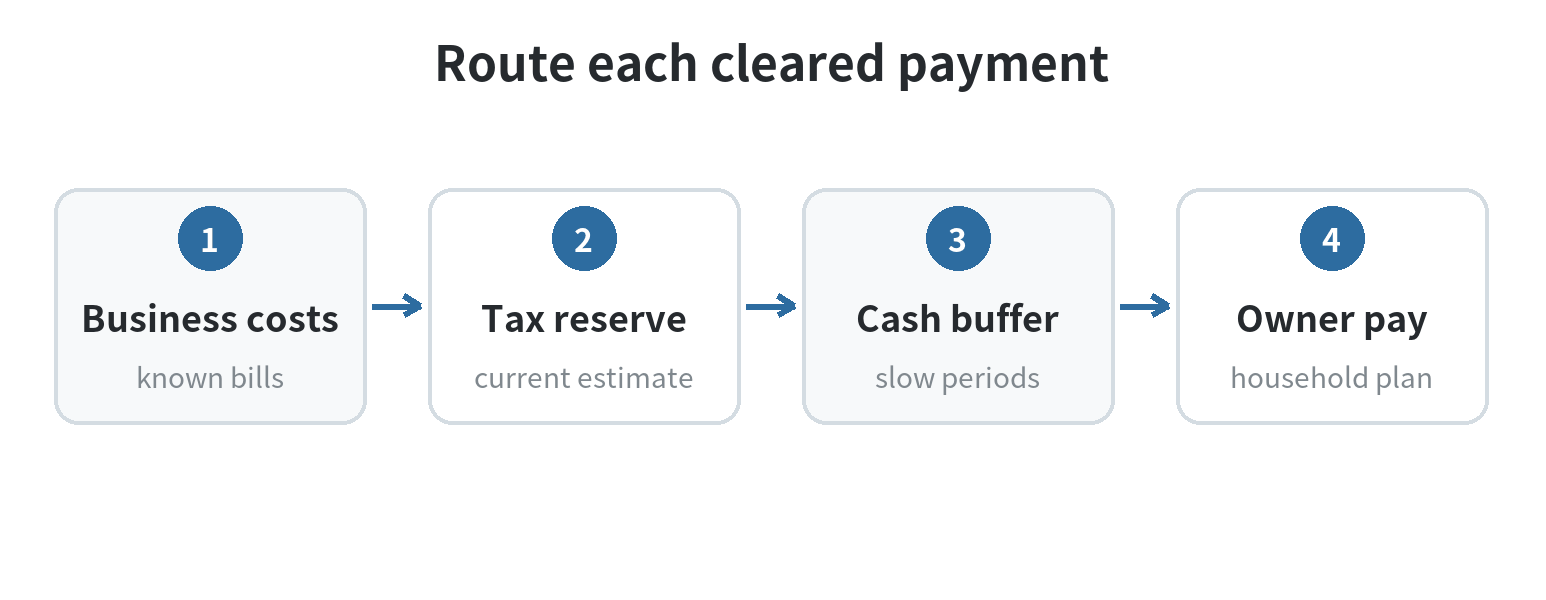
Budget self-employment income in this order: cover business costs, reserve money for taxes using an estimate prepared for your situation, then pay yourself a set amount you can support. Base the household plan on money that has actually cleared, not on invoices or a strong month. That keeps a late client payment from being mistaken for spendable cash.
The IRS describes federal income tax as pay-as-you-go. Its 2026 Publication 505 says estimated tax may cover income tax and self-employment tax when withholding does not cover them; the Small Business Administration also advises keeping income and expense records and setting money aside regularly in its tax recordkeeping guidance. Both sources were checked September 30, 2026. The example below shows a budgeting method, not a tax estimate for any individual.
Give every payment a job before it reaches your household
Use a business checking account for client receipts and ordinary business bills. When a payment clears, record the date, client, amount, invoice, and any processing fee. Reconcile the record to the bank statement so you can tell collected income from work that is still unpaid.
Keep four running balances: money available for business expenses, a tax reserve, cash held for slow periods, and money cleared for owner pay. Separate accounts can make those balances easier to see, but a spreadsheet can work if you update it consistently. These are budget categories, not a substitute for deciding how your business is legally structured.
Build the household plan from a cautious monthly floor
List the net business income that actually reached your account over the last several months. Mark unusually large projects or one-time deposits separately, then choose a monthly floor that the remaining months can support. If you are new to self-employment, start with signed work and payment dates you can document; leave unsigned prospects out of the household plan.
Next, list household essentials and their due dates: housing, utilities, food, transportation, insurance, minimum debt payments, and any recurring care costs. Add irregular bills such as annual renewals or equipment replacement to a monthly sinking-fund line. The number is your own bill total, not a national average.
Do the same sorting for business costs. Mark recurring bills as fixed, then list costs that rise with each project, such as materials or payment processing. Put annual renewals on a separate line and divide each bill across the months before it is due. When a client payment includes reimbursement for a project cost, record the receipt beside that cost so the cash does not look like free margin.
Keep the personal ledger separate from the business ledger, even if both live in one spreadsheet. If you prefer to track household transactions on your phone, the site’s phone budget tracker article covers a simple household record, while its monthly budget setup article focuses on household categories. Neither replaces the cleared-cash check for owner pay.
If you have just started and lack a useful history, list recurring business bills first and forecast receipts from signed work and its payment milestones. Separate one-time setup costs from operating costs that will repeat. After you have real deposits and expenses to review, replace the forecast with your own records instead of treating the strongest project as a permanent baseline.
Keep household spending below the cautious floor after business costs and the tax amount from your current estimate. When a month exceeds that floor, the extra can refill a business reserve, cover an upcoming annual bill, or remain unassigned until the next review. It does not have to become a permanent monthly commitment.
Use a sample month to test the order
Suppose a hypothetical consultant receives $6,200 in cleared client payments during a month. The business pays $1,400 in operating costs, and the owner moves $1,200 into a tax reserve based on a separate current estimate. That leaves $3,600 available for owner pay or additional savings. The figures are an illustration, not a recommended tax percentage or a typical income level.
| Illustrative cash movement | Amount | What to do |
|---|---|---|
| Cleared client payments | $6,200 | Enter receipts in the business ledger |
| Business operating costs | −$1,400 | Pay documented business bills |
| Tax reserve transfer | −$1,200 | Use a current estimate prepared for your circumstances |
| Remaining cash | $3,600 | Fund owner pay and keep any unassigned balance in reserve |
If the month’s receipts fall to $4,800 while costs and the tax transfer stay the same, the remainder is $2,200. A household plan built around $3,600 every month would need another source of cash. Instead, choose a base owner-pay amount the low months can carry, and use higher months to build the buffer before raising that amount.
Turn irregular receipts into a regular paycheck
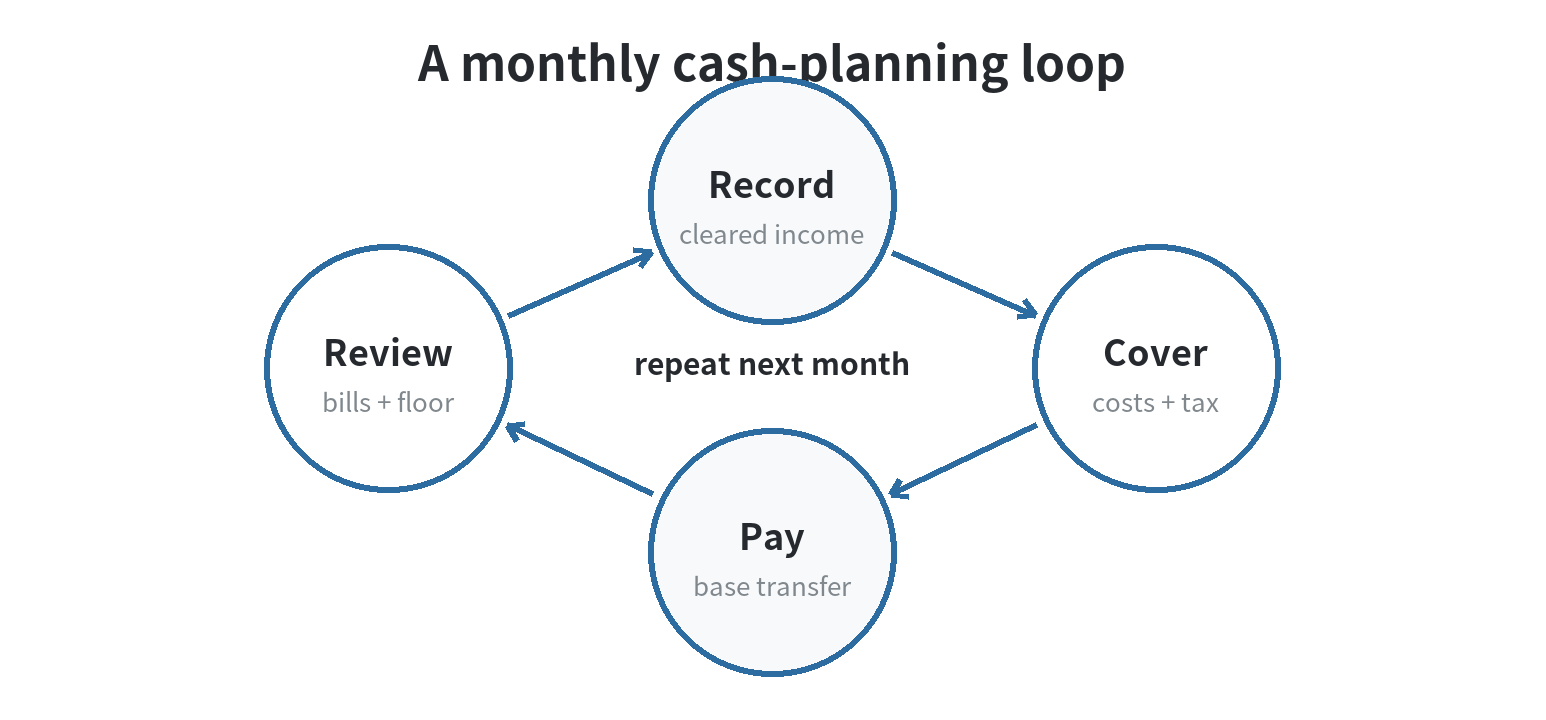
Pick an owner-pay day that follows your client payment pattern, then transfer the same base amount only when the business balance can cover it. If clients pay unpredictably, use two checkpoints: review cleared cash near the start of the month, then make the transfer after known business bills and the current tax reserve are covered.
For a simple example, if planned owner pay is $2,400 per month, you could transfer $1,200 twice during the month after checking the available balance. Those amounts are only a calendar example. If the second transfer would leave business costs or the tax reserve short, reduce or delay it and use the buffer for household bills rather than overdrawing the business account.
Keep invoices receivable on a separate list with expected payment dates. When one arrives late, update the cash forecast and move discretionary household spending before touching money reserved for taxes or a bill due soon. This makes the shortfall visible while there is still time to adjust.
Set a reserve target without guessing a tax rate
Do not copy a percentage from another self-employed person. The IRS’s 2026 Form 1040-ES worksheet uses expected income, deductions, credits, and tax to work out estimated payments; Publication 505 also says to adjust an estimate when circumstances or tax law change. Checked September 30, 2026. Put the amount from your own current calculation in the tax category, and revisit it when income changes.
For federal estimated-tax rules, start with the IRS’s current Form 1040-ES and Publication 505. State and local taxes may have separate rules, so identify the agencies that apply where you live and work. A qualified tax professional can help with a personal calculation; this budget cannot determine whether a specific person must pay or how much.
Your cash reserve has a different job: it pays routine business costs and household essentials when collections are slow. Set a first target by listing bills due before the next reliable client payment. Add to it from stronger months. Keeping the cash buffer distinct from the tax reserve prevents one balance from appearing available for two different obligations.
Review three numbers when work changes
At month-end, compare cleared receipts with invoices, compare actual business costs with the plan, and check whether your owner pay fit the cautious floor. If receipts rise or drop, update the floor and cash forecast rather than assuming the change will continue. A lost client, a late payment, or a new recurring cost belongs in the next version of the plan.
Also review the next few weeks of due dates. Match each bill to cash expected before it is due, and flag any gap. That short calendar check turns a yearly income total into a decision you can act on now: defer a flexible expense, contact a vendor about timing, or lower the next owner transfer.
FAQ
Should I budget from invoices that clients have not paid yet?
No. Use cleared receipts for available cash and track unpaid invoices separately. Update your forecast when payment arrives or the expected date changes.
What if self-employment is only a second source of income?
Track that income and its business costs separately from wages. The IRS explains that withholding from a paycheck and estimated payments are both ways to pay federal tax during the year; review the current Form 1040-ES instructions for how they fit together.
How often should I change my owner-pay amount?
Review it when receipts, recurring costs, or your reserve needs materially change. A monthly check keeps the transfer connected to actual business cash without turning every good week into a new household spending baseline.
Last updated: 2026-09.