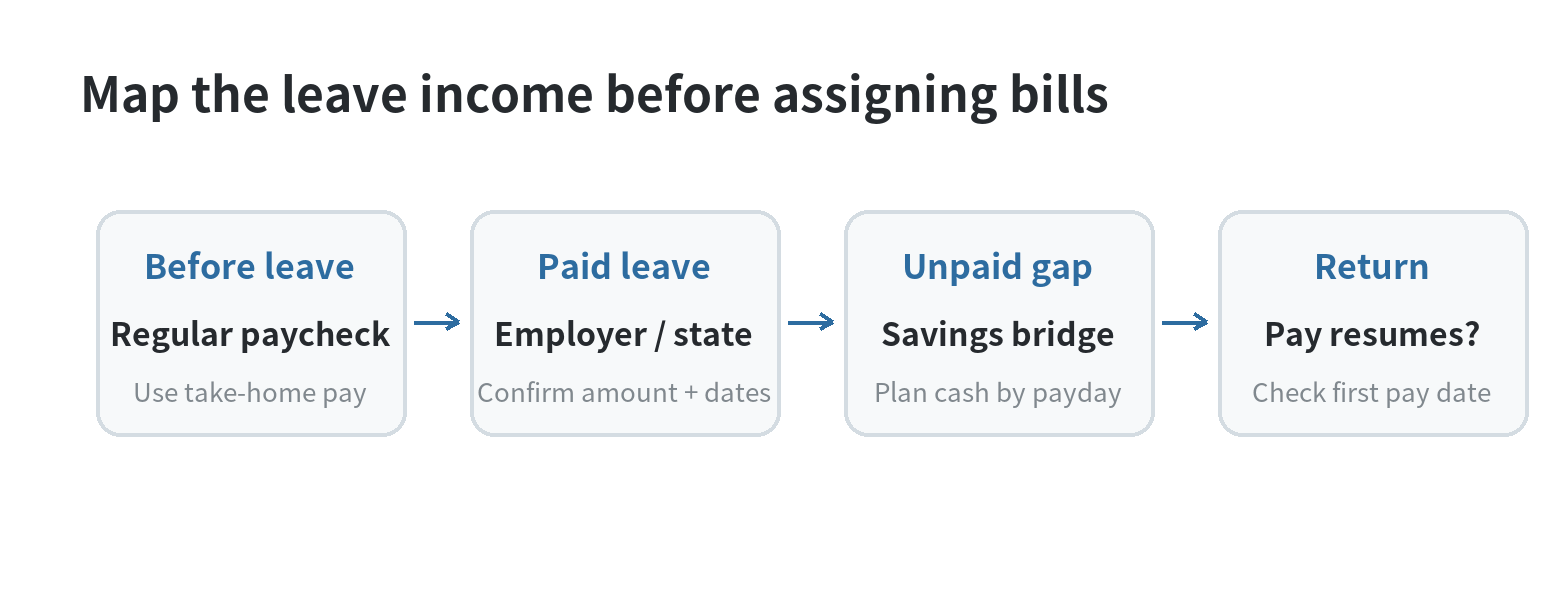
Budgeting for maternity leave starts with a calendar, not a monthly average. List the dates your regular pay stops, any paid leave or state benefits begin, and the first paycheck expected after you return. Then match those deposits against the bills due in each pay period. That shows how much cash you need to set aside and when you need it.
Do not count leave that has not been approved as income. The Family and Medical Leave Act can provide eligible employees with job-protected leave, but it is unpaid; pay during leave depends on a separate employer benefit, a state program, or paid time you can use. The U.S. Department of Labor describes FMLA as up to 12 workweeks for eligible workers, while paid leave options and eligibility vary by state (DOL’s FMLA guidance; DOL’s paid-leave overview).
Separate time off from money coming in
Start by asking your employer for the leave policy, benefits summary, and payroll schedule. Find out which parts of your leave are paid, what portion of your usual pay is replaced, whether benefits run at the same time as FMLA, and when deposits arrive. Ask for the expected start and end dates in writing. A leave approval answers when you can be away; it does not tell you how much money will reach your account.
Check state paid family leave separately. The U.S. Department of Labor’s state information and USA.gov both explain that program eligibility depends on the state (DOL’s state program page; USA.gov’s paid-family-leave information). Use your state labor agency’s current instructions to check whether you qualify, how to apply, when payment starts, and whether benefits overlap with employer pay. Until you have a confirmed estimate and timing, keep that benefit out of your core budget.
For FMLA, the Department of Labor’s eligibility guide asks about employer coverage, length of service, hours worked, and worksite size. Use its eligibility guide and ask your HR office how the rules apply to your position.
Build a pay-period version of the budget
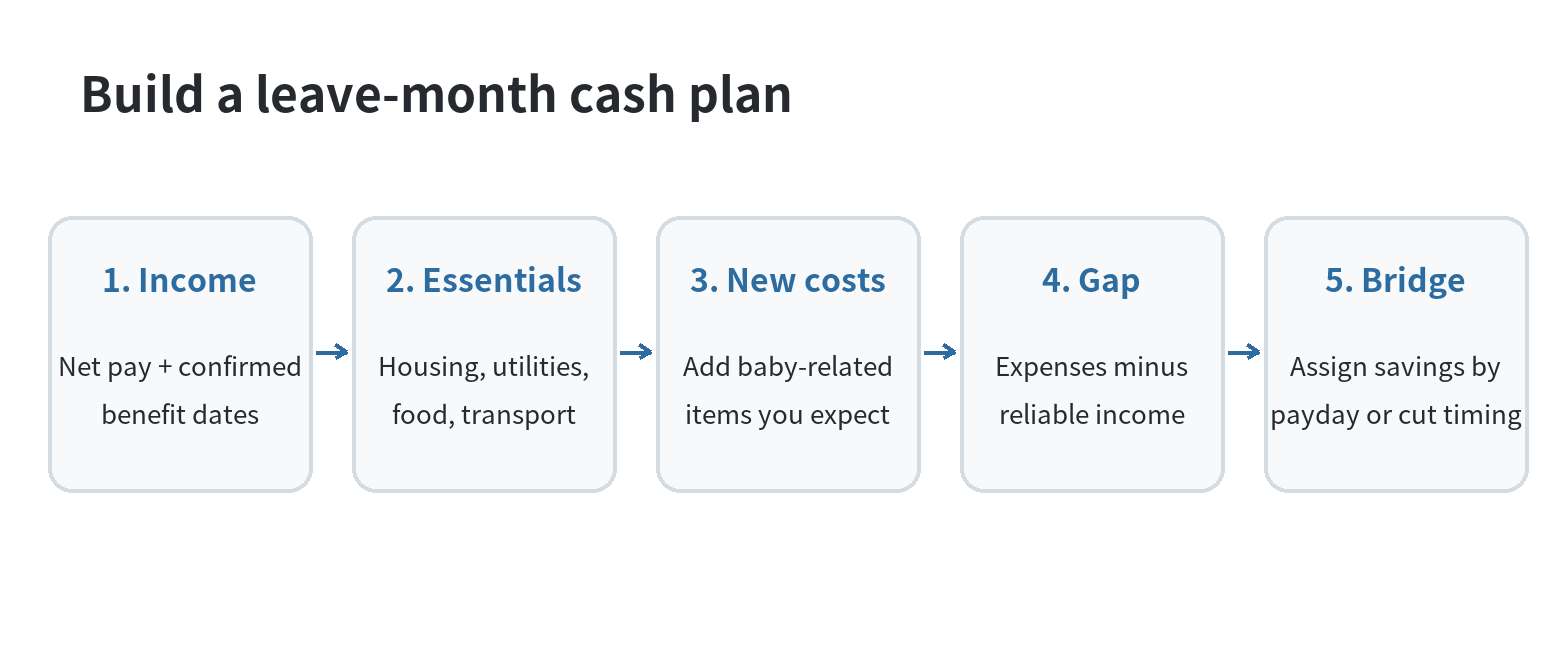
Write down take-home pay from a recent pay stub, not gross salary. List recurring bills with their due dates: housing, utilities, insurance, debt minimums, phone, and any childcare costs that continue during leave. Add flexible essentials such as groceries, transportation, and prescriptions using your own recent spending. Keep expenses you expect to pause separate from bills that will continue.
Next, place each reliable deposit on a calendar: a final regular paycheck, paid leave from work, a state benefit with an approved start date, and any partner income that will continue. Use the amount that will actually be deposited. If payroll says a benefit will replace part of pay, budget the confirmed net amount rather than estimating from your usual paycheck.
In a made-up example, take-home pay is $4,800 per month, continuing household income is $2,000, and essential bills and spending total $4,300. If regular pay pauses and no leave payment arrives in a particular month, the gap is $2,300: $4,300 in planned outflow minus $2,000 coming in. If a confirmed benefit pays $1,500 that month, the remaining gap is $800. These sample figures show the subtraction; replace them with the deposits and bills on your own calendar.
A monthly total can hide a cash shortage. If rent is due before a benefit deposit, you may need a larger checking balance at the start of the month even when total monthly income covers total monthly expenses. Mark the day each bill is due and each deposit is expected. Move savings into the account before the tight week, and ask billers whether a due-date change is available if timing remains difficult.
Budget for the costs that change around birth
Make a short list of expenses that will begin, rise, fall, or move to a different month. Possible categories include infant care, supplies, transportation to appointments, meals, and household help. Use quotes, benefit explanations, and your own plans rather than a national average. For each item, note whether it is a one-time purchase, a recurring bill, or a cost that starts only when you return to work.
Separate essential commitments from choices you can delay. A recurring care arrangement may need a deposit before the first month of care, while some supplies can be spread across paychecks. Put the due date beside each cost so it does not disappear inside a broad “baby” category. If another family member plans to contribute, include the money only after you agree on the amount and timing.
Keep a small line for irregular costs instead of assigning every available dollar to predictable bills. The amount is personal: review the room left after housing, food, utilities, insurance, minimum debt payments, and expected leave costs. If there is little room, focus first on the dates and amounts you can verify. A budget can show a shortfall without solving it; it gives you a specific figure to discuss with HR, a biller, or another person sharing household costs.
Give savings a job before leave begins
Calculate the gap for each pay period, then total the gaps across the planned leave. Compare that amount with savings you can use without missing other obligations. Keep money reserved for rent, utilities, insurance premiums, and debt minimums distinct from money intended for optional purchases. A separate savings account or a labeled line in a spreadsheet can make the boundary visible.
If savings do not cover the calendar, change the plan while there is still time. Review subscriptions or discretionary spending, ask whether a bill can move to a different due date, and find out whether your employer offers accrued paid time or a phased return. Record any change only when the other party confirms it. Avoid building the plan around credit, gifts, or a benefit application that has not been approved.
Also check how health insurance premiums and other payroll deductions will be handled while pay is reduced or paused. Ask the benefits office what you owe, when payment is due, and how to pay if deductions stop. Put the answer on the cash calendar. This prevents a non-payroll bill from being overlooked when your usual paycheck changes.
Recheck the plan when a date or estimate changes
Set a reminder to update the calendar when HR confirms leave dates, a state agency issues a benefit decision, or a provider gives you a new cost estimate. A revised start date can shift several deposits and bill due dates, even if the total expected income stays the same. Keep a copy of the latest version so you and anyone sharing expenses are working from one set of dates.
Before leave starts, make one final pass through the upcoming pay periods: confirm what is scheduled to arrive, identify any unpaid stretch, and check that money for bills is available before their due dates. When you return, use the first actual paycheck date—not just your first day back—to decide when the regular budget can resume.
FAQ
Does FMLA pay your salary during maternity leave?
No. FMLA leave is unpaid; check whether employer benefits or a state program will provide income during your time away. The Department of Labor explains federal leave in its birth and bonding fact sheet.
How should I budget if a paid-leave claim is still pending?
Build the core budget with confirmed income only. Add a pending benefit after the agency confirms eligibility, amount, and expected payment timing.
Should I budget by month or by paycheck?
Use both: monthly totals show the overall gap, while pay-period dates show whether money will be in the account when a bill is due.
What if my expected return date changes?
Move the expected paycheck and any care costs on your calendar, then recalculate the gap for every affected pay period.
Last updated: 2026-09