Living alone changes the shape of a budget: one person covers the whole rent, utility bill, and grocery run. Build your plan from take-home pay and your own account history, then give irregular costs a place before they arrive. A budget for one works best when it shows both what you owe and when cash needs to be available.
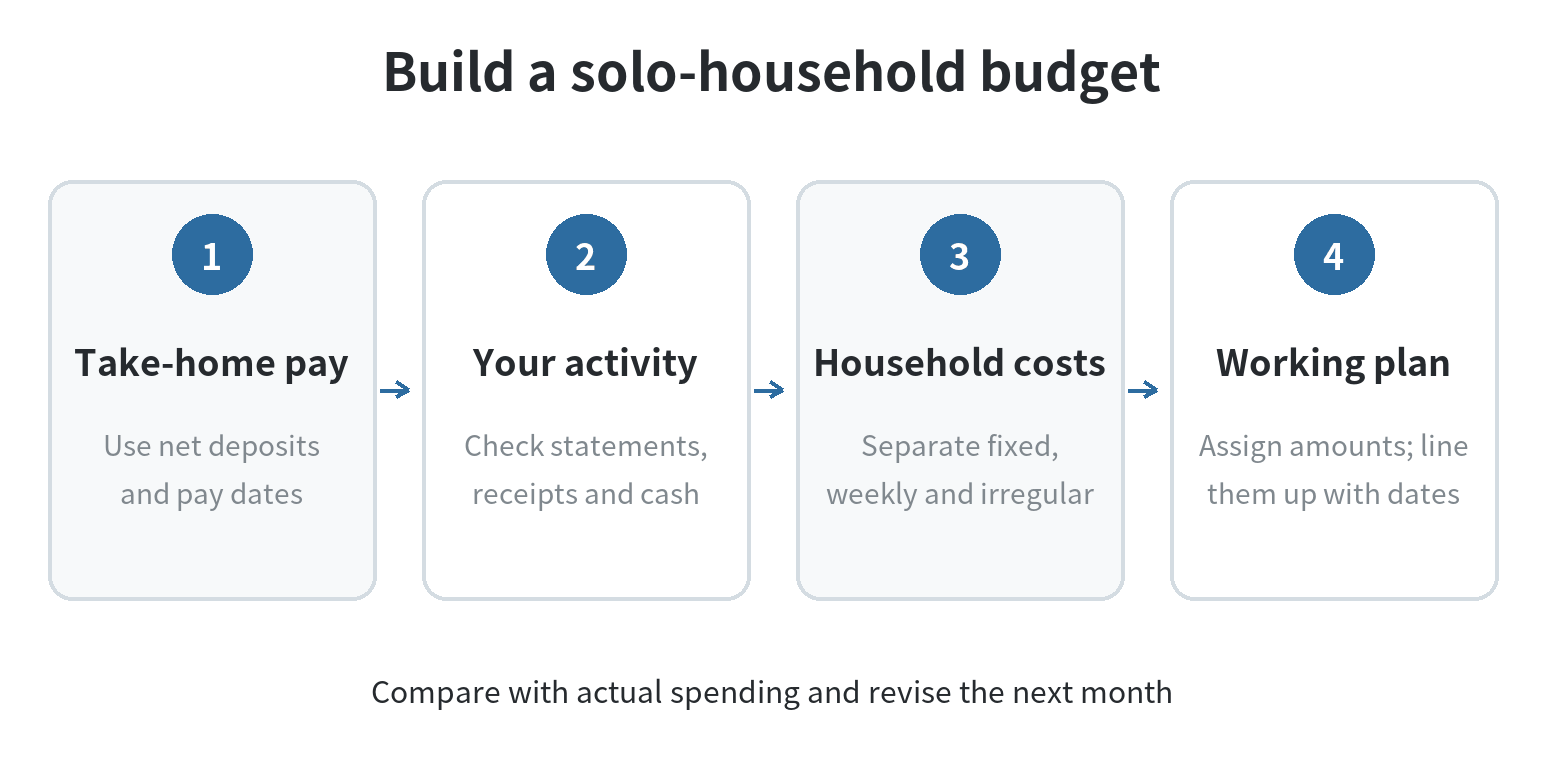
Start with the money that reaches your account
Use net pay, not the salary printed before payroll deductions. If you get paid on different dates, list each expected deposit and its amount. Add side-work income only if you can reasonably expect it; keep a bonus, refund, or gift outside the base plan until it arrives. The FDIC’s Money Smart guide distinguishes regular, unpredictable, seasonal, and one-time income, a useful way to avoid treating an uncertain deposit like rent money.
Next, look through recent checking and credit-card activity. The CFPB’s spending guidance recommends comparing the budget with account statements and including expenses that do not appear every month. Mark items as fixed, flexible, or occasional: rent set by your lease belongs under fixed costs, groceries can move, and an annual insurance bill is occasional. Your own records are a better starting point than a national average because they reflect your city, home, commute, and habits.
Use a notebook, spreadsheet, banking tool, or the CFPB’s spending tracker. Choose the one you will actually update. Record the date, amount, and category; a transaction list without dates can show where the money went but miss the week when the account got tight.
Give one-person costs their own lines
When you live alone, no one else shares a bill by default, so avoid hiding several costs in a broad “household” category. Separate housing, utilities, phone and internet, groceries, household supplies, transportation, insurance, medical expenses, debt payments, personal spending, and savings. Include cash purchases and autopay charges, not only card transactions.
Check which expenses are truly fixed. A monthly subscription may be cancellable, while a car insurance premium could be due every six months. If the bill is not monthly, divide the amount by the months until it is due and reserve that share as money comes in. For example, a $600 bill due twice a year needs a $100 monthly line in the plan. That $100 is not extra spending money; it is a portion of a known future bill.
One-person households also have lumpy costs: replacing a small appliance, renewing a license, traveling to see family, or paying a renter’s insurance premium. The CFPB advises reviewing several months of spending to catch less frequent expenses and adding a miscellaneous line for surprises. Give predictable irregular bills their own savings buckets; keep “unexpected” for costs you could not reasonably schedule.
Try the plan against a sample month
Here is an invented example, not a recommended standard. Imagine take-home pay of $3,600 and these monthly assignments:
| Category | Example amount |
|---|---|
| Rent | $1,450 |
| Utilities, phone, and internet | $260 |
| Groceries and household supplies | $450 |
| Transportation | $300 |
| Insurance and medical costs | $180 |
| Minimum debt payments | $160 |
| Known irregular bills | $200 |
| Emergency savings | $150 |
| Personal and leisure spending | $300 |
| Unassigned margin | $150 |
| Total | $3,600 |
The margin is deliberate. It can absorb a higher utility bill or a grocery trip that runs over, and it can be reassigned after you see actual spending. If every dollar is assigned before the month starts, decide which flexible category can shrink when a bill rises. Do not quietly count the same $150 as both savings and spending money.
Change the sample to match your statements. If rent and utilities take more than the example, lower the flexible categories first on paper and see whether the remaining amounts are realistic. If the numbers still do not fit, the budget has surfaced a gap to address; it has not created more income. You can then review the lease, recurring services, transportation choices, or bill due dates without assuming that food or basic needs can be cut indefinitely.
Make the calendar work with your paydays
A monthly total can balance while the checking account runs short midmonth. Put deposit dates and bill due dates on the same calendar. Beside each week, write the starting balance, deposits, bills, day-to-day spending, and ending balance. Carry that ending amount forward as the next week’s start. The CFPB’s cash-flow budget uses this week-by-week approach because timing matters as well as the monthly total.
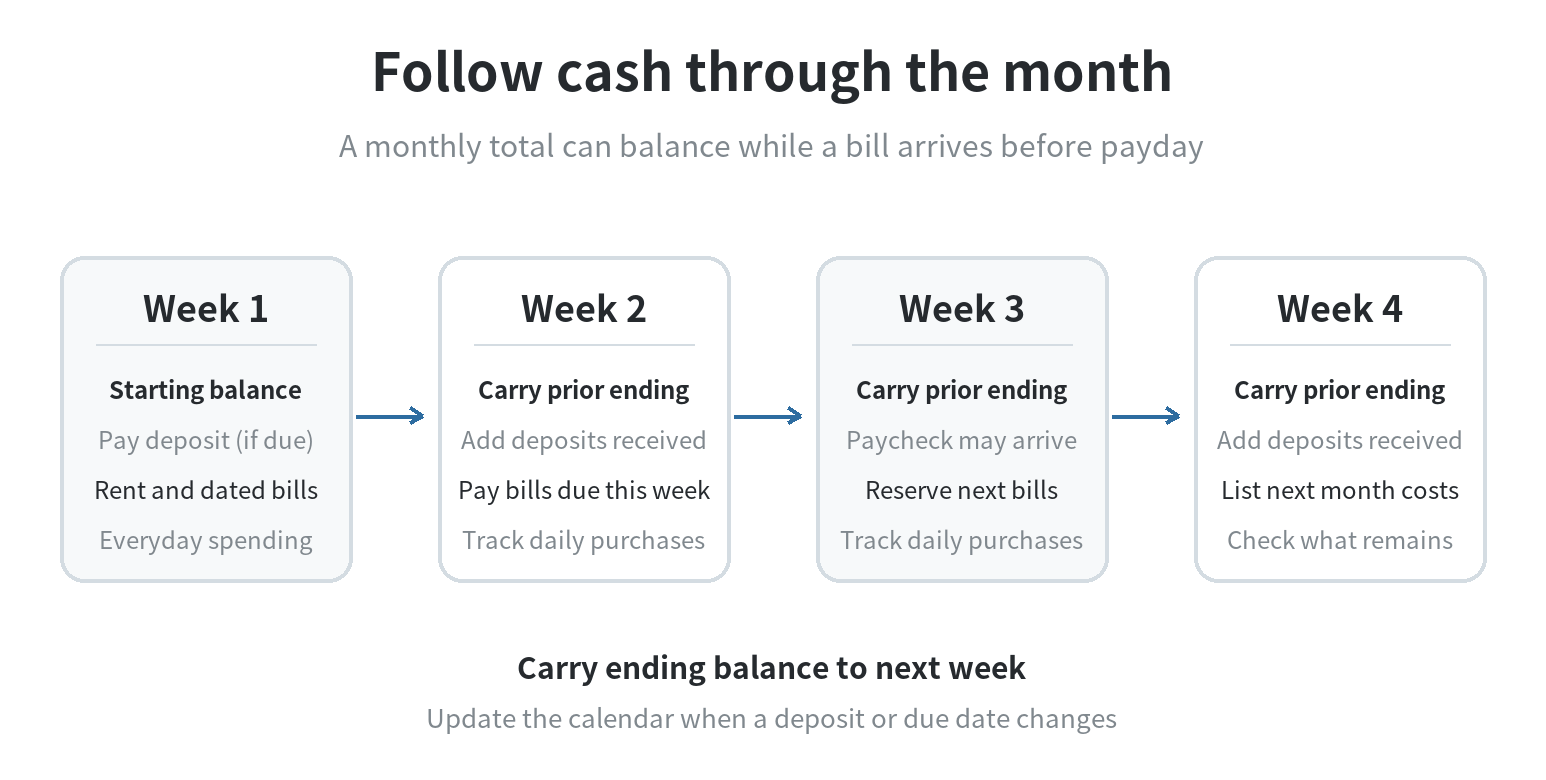
Suppose rent is due before the second paycheck. The budget needs a plan for the rent money before that date: hold back part of the prior paycheck, arrange a different due date if the landlord permits it, or keep a checking cushion that covers the gap. Do not mark a bill “covered” just because income expected later in the month is larger than the bill.
For variable pay, build the basics around the lower dependable amount from your own recent records. Use higher deposits to refill categories that ran short, set money aside for known irregular costs, or add to savings after the required bills are covered. If income changes, revise the calendar rather than relying on last month’s surplus.
When the first draft does not fit
If planned expenses exceed take-home pay, sort the list by what happens if you delay or reduce it. Protect housing, essential utilities, food, transportation needed for work, required insurance, and minimum obligations first. Then examine flexible purchases and recurring services. The FDIC’s Money Smart guide and the CFPB’s Your Money, Your Goals toolkit both group spending as needs, wants, and obligations; that distinction helps you identify which conversation or adjustment belongs next.
If a bill will be late, contact the company before the due date and ask what payment arrangements are available. A due-date change can help with timing, but it does not reduce the total amount owed. Avoid solving a recurring shortfall with credit-card borrowing without including the payment and interest cost in the plan.
Set an emergency-savings target from expenses you could plausibly face, such as a repair or a gap in income. The CFPB says the amount depends on a person’s circumstances and suggests using past unexpected expenses to shape a goal. Start with an amount the current cash flow can support; adjust it when rent, work, or other obligations change.
Review the budget after real life happens
At month-end, compare each planned amount with posted transactions and cash spending. If a category is off, ask whether the estimate was too low, the timing was different, or the purchase was one-time. Change the next month’s line instead of labeling the entire plan a failure.
Keep the review short: check deposits, scan bills, add irregular expenses, and decide how to use any remaining amount. If tracking on a phone helps, see the site’s overview of monthly budget tools; for a manual setup, the smartphone budget tracker walkthrough covers a simple transaction grid. The numbers and categories still come from your own records.
Keep a separate line for expenses that recur but do not arrive monthly. That makes a quiet month less misleading and gives you a clearer view of what is already committed. When the next bill lands, pay it from the amount reserved for it rather than letting it compete with groceries or rent.
FAQ
How do I make a budget if my income changes each month?
Build essential bills around income you can count on, then update the plan when each deposit arrives. Track changing income by date and amount, and use stronger months to cover known upcoming expenses before increasing flexible spending.
Should I count a credit card purchase when I buy something or when I pay the card?
Count the purchase in its spending category when it happens, then record the card payment as a transfer or debt payment rather than new spending. This keeps groceries or fuel from disappearing into a single large card-payment line.
What should I do with a third paycheck in a month?
The CFPB and FDIC describe biweekly pay as 26 deposits across a year, so a calendar can place three deposits in some months. Assign the extra deposit after checking upcoming bills and irregular expenses. If core costs are covered, direct the remaining amount to a savings goal or a debt balance you already planned to pay.
How much should I keep in checking when I live alone?
Set the cushion by looking at the bills and automatic withdrawals that can clear before your next deposit. A calendar of your own due dates and paydays gives you a concrete starting point; the needed cushion changes when either date or amount changes.
Last updated: September 2026.
Last updated: 2026-09