A workable pet food and supplies budget starts with your own receipts, not a national average. Separate the food you replace on a schedule from supplies that last longer, set aside money for the less frequent restocks, and check the total against your monthly cash flow.
Consumer.gov’s budgeting guidance says to list income and expenses, plan for the month, record spending, and use the results to shape the next month’s plan (checked September 30, 2026). Apply that cycle to pet purchases: the amount on your statements gives you a starting point, while a short purchase list helps you catch items that do not appear every month.
Start with the purchases you already make
Look through recent bank or card statements, order histories, and paper receipts. Mark each pet related charge and note what it covered. If one order combines household and pet items, use the receipt detail rather than assigning the full transaction to the pet budget.
Group the items by what prompts the next purchase. Food and other items you replace regularly belong in a recurring line. Supplies that last across several months belong in a restock line. An unusually large item or a purchase you are postponing can go in a separate planned purchase line, so it does not distort the routine total.
- Recurring: food or a regularly replenished item.
- Restock: litter, waste bags, cleaning products, or another supply you buy when its container runs low.
- Planned purchase: a nonmonthly item you expect to replace, such as a carrier or a bed.
Keep the list limited to food and supplies for this budget. Other pet costs can sit in their own household categories, where you can see them without obscuring the food and supply pattern.
Turn restocks into monthly amounts
A monthly budget works even when a supply is not bought each month. Write down the amount you paid last time and how long that purchase lasted. Divide the purchase amount by the number of months it covered, then reserve that monthly share. When you replace the item, record the actual cost and update the estimate.
For example, if a household’s illustrative supply purchase costs $36 and lasts three months, its planning amount is $12 per month. That is arithmetic for this example, not a typical price. Use the amount on your own receipt; if you do not yet know the price, check the current shelf label or request a quote before filling in the line.
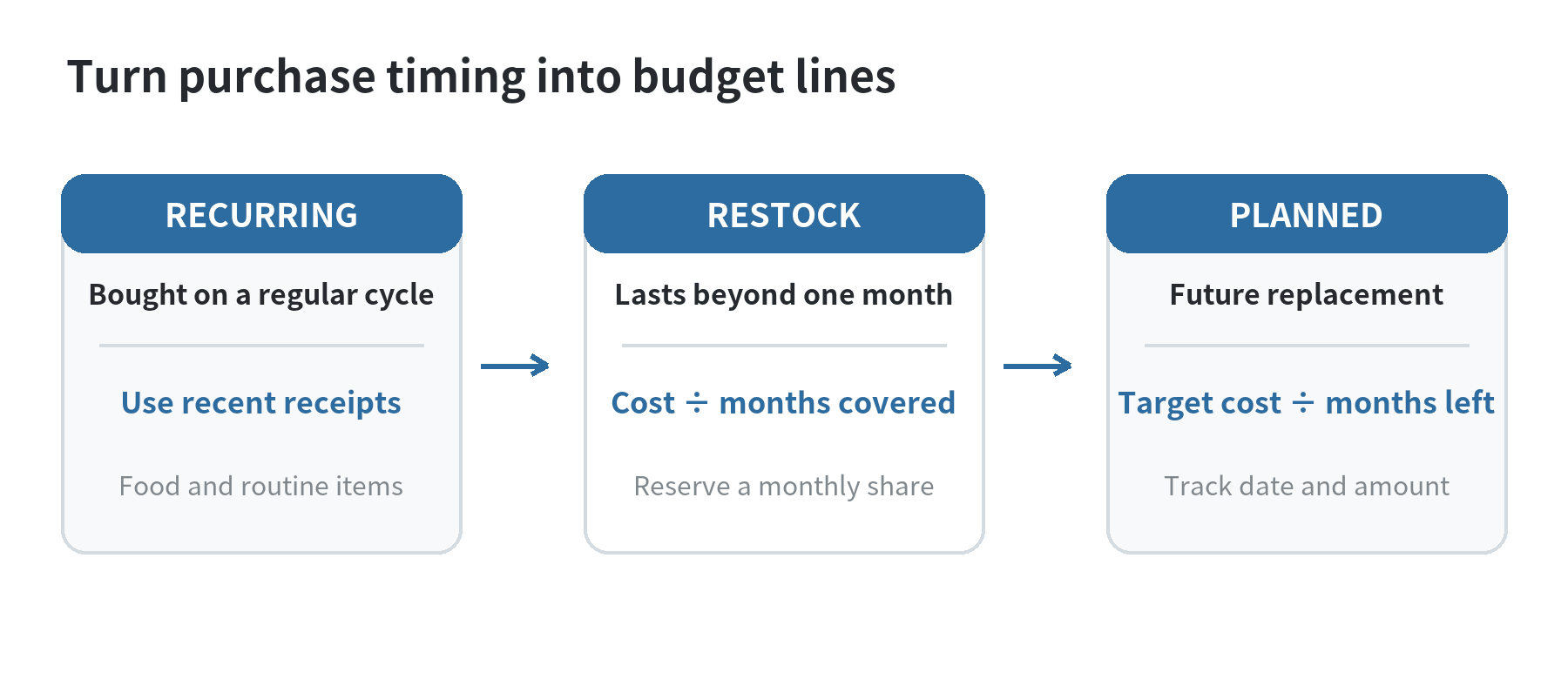
Consumer.gov’s budget worksheet has an “other expenses this month” area for costs that do not occur every month (checked September 30, 2026). CFPB’s Your Money, Your Goals toolkit also provides a spending tracker and cash flow budget tools (checked September 30, 2026). The same approach works for supplies: keep a note of the expected restock month, then spread the cost across the months before that purchase.
When one order lasts beyond the month
A card charge may land in one month even when the items last into the next. Keep a short record of the purchase date, item, package size, amount, and when you expect to restock. For a combined shipment, use the receipt line items to separate food from supplies; do not spread the whole charge across several months unless those items are expected to last that long.
If another person in your household also buys pet items, add those receipts to the same monthly picture. Otherwise, the total only shows the purchases made from the accounts you reviewed. Put a planned renewal date next to any scheduled shipment so you can distinguish it from an extra purchase.
A sample month, with every amount labeled as an example
The table below shows how a household might organize its own figures. Every amount is invented for illustration; it is not a price quote, average, or recommendation. Replace each figure with a receipt amount or a current quote for the item you use.
| Budget line | Example monthly amount | How to set your amount |
|---|---|---|
| Food | $260 | Use your recent food purchases as the starting figure. |
| Regular supply restocks | $48 | Convert each restock purchase into a monthly share. |
| Small replacement items | $18 | Use what you actually spent, not a generic allowance. |
| Planned supply purchase | $35 | Set aside a monthly amount toward a known future replacement. |
| Total example | $361 | Check against the amount available in your full budget. |
In this example, the $361 total combines recurring food, restocks, small replacements, and one planned purchase. Your own total can be lower or higher because the items, purchase timing, and prices are yours. If you cannot verify an item’s current cost, leave the number blank until you check a receipt, shelf label, or seller quote; do not fill the gap with an assumed average.
Give price changes a place in the plan
Keep a record of the item, package size, date, and amount paid. When the amount changes, note whether the package size or the quantity you purchased also changed. That lets you distinguish a changed purchase from a changed price without relying on memory.
For an item you have not bought before, find the current price from a shelf label or written quote, and write down the date, source, and package size. If you compare options, compare the same unit of measure and include any delivery or recurring charge shown in the quote. Recheck the amount when you plan the purchase so the budget uses a figure you can confirm.
Recurring shipments or subscriptions should be listed separately from one-time purchases. The FTC’s consumer guidance says to check the renewal terms, renewal amount, and cancellation instructions, and to review statements for charges after cancellation (checked September 30, 2026). Put the next renewal date beside the amount so an automatic charge does not look like a surprise supply purchase.
When the total does not fit your budget
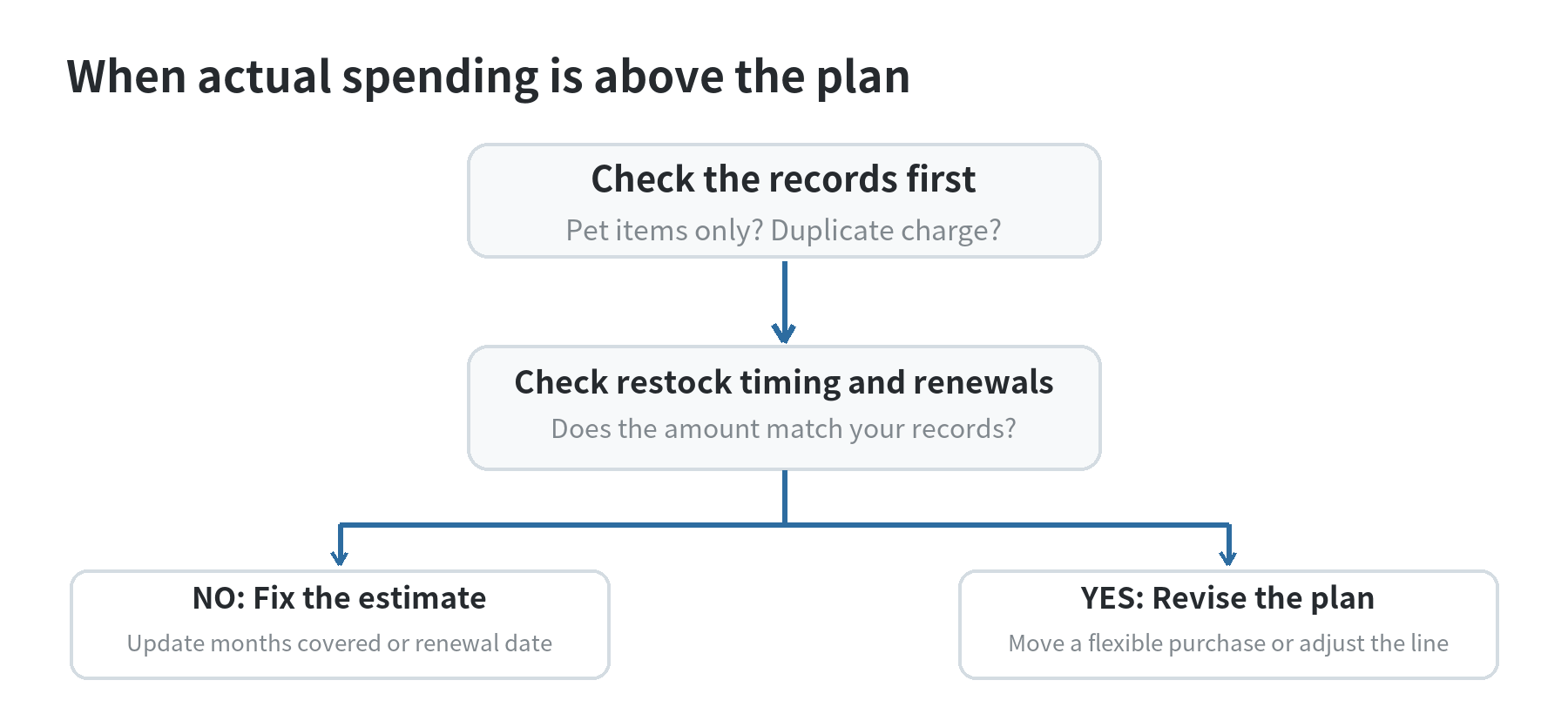
First confirm that the total includes only food and supplies, and that combined orders have not been counted twice. Then check your restock math and any renewal charges. These checks can explain a mismatch without changing the amount you actually have available.
If the numbers are right but the line still exceeds the amount you set, decide which purchase can move to a later month and revise the plan before the next order. Keep needed recurring items visible rather than hiding them under “miscellaneous.” If your household budget has no room for an item you must replace now, review the rest of the monthly plan and the timing of other flexible purchases.
Consumer.gov recommends comparing planned expenses with actual spending at month’s end and using that information for the next month’s budget (checked September 30, 2026). If food or supplies were used faster than you expected, update the quantity or timing in your notes. If you made a one-off purchase, keep it distinct from the repeating amount. The next budget should reflect what happened, not the number you hoped would happen.
Keep the routine simple enough to maintain
Use one note, spreadsheet, or budget category with a short item list. Record a purchase when it happens, keep the receipt or order detail when the transaction combines items, and revisit the monthly amount after the next restock. Consumer.gov’s budget guidance calls for using a monthly plan and tracking spending against it; the CFPB also offers a spending tracker and bill calendar among its money tools (both checked September 30, 2026).
When your next month begins, carry forward recurring amounts, keep monthly shares for future restocks, and remove planned purchases once they are complete. That gives you a pet food and supplies budget based on your own use and current costs, with the next step clear whenever an amount changes.
FAQ
How should I budget for supplies I only buy once or twice a year?
Divide the last verified purchase amount by the number of months it needs to cover, then reserve that amount each month. Update the calculation when you have a new receipt or quote.
What should I do if I have just adopted a pet and no purchase history?
Start with a dated list of the items you expect to purchase and check their current prices locally. Treat the first month as a working estimate, record each actual amount, and revise the next month from those receipts.
Should a recurring delivery be counted as a monthly expense?
Yes. Put the amount and renewal date in the recurring line, then compare the charge with the terms shown for that delivery. The FTC advises checking renewal terms and reviewing account statements for recurring charges (checked September 30, 2026).
What if I have more than one pet?
Keep a shared household total and label which purchases belong to each pet when that helps explain the spending. Shared supplies can remain on a household line; use your own purchase records to split them if you need a per-pet view.
Last updated: 2026-09