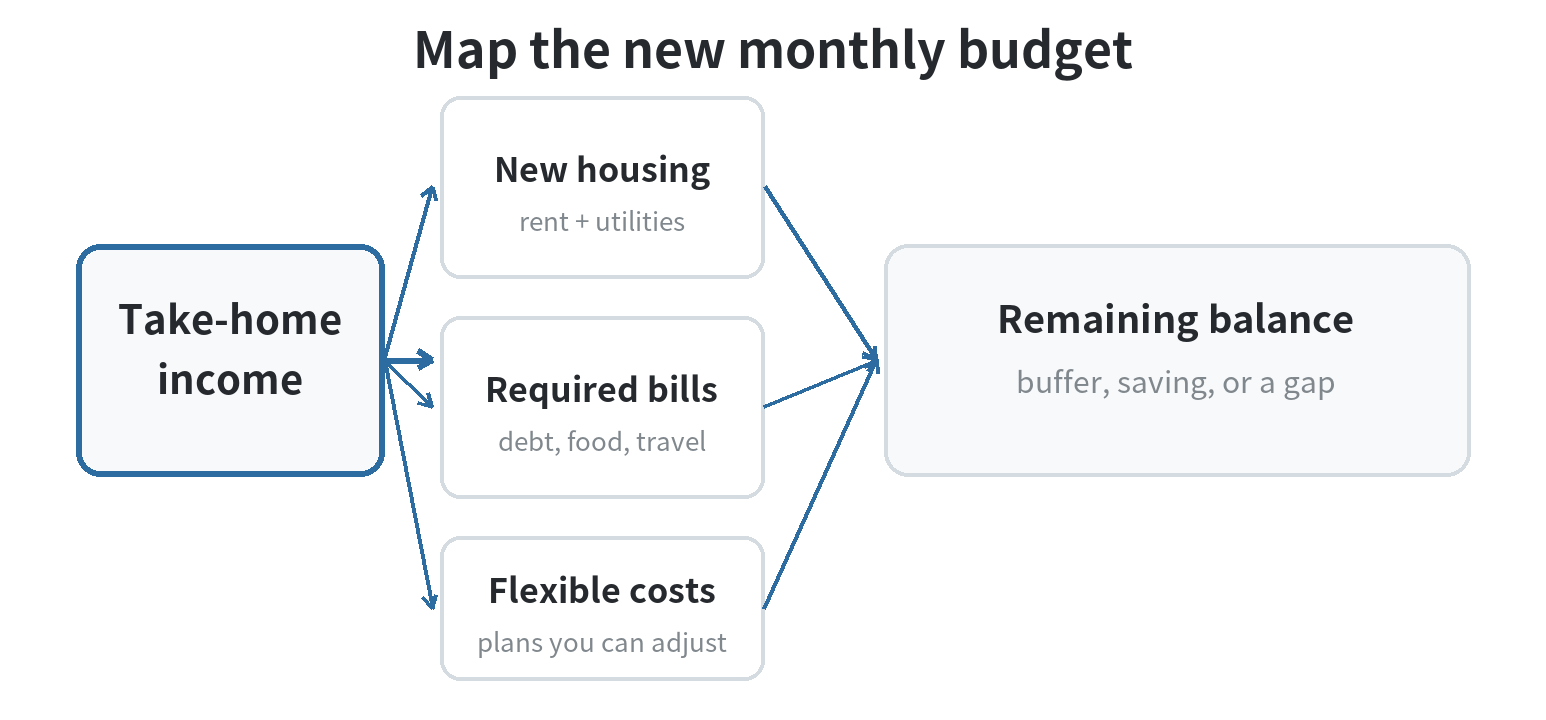
When your rent rises, rebuild the budget around the new amount before deciding what to cut. Compare your take-home income with the new rent, utilities, and other required bills; then identify the specific monthly gap. The change may be manageable through a few spending adjustments, or it may mean the lease no longer fits the money you have available.
HUD uses housing costs at 30% of income as an approximate affordability guideline, and its glossary says gross housing costs include utilities. The Census Bureau describes cost burden using rent and other housing costs as a share of income. That benchmark helps describe housing pressure; it does not tell you whether a particular rent works with your debts, household size, or take-home pay. (Checked September 30, 2026: HUD glossary; Census Bureau.)
Find the real increase, not just the rent line
Put the current and proposed lease amounts side by side, then check which services or fees are included. A rent increase can arrive with a utility change, parking charge, renter’s insurance premium, or a different billing arrangement. Keep each item in its own row so you do not mistake a higher total for a rent-only change.
Use a plain calculation:
New housing cost = new rent + utilities you pay + required housing fees
If your heating or electricity varies by season, use your own bills from the relevant months instead of one low month. The Census Bureau’s housing cost measure also includes rent and utilities, which is a useful reminder to assess the whole housing bill rather than rent alone. Checked September 30, 2026 (Census Bureau explanation of gross rent).
Then put the new total beside take-home income, not gross salary. If another adult contributes to rent, count only the amount that is actually available for the shared household bills. Keep a note of who pays each utility and when the payment leaves the account; a split that looks even on paper can still cause a cash shortfall if the dates do not line up.
Check the effective date against your pay and bill calendar. Mark when the new rent is due, when the utilities are billed, and when income arrives. If the change begins mid-cycle, use the amount and dates in your lease or written notice rather than assuming the first payment will be a full month or a partial month. This separates a timing problem from a lasting monthly gap.
Build a budget from the money that lands in your account
Use bank, debit-card, and credit-card statements to list your actual spending. The CFPB says to categorize expenses, include less frequent costs, and compare the total with monthly take-home pay. Its guidance was checked September 30, 2026 (CFPB spending review).
Start with obligations that are hard to change quickly: housing, utilities, insurance, minimum debt payments, transportation needed for work, childcare, and groceries. Add bills that do not arrive every month by setting aside part of their cost each month. For example, divide an annual premium by the number of months until it is due, then reserve that amount in the budget. This keeps a less frequent bill from appearing to be an unexpected rent-related problem.
The CFPB’s monthly budget tool puts income and spending into separate lists and subtracts spending from income. Checked September 30, 2026 (CFPB monthly budget tool). Your version can be a spreadsheet, paper, or bank statement notes; what matters is that it matches real transactions.
Use a replaceable example to see the gap
Suppose your household brings home $3,800 in a sample month. Rent changes from $1,450 to $1,575, while utilities average $180 in the bills you reviewed. The new housing total is $1,755. Subtract it from take-home pay, then subtract the rest of the household’s actual obligations.
| Example line | Amount | What to replace it with |
|---|---|---|
| Take-home income | $3,800 | Deposits available for this household |
| New rent | $1,575 | Lease amount after the increase |
| Utilities | $180 | Your bills for comparable months |
| Housing total | $1,755 | Rent plus utilities and required fees |
The point is not to copy the example’s proportions. Write down what remains after housing and compare it with food, transportation, debt, insurance, care responsibilities, and irregular expenses. If the remaining amount is already committed, a small trim to entertainment will not solve a structural shortfall. If the gap is smaller, assign a specific dollar amount to each change so you can tell whether the plan balances.
Choose adjustments that add up to the gap
Make a short list in three groups: spending you can pause, bills you can ask about, and costs that are fixed for now. A pause might be a planned purchase or a service you no longer use. For a bill, review the current statement and ask the provider about available payment dates or plan options; do not assume a discount or change is available. Fixed costs may need a longer conversation with the landlord or household.
Do not start by cutting every flexible line by the same percentage. Check which changes are realistic for your week: fewer paid meals, a temporary pause on a planned purchase, or shifting a savings contribution while keeping enough cash for required bills. Record the amount each choice frees. If the total does not cover the increase, the budget is still short.
Give each proposed adjustment a place in the budget and a date to review it. A line labeled “spend less” is hard to check; a named change with a dollar amount can be compared against the next set of transactions. Keep the original bill amounts beside the revised plan so you can spot an estimate that missed a fee or a utility swing.
Keep some room for expenses that do not arrive on a neat schedule. The CFPB recommends reviewing statements and including less frequent costs rather than editing the budget to reflect what you think you should spend. Checked September 30, 2026 (CFPB guidance). A plan that uses every available dollar can break when a car repair, school cost, or annual bill arrives.
Know when a spending trim is not enough
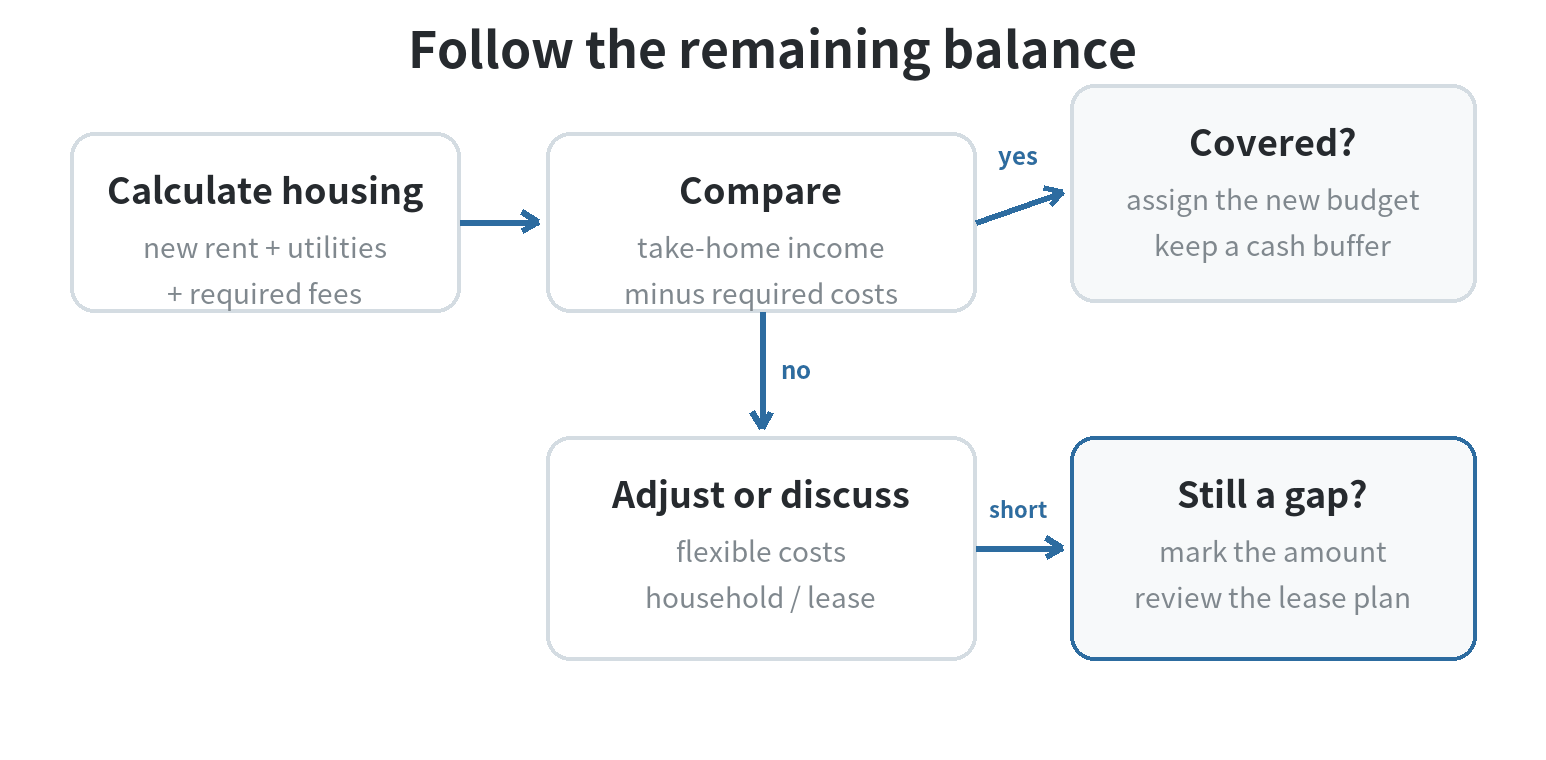
After assigning realistic amounts, look at the remaining balance. If it is negative, or if there is no cash left for bills that arrive irregularly, mark the exact monthly gap. A clear figure makes the next decision more useful: whether to change discretionary spending, coordinate a different split with a roommate or partner, ask about a payment arrangement, or consider whether the housing cost is sustainable.
If the lease is not signed yet, compare the full housing cost with your take-home budget before agreeing. If the increase is already in a notice or lease, read the document for its effective date and stated amount, and contact the landlord in writing with a concise question if anything is unclear. Rules and notice requirements vary by location, so use your state or local housing agency or a tenant legal-aid organization for local guidance; a general budget cannot determine your individual rights.
For a shared home, discuss the new number and payment dates together. Decide which person pays each bill, when contributions need to arrive, and what the plan is if a utility bill changes. Put the agreement somewhere everyone can check. Revisit the budget when the rent amount, income, or utility pattern changes, rather than waiting for an overdue bill to reveal the mismatch.
FAQ
Should I use gross income or take-home pay when deciding what rent fits?
Use take-home pay to build the amount you can spend from each paycheck. HUD’s 30% housing affordability guideline is stated against income and includes utilities, but it is an approximate benchmark; your cash budget should use the money that reaches your account and your actual bills.
What if my utility bill changes with the season after the rent increase?
Use your own bills from comparable seasons and keep utilities separate from rent in the budget. This makes a seasonal swing visible and prevents a lower-cost month from understating the housing total.
How do I budget a rent increase when I split rent with a roommate?
Write down the household’s full new rent, each person’s agreed share, and the date each contribution must be available. Also list utilities separately so a rent split does not hide an uneven or changing bill.
What should I do if the new rent leaves no money for other bills?
Calculate the shortfall from take-home pay after required costs, then identify whether flexible spending can cover it. If the gap remains, discuss the lease or household arrangement and check local tenant resources for location-specific questions.
Last updated: September 2026.
Last updated: 2026-09