Yes, you can budget and save at the same time: count savings as a planned expense, then make the rest of the budget fit the money that actually reaches your account. Start with take-home income, list bills and everyday spending, choose a savings amount that fits, and adjust the flexible categories before the month begins.
The point is not to hit a national percentage. A savings rate is simply the amount you set aside divided by your take-home income. Your own bills, pay schedule, and priorities determine the amount that is workable.
Start with the deposit that reaches your account
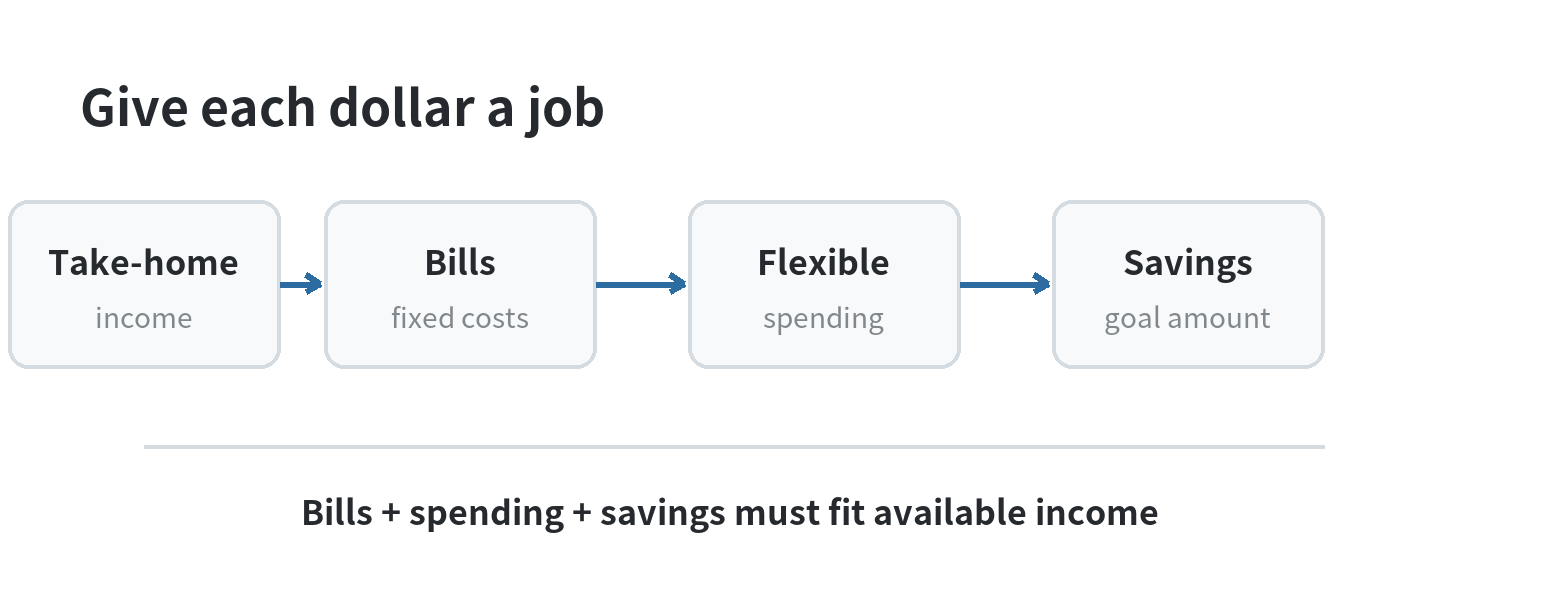
Use net pay rather than gross salary: the amount deposited after payroll deductions is what you can assign to rent, bills, food, debt payments, and savings. If your income changes month to month, list the deposits from recent months separately before choosing a planning amount. The CFPB’s My New Money Goal worksheet uses three months of income and expenses to calculate averages; Consumer.gov says people without monthly pay can add last year’s income and divide by 12 (both checked September 30, 2026).
Next, gather recent bank and card statements, pay stubs, and bills. Put each expense in a category you can recognize: housing, utilities, food, transportation, debt payments, subscriptions, and occasional costs such as insurance, gifts, or school expenses.
Separate fixed bills from choices you control week to week. A rent payment belongs in the fixed list; groceries may need a weekly cap; a streaming subscription can be listed by its renewal date. For a category paid by card, use the transaction date and amount rather than the card payment alone, so purchases do not disappear from the spending record when you pay the statement.
Do not treat every month as identical. An annual premium or a car repair may not appear on each statement, but it still needs a place in the plan. If you expect a $600 bill once a year, for example, reserve $50 per month for it. That is a planning example, not an estimate of what your bill should cost.
Calculate a savings amount from your own numbers
Use a short sequence:
- Add up monthly take-home income.
- Subtract essential bills, minimum debt payments, and realistic flexible spending.
- Choose how much of the remainder to assign to savings.
- Check that expenses plus savings do not exceed income.
For a simple savings-rate calculation, divide the amount assigned to savings by take-home income and multiply by 100. If your monthly take-home income is $3,200 and you plan to save $160, the calculation is $160 ÷ $3,200 × 100 = 5%. Both amounts here are made-up examples. They show the arithmetic, not a recommended target.
Keep the categories distinct. Money for an upcoming annual bill is a reserve for spending; money for a goal you want to keep accumulating is savings. You can track them in separate lines or accounts so the same dollars are not counted twice. Give each savings goal a name and date, then divide the amount still needed by the number of months you have chosen. For instance, a made-up $900 goal with six months available calls for $150 per month before any existing balance is counted. If that monthly amount does not fit, change the date or target and recalculate. The CFPB worksheet treats average expenses and average savings as separate amounts when showing what remains for a new goal.
Fit the plan to the pay calendar
A monthly total can balance on paper while leaving too little cash before payday. Write each payday and bill due date on a calendar, then assign bills to the deposits that arrive before they are due. Keep the savings transfer after the deposit is available and after you have accounted for bills due before the next payday.
If a due date falls just before payday, do not count the upcoming deposit as cash already available. Carry the amount needed for that bill forward from the prior deposit, or ask the biller whether another due date is available. Treat any change in due date as a calendar adjustment and update the plan so the money is assigned once.
For example, imagine two $1,600 take-home deposits in a month. The rent and utilities due early in the month total $1,250, while later fixed bills total $500. If $160 is assigned to savings, the remaining $1,290 has to cover food, transportation, debt payments, and other spending. The arithmetic leaves no room for a category that was forgotten; it does not mean the plan is affordable unless those costs also fit.
When pay varies, build the base plan around income you can count on, then decide in advance how to handle extra income. You might direct part toward a goal and part toward irregular bills. Consumer.gov’s budget guidance suggests using last year’s total divided by 12 for income that does not arrive monthly; the CFPB worksheet offers a three-month average approach. Choose a method that reflects your pay pattern and revisit the estimate when that pattern changes.
When the first draft does not balance
If planned expenses and savings exceed income, do not hide the gap by writing a smaller savings transfer while leaving every other number untouched. Look at the categories with room to move: optional purchases, restaurant meals, unused recurring services, or the timing and size of a goal. Fixed obligations may leave less flexibility, so the first workable savings amount can be small or temporarily zero while you cover bills.
If the budget balances but leaves no cushion, check whether you included less-frequent expenses and a line for unexpected costs. The CFPB advises reviewing several months of spending for items that do not appear monthly and including regular savings contributions in the budget. A buffer category can absorb an irregular bill; if it goes unused, you can decide at month-end whether to keep it there or move the remainder toward a goal.
When the numbers do not work, change one decision at a time. You could extend a savings deadline, lower the target, or reduce a flexible category. The CFPB goal worksheet presents those as adjustment options when the available amount does not meet the amount needed for the goal. Do not rely on an assumed bonus or unconfirmed refund to make the regular budget balance.
Review actual spending before setting next month’s amount
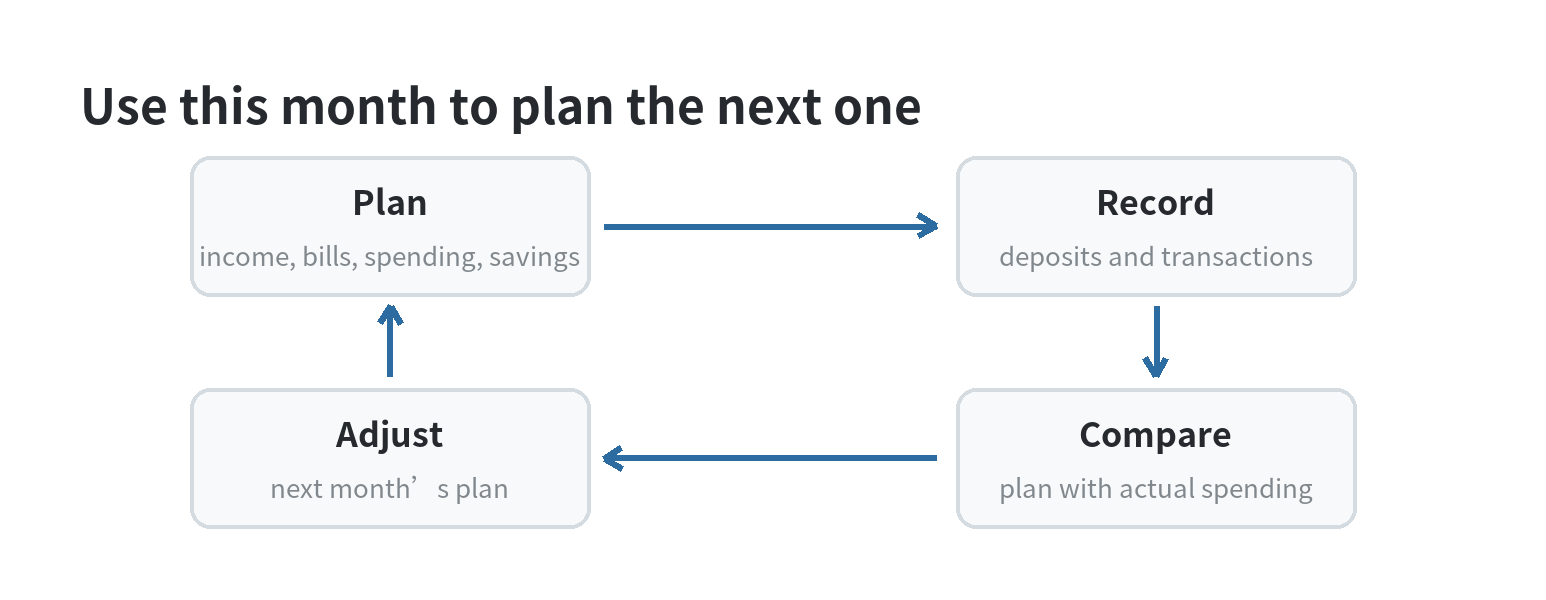
At month-end, compare the plan with deposits and transactions. Mark each difference as a one-time cost, a missed category, a timing issue, or a category whose estimate was too low. Carry useful information into next month rather than treating a miss as a personal failure. Consumer.gov describes budgeting as a monthly cycle: plan, record spending, compare with the plan, and use what happened to shape the next month.
If a planned transfer caused a bill payment to fall short, move the transfer date or lower the amount until the calendar works. If money remains after bills and spending, decide whether it belongs to the savings goal, a future irregular expense, or another priority. The right savings rate is the result of those choices: savings divided by take-home income, using your own recorded figures.
Last updated: 2026-09
FAQ
Should savings be calculated from gross pay or take-home pay?
Use take-home pay for a monthly spending plan because that is the deposit available to assign. Gross pay can be useful for other financial calculations, but it is not the amount available in your checking account after payroll deductions.
What if my income changes from month to month?
Record the actual deposits for several months and use an average or a conservative base amount that fits your pay pattern. The CFPB’s goal worksheet uses a three-month income average; Consumer.gov describes a yearly total divided by 12 for people who are not paid monthly. Both were checked September 30, 2026.
Should I save before paying extra on debt?
That depends on your bill due dates, required payments, cash reserves, and the terms of the debt. Put required payments in the budget first, then compare the remaining amount with your savings goals and any optional extra payment.
How often should I update a budget that includes savings?
Review it at least when you plan the next month, and revise it sooner when a paycheck, bill, or major expense changes. Consumer.gov recommends using each month’s actual spending to plan the next month (checked September 30, 2026).