A monthly paycheck works best as a month-long plan, not as one large balance to spend from on payday. Start with your actual take-home amount, reserve money for bills by due date, then set a weekly limit for flexible spending. That gives every dollar a place before the next paycheck arrives.
The Consumer Financial Protection Bureau (CFPB) monthly budget worksheet compares income with expenses, while its bill calendar records each bill, amount, and due date; both were checked September 30, 2026. Use those two views together: one tells you whether the month adds up, and the other shows when cash has to be ready.
Begin with the deposit that actually reaches your account
Use net pay after payroll deductions, not the salary printed in an offer letter. If your deposit varies, budget from the amount you can count on and leave uncertain overtime, commission, or reimbursements out until they arrive. Add other recurring income only when its amount and timing are clear.
For a swap-in example, say your monthly take-home pay is $4,200. Write that at the top of a page, then list recurring expenses from statements and account history: housing, utilities, insurance, debt payments, groceries, transportation, and any savings goals. The $4,200 is only an example; replace it with your own deposit.
Include expenses that do not arrive every month. If an annual $360 membership renewal is due in December, set aside $30 a month in the months before it is due. The arithmetic is $360 divided by 12. Use your actual renewal amount and date, and keep the set-aside in the same monthly plan so it is not mistaken for spare cash.
Make one list for the month and one for the calendar
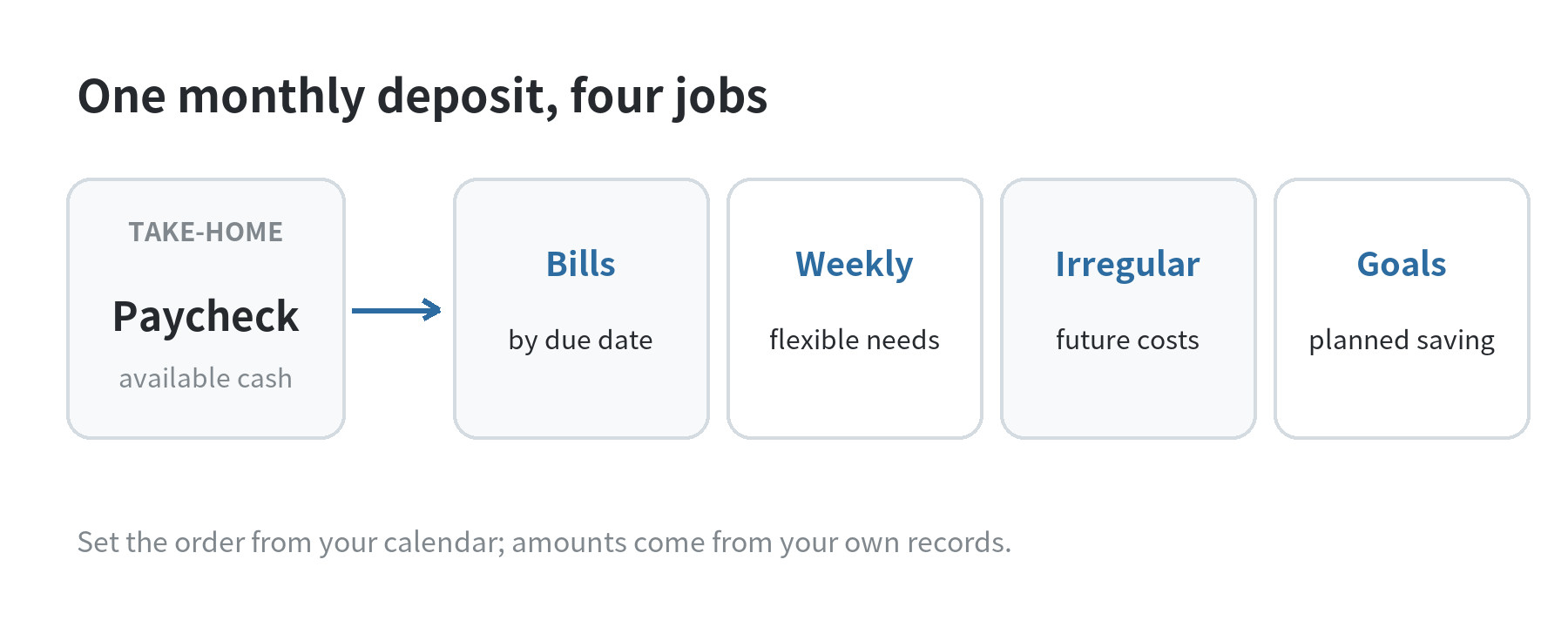
Group your monthly plan into fixed bills, flexible essentials, irregular costs, and goals. The CFPB worksheet includes categories such as housing and utilities, food, transportation, health costs, debt payments, and savings. The FDIC Money Smart spending plan checked September 30, 2026 also separates planned monthly amounts from past spending and compares total expenses with net income.
| Bucket | What to enter | Where to get your number |
|---|---|---|
| Fixed bills | Rent, insurance, loan minimums, phone plan | Current bill or account statement |
| Flexible essentials | Food, fuel, transit, household supplies | Recent transactions, adjusted for known plans |
| Irregular costs | Annual renewals, car maintenance, gifts | Past receipts, renewal notices, or a written estimate |
| Goals | Emergency savings or another named goal | The amount you choose after bills and essentials |
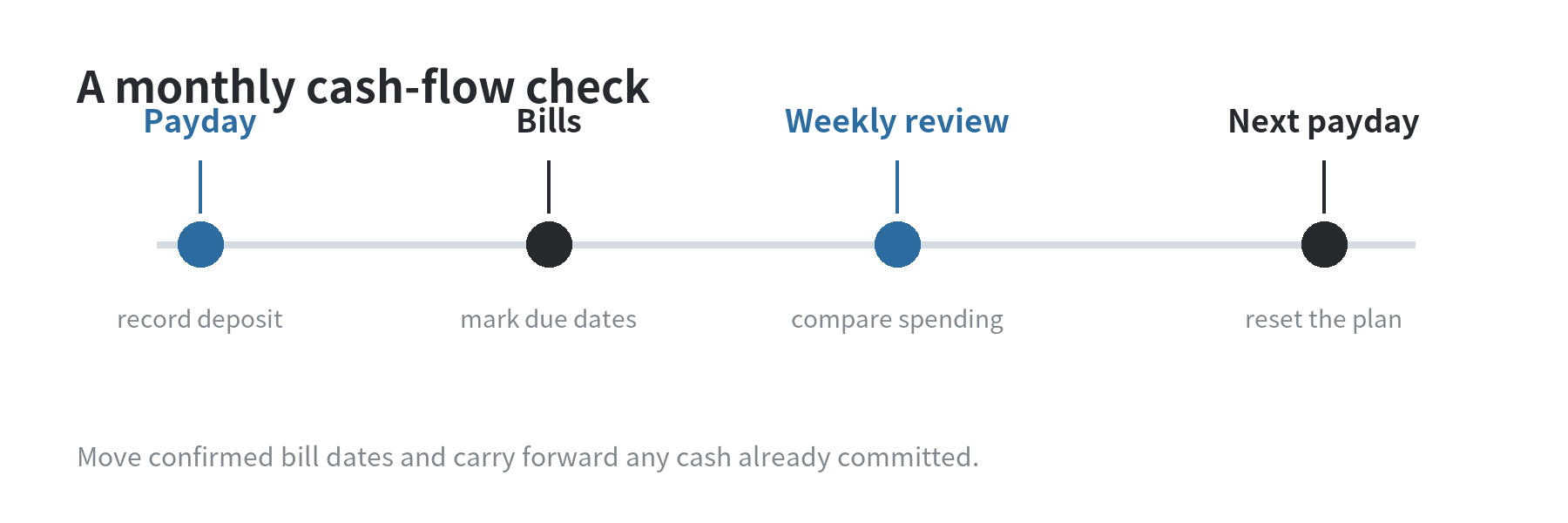
Next, make a calendar with each due date, amount, and payment account. Put the paycheck date on it too. The CFPB’s bill-calendar instructions say to gather bills, write down what each is for, its amount and due date, then review the calendar weekly; checked September 30, 2026. If phone reminders help you follow that schedule, see our guide to paying bills on time using your phone. If a due date lands before the deposit that covers it, mark the gap instead of assuming the monthly total will solve the timing problem.
Assign the paycheck before the first bill clears
On payday, write down what is already committed before deciding how much is available for day-to-day spending. If your sample $4,200 deposit has $2,350 in fixed bills, $1,050 in food and transportation, and $300 reserved for irregular costs, $500 remains for savings goals and other planned spending. These are sample figures, not a recommended split.
If that remainder is too small for a goal, revise the plan on paper first. Check whether a flexible category can change, whether an irregular expense can be spread across earlier months, or ask the biller whether it offers a different due date. Record a change on your calendar only after it is confirmed.
Keep bill money separate from the amount you use for ordinary spending. That can mean separate accounts, labeled savings spaces, or a simple ledger; the method matters less than being able to see which dollars are already committed. If you use one checking account, track scheduled payments so the visible balance does not look larger than the amount available to spend. For app-based tracking options, see our overview of budgeting apps for managing money on your phone.
Turn the flexible amount into a weekly boundary
Monthly budgets can feel abstract when groceries, gas, and small purchases happen throughout the month. Divide the flexible amount by the number of weeks you want to manage at a time. For example, $600 set aside for flexible purchases over four planned weeks gives you $150 per week. It is a planning example; adjust the number of weeks to match your calendar and pay cycle.
Check the actual calendar before setting weekly amounts. If your plan covers four weeks but the month includes another week of groceries or transit, do not stretch the four-week allowance and hope it covers everything. List that spending separately, then decide whether to reserve money for it from the monthly amount or reduce another flexible category.
For a paycheck deposited on the last day of the month, label that deposit for the spending period it needs to cover. If the deposit arrives on September 30 and rent is due October 1, write the rent reservation under the October plan even though the deposit posted in September. This makes the account balance easier to read: money meant for the next month does not look like September spending money.
Now mark every bill due before the next deposit. If the next paycheck will not arrive until October 31, the October plan needs to include all October bills, not just the ones due in its first few days. Keep the later bills reserved as the month moves along. A calendar-month budget answers “how much belongs to October?”; the date list answers “which of that money must still be in the account today?”
If your pay date moves because of a weekend or holiday, use the date the funds are actually available in your account. Check the employer’s payroll notice or bank activity rather than assuming the deposit will appear on the same day every month. Carry forward the bill amounts that fall before the next confirmed deposit.
A short weekly check can catch a mismatch early. Compare posted transactions with your plan, note bills that cleared, and update remaining category amounts. If a utility bill or grocery run is higher than planned, adjust a category that has not been spent yet rather than counting the same dollars twice.
When the monthly math comes up short
Subtract planned expenses and savings from take-home pay. A positive remainder can stay assigned to a goal or a buffer; a negative remainder means the plan needs a change before the month starts. The FDIC worksheet frames this as a comparison of total net income and total expenses, and says amounts may need conversion when income or expenses follow a non-monthly schedule; checked September 30, 2026.
Check estimates against recent statements, especially for categories that move. Then separate must-pay commitments from expenses you can reschedule or reduce. If there still is not enough for all bills, the FDIC Money Smart guide advises prioritizing bills by the consequences of missing them and contacting creditors; checked September 30, 2026. Your providers can explain their own payment options and any fees.
At the end of the month, compare the plan with what actually cleared. Change next month’s amounts where the record shows a recurring difference. A monthly budget is a working calendar: the paycheck date, the bill dates, and the money left for each week all belong on the same page.
FAQ
What if I am paid on the last business day instead of the first?
Build the plan around the date the deposit is available, not the calendar month label on your pay stub. Mark bills due before that date as needing money carried over from the prior month, then leave that amount untouched.
Should I budget from gross pay or take-home pay?
Use take-home pay for a household spending plan because that is the deposit available for bills and purchases. The FDIC Money Smart worksheet labels employment income as net, or take-home, pay; checked September 30, 2026.
How should I handle a month with an extra week of spending?
Keep the monthly total intact and choose a weekly amount that accounts for the actual calendar. If a fifth week needs groceries or transit money, reserve for it explicitly instead of treating the month’s remaining balance as unassigned.
What should I change if a bill date falls before payday?
First check whether you can carry the bill amount forward from the previous deposit. You can also ask the provider whether it permits a due-date change, then update the calendar only after the change is confirmed.
Last updated: September 2026.
Last updated: 2026-09