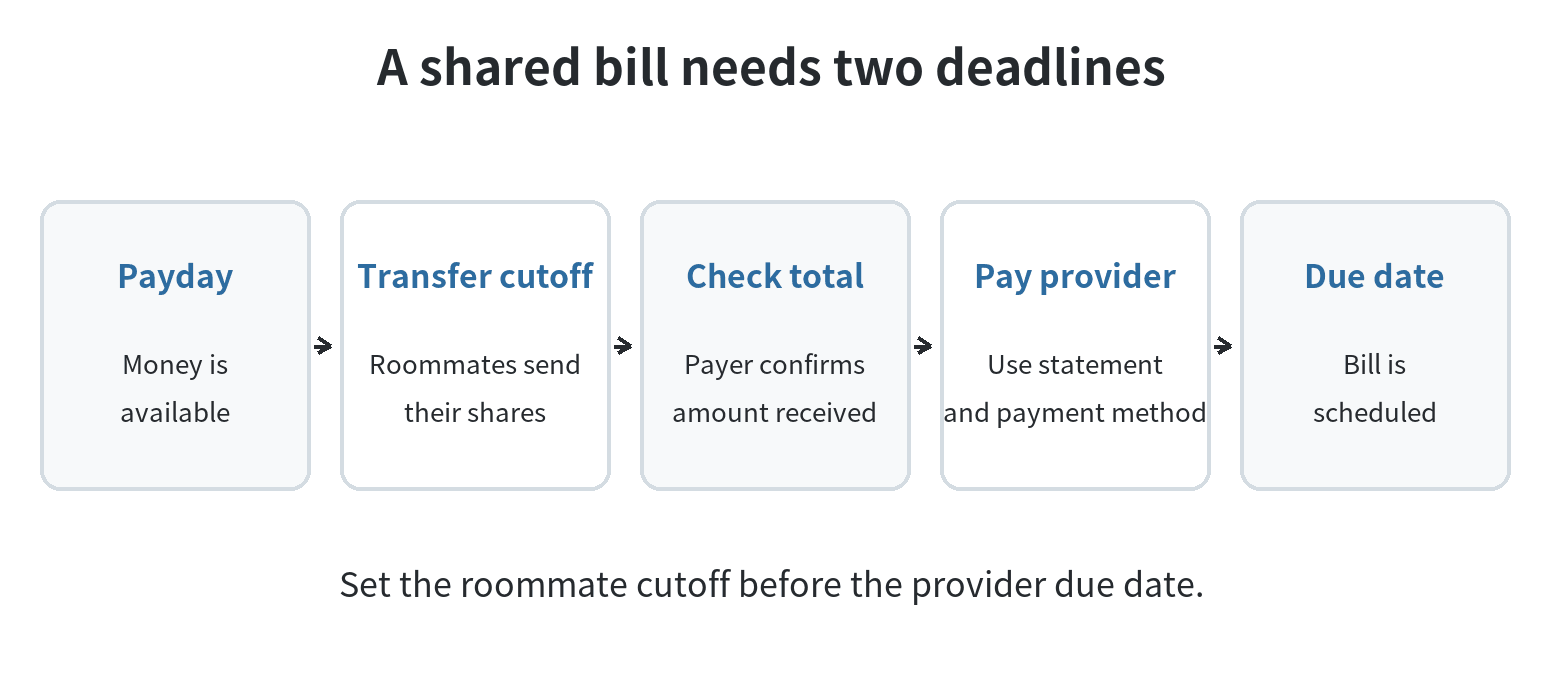
Roommate bills stay on schedule when everyone agrees on two dates: when each person sends their share and when the account holder pays the provider.
Put the bill amount, due date, roommate cutoff, payer, and payment status in one shared calendar.
Then fund each bill from the paychecks that arrive before it is due, instead of waiting for the due-date reminder.
The CFPB bill-calendar guidance, checked September 30, 2026 says to list what each bill covers, its amount, and its due date, then review the calendar regularly.
The FDIC Money Smart guide, checked September 30, 2026 also recommends a monthly payment calendar and recording when a payment needs to be sent.
That gives roommates one place to track shared bills.
Agree on the bill and the rule before setting dates
Start with shared rent, utilities, internet, or another charge the household has explicitly agreed to cover together.
Keep personal subscriptions, individual fees, and groceries outside this calendar unless the roommates have chosen to share them.
For each shared line, record the service period, bill total, split rule, each person’s amount, account holder, provider due date, and the household transfer date.
The schedule cannot resolve a disagreement about who owes what.
Set that rule first, then calendar the result.
Equal shares may fit a bill used by all roommates; a different split needs an agreed reason and a clear calculation.
For rent and other allocation questions, see the site’s roommate bill-splitting guide.
Record who pays the provider and who reimburses that person so the household keeps those two jobs clear.
Use the provider’s statement as the source for the total and due date.
If the bill changes each month, leave the split formula fixed and update only the amount after the statement arrives.
If a new line appears, label it and ask the account holder to confirm what it covers before adding it to everyone’s share.
Give roommate transfers their own deadline
Set the household transfer date before the provider due date.
Leave time for the account holder to confirm receipt and pay the provider.
The CFPB calendar, checked September 30, 2026 marks online payments two or three days before the due date.
The FDIC consumer guide, checked September 30, 2026 suggests electronic or automatic payments two to three days early for processing.
Check the provider’s current cutoff and posting time.
For instance, if a bill is due on the 18th, roommates might send shares by the 12th and the account holder pay by the 15th.
These are sample dates, not a universal rule.
Pick dates that fit the statement, payment method, and household paydays.
Ask roommates to use a consistent payment note such as “electricity — April” so the payer can match incoming money to a bill.
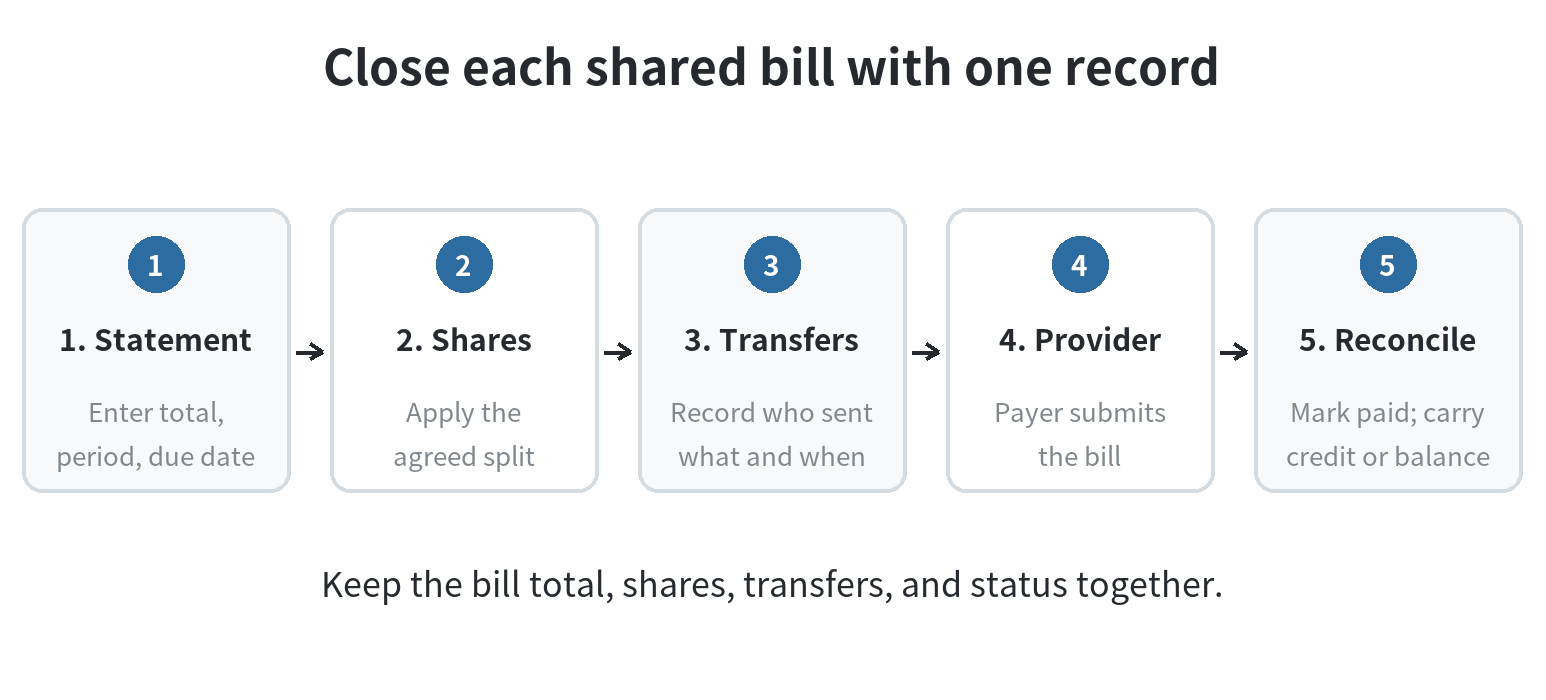
In the shared record, mark the date received and the amount.
Do not mark a bill paid to the provider until the account holder can confirm the payment cleared or the provider shows it as paid.
Set a cutoff time as well as a date, so everyone knows when the payer will check the ledger.
If someone will be late, ask them to tell the payer before the cutoff and give a new date.
Leave the share marked outstanding until the money arrives.
Work the shared total through one monthly example
Say three roommates agree to split electricity and internet equally.
The example electricity statement is $126 and internet is $60, so the household total is $186.
Each person’s share is $62: $42 for electricity and $20 for internet.
These figures are sample arithmetic, not a typical bill amount.
Replace them with the statements and split rule your household agreed to.
The CFPB calendar format, checked September 30, 2026 asks you to record bill amounts and due dates before planning payments.
| Shared bill | Due date | Household transfer date | Each roommate’s example share | Account holder |
|---|---|---|---|---|
| Electricity: $126 | 18th | 12th | $42 | Roommate A |
| Internet: $60 | 24th | 18th | $20 | Roommate B |
Roommate A pays the electric provider and roommate B pays the internet provider.
Each person still owes their own $42 and $20 share, so the household can settle the combined $186 total in a single monthly transfer if everyone agrees.
After A’s $126 payment and B’s $60 payment, A has covered $64 more than A’s $62 share, B is short by $2, and C has not paid yet.
The roommates can settle those balances by having B send $2 to A and C send $62 to A.
The balances now net to zero.
Another option is to record each bill separately and reimburse the payer for the other roommates’ shares.
Choose one method and use it consistently.
These example amounts follow the bill-calendar process of recording bill totals and payment dates.
If one person pays more than one provider, compare each roommate’s total paid with their total share at the cycle’s end.
Show the math before sending one net reimbursement, and decide in advance whether credits carry forward or are settled that month.
Match bill dates to paydays without guessing
List expected take-home pay dates beside the transfer cutoffs; no one needs to share private budget details.
This shows whether a household deadline falls before the money arrives.
If it does, agree on a different roommate cutoff before the next cycle.
The CFPB guidance on comparing bill dates with income, checked September 30, 2026, and the FDIC guide, checked September 30, 2026 recommends tracking income and payment dates.
Keep the provider’s due date unchanged unless the account holder confirms a change.
For example, a roommate is paid on the 5th and 19th, the bill is due on the 18th, and the transfer cutoff is the 12th.
The first check arrives before the cutoff.
If your payday falls after your household’s cutoff, resolve that mismatch before agreeing to the schedule.
The CFPB bill-timing guidance and FDIC payment-calendar guide both support planning around income and bill dates.
For a variable bill, replace any placeholder estimate with the statement total.
If roommates collected too little, show the statement and set a date for the remaining shares.
If they collected too much, record a credit or return the extra as agreed.
Keep one ledger and close each bill after payment
A shared note can show the bill, period, total, each share, transfer cutoff, amount received, provider due date, payer, and paid status.
Keep the statement with the entry.
Leave passwords and full bank-account details out of the ledger.
Review totals and transfers at a set household check-in, then update due dates from new statements.
The CFPB toolkit includes a bill calendar and spending tracker; FDIC Money Smart covers expense records and payment dates.
For shared food costs, see the site’s roommate grocery method.
If a roommate moves out, record the last shared billing period and who will handle any later final bill.
Note the effective date if someone takes over the provider account, and keep the old entry until the balance is settled.
Last updated: 2026-09
FAQ
What if a roommate’s transfer arrives after the household cutoff?
Tell the account holder immediately and agree on a specific payment time.
Update the ledger with the amount still outstanding, and keep the provider due date visible so the payer can decide what the household needs to do before it passes.
Should roommates use one shared bank account for bills?
There is no single setup every household needs.
Roommates can keep separate accounts and record transfers in a ledger.
Before opening a joint account, review ownership, access, fees, and what happens when someone moves out.
How should roommates handle a utility bill that changes after everyone pays?
Share the final statement, recalculate each person’s share under the agreed rule, and record the difference as an amount due or a credit.
Use a new transfer date for the adjustment instead of silently changing the next bill’s calculation.
What if the provider’s bill due date falls before a roommate gets paid?
Set a household transfer cutoff that gives the account holder time to pay the bill, then check whether the account holder can request a due-date change from the provider.
Keep the listed date in the shared calendar until the provider confirms a change.