A dating budget works best as a monthly limit you choose after covering bills, savings goals, and other priorities. Set that amount from your own take-home pay and spending records, then plan each date inside it; you do not need a national average to decide what fits your life.
The Consumer Financial Protection Bureau (CFPB) recommends listing income and expenses before building a budget, and Utah State University Extension similarly advises using tracked spending to set category amounts (checked September 30, 2026). The figures below are a made-up example to show the arithmetic, not a typical household budget.
Give dating its own line in your monthly plan
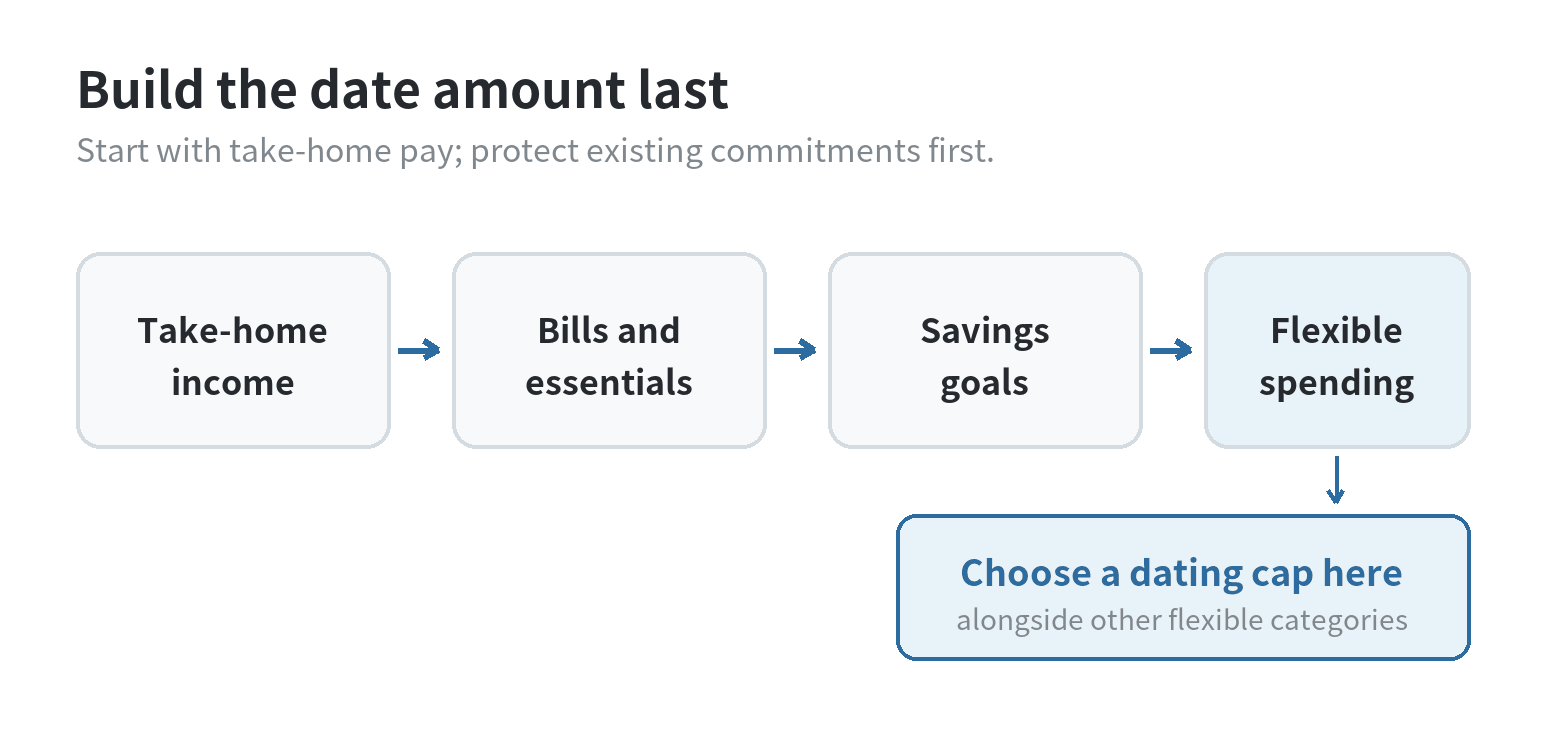
Start with take-home income: the money available after payroll deductions. List rent, utilities, groceries, transportation, debt payments, savings goals, and any bills due before deciding what is available for dates. A date fund should come from what remains after those commitments, not from money needed for rent or a bill.
For example, imagine monthly take-home pay of $3,200, required bills and essentials of $2,250, and planned savings of $350. That leaves $600 for flexible categories. If you assign $240 to dating, the other $360 remains for other flexible spending. Those numbers are placeholders; replace every line with amounts from your own records.
| Example monthly line | Amount | How to use it |
|---|---|---|
| Take-home income | $3,200 | Starting amount for the example |
| Bills and essentials | $2,250 | List obligations before dates |
| Savings goals | $350 | Keep planned contributions visible |
| Dating fund | $240 | Set a limit for date-related spending |
| Other flexible spending | $360 | Remaining amount after the lines above |
Include more than the main activity in the dating line. Add your share of food or tickets, transportation, parking, childcare if it applies, and any small purchases you expect to make during the outing. If you and a partner split costs, budget the amount you personally plan to pay, rather than the full bill.
Use your records to choose a limit
Look at bank and card activity, receipts, and cash notes. The CFPB suggests tracking spending for at least two weeks or a month to get a clearer picture; FDIC Money Smart materials also recommend writing down expenses, preferably for a month. Utah State University Extension advises tracking expenditures across a month before setting category amounts (checked September 30, 2026).
Separate date-related purchases from other restaurant meals or entertainment. A meal with coworkers may belong in a different category than a planned date. If a charge could fit either one, choose a rule and apply it consistently so the total can guide next month’s plan.
If you have not kept records, choose a temporary cap that leaves your bill money untouched and track each date expense as it happens. Treat the first month as a draft. At month-end, compare the planned amount with what you actually spent and adjust the next month’s line to match your records and priorities.
Turn the monthly cap into choices for real dates
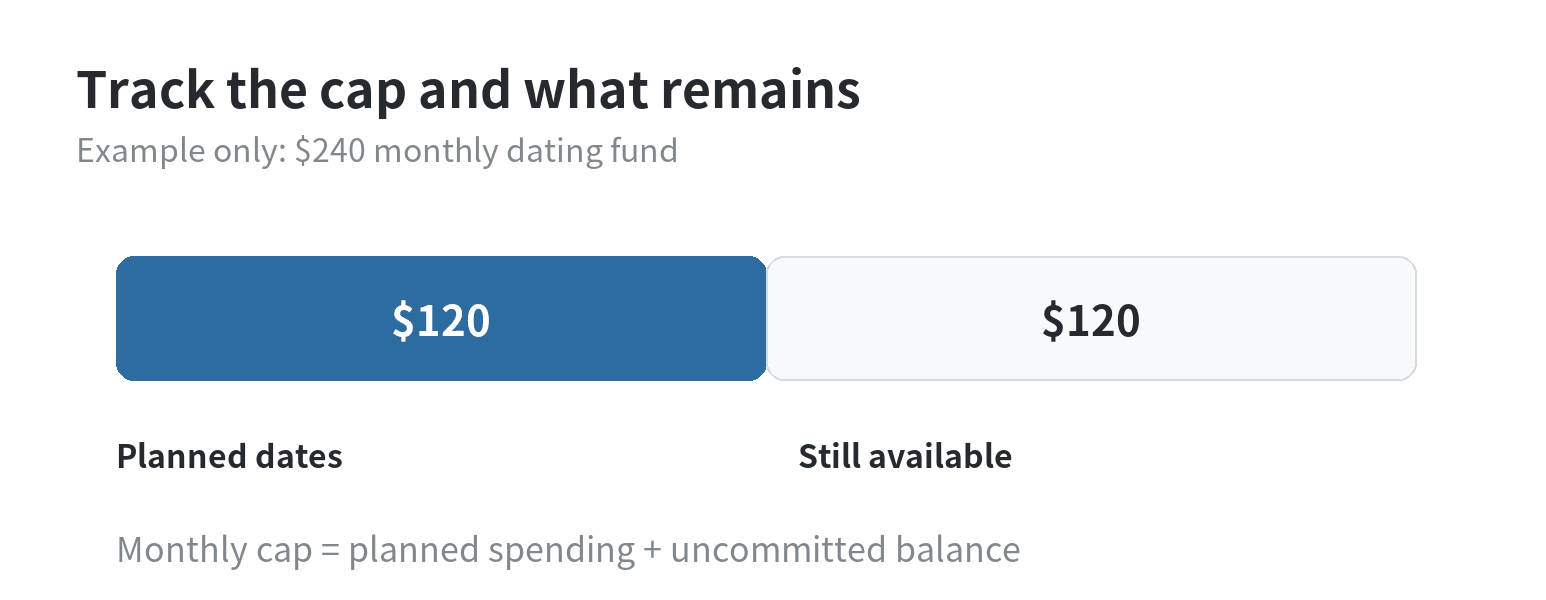
With a $240 example fund, one possible plan is two outings at $45 each, one at $30, and $120 still available. The amounts are examples, not price guidance. The point is to reserve money for planned dates and see what remains before committing to another expense.
Build a plan around what matters to you. One outing might prioritize a shared activity, while another might leave room for a meal. If the main event costs more than planned, decide in advance whether to use money from another date or choose a lower-cost activity. That keeps the limit useful without turning it into a rigid rule about what a date should look like.
For a date with multiple costs, write a quick estimate before making plans: activity, food, transportation, and any extra charge you expect. Compare the total with the amount left in the fund. If it does not fit, change one part of the plan, agree to split a specific cost, or pick another date idea.
A low-cost plan can still be specific: take a walk in a public place, cook together using groceries already in the household budget, visit a free community event, or make coffee at home before a neighborhood stroll. Check local event details and transportation needs before setting the amount. The goal is to choose an activity that fits both people’s preferences and the limit you set.
Line up the fund with your pay dates
A monthly cap is useful only if the money is available when you plan to spend it. The CFPB’s bill calendar asks readers to list each bill, amount, and due date, then use the overall budget to review the month (checked September 30, 2026). Apply the same calendar view to dates: mark expected paydays, bill due dates, and planned outings together.
In the $240 example, someone paid twice in a month could reserve $120 from each paycheck for the date fund. That is one way to stage the same monthly total, not a required split. If a planned outing falls before the second payday, use only money already set aside; do not spend against income that has not arrived. If the timing does not work, move the outing or choose an option that fits the current balance.
When pay arrives on an irregular schedule, write down the amount after it reaches your account and update the flexible balance from there. You can keep the monthly limit unchanged while shifting plans within it, or lower the limit for a month when essential bills take a larger share. Review the calendar after a bill date changes so the date plan does not rely on money already assigned elsewhere.
Make the conversation clear and comfortable
Money expectations are easier to discuss before a reservation or ticket purchase than when the bill arrives. You can say, “I set aside $40 for tonight. Would you like to choose something within that?” Or ask whether the other person would rather split the cost, alternate paying, or choose a no-cost plan. A clear proposal gives both people room to respond.
For a new relationship, keep the conversation about this plan rather than asking for private account details. For an established partnership, decide which expenses belong to each person and how shared costs will be recorded. If one person pays upfront, agree on the other person’s share and when it will be settled; do not count an unpaid reimbursement as available cash.
If you want a simple way to record the category, a basic budget tracker on your phone can hold the date, amount, and category. For broader category planning, see the site’s guide to planning a monthly budget. These are optional record-keeping approaches; a notebook or spreadsheet works too.
When a plan costs more than the remaining balance
Pause before putting the difference on a credit card or borrowing from money reserved for bills. First check whether the estimate includes all costs. Then decide whether to lower the cost, move the date, or wait until next month’s fund is available. If you do change the limit, identify which other flexible category will shrink so the same dollars are not assigned twice.
At the end of the month, review three things: what you planned, what you spent, and which choices felt worthwhile. If the amount was too high for the rest of your budget, lower it. If actual spending was below the cap, keep the unused amount for a future date or return it to another priority; choose one treatment and use it consistently.
For a visual check, the diagram below separates the total cap from already planned expenses and the remaining amount. Use your own figures each month; the picture illustrates the relationship between those amounts.
FAQ
Should unused date money roll into the next month?
Choose one rule that fits your budget: carry it forward for a larger planned outing, or return it to another category at month-end. Record the transfer so the same money is not counted in both months.
How can I budget for dates when my income changes each month?
Set the date amount after required bills and savings for that month are accounted for. When take-home pay is lower, reduce or pause the flexible line before assigning money needed for obligations.
What if one person prefers expensive dates?
Say what you can spend before agreeing to the plan, then suggest an activity within that amount. You can also agree to pay separately so each person controls their own spending.
Last updated: 2026-09