If you earn a solid paycheck but feel broke, start with the money that actually reaches your checking account, then map each bill and recurring choice to the date it leaves.
A higher income can disappear into larger fixed costs, small repeat purchases, and badly timed bills before it feels like spending money.
Start with take-home pay, not the salary number
Your gross salary is not the amount available for rent, groceries, and saving.
Use the deposited amount from your pay stubs, and list any dependable second income separately.
If your pay changes, keep the variable part out of the baseline until it arrives; a budget built on a strong month can leave a short month exposed.
Consumer.gov says to use bills and pay stubs to list income and expenses.
Subtract expenses from monthly income to see what remains (checked September 30, 2026).
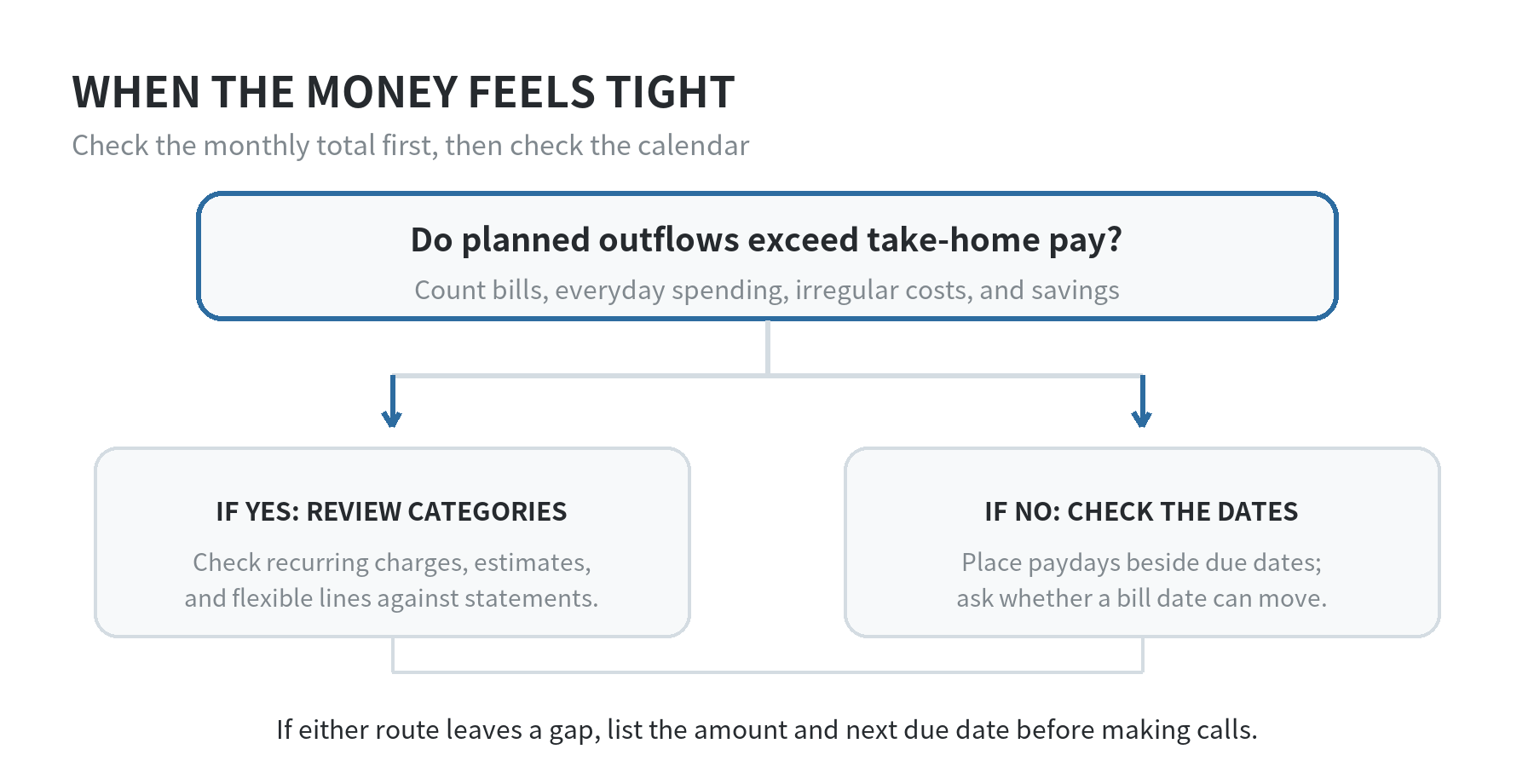
Does your plan exceed take-home pay?
Or does the total fit while due dates leave too little cash?
Do not count a credit limit as income or treat an account balance as uncommitted cash. A checking balance may already have rent, insurance, or a card payment assigned to it.
Write those obligations beside the dates they are due before deciding what the balance can cover.
Find the lines that grew quietly
“Lifestyle creep” is easier to spot when you name the recurring choice instead of blaming yourself for earning more.
Scan bank and card statements for charges that repeat: a larger apartment, a car payment, delivery fees, memberships, upgraded plans, or frequent meals out.
Mark each as fixed, adjustable, or occasional. The label is about how quickly you can change it, not whether the purchase was good or bad.
Review a full month of transactions first.
Then look across older statements for bills that arrive less often, such as annual renewals, school costs, gifts, travel, or vehicle maintenance.
CFPB says to track spending and record bill due dates.
It also notes that mismatched income and bill dates can leave you short at month end (checked September 30, 2026).
Separate a one-time surprise from a repeat pattern.
A single repair belongs in an occasional-cost bucket; repeated rides, convenience purchases, or recurring services deserve their own line.
If a transaction is hard to identify, check the merchant description and receipt before assigning a category.
A wrong category can make a budget look balanced while hiding the real pressure point.
Look for the decision point attached to each flexible expense. “Eating out” is a result, not a useful limit by itself.
You might set separate amounts for workday lunches and social meals, or decide how many planned outings fit after bills and groceries.
The aim is to give the choice a boundary before the week gets busy.
Give irregular costs a monthly place
Annual and seasonal bills make an ordinary month look cheaper than it is.
List the known total and due month for each expense, then divide the total by the number of months until it is due.
If car registration is $360 and comes due in six months, setting aside $60 each month builds that bill into the plan.
The amount is an illustration; use your actual bill and deadline.
Keep this money in a separate budget line even if it stays in the same checking account. The line tells you that part of the balance already has a job.
If every goal will not fit, rank upcoming obligations by due date and consequence.
Reduce a lower-priority contribution to cover a nearer bill instead of treating the cash as free.
A modest “unplanned” line also matters.
It can absorb a school field trip, replacement charger, or a higher utility bill without forcing you to rewrite every other category.
Set it from your own history, and adjust after you see what actually happened.
CFPB advises including irregular bills and savings in a realistic budget.
Its guide says to compare the plan with account history (checked September 30, 2026).
Try the arithmetic with your own numbers
This sample uses $6,200 in monthly take-home pay. It is an invented planning example, not a typical household budget.
Replace each line with a figure from your statements and bills; the point is to make all the dollars visible before assigning the remainder.
| Monthly line | Example | What to check |
|---|---|---|
| Housing and utilities | $2,050 | Rent, electricity, water, internet |
| Transportation | $520 | Payment, fuel, transit, parking |
| Groceries and household goods | $720 | Statement totals, not a guess |
| Required debt payments | $400 | Minimum due and date |
| Recurring services | $150 | Renewals and memberships |
| Irregular-cost set-asides | $600 | Upcoming annual or seasonal bills |
| Flexible spending | $700 | Meals out, hobbies, personal items |
| Savings goal | $450 | A planned transfer you can sustain |
| Unassigned cushion | $610 | Room for estimates and surprises |
| Total | $6,200 | Must match take-home income |
In this example, the cushion is not a reward for finishing the worksheet; it is a deliberate margin for bills that vary and estimates that miss.
If your own total is above take-home pay, reduce or defer a flexible line, revise a savings amount, or investigate a bill change you can request.
Do not fill the gap with an assumed raise, bonus, or investment gain.
If your total is below take-home pay but your account still runs low, inspect timing next.
A budget can balance monthly and still fail during a particular week because several large payments leave before the next deposit.
The calendar view exposes that problem more clearly than a category total.
Match bill dates to the deposits that cover them
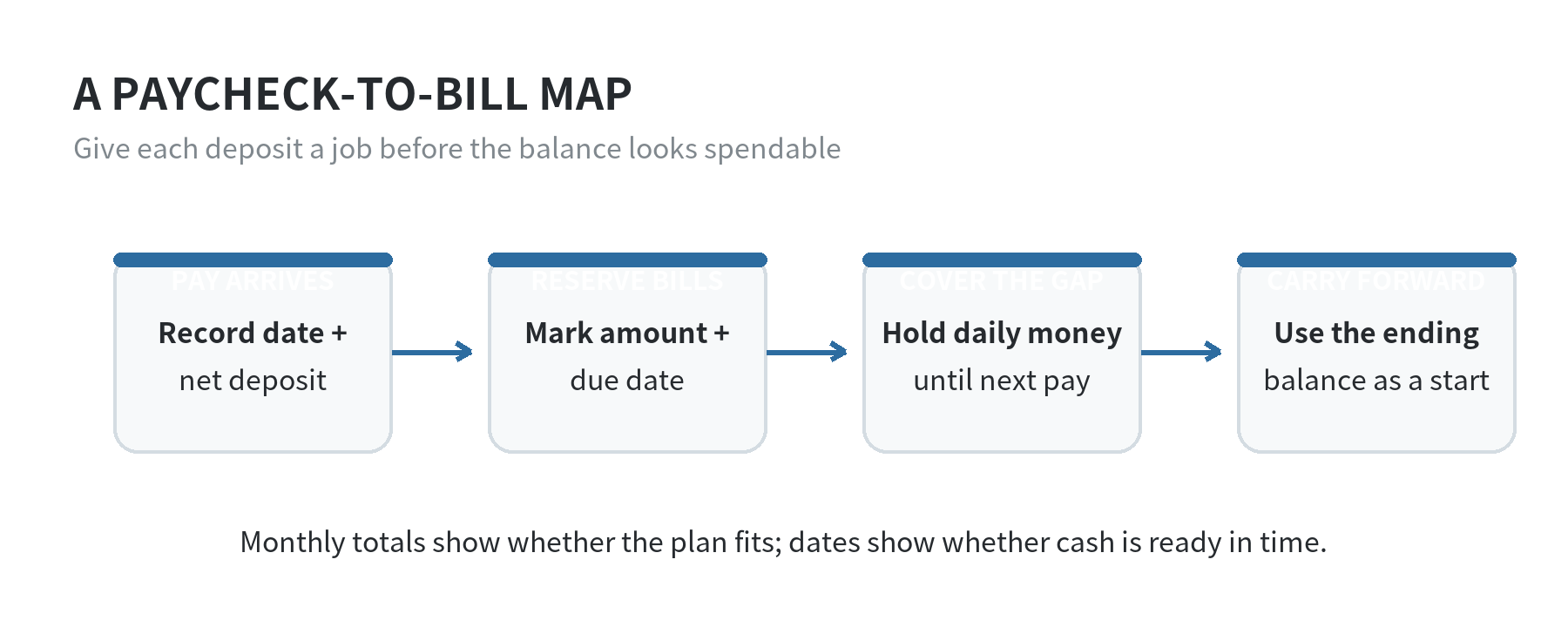
Write pay dates and bill due dates on one calendar. For each period between paychecks, add the opening balance, deposits, bills, and planned day-to-day spending.
Carry the ending balance into the next period.
CFPB defines cash flow as the timing of money coming in and going out, and recommends looking week by week when you run short (checked September 30, 2026).
This helps separate a cash-flow squeeze from a spending problem.
If the monthly totals fit but cash runs out early, ask whether a bill’s due date can move.
You can also reserve part of an earlier paycheck for a later bill.
CFPB’s bill-calendar guidance recommends tracking amounts and due dates and considering a due-date request when the schedule does not line up with income.
Before moving a payment, check the provider’s terms, processing time, and any fees. A changed due date may shift one payment without lowering its amount.
Update the calendar only after the company confirms the arrangement, and keep the old date visible until the change takes effect.
Make one adjustment you can keep
Choose the line that has both a clear cause and a manageable next action.
You might remove a service you no longer use, plan meals around what is already at home, or set a weekly cap for convenience spending. Give the change a number and a review date.
“Spend less” is hard to follow; “keep takeout within $120 this month” tells you what decision to make.
Do not cut every enjoyable expense at once.
A plan that leaves no room for ordinary social life can be difficult to follow, and one overspend can make the entire month feel lost.
Keep a defined flexible amount and decide what happens if it runs out.
Pause that category, move money from another optional line, or wait for the next budget period.
At month end, compare the plan with actual transactions.
Keep the categories that were useful, correct estimates that were wrong, and carry forward bills that have not arrived yet.
Consumer.gov advises making a monthly plan, recording spending, and using what happened to plan the next month.
A budget is a working map; it gets more useful when the next version reflects your real calendar and choices.
When the numbers remain negative after flexible spending is trimmed, the issue may be structural: housing, transportation, debt payments, or income may not fit together.
Write the gap and due dates clearly, then contact the relevant creditor, service provider, or a qualified nonprofit financial counselor to discuss available options.
A clear list gives that conversation something concrete to work from.
FAQ
Should I use gross income or net income for a household budget?
Use the amount deposited after payroll deductions for day-to-day planning.
Keep gross pay on hand only when you need to understand a pay stub or estimate a change; bills are paid with money available to you.
What if I am paid irregularly or work on commission?
Build required bills around income already received, and keep a separate list of expected but unreceived pay.
Consumer.gov suggests dividing last year’s income by twelve when pay is not monthly (checked September 30, 2026).
For uneven pay, compare that estimate with actual deposits.
If it overstates available cash, use a lower planning baseline.
How do I budget for a bill that has no fixed monthly amount?
Use recent bills to create a provisional line, then revise it when the next statement arrives.
If the cost is seasonal, place the due month on the calendar and set aside money in advance rather than treating a low-bill month as extra spending money.
What should I do if every category already feels necessary?
List the amounts, due dates, and consequences of missing each obligation, then contact the provider or creditor about options before a payment is late.
If the monthly total still exceeds take-home pay, a nonprofit financial counselor can help you organize the choices without guessing which bill can safely wait.
Last updated: 2026-09