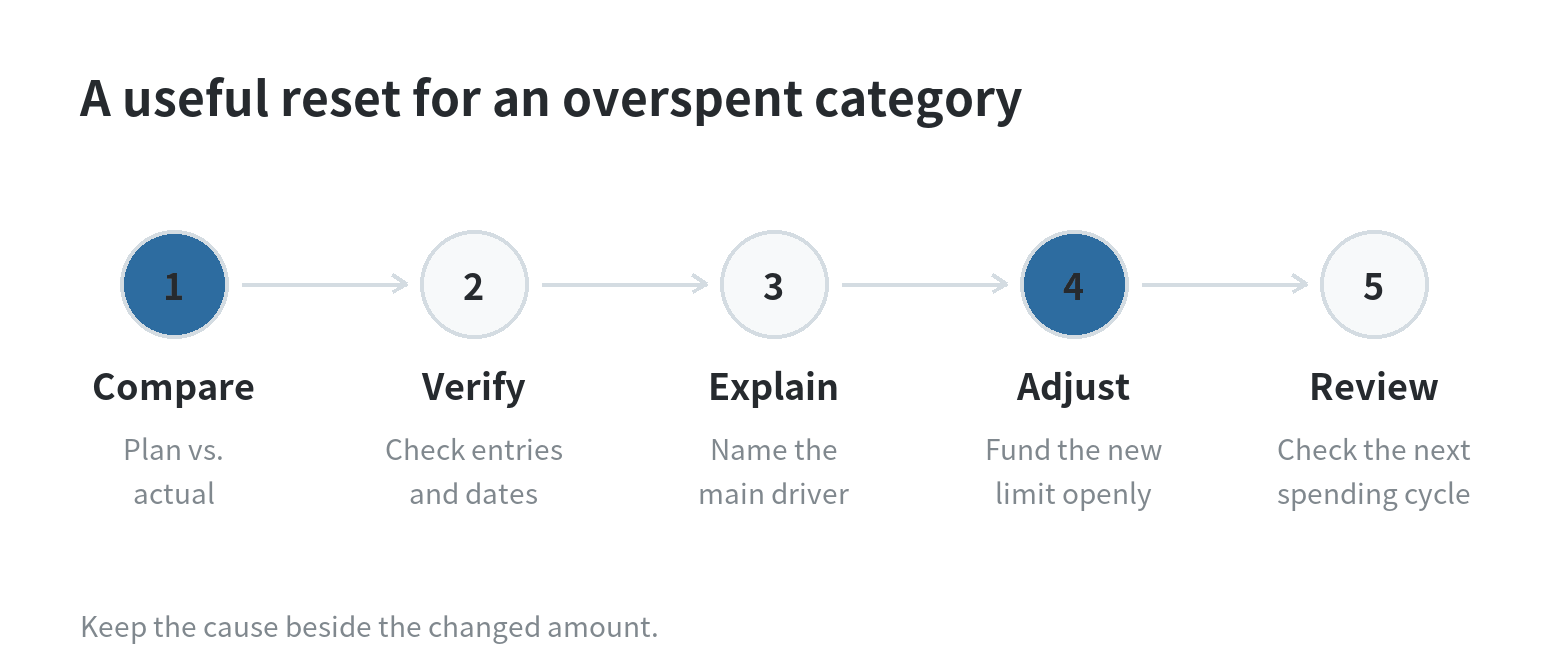
If one budget category keeps overspending, wait to raise its limit until you know why. Compare the plan with actual transactions.
Separate timing or classification issues from a real change in spending, then adjust one part using your take-home pay and bills.
A category is a signal, not a verdict. A grocery line can run high when a household purchase lands with food. A dining line can hide work lunches.
A car line can include an annual registration charge. The fix depends on which pattern you find.
Start with the transactions behind the red number
Write down the category’s planned amount and the transactions counted against it.
Compare the same period: a monthly plan against the full month, or a weekly plan against that week.
If you review halfway through a month, mark the date range so you do not compare a partial month with a full-month limit.
Check the transaction list against receipts, bank activity, and card activity.
Look for a purchase posted twice, a refund that has not been counted, or a charge placed in the wrong category.
If you share accounts with a partner, confirm that you are looking at the same transactions before changing the plan.
Set the category boundary before you track the next cycle. If groceries include toiletries in your system, keep that choice consistent.
If you want food spending by itself, move toiletries into household supplies and apply the same rule to returns and shared purchases.
A stable definition makes the next comparison useful.
Consumer.gov describes a budget as a record of income and spending that you revisit as you plan the next month.
CFPB’s Your Money, Your Goals toolkit includes a spending tracker and a bill calendar for organizing transactions and due dates.
A paper list or spreadsheet works too if it shows the transaction, date, amount, and category.
Sort the overage by its cause
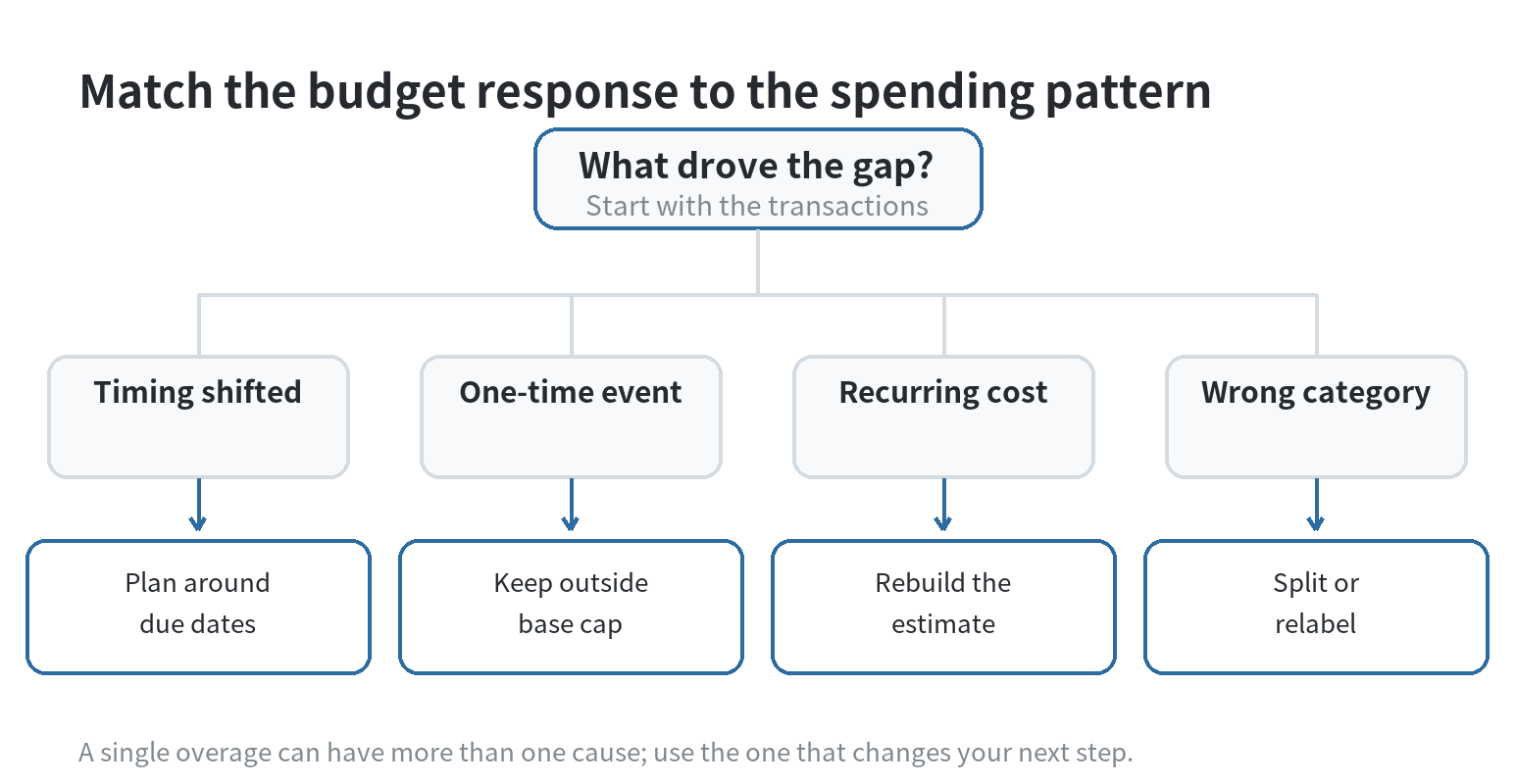
After checking the entries, label each item in the overage.
Keep the labels simple: a timing shift, an irregular bill, a changed price, a one-time choice, a recurring habit, or a category that does not match the way you spend.
One transaction can fit more than one label, but use the main reason that would change your next decision.
| Pattern in the transactions | What to check | Budget response to consider |
|---|---|---|
| Large charge landed early | Does the expense recur on a different schedule? | Plan for its timing or set aside money across pay periods. |
| Costs rose across routine purchases | Did the item, quantity, or price change? | Rebuild the line from current records and decide what to trim elsewhere. |
| Several purchases feel unrelated | Are distinct needs sharing one category? | Split the category if each part needs a different limit. |
| One unusual event drove the gap | Will that event repeat? | Keep the base plan separate from a one-time exception. |
This sort keeps a one-off from quietly becoming a permanent monthly target.
It also prevents you from treating every overage as careless spending when the records may point to a bill date or a changed cost.
Consider a household category that combines cleaning supplies and small repairs. A repair part may be necessary but irregular, while cleaning supplies are routine.
If those costs share one cap, the repair can make the routine line look too small.
Separate the entries when the distinction helps you plan, then decide whether the repair belongs in a broader home-maintenance reserve.
Use your numbers to choose a new limit
Suppose your take-home pay is $3,600 in a sample month. You planned $480 for groceries and the transaction list totals $560. The gap is $80.
Those figures are an example, not a national spending benchmark.
Now inspect the $560 instead of copying it into next month’s plan.
Imagine $35 came from a pantry restock that will not repeat, $25 was a household item assigned to groceries, and the remaining $500 covered routine food purchases.
If your records support that breakdown, you could keep the grocery limit near $500, move the household item to its own category, and record the restock as irregular.
If the entire $560 reflects the food you need, compare that amount with your take-home pay and the rest of your plan before choosing a cap.
Use a simple check: start with take-home income, subtract required bills and commitments, then review the flexible categories together.
A higher cap in one line needs room somewhere else or a deliberate decision to use money already set aside.
Do not move the shortfall onto a credit card in the worksheet and call the plan balanced.
Adjust the part you can actually control
If the category reflects a higher recurring cost, update the estimate and identify what will fund the change.
A utility increase may leave less for restaurant meals; a higher commute cost may require lowering a flexible purchase line.
Make the trade visible in the budget instead of editing only the overspent category.
If a few discretionary purchases drove the gap, choose a concrete boundary for the next period.
You might set a weekly allowance, decide in advance which outing matters most, or pause a type of purchase until the next payday.
A rule that fits the moment is easier to follow than a vague promise to spend less.
If the cause is timing, line up bill due dates with pay dates.
CFPB’s bill calendar asks you to list each bill, amount, and due date so you can see when money is scheduled to leave.
For a yearly or seasonal cost, use a separate irregular-expense line.
If you expect a $240 bill once a year, reserving $20 per month is the arithmetic equivalent; your own bill amount and due month should come from your statement.
When a category runs short before payday, check whether the problem is the total monthly amount or the week the money is needed.
A plan can fit on paper and still leave too little cash before an early bill.
Map the deposit and due dates, then decide whether to reserve more from the prior paycheck or change a flexible expense.
Review a short cycle before locking in the change
Choose a check-in date that suits the category. For frequent purchases, review the remaining balance once a week.
For a bill that arrives monthly, compare the statement after it posts. Record the starting limit, any adjustment, and the reason.
That creates a trail you can use when you set the next plan.
A weekly checkpoint can help with a monthly category, but do not treat it as a second budget. For example, a $480 cap divided across four planning weeks is $120 per week.
If you spend less in one week, the unused amount remains part of the monthly balance; if a bill lands early, note its timing before changing the total.
If spending is still above the limit, ask whether the estimate is unrealistic, the category is too broad, or a different expense is competing for the same dollars.
You can split a broad line such as “shopping” into clothing, household supplies, and gifts when those purchases need separate decisions.
Avoid adding categories just to make the report look tidy; every new line should help you choose what to do.
Keep a small note beside the plan: “limit changed because the annual bill is due in October” is more useful than “overspent again.”
For a way to log purchases on a phone, see the site’s phone expense-tracking walkthrough.
To organize categories on a device, see the smartphone budget-tracker guide.
The next limit does not need to reward or punish you. It needs to match the job the category is doing and the money available after the rest of your plan.
When you can explain the change in one sentence, you have a number you can review rather than a guess you have to defend.
FAQ
Should I move money from another category when one line is short?
You can move money if the other category has room and the trade does not leave a required bill uncovered.
Update both lines so your remaining plan still matches your income.
What if my category is over before payday?
Pause optional purchases in that line and check the due-date calendar before borrowing from another category.
If an essential expense cannot wait, review which bills are due and contact the biller to ask about available arrangements.
Should I budget with gross pay or take-home pay?
Use the amount that reaches your checking account for the spending plan. Your pay stub can help you distinguish take-home pay from deductions already withheld.
How do I budget for a bill that happens once a year?
Use the prior statement or renewal notice to get the amount and due month, then divide the amount across the months before it is due.
Keep the reserved money separate from routine spending in your tracking method.
Last updated: September 2026.
Last updated: 2026-09