If your partner is not ready to follow a budget, start with one shared decision instead of asking for agreement on every dollar.
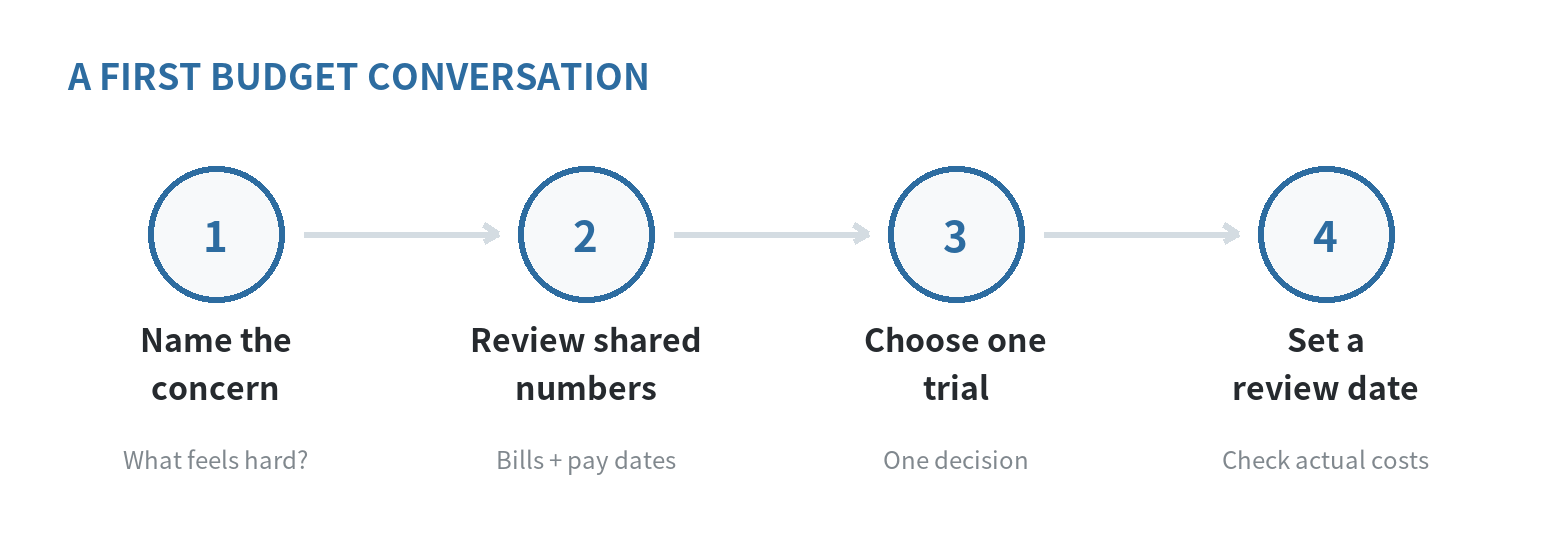
Review bills and pay dates, ask what feels risky or important, and agree on a short trial with a review date.
The first talk can be about understanding the problem, not changing every habit.
The CFPB’s Your Money, Your Goals toolkit includes money-conversation prompts and budget tools. It covers goals, spending, bills, and cash flow.
Utah State University Extension recommends discussing money values, setting goals, and reviewing a household plan together.
Checked October 1, 2026: CFPB toolkit and Utah State University Extension article. Use their ideas to make the talk specific to your household.
Begin with the concern underneath “I don’t want a budget”
“No budget” can mean different things.
Your partner may fear asking permission for personal purchases, worry that the numbers will show a shortfall, or dislike tracking.
Ask what feels uncomfortable before proposing a spreadsheet or spending limit.
Try a neutral opening: “I’m not asking us to approve every purchase.”
“I want us to know which bills are covered and how we’ll handle an unexpected expense.”
Then ask, “What part of making a plan worries you?”
Let your partner finish, then repeat the concern in your own words and ask if you understood it.
Share your reason without labeling your partner: “I feel tense when I don’t know whether rent and the car payment are covered.”
“I’d like us to look at next month together.”
If the talk gets heated, pause and name a time to return to it. “Later” can leave the issue hanging.
Make the request small enough to answer. “Can we take a short time to look at rent and utilities?” is clearer than “We need to fix our finances.”
Offer a choice of time and format. You might talk at the kitchen table, review a printed page, or use a screen.
A bounded request gives your partner room to agree, suggest another time, or explain what information is missing.
Bring a one-page picture, not a surprise audit
Before the conversation, list take-home income, bills, due dates, debt payments, and flexible spending from recent statements.
Mark amounts that change, such as utilities or irregular pay.
The FTC’s consumer.gov budget guide starts with bills and pay stubs.
The FTC guide compares income with expenses and recommends using actual spending to plan the next month (checked October 1, 2026).
The CFPB’s cash-flow materials pair income and bills with their timing.
Show your partner what you collected and invite corrections. A statement identifies a charge, but not why it matters to the person who made it.
Leave personal purchases out of the shared list unless you agree they belong there.
Use a page with four groups: take-home income, fixed bills, flexible shared costs, and personal spending. Add due dates and paydays.
The CFPB’s bill-calendar and spending-tracker resources use these building blocks to show when money moves.
Mark estimates as estimates. If a utility bill changes, keep the difference visible until you confirm the next amount.
Bring the statement or notice to the review, then update the shared figure from that record.
Use your numbers to make a small, testable agreement
Illustration: combined take-home pay is $4,200 and $3,300 (a $7,500 total); shared bills are $2,400, groceries $700, and reserve $300. Enter your figures in the FTC’s budget worksheet.
After those bills, groceries, and reserve, $4,100 remains from the combined $7,500 for other obligations and goals; replace the example figures with your own income and expenses.
The shared total is $3,400; an equal contribution is $1,700 each. Test your own totals in the budget worksheet.
Proportional contributions are $1,904 of $4,200 and $1,496 of $3,300. Enter your own figures in the FTC worksheet.
After shared costs, compare what remains with individual bills and personal spending.
Those calculations answer different fairness questions.
Equal contributions treat the shared amount the same for each person; proportional contributions account for the income difference.
Neither calculation includes personal debt, support obligations, or bills the couple has kept separate.
Add a private line for those obligations when checking the plan, without reviewing every purchase.
Choose one question instead of deciding the whole system: which expenses are shared, how much each person contributes, or what stays personal.
Separate accounts can still use one bill plan. If you use a joint account, agree on access, alerts, and personal spending.
A budget does not require one account structure.
Write the agreement plainly: “We’ll each transfer $X toward rent and utilities by these dates.”
“Personal purchases stay outside this list. We’ll review actual bills after payday.”
Replace X and the date with terms you accept. Use the trial to check whether contributions cover due dates.
A useful trial has a clear question: did the contribution cover listed bills by their due dates?
Did each person retain the agreed personal amount?
If the answer is no, adjust the rule that caused the gap instead of reopening every category.
If fairness is the sticking point, compare an equal split with contributions based on take-home pay.
Put each person’s share and remaining personal obligations beside the options.
You can also assign different bills to each person. The first talk does not need to settle a permanent arrangement.
Make room for personal choice and shared responsibility
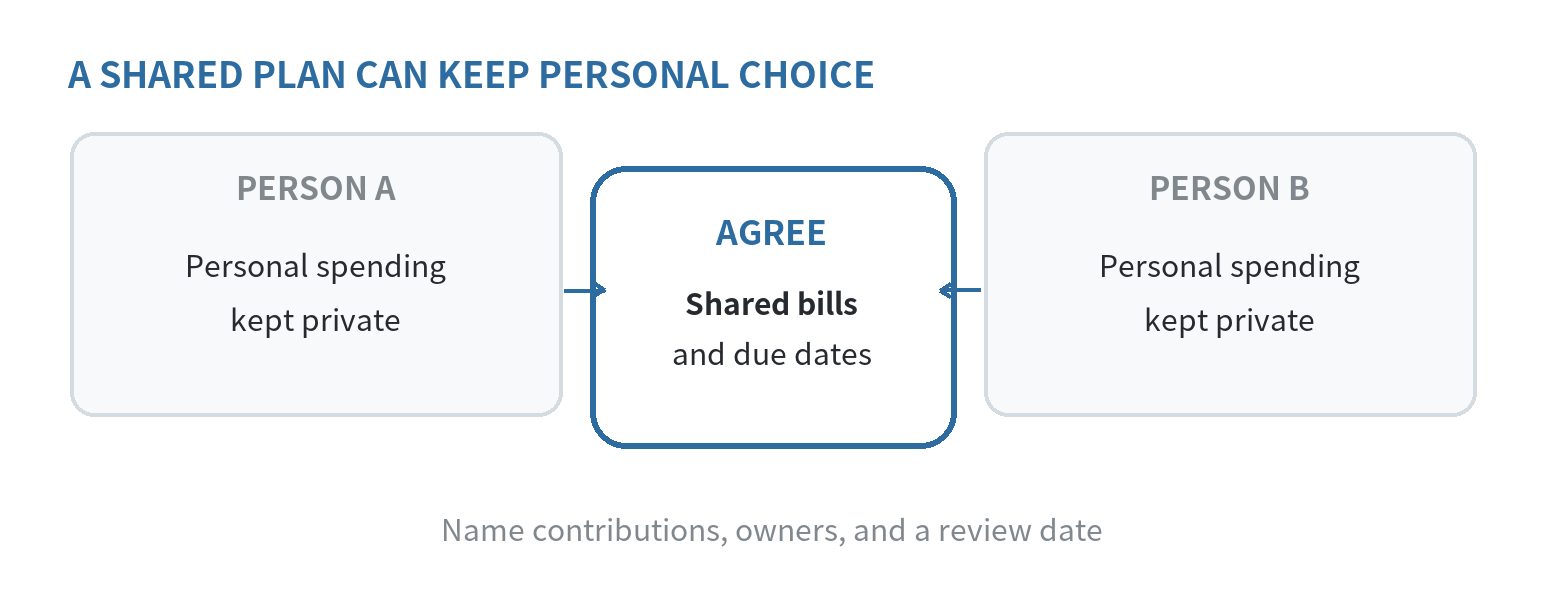
“Budget” can sound like surveillance. Create a personal-spending line for each person, with an amount each can use without explaining purchases.
Agree on what remains shared: housing, utilities, groceries, childcare, or other costs you both choose.
Assign an owner and due date to each shared bill.
Give each person a visible role: one enters bills while the other checks due dates, then switch tasks at a later review.
If one partner handles accounts, look at balances and upcoming obligations together so both know what has been paid.
If one person will not share every account detail, separate household questions from private activity.
You can agree on contributions and shared bills without pooling all income.
If you cannot settle the amount, write down each proposal and the missing facts, such as a variable paycheck.
When the numbers do not balance, pick the next decision
If costs exceed take-home pay, check for missing bills, a one-time charge, a due-date mismatch, or a rising cost before assigning blame.
Separate essentials, obligations, and flexible categories.
Agree what to address first, such as a bill timing issue or an amount that needs confirmation.
If one partner refuses to look at shared bills, keep records of household income, payments, and due dates.
Ask to discuss one concrete item, such as the next rent payment.
If money discussions involve threats, hidden access to money, or fear about raising a concern, a spreadsheet cannot resolve that problem.
Seek support from a qualified local counselor or financial counselor, and use a safe way to communicate.
For help organizing expenses, see the site’s guide to budgeting shared household expenses.
The budgeting-app overview covers digital tracking after you agree on categories.
A tool can record a decision; it cannot decide what feels fair to both of you.
Close the meeting with a date and one task each
End by repeating the agreement, task owners, and review date. One person can confirm the electric bill while the other marks paydays and due dates.
If you did not agree, record the open question and what information each person will bring back.
At the check-in, ask: Were bills covered on time? Did planned amounts match actual spending? What felt restrictive or unclear?
Adjust the bill calendar or one shared rule before revisiting the whole plan.
Last updated: 2026-10
FAQ
Should we combine bank accounts before making a budget?
No. You can agree on shared bills, contribution amounts, and due dates while keeping separate accounts.
Discuss access, personal spending, and bill responsibilities before choosing an account structure.
What if my partner earns an irregular income?
Build the first plan from deposits you can confirm. Mark which bills depend on uncertain pay.
Revise the plan when the next deposit arrives and compare it with the amount you reserved.
How do we split bills when our incomes are different?
Compare an equal contribution with one based on each person’s take-home income.
Check what each person has left for personal obligations. Write down the covered bills and agree on a review date.
What if we cannot agree on a spending limit?
Choose one category or bill to review first and leave unresolved categories open.
Bring the statement that addresses the disagreement. Decide whether to test a temporary amount before changing the whole plan.