Financial independence, retire early (FIRE) planning starts with a spending plan you can live on, not a return target. Build your monthly budget from actual bills, give irregular costs their own lines, and separate money you may need soon from retirement accounts with withdrawal rules. That makes the spending side of an early-retirement plan visible without assuming what an investment will earn.
Turn “I need less” into a monthly number
Start with a month of take-home income and list the costs your household would still have if work stopped: housing, utilities, food, transportation, insurance, health care, taxes, and recurring services. Use recent statements and bills rather than a round percentage. Keep one-time purchases out of the monthly baseline unless you divide their expected total across the months you have to prepare.
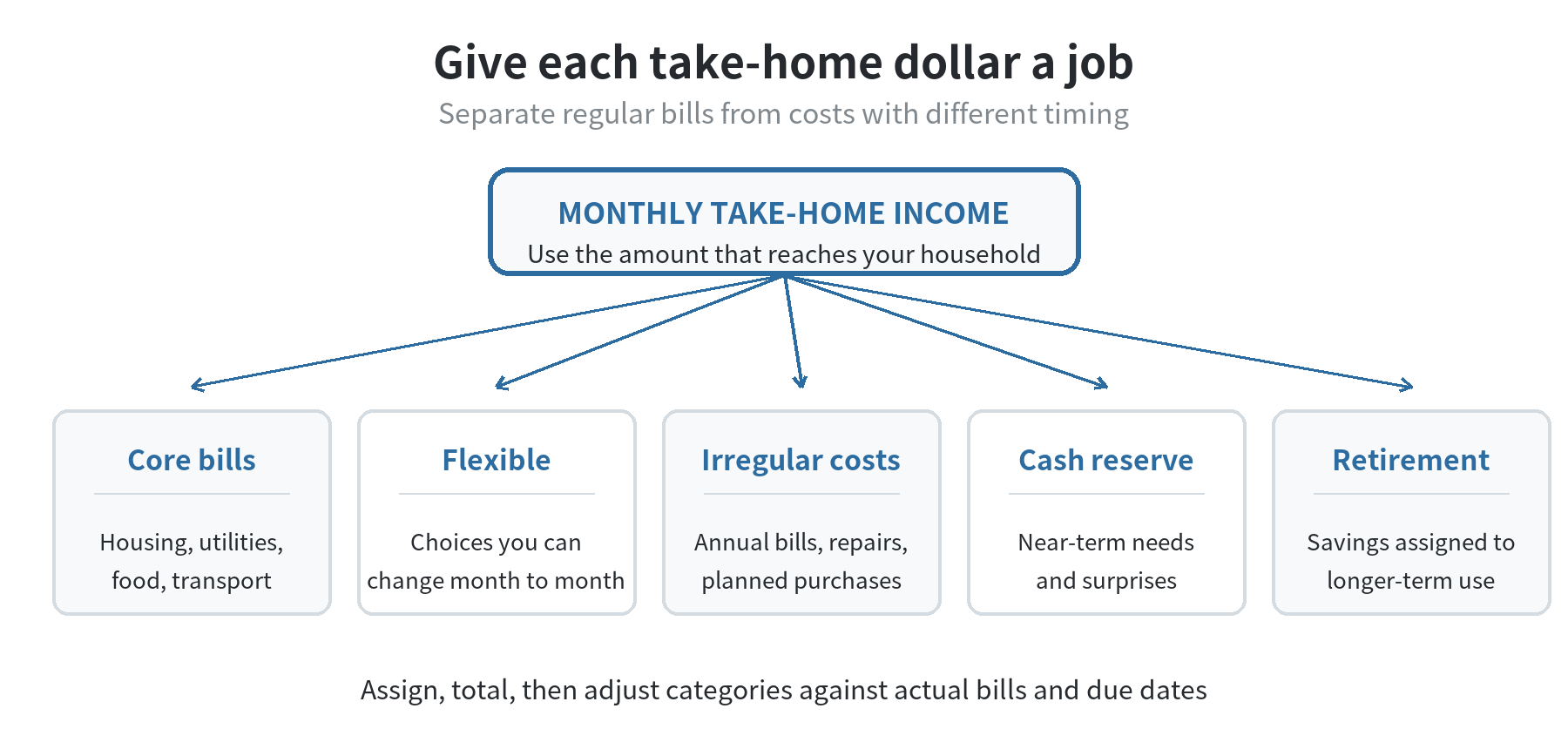
Then mark each line as fixed, flexible, or irregular. Rent may be fixed for the lease term; groceries can move from month to month; car registration or an annual premium may arrive once a year. A line that is irregular still belongs in the plan. Divide a known annual bill by twelve and reserve that amount each month, so its due date does not have to compete with rent or food.
Separate essential spending from choices you could pause or change. This is not a judgment about what you should enjoy. It shows which costs are hard to move if income changes and which ones you control month by month. If you share expenses, write down whose account pays each bill and whether the amount is the full bill or your household share.
Give irregular costs a place before they arrive
A FIRE budget can look smaller than real life if it includes only the bills paid every month. Review bank and card statements for costs that appear quarterly or annually, plus repairs, travel, gifts, and deductibles. Put each known cost beside its due month. If an amount is uncertain, use the bill or quote you have and label the estimate; do not disguise a guess as a stable monthly bill.
For example, if an annual membership renewal is $240, assigning $20 a month to that line is simple arithmetic, not a claim about what memberships cost. When the bill arrives, pay it from the amount already set aside. A spreadsheet can keep the monthly contribution and due date visible; a separate account is optional, as long as you do not count the same dollars both as available spending and as reserved money.
This detail matters when comparing a working month with a future month. Some costs may disappear after a move or a job change, while others can rise or begin later. List the change and the reason beside it instead of deleting the expense from every future month. A health-insurance premium, for example, should be entered from the plan information available to your household rather than borrowed from someone else’s budget.
A sample month you can replace with your own bills
Suppose a household brings home $5,200 in a month. The figures below are a made-up planning example, not a recommended spending pattern. Replace each line with your statement totals, household share, and expected dates.
| Monthly line | Example amount | What to check |
|---|---|---|
| Housing | $1,850 | Rent or mortgage, plus any separately billed fees |
| Utilities and internet | $320 | Recent bills and seasonal changes |
| Food | $620 | Grocery spending separated from dining out |
| Transportation | $410 | Fuel or transit, insurance, upkeep, and parking |
| Insurance and medical costs | $390 | Premiums, prescriptions, copays, and planned care |
| Irregular-cost reserve | $460 | Annual bills and planned replacement costs |
| Flexible spending | $450 | Entertainment, meals out, and personal purchases |
| Cash reserve | $400 | Money held for near-term surprises |
| Retirement saving | $300 | Contribution amount and account rules |
| Total assigned | $5,200 | Income less assigned lines should equal zero |
The useful part is the assignment, not the particular amounts. If your required bills already use nearly all take-home pay, the table shows that the next decision concerns a real cost or a real income change, not a spreadsheet trick. If the month has money left over, give it a named job before treating it as free spending. A zero remainder means every dollar has a place; it does not mean every category is fixed forever.
Keep spending money and retirement accounts on separate timelines
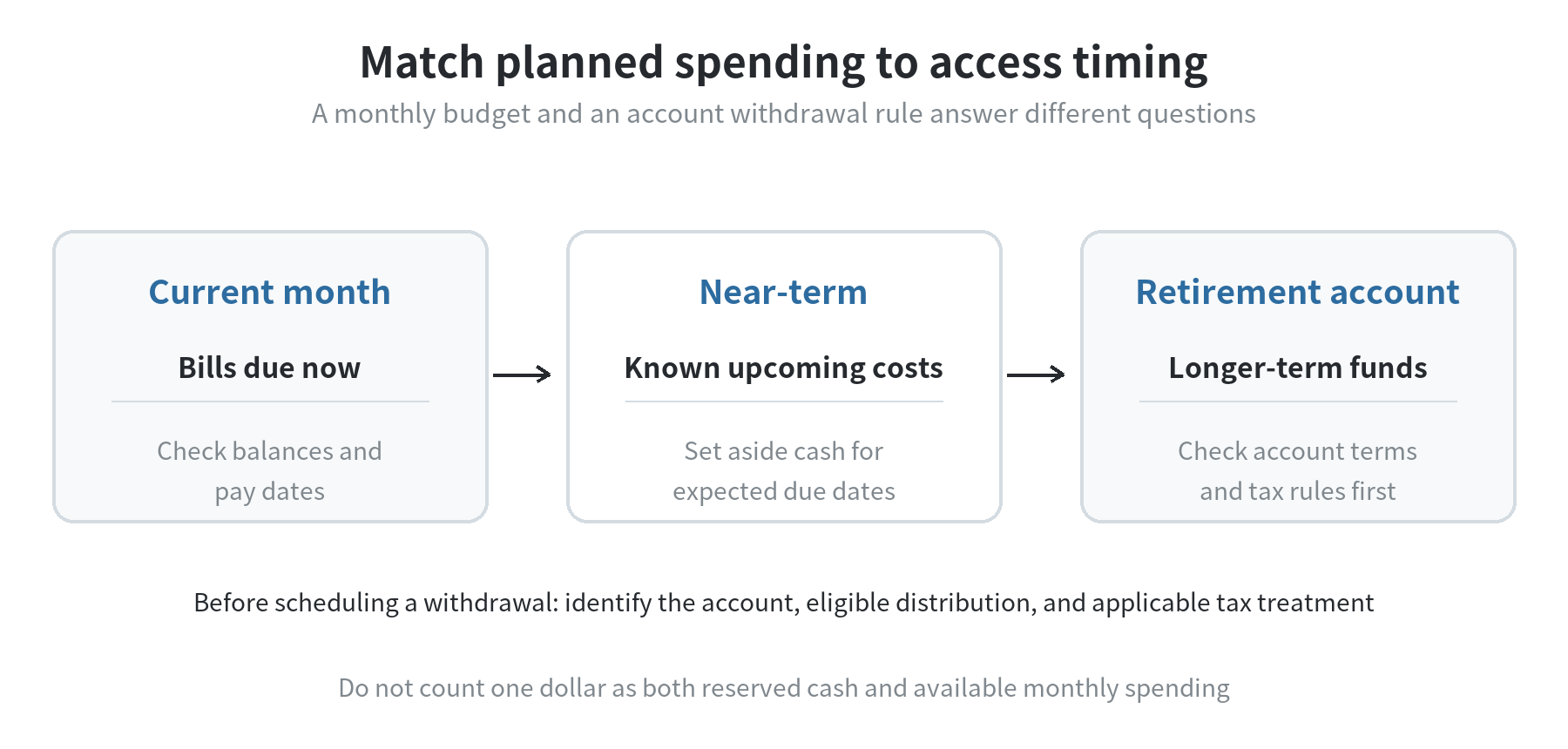
For an early retirement plan, sort savings by when you expect to need access, then check which account holds each dollar. A workplace plan, traditional IRA, and Roth IRA have different withdrawal rules. The IRS says a distribution from an IRA or retirement plan before age 59½ is generally an early distribution, and the taxable portion may face an additional 10% tax unless an exception applies; Investor.gov also notes that taking employment-plan money before age 59½ can mean taxes and possible tax penalties (both checked September 2026).
The IRS exception table, checked September 2026, shows that exceptions differ by account type. It lists qualified higher-education expenses and up to $10,000 for certain first-time homebuyer costs as IRA exceptions to the additional tax, while the table does not list those exceptions for a qualified workplace plan. The IRS also lists a separation-from-service exception for certain workplace-plan distributions beginning in or after the year a worker reaches age 55; the table does not apply that exception to IRAs. Check the plan’s distribution terms before scheduling a withdrawal.
A Roth IRA also has ordering rules. The IRS’s 2025 Publication 590-B, checked September 2026, describes regular contributions as distributed before conversion and rollover contributions, and earnings; whether a distribution is taxable or subject to additional tax depends on the full facts and applicable requirements. Do not treat the account balance as one undifferentiated cash bucket. Before including a withdrawal in a spending plan, identify the account, the type of dollars involved, the plan’s distribution terms, and the federal and state tax questions that apply to your circumstances.
Test the plan against a difficult month
Do not judge the budget only by its calmest month. Pick a month with an annual premium, a car repair, or a high utility bill and place those dates on the calendar. Ask which line pays first, what can move, and how much cash remains after bills due before the next income deposit. If the answer depends on selling an investment or taking an early retirement-account distribution, record that as a separate decision with its tax and access questions.
If you have a target month for leaving work, build a cash calendar for the final working month and the first month after the paycheck ends. Enter the last pay date, the end date for employer benefits, any documented severance, and the date a new insurance premium or other replacement bill begins. Check those dates against employer and plan documents, then place automatic bill payments on the same calendar. The goal is to identify timing gaps before you assign a retirement-account withdrawal to cover them.
Keep the first version modest. Use one month of actual spending, then add costs with a clear source: a bill, renewal notice, plan estimate, or written quote. Mark assumptions visibly and revisit them when the underlying bill changes. The Consumer Financial Protection Bureau’s cash-flow budgeting materials describe tracking the amounts and timing of money in and out; that timing view helps expose a shortfall that a monthly total alone can hide (checked September 2026).
Before treating a FIRE spending figure as ready, check three things: all recurring bills have an owner and due date; irregular costs have a monthly line; and each planned withdrawal has been matched to its account’s rules. If one piece is unknown, leave it as an open estimate instead of covering it with an assumed return or a generic rule of thumb.
For another way to organize monthly income and expenses, see the monthly budget setup guide across income levels. If you want a simple way to record categories and totals, the phone budget tracker walkthrough covers a basic ledger format.
FAQ
What does FIRE mean in a household budget?
FIRE means financial independence, retire early. In a budget, it means estimating the spending your household wants to fund without relying on a paycheck, then checking how each cost and funding source fits the dates when money is needed.
Does every retirement-account withdrawal before age 59½ get the 10% additional tax?
No. The IRS exceptions page, checked September 2026, lists exceptions that vary between IRAs and qualified workplace plans. The taxable portion may still have regular income-tax treatment, so check the exact account and distribution before using an exception in a personal tax calculation.
Can Roth IRA contributions be budgeted as an emergency cash source?
Do not count them as ordinary checking-account cash. The IRS’s 2025 Publication 590-B, checked September 2026, describes Roth IRA ordering and qualification rules; a distribution can include conversion amounts or earnings as well as regular contributions. Review the account records and current IRS rules before planning a withdrawal.
How should I handle a FIRE budget when a bill amount is unknown?
Use the latest bill, plan estimate, or written quote you can obtain, label it as an estimate, and show the month when it is due. Update the line when the provider gives you a confirmed amount.
Last updated: 2026-09