Budget utilities from your own bill history, then hold a little room for months when heating or cooling demand changes. Add up what you actually pay for electricity, gas, water, sewer, and trash.
Don’t treat a national average as your household’s bill. The U.S. Energy Information Administration (EIA) says home energy use varies with climate, home type, equipment, and household size (checked September 30, 2026).
Start with the bills you already have
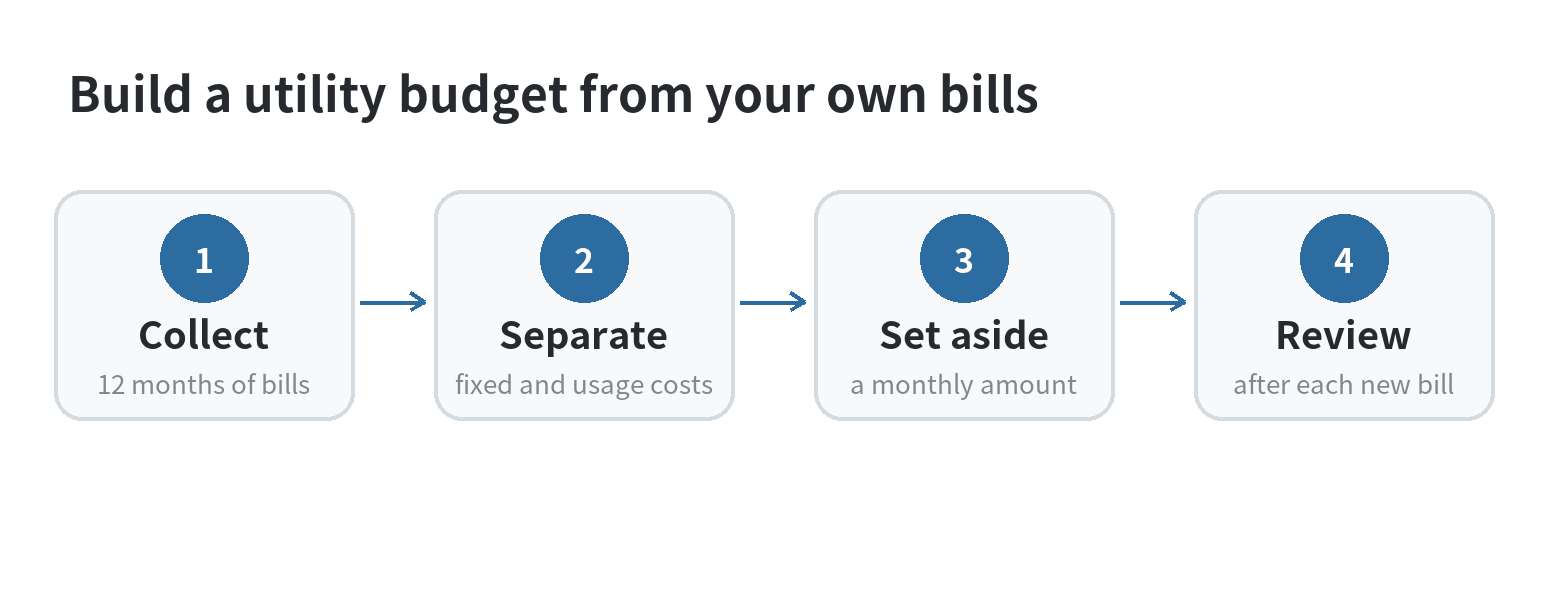
Gather the latest twelve bills for each service, or as many as you can find. Use the statement total and due date, and note the billing period. A bill that covers more days can look unusually high even if daily use stayed close to normal.
Make one line for each service. Electricity and natural gas may rise in different seasons; water, sewer, trash, and internet may follow different billing schedules. Keep internet separate from utilities if you track communications elsewhere, so the same charge does not land in two budget categories.
Use your account’s bill history or saved statements. If you moved recently, use the bills available and label the budget as a starting estimate. Replace that estimate as your own complete billing history arrives.
For each line, record the service, billing period, amount, and due date. The billing period explains what the charge covers; the due date tells you when cash must be ready. If you use autopay, keep the draft date in the same record so a scheduled withdrawal does not surprise another category.
Choose a monthly amount that can handle uneven seasons
For a service with a full year of bills, add the twelve totals and divide by twelve.
That average gives you a monthly set-aside; it does not mean every bill will match it. If the year total for one service was $2,430, for example, the budget line would be $202.50 per month. This is an example calculation, not a typical bill.
If you do not have twelve bills, add the months you do have and divide by that number. Mark the result as temporary, especially if your records cover only mild-weather months. Recalculate when a high-use season appears in the record.
For a quick-start budget, set a monthly amount from the bills on hand and put the difference between that amount and the actual bill into a utility reserve.
When the bill is higher than the set-aside, use the reserve. When it is lower, leave the remainder there for a later bill. Keep this money distinct from general savings so it stays assigned to household costs. Treat it as bill money, not spare cash.
Separate usage charges from charges you cannot trim
Read the bill’s itemized charges before treating the whole total as flexible. The Department of Energy’s Federal Energy Management Program describes electricity bills as potentially including energy charges tied to use, demand charges tied to peak demand, and fixed monthly charges (checked September 30, 2026).
A household bill may not use every charge type, so follow the labels on your own statement. Mark each amount as fixed, usage-based, or unclear. A fixed service charge belongs in the baseline even if you reduce consumption.
For a usage-based line, copy both the units used and the amount charged. If the statement separates supply, delivery, taxes, or fees, keep those labels rather than combining them into an invented per-unit rate.
If a charge is unfamiliar, use the phone number or customer service information on the statement and ask what the line covers. Write down the answer beside that bill. This helps you tell a real change in use from a rate, fee, or billing-period change.
Give seasonal bills their own cushion
Heating and air conditioning can make energy bills uneven across the year. EIA reports that space heating and air conditioning made up 52% of household energy use in 2020, with use varying by location, home structure, equipment, and fuels (checked September 30, 2026).
The share is historical national data, not a prediction of your next bill. Use your high months to size the reserve, because the pattern in your home is the number that matters for cash flow.
Look at your own highest months and decide how much reserve they require. If winter bills are the pressure point, save toward them during lower-bill months; if summer cooling is the issue, build the cushion beforehand.
The timing depends on your billing pattern, so use the month labels in your account rather than assuming every household has the same peak season.
Keep the regular monthly line and the seasonal reserve visible as separate figures. That shows whether the planned amount covers the year as a whole, and whether the timing of your paychecks leaves enough cash available when the larger statements arrive.
Find a change you can actually control
When use-based charges are driving the total, start with a single routine connected to the service. For electricity, review heating, cooling, water heating, laundry, or appliance use; EIA identifies these as residential energy end uses.
For water, check the bill’s usage units and look for a change in household routine or a possible leak before cutting a different budget category.
Check the utility’s current rate plan and bill explanation before changing a schedule. The Department of Energy notes that some electricity rates vary by time of use or season, while fixed charges are determined by the rate schedule.
A time-based rate only helps your planning if the terms apply to your account and your household can shift the relevant use.
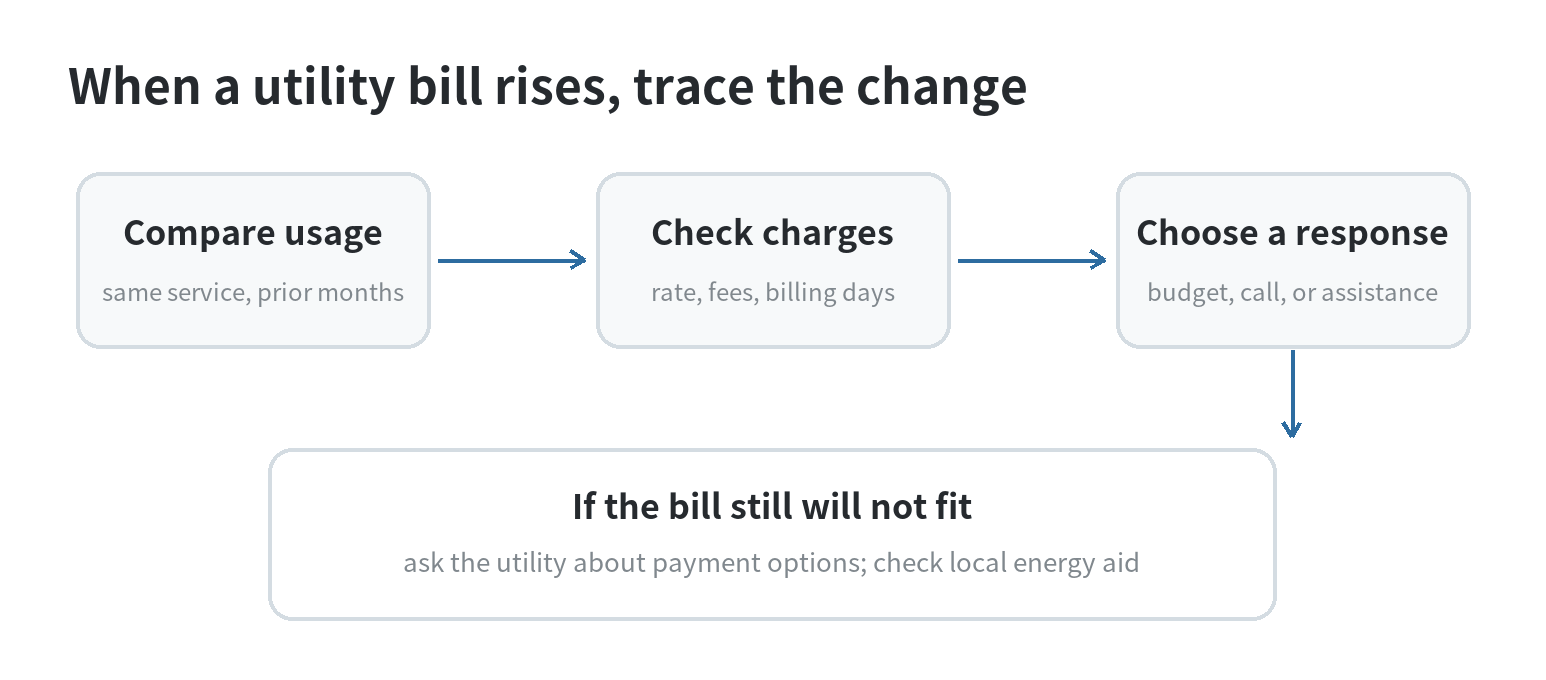
Set one review date after the next statement. Compare the same service’s usage, billing days, and line items with the prior bill. If the change is not clear, ask the utility to explain it before rewriting your monthly budget around a one-time spike.
If the amount does not fit this month
Contact the utility before the due date and ask which payment arrangements, budget-billing options, or hardship programs are available for your account. Ask what happens to any unpaid amount and whether fees apply.
Find out whether the plan changes later monthly amounts. Record the representative’s instructions and the next date you need to act.
LIHEAP, the Low Income Home Energy Assistance Program, provides federal funding to states, territories, and Tribes to help eligible low-income households meet home energy needs, according to the Administration for Children and Families’ FY2024 program fact sheet (checked September 30, 2026).
USAGov says state and territory requirements differ and directs applicants to their local office (checked September 30, 2026). Use your state’s current office information to check eligibility and application steps. Do not build an assistance payment into the budget until an agency confirms it for your household.
If you share bills, agree on the amount, due date, and who will submit payment before the next statement arrives. Keep a shared record of the bill and each person’s contribution.
For help fitting these dates into the rest of the month, see how to plan a monthly budget and how to organize bill due dates.
FAQ
Should I use a utility company’s average-payment plan?
Compare its monthly payment with your annual use and the plan’s settlement rules before accepting it. Ask whether the account can carry a balance, when the amount is recalculated, and how a remaining balance is handled if you move.
What if my landlord includes utilities in the rent?
Budget the amount you owe under your lease or roommate agreement, then keep separate records for any utility charges passed through to you. Ask for the bill and the method used to divide it if the amount changes.
How do I budget a bill that arrives every other month?
Convert the amount into a monthly set-aside by dividing the expected bill by the number of months it covers. Keep the money reserved until the due month instead of treating it as available spending.
Can I use a national average when I have no bill history?
Use an average only as a temporary placeholder because home energy use varies by location, building, equipment, and household. Ask the utility whether it can provide prior usage for the address, then replace the placeholder with your own statements.
Last updated: 2026-09