
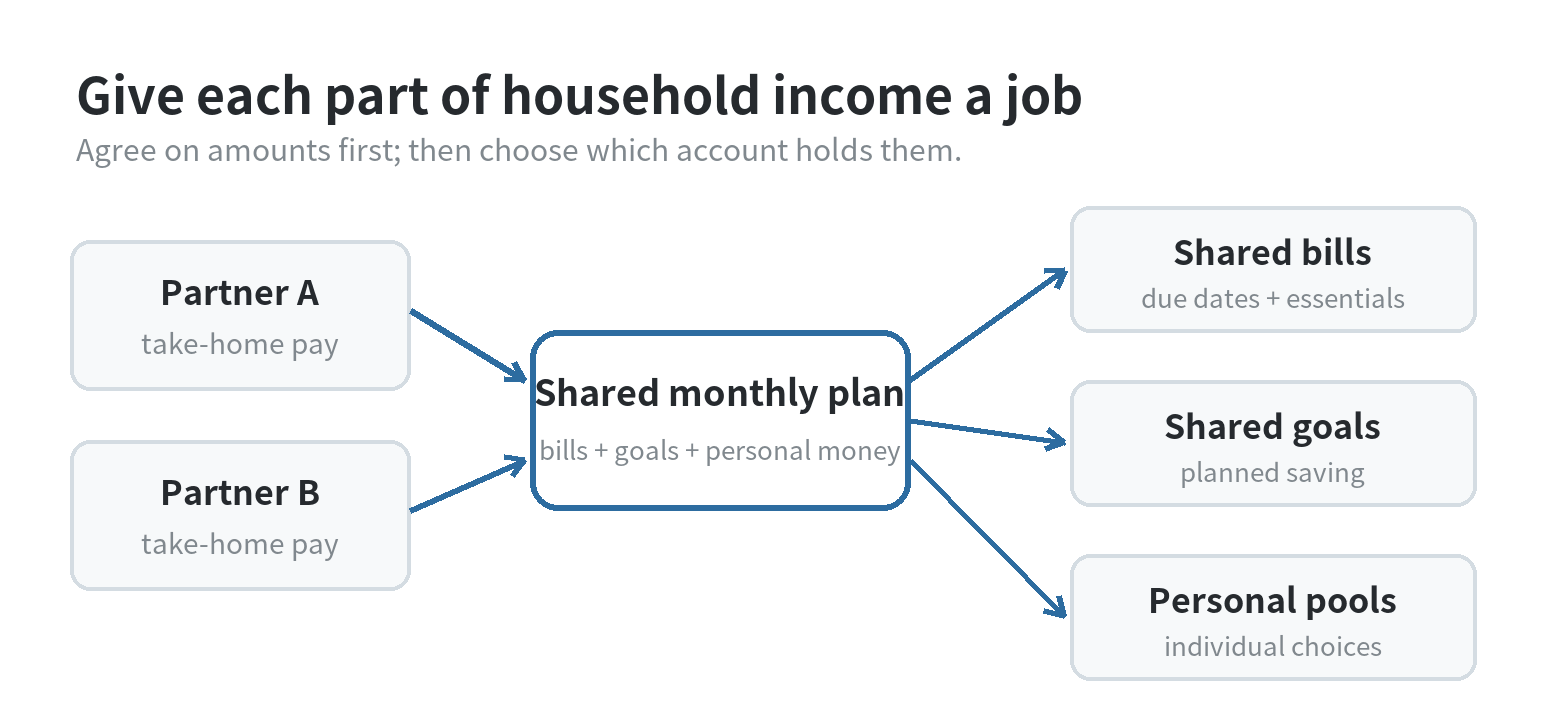
When you combine finances, start with one shared budget and a clear rule for what stays personal. You do not have to merge every account to plan together: list both take-home incomes, agree on shared bills and goals, then choose whether money flows through one joint account or stays in separate accounts with scheduled contributions.
That order matters. A joint account changes who can access the money, while a budget is simply a plan for where household income goes. Build the plan first, then choose the account setup that fits it.
Put both paychecks and bills on one page
Use take-home pay rather than gross salary, because the budget has to work with the amount that reaches your accounts. The Consumer Financial Protection Bureau’s monthly budget tool starts by listing income and expenses, then subtracting spending from income (checked September 30, 2026).
Make one list together. Include rent or mortgage, utilities, groceries, transportation, childcare, debt payments, insurance, subscriptions, and irregular costs such as car registration or gifts. For each bill, write down the amount, due date, account it comes from, and who currently pays it. The CFPB’s couples financial checklist also asks partners to know what income is coming in, where it is deposited, which bills are paid, and when they are due (checked September 30, 2026).
Use a few recent statements to estimate categories that move around, such as groceries or utilities. If an expense happens once or twice a year, divide the expected bill by the number of months until it is due and set that amount aside each month. Mark estimates separately from fixed bills so you can replace them with actual totals later.
Try the plan with your own numbers
Here is an example to show the arithmetic, not a national average. Suppose one partner brings home $3,200 a month and the other brings home $2,400. Together, that is $5,600. Their agreed shared costs are $3,100 for housing, utilities, groceries, transportation, and recurring bills. They set aside $500 for a shared savings goal, leaving $2,000 for personal spending, individual obligations, or additional goals.
| Monthly plan | Example amount | How to replace it |
|---|---|---|
| Partner A take-home pay | $3,200 | Use the deposit amount from a typical month |
| Partner B take-home pay | $2,400 | Use the deposit amount from a typical month |
| Shared bills | $3,100 | Add the household bills you both classify as shared |
| Shared goal | $500 | Choose an amount after required bills are covered |
| Unassigned remainder | $2,000 | Decide how much stays personal and what gets another job |
If you want contributions to reflect income, divide each person’s take-home pay by the combined total. In this example, Partner A brings in about 57% and Partner B about 43% of the household take-home pay. Applying those shares to the $3,600 shared bills-and-goal amount gives contributions of about $2,057 and $1,543. Round to whole dollars and check that each person can still cover personal bills. If that split feels wrong, agree on another rule, such as equal contributions or a fixed amount from each paycheck.
Keep a small “unassigned” line while you are setting up. If the plan spends every dollar on paper, a forgotten annual bill or a lower-pay month can force a rushed choice. Name the next decision together: add to a buffer, pay down a shared obligation, save toward a planned expense, or leave the money in personal accounts.
Handle a shortfall before opening an account
If the shared plan costs more than the two take-home paychecks, account structure will not close the gap. Check the math in this order: confirm that both amounts are take-home deposits, remove duplicate bills, separate shared costs from personal obligations, and replace rough estimates with statement totals. A bill that appears twice under different names can distort the plan; so can treating one person’s individual payment as a household bill without agreeing to do that.
For example, suppose your combined take-home pay is $4,500 and the shared bills you listed add to $4,800 before savings or personal spending. The $300 gap is visible before you move money. Mark which costs are fixed for the coming month and which categories you can reconsider together, such as the amount assigned to flexible spending or a planned purchase. Write down the change and its date so each person uses the same version of the budget.
Keep personal debt and personal subscriptions visible even if they are paid from separate accounts. Decide whether those payments remain each person’s responsibility or enter the shared plan; either choice changes how much is available for shared bills. If the plan still does not balance after you correct the list, agree on the next conversation before setting automatic transfers.
Choose how money moves between you
The budget does not dictate account ownership. You can pool income, share only household costs, or keep separate accounts and transfer agreed contributions. Choose based on the access and recordkeeping you both want.
| Setup | Money movement | Conversation to have |
|---|---|---|
| Fully pooled | Paychecks enter shared accounts; bills and personal allowances leave from planned categories | What amount can either person spend without checking first? |
| Shared bills account | Each person contributes an agreed amount; shared bills leave from that account | What counts as shared, and what happens if a bill is higher? |
| Separate accounts | Each person keeps existing accounts and pays assigned bills or sends a scheduled contribution | Who checks that transfers arrive before due dates? |
A joint bank account is a separate ownership decision from a shared budget. The CFPB says people named on a joint account can generally withdraw money, make transactions, move funds, or close the account; the FDIC’s consumer guidance says joint owners have equal rights to withdraw and transact (both checked September 30, 2026). Read the account agreement and confirm the bank’s terms before adding an owner. If either partner needs money to remain separately controlled, consider keeping that money in an individually titled account and include only agreed contributions in the shared plan.
Set a transfer rule that matches payday
Choose an amount and transfer date that line up with when pay arrives and bills are due. For example, if shared bills total $3,100 and each partner contributes in the same income proportions as above, schedule each person’s contribution so the account holds enough before rent and automatic payments clear. If paydays differ, set the transfer after each deposit rather than assuming both checks arrive together.
Write down who monitors the balance, who updates a bill when its amount changes, and what to do if a paycheck is delayed or reduced. Agree on a minimum cushion for pending payments based on your own bill timing. Do not count the same dollars twice: money reserved for rent is not available for groceries or a personal purchase.
For a separate-account approach, use a shared bill list and make the payer visible. If one person pays a bill from a personal account, record the amount and whether the other person’s contribution is due that month. That simple ledger prevents a transfer from looking like extra spending or being forgotten when the next month starts.
Review the first month before expanding the setup
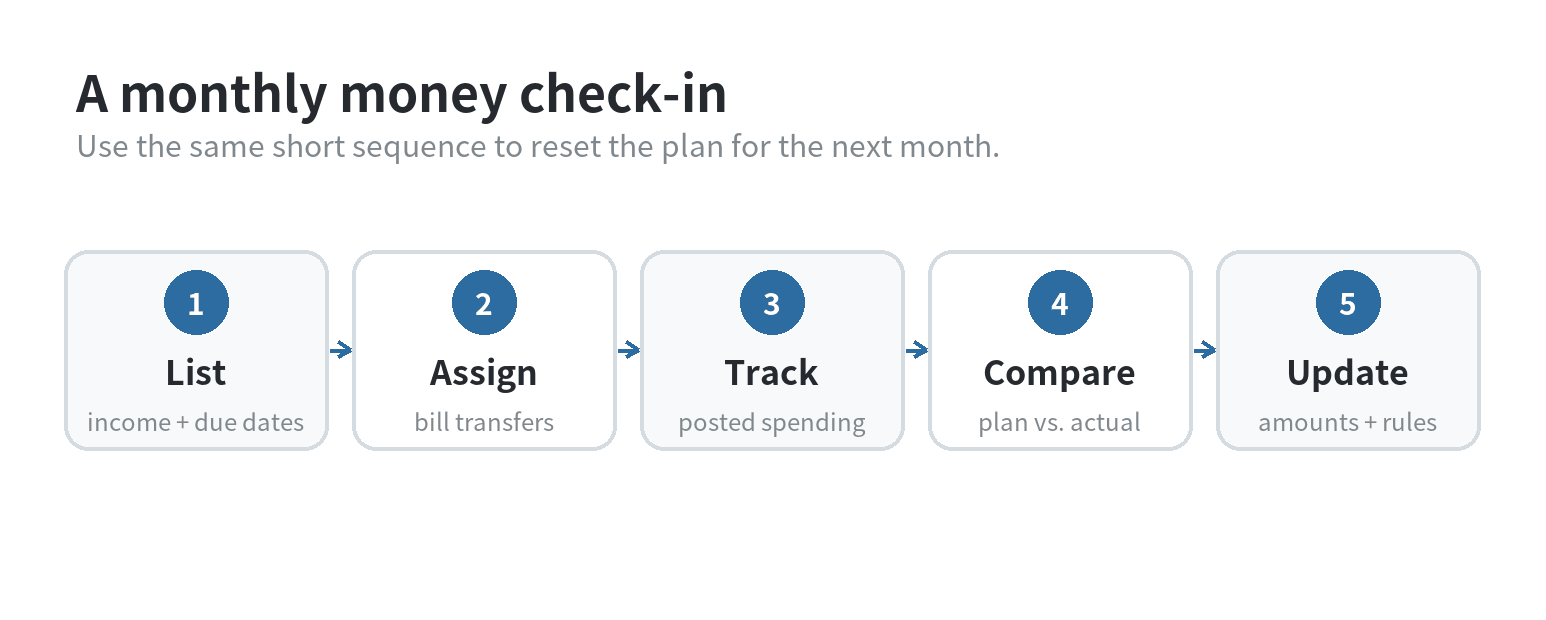
At the end of the first month, compare planned amounts with posted transactions and receipts. Correct categories that were estimated, add any missed annual or quarterly bill, and decide how to handle money left over. If a category ran short, identify the bill or purchase that caused it and choose whether to raise that line, shift money from another category, or change the spending plan.
Keep the next review specific: confirm upcoming due dates, check that both partners can see the information they need, and change one rule at a time. The CFPB’s couples checklist recommends sharing an inventory of income, expenses, debt, accounts, and bill timing (checked September 30, 2026). A simple shared record can be a spreadsheet or notebook; store account details securely and share access instructions with each other.
If you are also setting a savings target, see how to organize an emergency-fund goal. For a separate look at tracking household categories, use the site’s monthly budget and app setup overview.
Last updated: 2026-09
FAQ
How should we divide a shared cost that one person uses more?
Agree on whether that cost is shared at all before choosing a split. If you both classify it as a household expense, write down the amount and contribution rule; if not, keep it in the person’s own spending line.
What should we do with a bonus or other extra paycheck?
Decide on a rule before the extra deposit arrives. You might assign an agreed portion to a shared goal and leave the rest in personal accounts, or choose another division that fits your plan.
How can our budget work if one partner pays all the bills?
Keep a shared list showing each bill’s amount, due date, payment method, and account. The CFPB couples financial checklist asks partners to know what bills are paid and when they are due (checked September 30, 2026), so the other person can follow the plan too.
How do we track a shared bill paid from a personal account?
Record the charge in the shared bill list with the person who paid, the amount, and the agreed contribution or reimbursement. This keeps the household cost visible without counting the same payment again as a new expense.