
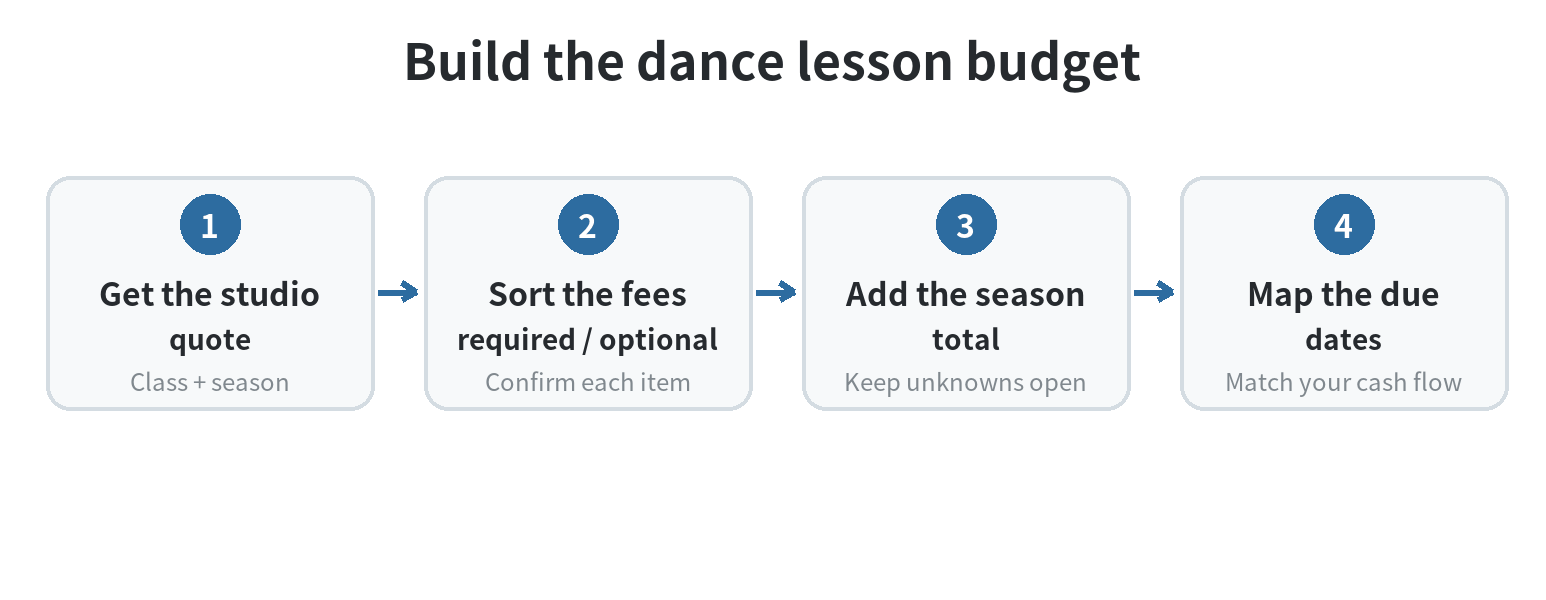
Budget for dance lessons by pricing the full season, not just the advertised class tuition. Ask the studio for every required charge, when it is due, and what is optional; then divide the confirmed seasonal total across the months you have to prepare. That keeps an enrollment fee or recital bill from surprising your regular household budget.
Use the written price list for the exact class and season you are considering; that is the number to put in your budget. Dance schools set their own schedules and policies, so another school’s quote is a comparison point, not your total.
Get the complete price before choosing a class
Start with the class itself: style, level, class length, number of weekly classes, and the dates the session runs. Ask whether tuition is charged by class, by month, by session, or as a season total split into payments. A monthly bill does not always mean you are paying only for the classes held that month; the studio’s calendar and tuition policy explain how breaks are handled.
Then request a list of every charge that may apply to your dancer. Ask the office to mark each item as required, optional, or conditional, and to show its due date. Check these categories:
- Registration or enrollment fee, including whether it is charged per dancer or per family.
- Tuition for the chosen class or combination of classes.
- Required shoes, tights, leotards, or other dress-code items.
- Costume, recital, performance, rehearsal, or event fees.
- Tickets, photos, video, travel, or other optional recital expenses.
- Late, returned-payment, withdrawal, or class-change charges in the written policy.
Fee schedules are studio-specific. AZ Dance District lists tuition and registration separately, with added costume fees for its recital; Tribe Dance Center lists tuition, registration, costume, and recital charges separately. Both pages were checked September 30, 2026. Use the fee list for your exact class and season.
Turn a quote into a season total
Use a simple worksheet with one row per charge. Record the amount, due date, whether it repeats, and whether it is required. For an item the studio has not priced yet, write “quote pending” and ask when that amount will be set. Keep optional purchases out of the required total until you decide to include them.
| Budget line | What to enter | Question to settle |
|---|---|---|
| Tuition | Quoted rate and billing dates | How many payments cover the full season? |
| Enrollment | One-time charge, if any | Per dancer or per household? |
| Attire and shoes | Required items and replacement needs | Which items must meet the dress code? |
| Recital | Costume, event, rehearsal, and tickets | Which charges apply if the dancer does not perform? |
| Other | Optional items or policy charges | Can this line be skipped or avoided? |
Add the confirmed required lines to get the season commitment. Keep optional lines below it so the minimum plan stays visible. If the studio offers a discount for multiple classes or family members, ask for the quoted total after the discount and confirm which fees the discount does not cover.
Keep the written quote beside your worksheet. If the studio updates an amount or due date, change the affected row and recalculate the season total. Note when the revised quote arrived so you can tell which schedule the budget uses.
For example, a quote listing $90 for registration, $720 for tuition, and $120 for required attire and performance costs totals $930 for the season. These are sample amounts, not dance-school prices. Replace them with the studio’s quote; leave unannounced charges open until priced.
Match due dates to the way the studio bills
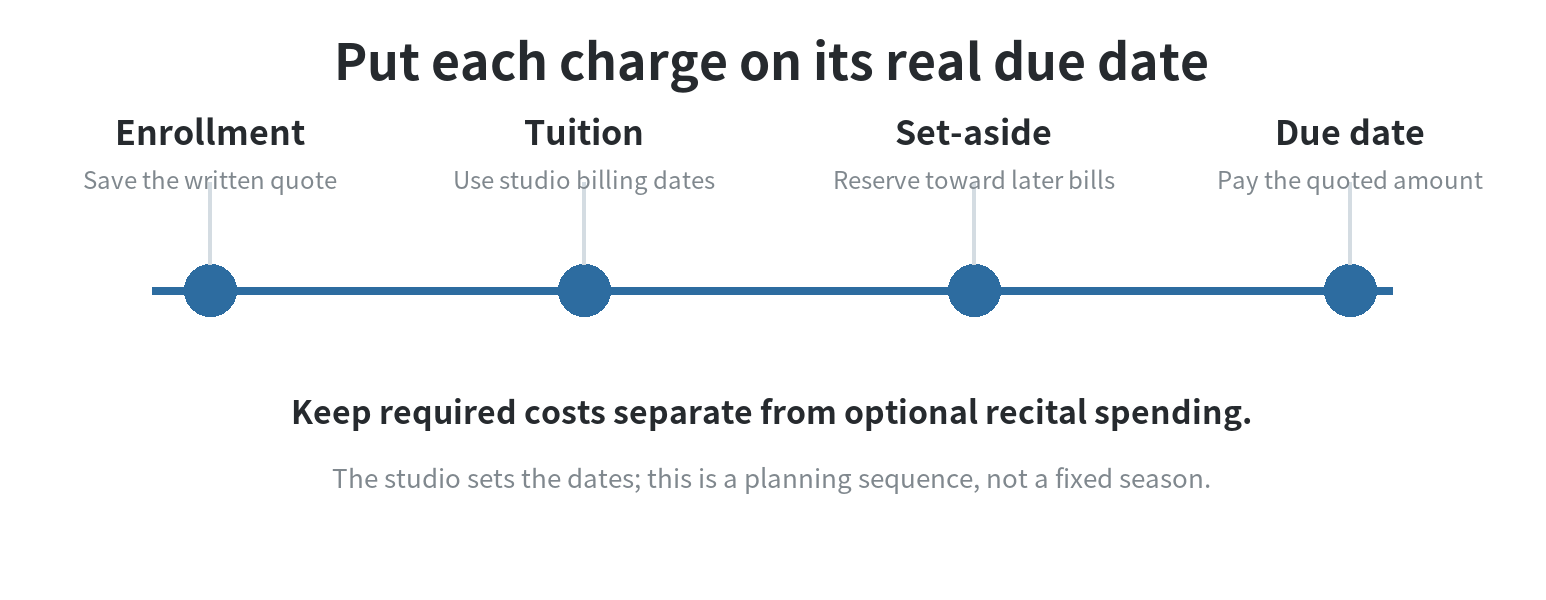
Place each quoted charge in the month it is due. Registration may fall near enrollment, while costume or recital charges may come later. AZ Dance District lists added recital costume fees; Tribe Dance Center assigns costume payments and a separate recital fee to different points in its season. Ask your own studio for its dates.
If tuition is paid in equal installments, list those installment dates rather than dividing the whole amount a second time. Add a separate monthly set-aside for any larger charge due later. For a one-time seasonal bill, divide the quoted amount by the number of months remaining before its due date. If the quote is $180 and there are six months to prepare, the set-aside is $30 per month. This is just arithmetic using a made-up example.
Keep the set-aside in your budget as its own line, even if the money stays in your regular checking account. The label makes it less likely that a future recital bill will be mistaken for money available for groceries or another bill. If your pay schedule does not line up with the studio’s due date, set aside part of the amount from each paycheck that arrives before the charge.
If you keep the household plan on your phone, How to Use Your Phone to Track All Your Expenses covers expense logging, while Best Budgeting Apps to Manage Money on Your Phone explains what to compare in a budgeting app.
Test the budget against the rest of your month
Compare each month’s dance payment with take-home income and bills already committed. A season total can fit on paper while one enrollment month strains cash because several charges arrive together. Look at the month with the largest combined dance bill and include rent, utilities, food, transportation, and other fixed obligations due then.
Use a replaceable example: suppose your take-home pay is $3,200 in a month, regular bills and planned spending use $2,950, and dance-related payments due that month add up to $180. That leaves $250 before dance and $70 after the dance payment. These amounts are examples, not income or cost benchmarks. Put your own net pay and actual due dates in the same calculation.
If the remaining amount is too small for groceries or another necessary bill, adjust the plan before enrollment. Ask whether a lower-cost class schedule is available, whether performance participation is optional, and whether payment dates can be arranged. Review withdrawal deadlines and refund terms before relying on a future class change to reduce the bill. Get any agreed change in writing.
Reduce the bill without guessing at savings
Choices that change a quote include fewer classes, a different class length, a session without a performance, or a studio whose required charges fit your set-aside. Compare class frequency and length, season dates, attire, recital participation, and nonrefundable charges. A lower tuition line may still lead to a higher season total if other charges sit outside it.
Next, separate required spending from choices you control. Ask whether the dress code allows clothing or shoes you already own, whether recital tickets are needed for your household, and whether photos or video are optional. Do not assume an item is optional because it appears under a separate heading; confirm with the office.
Finally, set a limit for optional recital spending before the event details arrive. Choose how many tickets fit the family budget, and decide in advance whether keepsakes or travel belong in the plan. If a fee changes, update both the season total and the month-by-month calendar. The budget stays useful when it reflects the current written quote.
Questions to send the studio
A short written request can resolve the open lines before you commit. Ask: “For this class and season, what is the full required cost, including tuition, registration, attire, costume, recital, and any other fee? Please list each amount, due date, whether it is refundable, and whether performance participation is optional.”
Ask how missed classes, holidays, withdrawal, and payment timing affect what you owe. AZ Dance District and Tribe Dance Center publish different studio-specific withdrawal terms, including notice requirements and charges tied to existing commitments. Read your studio’s current policy before budgeting around a cancellation or refund.
Once the office confirms the quote, save the fee list and calendar with your household budget. The number you need is not a national average. It is the total for the class, season, and participation choices you actually plan to make.
FAQ
Can I budget dance lessons if the studio has not announced recital costs?
Yes: enter the known tuition and fees, leave recital costs as a pending line, and ask when the studio will publish them. Avoid treating an estimate from another school as your final number.
Should I budget by class, month, or full season?
Calculate the full season commitment first, then map the actual due dates by month. This catches fees that are outside tuition and months when several charges overlap.
What if my dancer might stop before the season ends?
Read the studio’s withdrawal, refund, and costume-order policies before enrolling. Ask which charges remain due after a class is dropped and request the answer in writing.
How do I include a recital in a household budget?
List required costume, rehearsal, performance, and ticket charges separately, then add optional photos, video, or travel only if you choose them. Put each amount in the month the studio says it is due.
Last updated: 2026-09