Give alcohol its own monthly line, set that line after rent, food, utilities, transportation, debt payments, and savings, then track what you actually spend.
A usable number comes from your cash flow and purchase history, not from copying a national average.
The U.S. Bureau of Labor Statistics (BLS) reported that consumer units spent an average of $643 on alcoholic beverages in 2024.
That is context for a population, not a target for your household (checked September 30, 2026).
Start with the money left after essentials
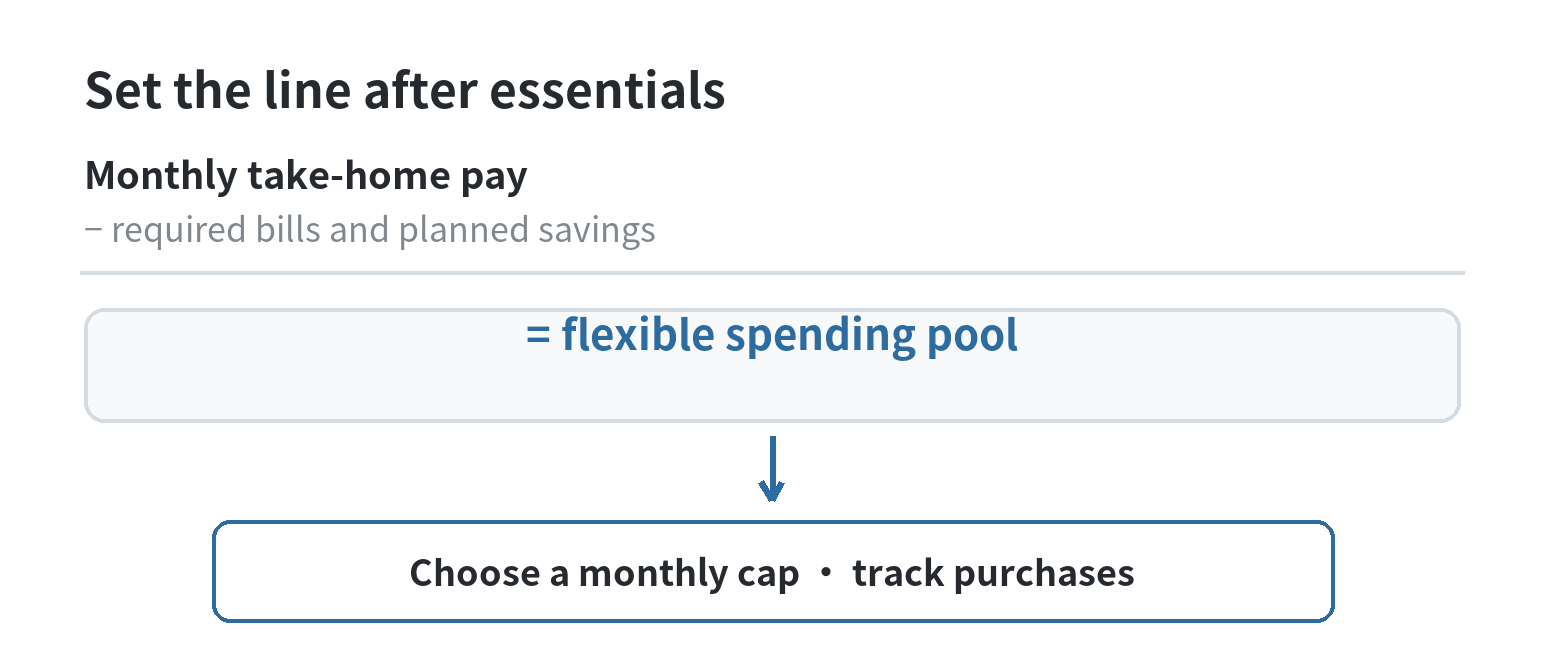
Begin with take-home pay for the month. Subtract required bills and the amounts you need for groceries, transportation, minimum debt payments, and planned savings.
The remainder is the pool for flexible spending. Alcohol belongs inside that pool, alongside dining out, hobbies, and other optional purchases.
Do not set the line by asking what a person “should” spend. Ask what amount fits without borrowing from next month or pushing a bill onto a credit card.
If your budget has no flexible money left, the current alcohol allowance is zero until another category changes or income arrives.
That is a cash-flow result, not a judgment about you.
Use the same unit throughout: a monthly amount is easiest to compare with monthly bills.
If you are paid weekly or every other week, you can still set a monthly cap and reserve part of each paycheck for it.
For a $40 monthly cap, for example, transfer $20 from each of two paychecks. Set your cap from your bills and cash flow; the example only shows how to reserve that amount.
Check the dates money arrives and bills leave your account before choosing the transfer day.
A cap can look affordable on paper but still collide with rent if you set it before the next paycheck clears.
Put the planned amount after required payments in the calendar, then reserve it only when those payments are covered.
For example, a month with $3,200 in take-home pay, $2,150 in required costs, and $450 in planned savings leaves $600 for flexible categories.
Assigning $60 of that pool to alcohol leaves $540 for everything else. The example shows the order of the calculation; your own bill dates and savings goals determine the amounts.
Use your own purchases before choosing a cap
Review recent bank and card statements, receipts, and cash notes.
Mark alcohol purchases at stores or restaurants, including the alcohol portion of a larger meal check when you can identify it.
Exclude non-alcohol items rather than counting an entire grocery or restaurant transaction.
Sort each purchase into two buckets: for home and away from home. BLS uses these separate categories too.
Its 2024 survey averages were $269 for alcohol at home and $374 away from home, for $643 combined per consumer unit. Those figures were checked September 30, 2026.
Averages can hide households that spend nothing and households that spend far more, so use your records to set your own line.
For a mixed receipt, keep the alcohol items rather than assigning the entire grocery trip to this category.
For a restaurant check shared with others, use the alcohol items you paid for and include their share of tax and tip if you want a closer total.
If the receipt does not separate items, record the best estimate you can explain, and use the same method next time.
When cash purchases are hard to reconstruct, keep a simple note for one full pay cycle: date, amount, and where the purchase happened.
A workable estimate is enough to spot a pattern. The National Institute on Alcohol Abuse and Alcoholism (NIAAA) spending calculator also estimates weekly, monthly,
and yearly spending from days per week, drinks on a typical drinking day, and average price per drink; its page was checked September 30, 2026.
Turn the cap into a number you can follow
Suppose a sample household has $600 left for flexible spending after bills and savings.
It chooses a $60 alcohol line, leaving $540 for dining, hobbies, gifts, and other flexible costs.
If the household spends $18 on a restaurant check and $22 on a store purchase, $20 remains for the month.
Choose the line before buying so each purchase has a remaining balance to compare.
Choose a cap that fits both your statement history and next month’s calendar. A birthday dinner, holiday gathering, or planned trip can make one month unusual.
If you know about an event, create a separate one-time amount for it or adjust another flexible category in advance.
Do not quietly raise the cap after it is used up and then treat the larger total as the original plan.
If your pay varies, base the committed amount on income you can count on. Keep extra income unassigned until essential bills and near-term obligations are covered.
You can decide what to do with the remainder when it arrives rather than promising it to a flexible category early.
A planned gathering can be handled as a one-time adjustment with a clear source. If you move $25 from dining to the alcohol line, reduce dining by the same $25 in your notes.
The combined flexible pool stays the same, and the next review can show whether that tradeoff matched the month.
Track purchases without turning the budget into a project
Pick one method: a budget app category, a spreadsheet row, or a note on your phone.
Record the amount soon after spending, and check the running total on payday or when you review bills.
An app may import a transaction, but a mixed restaurant charge can still need a manual adjustment if you want the alcohol portion separated.
If a purchase comes from a joint account, agree on what the category includes and how you will record it.
That keeps the conversation about the shared plan: the monthly limit, what has already been spent, and which category would change if the plan changes.
If you already track spending on your phone, the site’s guides to budgeting apps and planning a monthly budget cover those tools in more detail.
At month-end, compare the planned amount, recorded purchases, and what remains in the category.
Check the last few days of the statement period for pending or late-posted charges, and enter any cash note you have not added yet.
Close the month only after those items are counted once.
If the total differs from the plan, label the reason in plain terms: a planned event, a missed cash purchase, or a change in income. That note makes next month’s decision specific.
It also separates a one-time exception from a cap that repeatedly fails to fit your available flexible money.
When the line runs out, choose what moves
If the category reaches zero before month-end, pause and look at the remaining flexible money.
You can stop spending in this category until the next budget period, or deliberately move a stated amount from another flexible line.
Write down the tradeoff so the same dollars are not promised twice.
Do not pull from rent, utilities, groceries, minimum debt payments, or money already reserved for an upcoming bill.
If the shortfall came from an unplanned expense, record it separately.
That makes it easier to tell whether the planned cap was too low, the month was unusual, or the tracking missed transactions.
At the next budget review, compare the planned amount with the actual total and ask one practical question: did the line fit the month’s real cash flow?
If not, adjust it only alongside the category that will fund the change.
If bills are already difficult to cover, leave the alcohol line at zero and work on the essential shortfall first.
A missed cap does not require a complicated reset.
Keep the original plan visible, write the amount and source of any approved change, then start the next month with the revised figures.
If there was no safe flexible category to draw from, keep the cap closed until the next review instead of carrying a balance into the next month.
FAQ
Should I use the national average as my monthly alcohol budget?
No. The BLS figure is a population average for 2024, not a spending recommendation or a prediction for one household.
Use your own statements and the money left after required bills to choose a cap.
How can I budget for alcohol purchases paid in cash?
Keep a short dated note with each amount until you have enough history to estimate the category.
Add those entries to the same monthly total as card purchases, and stop counting any transaction already captured elsewhere.
What if one social event costs more than my monthly cap?
Decide before the event whether to set aside a one-time amount or reduce another flexible category.
Keep the regular monthly line separate so the event does not obscure your ordinary spending.
How should couples handle different views about this budget line?
Agree on the amount and how shared purchases will be recorded before the month starts.
If either person wants a different cap, identify the flexible category that would fund the difference and make that choice together.
Last updated: 2026-09