Budget for a Roth IRA by choosing an amount your monthly cash flow can support, then checking that amount against the IRS contribution and income rules. Treat the planned deposit as a flexible savings line. Fund rent, utilities, food, minimum debt payments, and a workable cash reserve first. If your income or expenses change, adjust the planned contribution before the next deposit.
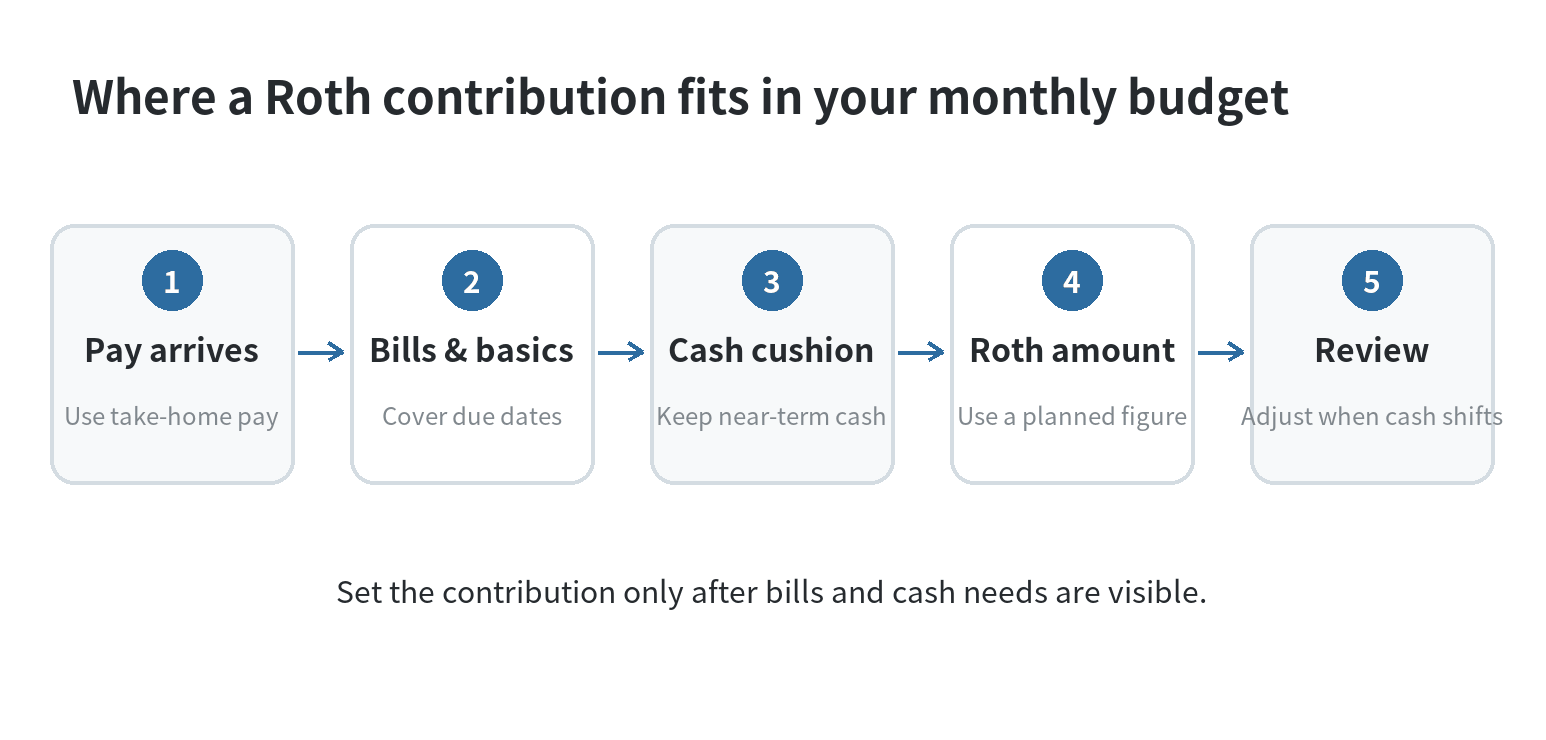
Start with money you can actually spare
Use take-home pay rather than gross salary for the monthly budget. List bills by due date, then set aside groceries, transportation, and other routine costs. Add irregular expenses such as car registration, annual insurance, or school costs as monthly sinking-fund amounts. What remains is the pool from which savings goals can be funded.
Keep short-term cash needs separate from retirement contributions. If an upcoming bill would push you onto a credit card, lower the Roth line for now and direct that amount to the bill or cash reserve. In that month, a smaller deposit can preserve cash for the bill while keeping the rest of your budget intact.
If you are still mapping routine spending, a monthly budget tracking method can help organize categories. If you are building cash for surprises, see the emergency-fund steps before deciding how much can leave checking each month.
Turn an annual goal into a paycheck-sized amount
Once you know your monthly room, divide the planned contribution across the paydays that fund it. For example, if your example budget can spare $180 per month and you are paid twice monthly, assign $90 from each check. Those sample amounts are a planning illustration, not an average or a recommended contribution.
With biweekly pay, use the number of deposits that actually arrive in each month instead of assuming every month has two. If your plan is $180 per month, you might set aside $90 from each of the two expected checks and decide in advance what the extra paycheck in a three-paycheck month will cover. Do not count the same deposit twice in the annual total.
For variable income, build the budget around a dependable baseline. Set a modest recurring amount that fits a lower-income month, then make an additional contribution only after the month’s bills and reserve are covered. If a bonus or freelance payment arrives, leave it unassigned until estimated taxes, work costs, and near-term obligations are accounted for.
For a worked household example, say $4,000 reaches checking after payroll deductions. If $2,650 is assigned to housing, utilities, food, and transportation; $400 to debt payments; $300 to a cash reserve; and $250 to irregular bills, $400 remains unassigned. A planned $180 Roth contribution would leave $220 for flexible spending or another cash need. These are sample figures, not a national budget benchmark.
If you begin contributing partway through the year, calculate from the remaining pay periods instead of dividing by twelve. For example, a hypothetical $900 plan spread over six months is $150 per month. Confirm that the annual amount still fits the IRS limit and any contributions already made to another IRA.
Check the current IRS ceiling and income range
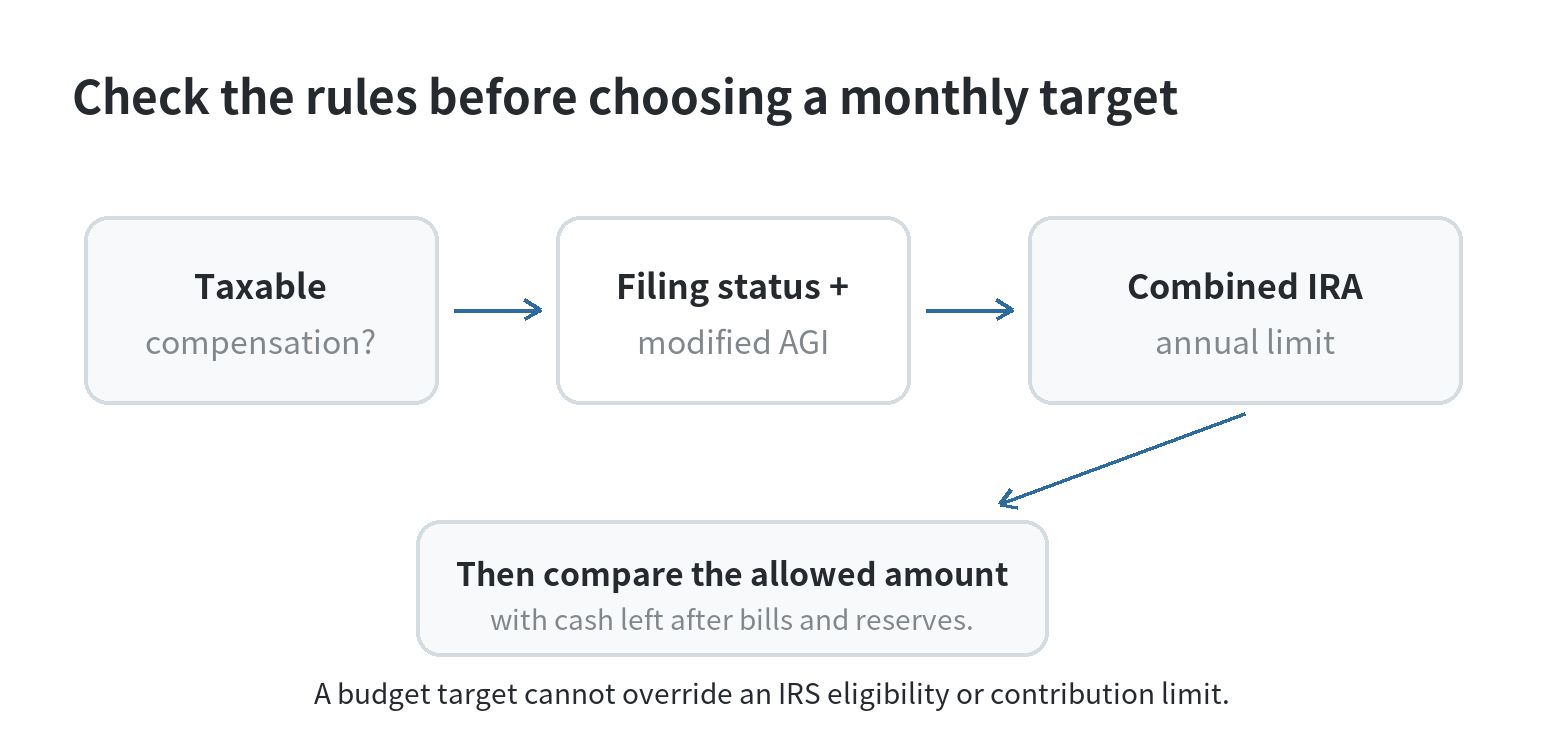
For tax year 2026, the IRS lists a combined annual limit of $7,500 for traditional and Roth IRAs, or $8,600 if you are age 50 or older by year-end. The ceiling is also limited by taxable compensation when that amount is lower. The IRS’s Publication 590-A and its 2026 contribution-limit guidance were checked on September 30, 2026.
The Roth limit can be reduced by modified adjusted gross income (modified AGI) and filing status. The IRS’s 2026 income phase-out ranges, checked September 30, 2026, are $153,000 to $168,000 for single filers, heads of household, and certain married people filing separately; for married couples filing jointly or qualifying surviving spouses, the range is $242,000 to $252,000. A separate-return filer who lived with a spouse during the year has a special range beginning above $0 and ending at $10,000.
Investor.gov explains that annual IRA contributions cannot exceed the maximum set by the IRS and directs readers to the IRS for current tax rules. The 2026 dollar values and Roth phase-out ranges above come from the IRS. Check the IRS table again when planning for a different tax year. A household budget cannot establish eligibility; modified AGI is calculated under IRS rules and is not always the same as take-home pay.
Keep traditional and Roth IRA deposits in one ledger
The annual ceiling applies across your traditional and Roth IRAs, so track both in the same yearly total. If you put money into a traditional IRA earlier in the year, subtract it from the shared limit before setting a Roth target. Record the tax year attached to each deposit, the date, and the amount. This makes it easier to compare your running total with the applicable IRS limit.
Also leave room for uncertainty if your income may cross a phase-out threshold or your compensation is uneven. A conservative budget amount can be revisited when you have a clearer estimate; it should not be treated as confirmation that a contribution is allowed. If you are near a limit, use the IRS worksheet or ask a qualified tax professional about your circumstances.
Review the line when the month changes
Check the budget after a rent change, a change in work hours, a new insurance premium, or a large annual bill. Compare the planned contribution with what actually remained after essentials and reserve transfers. If you had to move money back to cover bills, lower the next planned deposit rather than borrowing from another category and pretending the budget still balances.
When income rises, first decide whether the added cash has another near-term job. When income falls, protect housing, utilities, food, minimum payments, and cash for known expenses before maintaining a fixed retirement amount. Revisit the annual total as well as the monthly figure, since a lower recurring deposit can still add up across the year.
Review the budget when income or expenses change and when you prepare for a new tax year. Use the IRS’s current contribution limit and income table for that year, then decide what amount fits the household cash plan. The useful number is the amount that fits both checks: the IRS rules and your actual budget.
FAQ
Can I contribute to a Roth IRA if I also have a 401(k) at work?
Yes, having an employer retirement plan does not by itself prevent an IRA contribution. The IRS says Roth IRA eligibility and the amount allowed can still depend on taxable compensation, filing status, modified AGI, and the shared annual IRA limit.
Can I make a Roth IRA contribution for the prior tax year?
Yes, the IRS allows contributions for a tax year through that year’s federal return due date, excluding extensions. When making a deposit near the deadline, designate which tax year it applies to and check the IRS deadline for that year.
Should I budget a fixed amount or change it with every paycheck?
Use a fixed amount only when it fits the lowest dependable version of your monthly cash flow. With variable pay, set a baseline you can cover after essential bills, then review any extra contribution after income and expenses are known.
Last updated: September 2026. Review IRS contribution and income limits each tax year.
Last updated: 2026-09