Give diapers and formula their own lines in the household budget, then fund them from your actual receipts and the number of packages you buy. Published cost estimates can help you decide what to check, but the price on your receipt and your household’s use should set the working amount.
Start with take-home income, required bills, and these two baby-care lines before assigning money to flexible spending. Keep wipes, diaper cream, and other supplies separate if you want to see which item pushes the total up.
Keep diapers and formula visible as separate expenses
A combined “baby” category hides changes. If diapers rise while formula stays steady, a single total will not tell you which line needs a new limit. Use separate labels such as Diapers, Formula, Wipes, and Feeding Supplies, and record the date and amount for each purchase.
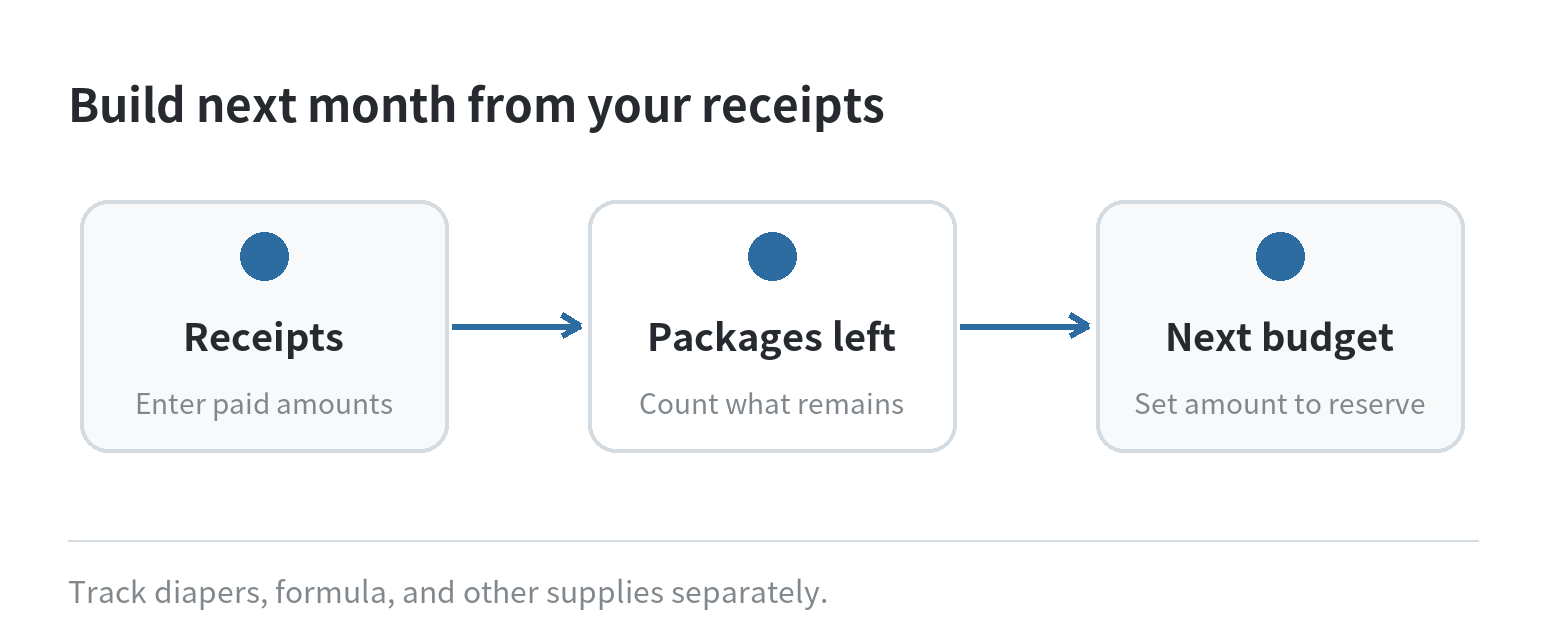
Look back at receipts, card transactions, and any cash notes for a complete month. Count the packages purchased and note whether the total includes a one-time stock-up. If you have not started buying yet, write down the package price you see and leave the quantity as a planning estimate until you have actual transactions.
These are dated reference points, not a price quote for your area; your size, package count, and local price determine your line.
For formula, make a household estimate from your receipts rather than assuming one national monthly figure. The Government Accountability Office reported an inflation-adjusted average retail price of $5.48 per 26 reconstituted fluid ounces of milk-based powder formula in 2023 dollars in its 2025 report. Those are dated reference points with different methods, not a current price quote or a national monthly average. A household’s product, container size, amount used, and any assistance change the amount it pays.
Turn purchases into a monthly baseline
Use one full month of transactions as your first baseline. Add the diapers purchased, formula purchased, and any directly related items you chose to track. If the first month includes a bulk purchase intended to last beyond that month, note the remaining packages so you do not budget as if you must repeat the same checkout total right away.
Here is a made-up example for a household with $4,000 in monthly take-home pay. The values illustrate how to lay out the budget; they are not national cost averages.
| Budget line | Example amount | How to replace it |
|---|---|---|
| Diapers | $95 | Use your recent receipts and package count |
| Formula | $220 | Use your paid amount after any confirmed benefit |
| Wipes and supplies | $35 | Keep only items you actually buy |
Those three example lines total $350. In the same worksheet, list rent, utilities, groceries, transportation, debt payments, and other fixed bills before deciding what remains for flexible spending. A separate line for each baby-related category makes the total easy to update without rebuilding the whole budget.
Separate a dated estimate from your current price
Use outside estimates to establish a starting question, not a permanent cap. The diaper figures above date from June 2024 and 2025. The formula benchmark uses retail data through 2023, adjusted to 2023 dollars. None of those figures can tell you the amount charged at a nearby store or the amount your household uses.
To update the budget, write the current package price beside the package size, then record how many packages you paid for in the month. Keep discounts, coupons, or reimbursements visible as separate entries so a temporary reduction does not silently lower your normal estimate. If you switch container sizes, compare the cost per prepared quantity shown by the source data or package information you can verify, not just the shelf price.
After you have a month of receipts, add a modest reserve if costs fluctuate. If receipts total $280, an illustrative $20 cushion makes a $300 plan. That cushion is your choice, not a forecast; revise it with later receipts.
For a broader framework for organizing household categories, see our monthly budget setup article. If your next question is how to hold money for a later bill, our emergency fund article covers that separate goal.
Check WIC before counting formula as fully self-paid
WIC may affect the household’s formula outlay, but it does not belong in the diaper budget. The USDA describes WIC as a nutrition program that provides supplemental foods and other nutrition services. The National Diaper Bank Network’s June 2024 fast facts says federal nutrition programs, including WIC, do not provide funding to purchase diapers.
Eligibility depends on more than having a baby. USDA’s WIC eligibility guide lists category, residency, income, and nutrition risk requirements. USAGov’s WIC page, updated December 23, 2025, says applicants may include pregnant people, people who are breastfeeding or within six months after pregnancy, and children under age five; it directs applicants to a state or local agency for application instructions. The agency can tell you what income standard and documents apply where you live.
When you make the budget, subtract a WIC benefit from the household’s formula cost only after the benefit is confirmed and you know which allowed items it covers. Enter the benefit and your out-of-pocket purchase as separate figures. If eligibility or the amount is still pending, keep the full expected receipt total in the plan and revise it when the agency responds.
WIC is not a general cash payment. USDA describes food benefits as packages tied to life-stage needs, while the Oklahoma State Department of Health says its package details are assigned through an appointment or clinic and are being updated by that state. Ask your local agency what your household’s current package covers; do not use another family’s balance or package as your estimate.
Match the budget to your pay dates
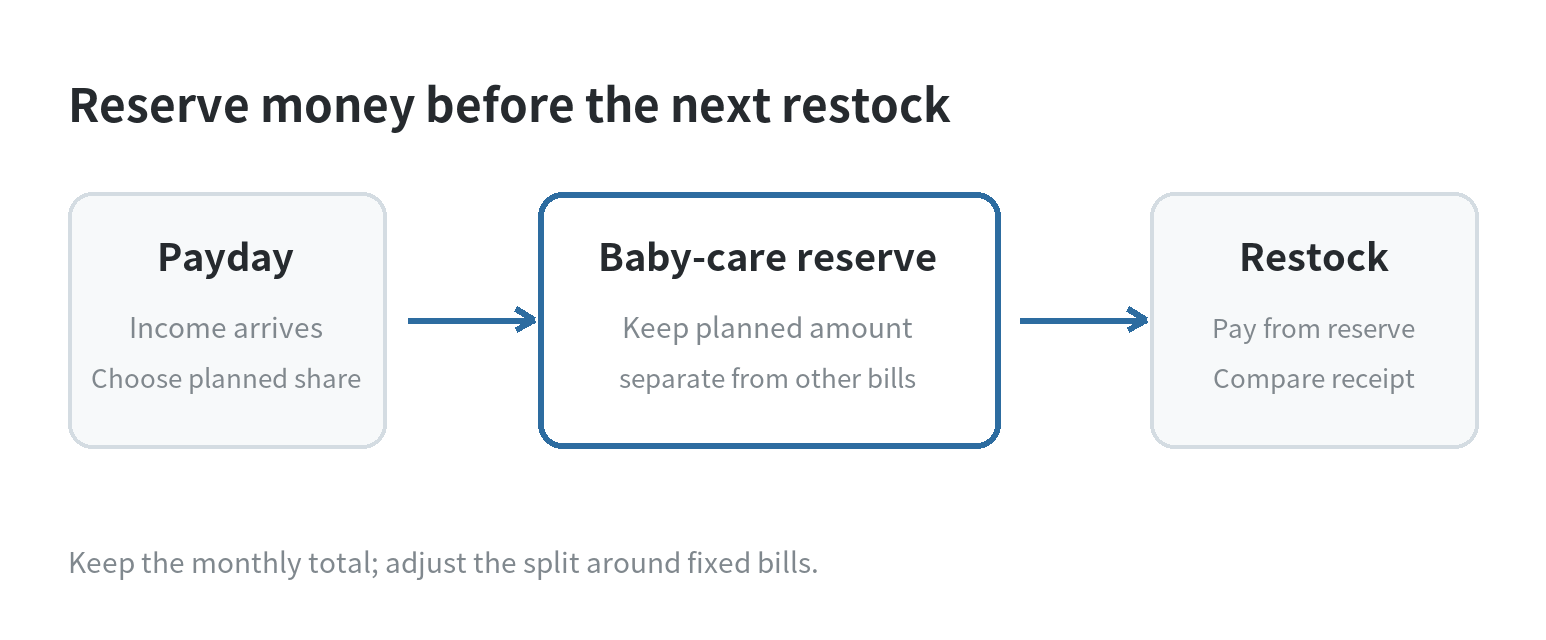
Monthly totals do not always line up with paydays. Put the next diaper and formula purchases on a simple calendar, then reserve the needed amount from the paycheck that arrives before each purchase. Keep the baby-care money in the checking balance or a separate envelope so rent, utilities, and a planned restock do not compete invisibly.
Suppose the household has two scheduled $2,000 paychecks in the month and expects $350 in baby-care purchases. In an example plan, reserve $175 from each check. If one check already covers rent and another fixed bill, assign more of the baby-care line to the paycheck with room, but leave the monthly total intact.
At month end, compare planned and actual amounts by category. A larger formula receipt could reflect a changed package size or an extra purchase; a diaper total might include supplies for the next month. Record the reason beside the difference. Then reset the next month’s estimate from what was bought and what remains at home.
This gives you a clear next step when money is tight: identify the line that is short, check what is already covered, and contact the local WIC office about eligibility or package questions. For diaper assistance, ask a local community program what support is available. Keep both inquiries separate from the budget math so the amount you still need to pay remains visible.
FAQ
Should I budget for wipes in the diaper category?
Track wipes separately if you want to see their cost on its own. If you prefer fewer lines, group wipes with diapers and use receipts that include both items to set the combined amount.
Can I count WIC before my application is approved?
Keep the expected household purchase in the budget until the state or local agency confirms eligibility and the benefit details. Then lower only the expense that the confirmed package will cover.
What if my formula or diaper package changes size?
Record the new package size and price, then compare the quantity purchased with the prior package. Set the next monthly line from the amount you expect to pay, rather than copying the old package price.
Where can I look for diaper assistance?
Contact a diaper bank or family-service program in your area and ask about its location, current eligibility, and available supplies.