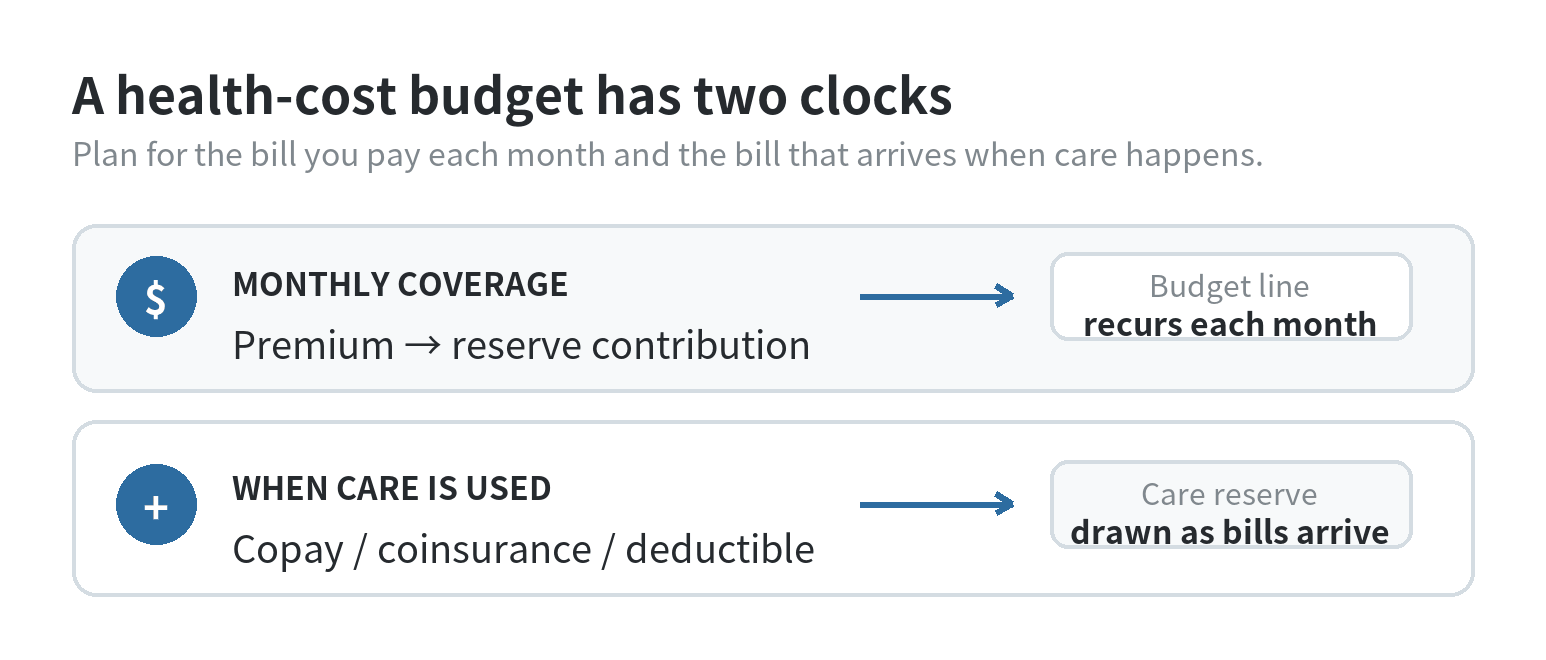
Budget health insurance in two lines: the premium you owe whether you use care or not, and a reserve for deductibles, copays, coinsurance, and other covered care costs.
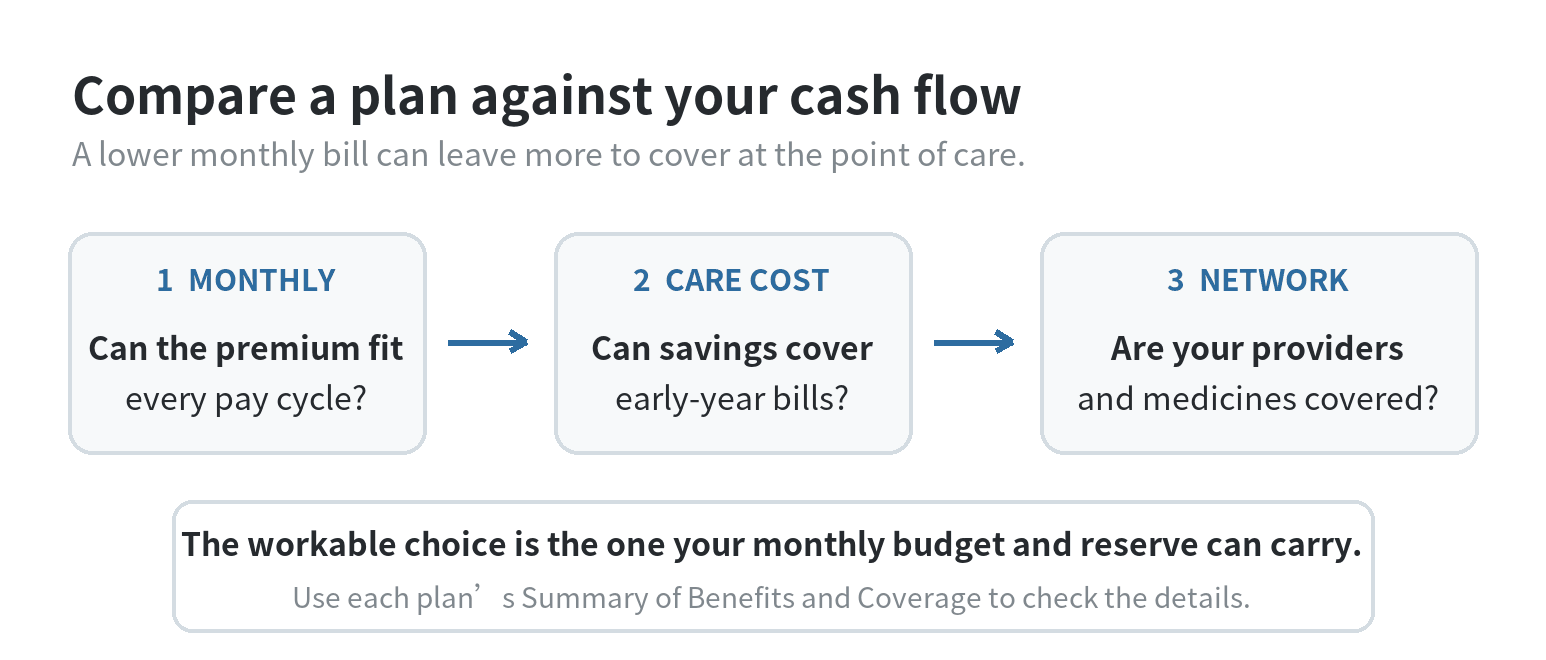
Compare plans by their estimated yearly cost and by the cash you could need early in the year; the lowest monthly premium alone does not show the full budget impact.
Separate the monthly bill from the care bill
Your premium is the recurring charge for coverage. Your out-of-pocket spending depends on the plan and the care you receive.
HealthCare.gov lists premiums, deductibles, copayments, coinsurance, and the out-of-pocket maximum for yearly cost comparisons.
Its cost overview was checked September 30, 2026.
A deductible is the amount you pay for certain covered services before the plan begins paying its share.
A copay is a fixed amount for a covered service; coinsurance is a percentage of its allowed cost.
The plan’s Summary of Benefits and Coverage (SBC) sets out how those amounts work for that plan.
A plan can have separate rules for services or prescriptions, so read the relevant rows instead of treating one deductible as the price of every kind of care.
The out-of-pocket maximum applies to covered in-network care under the plan’s rules.
HealthCare.gov says it excludes monthly premiums, services the plan does not cover, out-of-network care, and amounts above the allowed amount (checked September 30, 2026).
Check your plan documents for the exact terms.
Keep these costs in distinct budget categories. Put the premium in fixed bills.
Give the care reserve its own savings line, even if you have not used it recently.
That makes an insurance bill less likely to collide with rent, utilities, or a car payment when care costs land unevenly.
Turn the plan documents into a yearly estimate
Start with the amount you would pay for premiums across the coverage year.
Then add a care estimate that reflects your own planned appointments, prescriptions, and ongoing services.
Use the SBC and plan details to check the cost-sharing terms for those services.
For Marketplace comparisons, HealthCare.gov offers an estimated total-cost view based on an expected level of care.
The result is an estimate, not a bill. (Checked September 30, 2026.)
Build two versions rather than trusting one forecast.
The first is your expected-use budget: the premium plus the care you already expect to schedule.
The second is a high-use stress test: the premium plus covered cost sharing up to the plan’s out-of-pocket maximum.
Keep the premium separate in that calculation because the maximum does not include it.
This second view is not a prediction that you will reach the limit; it shows how much more cash the plan could require if covered care is extensive.
For a made-up comparison, suppose Plan A costs $410 a month with a $4,800 out-of-pocket maximum, while Plan B costs $535 a month with a $3,200 maximum.
Annual premiums would be $4,920 and $6,420.
If you reached each plan’s stated maximum for covered services, premiums plus that maximum would total $9,720 for A and $9,620 for B.
These fictional figures show why a higher premium can sit beside a lower high-use total.
They say nothing about which plan is right for a real household; actual premiums, networks, covered services, and cost sharing vary by plan and location.
Do not treat the high-use total as the amount you must save immediately.
Use it to see the exposure, then set a monthly reserve amount your budget can support.
If your budget cannot absorb a surprise bill, compare the deductible and copays before the deductible.
Check prescription costs and the out-of-pocket maximum, too. Then decide how much of your budget can go to premiums.
Make the reserve fit your paycheck calendar
Look at how the premium is collected. An employer plan may come out of paychecks, while an individual plan may require a separate payment.
Your budget should follow the real due date and cash flow.
If money arrives twice a month, split a monthly bill between those pay periods in your plan, while leaving enough in the account before the premium is due.
Example only: take-home pay is $3,000 a month, the premium is $450, and the reserve is $150.
With two equal paychecks, set aside $225 for the premium and $75 for the reserve from each.
The remaining $2,400 stays for other budget categories; replace these amounts with your own.
For care costs, use a separate category in your budget or a separate savings bucket.
Add the contribution on payday, then subtract bills when you pay them.
If the balance pays for a deductible or prescription, keep the receipt or explanation of benefits with the transaction.
That helps you distinguish a plan cost from a bill still being processed.
Use your own paperwork to choose a starting amount.
Review last year’s explanation-of-benefits statements and pharmacy receipts, then note services already scheduled for the coming year.
Do not copy a national “average” into your budget: the plan, location, providers, prescriptions, and household’s planned care change the estimate.
If you are building the rest of your monthly plan alongside this reserve, the site’s guide to tracking a monthly budget explains ways to keep category balances visible.
Check Marketplace savings before you lock the numbers
If you are looking at Marketplace coverage, do not budget from a headline subsidy estimate.
Marketplace savings use expected household income for the coverage year and household size, according to HealthCare.gov.
The application gives an eligibility result and amount.
The amount also depends on the information entered, so update the Marketplace when household or income details change.
HealthCare.gov’s income and savings pages were checked September 30, 2026.
CMS’s 2026 consumer guidance describes premium tax credits and cost-sharing reductions as separate forms of assistance.
A premium tax credit can reduce the monthly premium. Cost-sharing reductions lower eligible deductibles, copayments, and coinsurance.
CMS says income-based savings require Silver-category Marketplace coverage and APTC eligibility.
Compare the final plan details and eligibility result rather than assuming that a lower premium also means lower costs when you use care.
Advance premium tax credit payments affect later tax filing.
The IRS says people who receive advance payments use Form 8962 to compare those payments with the premium tax credit determined from actual household income and family size.
For household tax questions, get advice from a qualified tax professional.
IRS guidance was checked September 30, 2026.
Run this quick cash-flow check on each option
Before you select a plan, put its monthly premium next to your regular bills, then check whether the care reserve can handle the plan’s early-year cost sharing.
Confirm that the doctors, clinics, and prescriptions you rely on appear in the plan’s current network and covered-drug information.
Network and coverage details can change by plan, so use the current plan documents, not last year’s notes.
| Budget question | Where to check | What to put in your plan |
|---|---|---|
| What leaves every month? | Premium notice or payroll record | Recurring premium amount and due date |
| What could I owe before the plan pays more? | SBC and deductible details | A reserve for covered care early in the year |
| What do visits and prescriptions cost? | Copay, coinsurance, and drug sections | Expected-use estimate by service type |
| What is my covered-care exposure? | Out-of-pocket maximum and exclusions | A high-use stress-test total, including premiums separately |
For another angle on keeping irregular expenses from upsetting a monthly plan, see the site’s emergency-fund budgeting article.
The aim here is a clear monthly premium line and a care reserve you can actually maintain.
Revisit both when your plan, income, household, or expected care changes.
FAQ
Should I keep my old plan’s deductible in my new budget?
No. Recheck the current plan’s SBC because deductibles and cost-sharing terms are plan-specific and may change at renewal.
Use the old year’s spending history as a clue about timing, then recalculate with the current documents.
What if my income changes after I estimate Marketplace savings?
Update the Marketplace application when your expected income or household details change.
HealthCare.gov says savings are based on the expected income for the coverage year and warns that changes can affect the amount of assistance.
Does the out-of-pocket maximum include my monthly premiums?
No. HealthCare.gov lists the premium separately from the out-of-pocket maximum.
Keep premiums in recurring bills and budget separately for covered care that counts toward the plan limit.
Where can I find a plan’s real cost-sharing details?
Use that plan’s Summary of Benefits and Coverage and current plan documents.
Check the deductible, service-specific copays or coinsurance, prescription terms, network, exclusions, and out-of-pocket maximum.
Last updated: 2026-09