Build a subscription budget from the charges that actually hit your accounts, then convert each billing schedule into a monthly amount.
That gives you one number to reserve, even when a service bills annually or on a date that does not match payday.
The figures below are a made-up household example; replace them with your own statements.
Start with the charges, not your memory
Search recent checking, credit-card, digital-wallet, and app-store statements for recurring charges.
Write down the service, amount, billing date, payment method, and whether the charge is monthly, annual, or another schedule.
Include memberships, cloud storage, software, streaming, news, and free trials that can renew.
Do not count a one-time purchase as a subscription just because it came from the same company.
Use the merchant description on the statement as a clue, not the final answer.
A parent company may process several services under one label; a family member may also have started a plan on a different card.
Open the account or ask the household member who uses it before deciding what the line item represents.
Put the findings in one list, even if payments come from different accounts. For each charge, keep the last amount you can confirm and the next renewal date if it is visible.
Mark a price as uncertain when a promotion ended, a renewal notice mentions a change, or the statement description is unclear.
Check the service’s own account or current notice before using that amount in the budget.
Turn every billing cycle into a monthly reserve
A subscription budget works best when it follows the cost of using the service, rather than the date the payment happens.
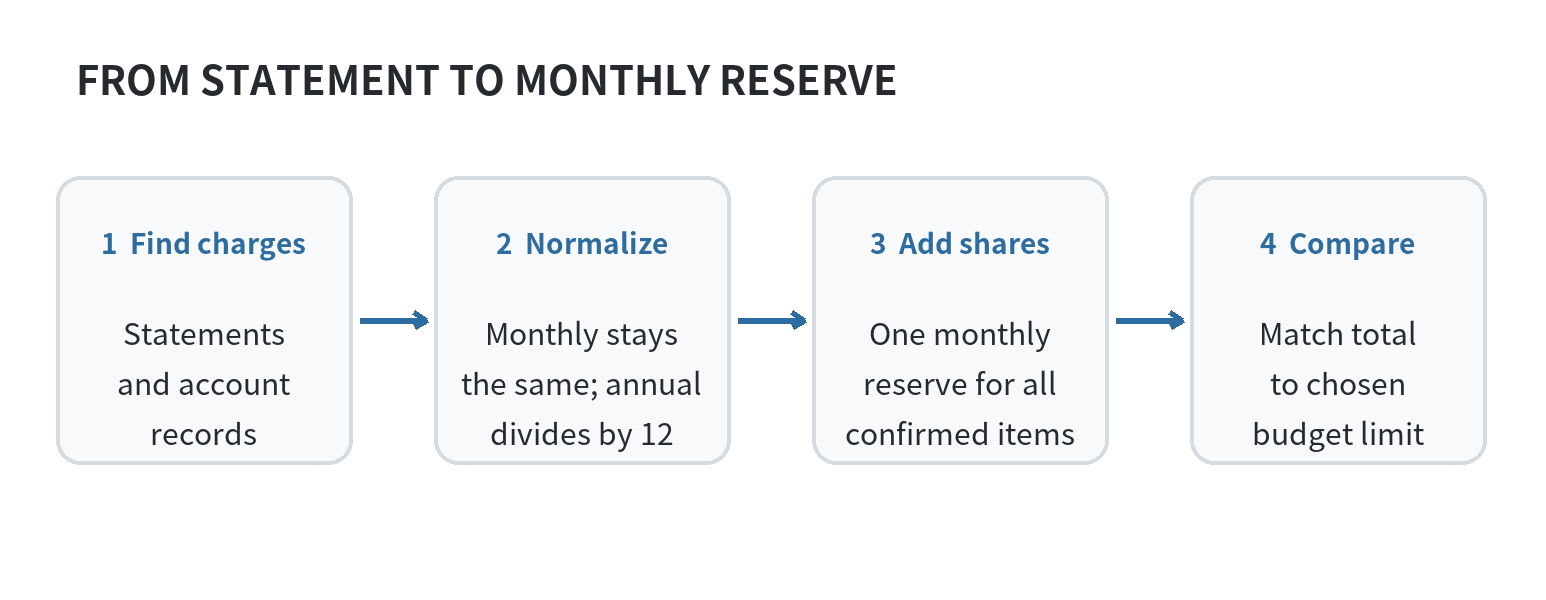
For a monthly charge, set aside the confirmed monthly amount. For an annual charge, divide the annual bill by twelve and reserve that share each month.
If the bill arrives before you have built the reserve, note the gap separately; do not pretend the full annual charge is already covered.
Here is an illustrative list: a $12 monthly service, a $60 annual membership, and a $9 monthly app. The monthly reserve is $12 + ($60 ÷ 12) + $9, or $26.
The actual account withdrawals still happen on their billing dates; the $26 is the amount this example assigns to subscriptions in each month.
| Illustrative charge | Billing schedule | Monthly reserve |
|---|---|---|
| Service A | $12 each month | $12 |
| Membership B | $60 each year | $5 |
| App C | $9 each month | $9 |
| Total | Different dates | $26 |
The arithmetic is a planning aid, not a prediction of what a company will charge.
If tax, a renewal increase, or a plan change appears, update the reserve from the current bill.
Keep this subscription line distinct from other recurring bills so a renewal does not quietly consume money assigned to groceries or utilities.
Give each subscription a job in the household plan
After you total the monthly equivalents, compare the number with the amount your budget can spare after essential bills and planned savings.
If the number fits, assign it a clear category and reserve it. If it does not fit, sort the list by use and flexibility instead of cutting every service by the same amount.
For each line, ask who uses it, what it is for, whether another household plan already covers the same need, and when the next renewal occurs.
Mark each one as keep, review, or cancel. “Review” is useful when the service still matters but the current plan, add-ons, or billing period needs another look.
Write down a specific next action and date so a vague intention does not become another renewal.
Suppose the example household can reserve $22, while its list converts to $26. The gap is $4.
It could review a service before its next renewal, remove an unused add-on, or move a flexible expense from another category.
The example does not establish a standard amount for anyone else; it shows how to compare a real total with a chosen limit.
If you want subscriptions to sit inside a larger spending plan, the site’s budgeting overview discusses how recurring transactions fit into a household plan.
For another app-neutral way to organize spending, see the guide to personal budgeting tools.
When a renewal lands before payday
The monthly reserve can smooth an annual bill only if the money is available when the charge arrives.
Put the renewal date next to the budget category, then compare it with your pay dates and account balance.
If you are starting midyear, the reserve may not have accumulated enough for an upcoming annual renewal.
Treat that shortfall as a separate upcoming expense and choose which other category can cover it, or decide whether to cancel before renewal.
Keep the reserve in your normal bill-paying account if that is easiest to track.
If you use a separate savings bucket, label it clearly and check the transfer timing; moving money after the charge posts will not prevent an overdraft.
A simple calendar reminder before a large renewal gives you time to confirm the amount, account balance, and keep-or-cancel decision.
When an amount changes, update both the next charge and the monthly reserve.
If the budget is already tight, do not wait until the statement arrives to discover that a promotional price ended.
Use the renewal notice or service account to confirm the charge, then adjust the category before assigning the remaining money elsewhere.
Cancel the service and verify the payment stops
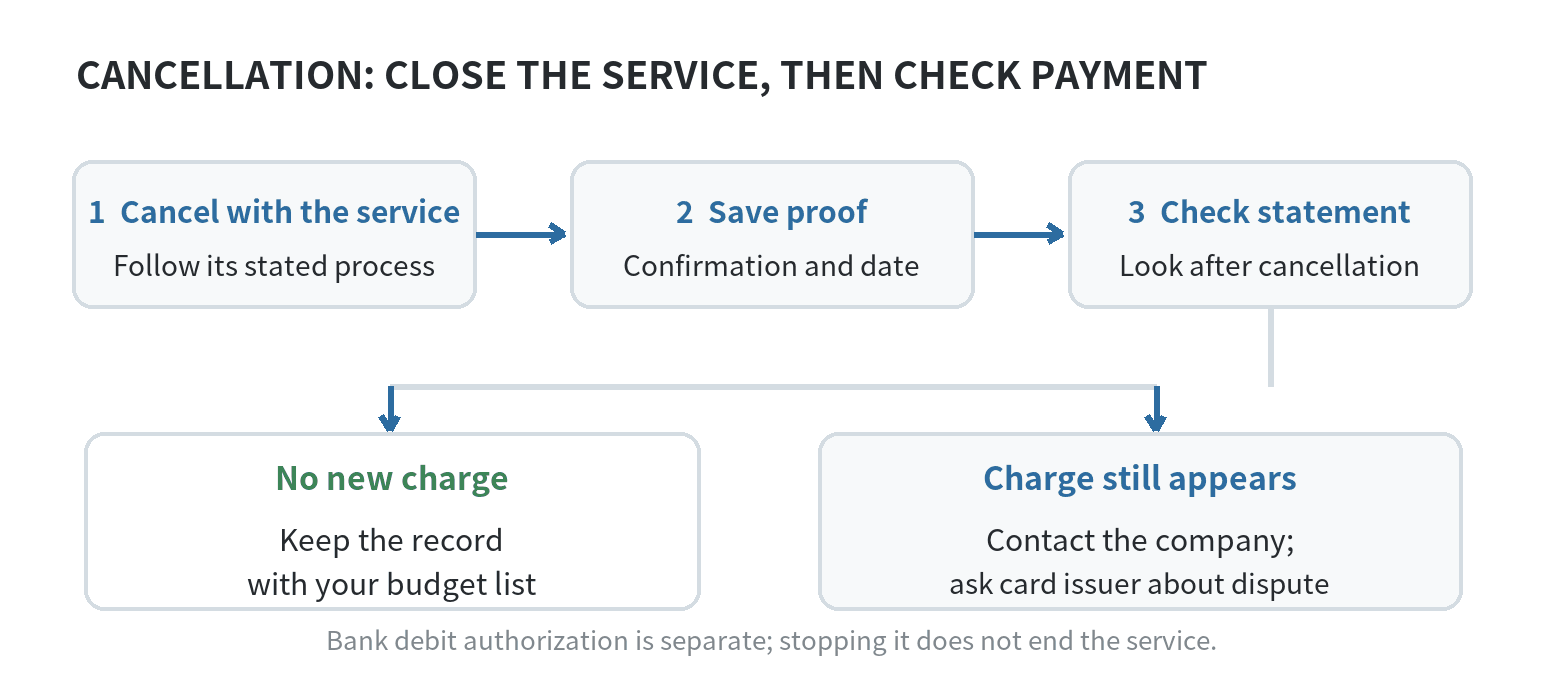
The FTC’s consumer guide, checked September 30, 2026, advises customers to follow the subscription company’s cancellation instructions,
keep a copy of the request and related notes, and check later statements for further charges.
Save the confirmation email or screen and note the date. The company’s account page or support channel is the place to verify that the service itself is canceled.
Stopping a bank withdrawal is a separate action from ending a service.
The CFPB’s automatic-payment guidance, last reviewed August 28, 2026,
says to contact the company to cancel the contract and separately contact the bank or credit union to revoke payment authorization when needed.
It also explains that stopping automatic payment does not cancel the underlying service contract. Keep paying any amount still owed through an accepted method.
If a charge appears after you canceled, compare it with the confirmation and contact the company.
The FTC guide says you can dispute a charge with your card issuer if the company charged you after cancellation.
For an automatic debit from a bank account, the CFPB describes contacting the bank promptly about a payment made after authorization was revoked.
Keep records of dates, messages, and statements together while the issue is being handled.
Keep the list useful after the first cleanup
When a new recurring charge starts, add it to the list before spending the rest of that month’s flexible money.
When a service ends, remove its future reserve only after you have checked the renewal date and any remaining obligation.
If someone else in the household manages the account, share the service name, payer, renewal date, and decision rather than relying on a note that says only “cancel.”
A subscription budget is complete when the list ties back to real statements, annual charges have a monthly equivalent,
and each uncertain or unwanted service has a next action.
Revisit it when a statement or renewal notice changes the facts. Your own list—not a national average—sets the amount to reserve.
FAQ
Should I budget a free trial before it starts charging?
Yes, record the end date and the amount that would apply if you keep it.
The FTC’s consumer guide advises marking a trial deadline and checking the offer’s cancellation terms.
If you do not intend to continue, set a reminder early enough to follow the company’s instructions and keep proof of the cancellation.
What if a subscription is billed through an app store?
Check the account that manages the subscription and identify which party handles cancellation and billing.
Save the cancellation confirmation from that account, then check the payment statement for a later renewal charge.
A bank or card payment block does not by itself show that the service account has ended.
Can I stop a card or bank payment instead of canceling the service?
Payment authorization and the service agreement are separate. The CFPB says that stopping an automatic payment does not cancel the underlying contract.
Contact the service to end it, and contact the payment provider separately if you also need to revoke automatic payment authorization.
What should I do with a subscription shared by my household?
Ask who owns the account, who pays, and which people rely on it before changing the plan.
Choose one person to confirm the cancellation or renewal and share the confirmation with everyone affected.
Put the next renewal date and monthly reserve in the same household budget record.
Last updated: 2026-09