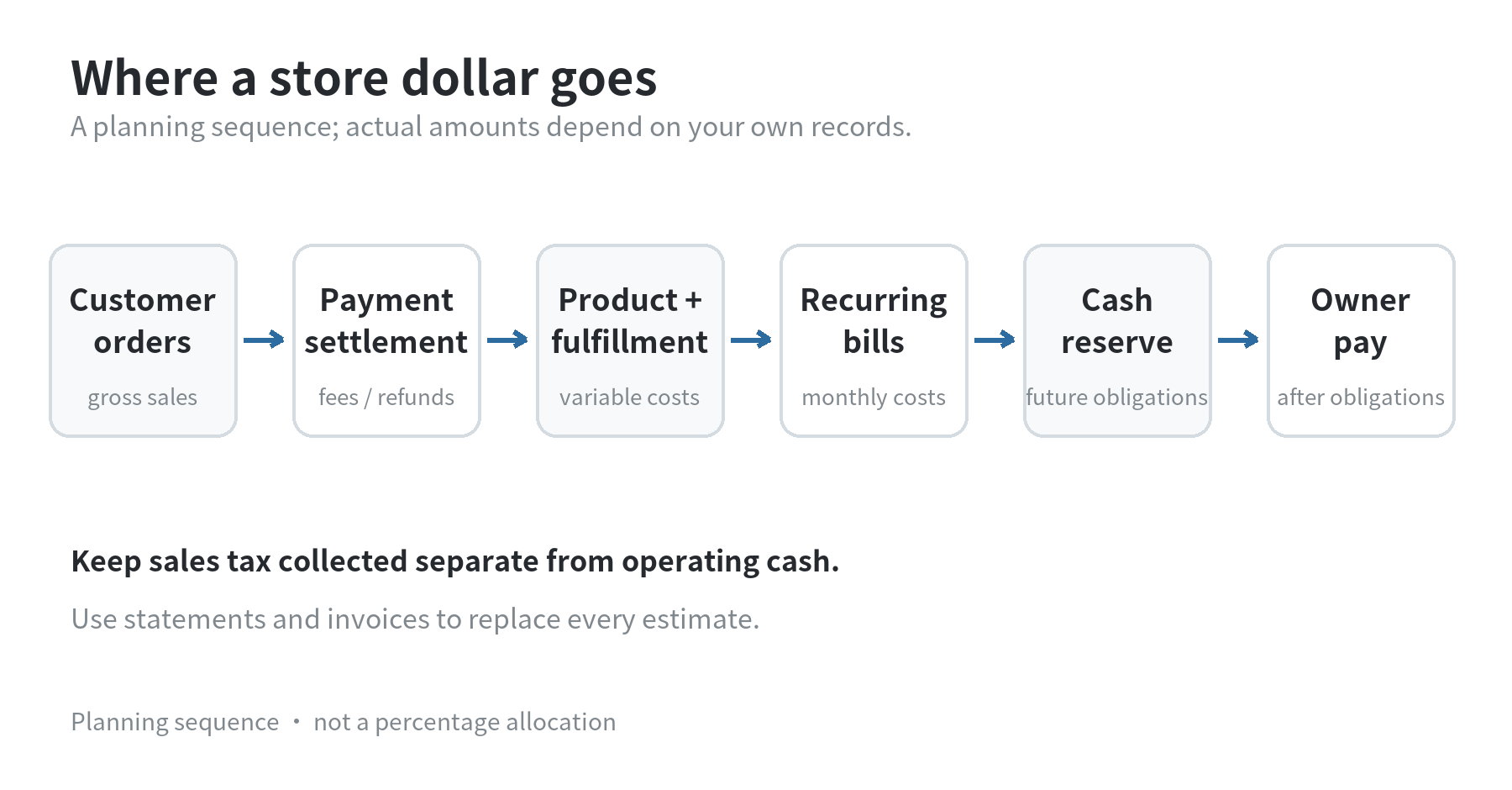
A workable store budget starts by separating money that only passes through your account from money the business can spend.
Set aside product and fulfillment costs, payment fees, recurring tools, taxes, and a cash reserve before deciding what is available for owner pay.
The monthly plan charge is only one line in that picture.
Start with the cash that actually belongs to the business
Record gross orders, refunds, discounts, sales tax collected, and payout deposits as separate figures. A payout is not the same as revenue:
it may already reflect refunds or payment processing charges, while sales tax collected for a tax authority is not operating cash.
Reconcile the store’s order report to bank deposits so you can spot timing differences instead of treating every deposit as new income.
Use a separate business checking account if you can. When personal and store purchases share one account, mark each transaction as business,
owner transfer, or personal. This keeps a transfer to yourself from looking like a store expense and makes the monthly review easier to follow.
Build the plan from completed months, not a sales target. Pull order, refund, ad, shipping, and supplier records for a representative period,
then label each line fixed, per-order, or occasional. If the store is new,
keep the first budget provisional and use actual invoices to replace estimates as they arrive.
Price the recurring bill and the cost per order separately
The help center says annual billing charges the full year upfront, even though it shows a lower effective monthly rate.
Put the billing option you actually select into the cash calendar; do not multiply a yearly rate by one month and assume that is the amount due.
Those are plan and payment costs, not a complete operating budget.
The help center explains that a third-party payment provider can create a separate provider card charge,
while the platform’s own third-party transaction fee varies by plan. The pricing page lists a 2% third-party transaction fee for Basic.
If you use a provider outside the built-in payment service,
model both charges and check the current terms for your account before relying on a fee estimate.
To see what an order contributes, start with the amount collected before tax, then subtract discounts, product cost, packaging and postage you cover,
payment charges, and any order-based marketing or referral cost. A percentage fee rises with order value;
a fixed per-transaction charge takes a larger share of a small order.
Keep this worksheet separate from gross sales so a busy order count does not hide thin contribution per order.
Refunds deserve their own line. The help center says credit card transaction fees are not returned when you issue a refund.
Check the terms for your payment method and include any unrecovered processing cost in your returns estimate instead of assuming the full original
charge comes back.
Give each cost a home in your worksheet:
- Recurring: plan, domain renewal, paid apps, bookkeeping, and any monthly service contracts.
- Per order: product cost, packaging, postage subsidy, payment processing, returns, and marketplace or referral charges if applicable.
- Occasional: photography, samples, equipment, seasonal inventory, and annual renewals.
- Cash held aside: tax obligations, refunds, chargebacks, and supplier invoices due before customer payouts arrive.
Do not count sales tax collected as sales income. Track it in a separate liability line. For filing obligations specific to your business,
consult state guidance or a tax professional.
Use a sample month to find the break-even gap
Here is an illustrative planning example, not an industry average. Suppose the store records $8,000 in completed orders before refunds.
If those orders total 200 card transactions averaging $40, the listed Basic standard rate would produce a sample processing estimate of $292:
2.9% of $8,000 ($232), plus 30 cents for each of 200 transactions ($60). Actual charges depend on payment mix, refunds, plan terms,
and account details, so use the statements for the real budget.
Now add costs using your own records: $3,200 for products, $900 for shipping and packaging, $450 for advertising, $180 for app subscriptions,
and $250 for returns and replacements. With the sample $39 monthly plan charge and $292 processing estimate, those listed costs total $5,311,
leaving $2,689 before taxes, unlisted expenses, and owner pay. That remaining figure is not profit until every cost and obligation is accounted for.
The useful question is not whether the example’s remainder looks large. Ask how many orders you need to cover costs in a slow month,
what each order contributes after variable expenses, and when supplier bills clear relative to payouts.
A lower-sales case can show whether cash reserves cover the gap without borrowing from tax or refund money.
Build a cash calendar around the dates money moves
Profit on a monthly report does not guarantee enough cash on a particular day. Make a simple calendar with expected payout dates, supplier due dates,
subscription renewals, tax set-asides, and large planned purchases. Use the dates from your own payment and billing statements;
payout timing can differ by payment method and account.
Keep a reserve line for refunds, chargebacks, replacement shipments, and inventory that must be reordered before payouts arrive.
Choose a reserve target from your own refund history, supplier terms, and the length of time between paying for stock and receiving customer cash.
When a cost is uncertain, write down the source of the estimate and when you will replace it with an invoice or statement.
For large supplier commitments, note any deposit, balance due date, expected ship date, and planned reorder date.
Cash can be committed before stock is ready to sell, so a month-end inventory total alone will not show whether checking can cover the next invoice.
If supplier terms change, update the cash dates even when the per-unit price stays the same.
If household expenses depend on store income, set an owner-pay amount only after the business has covered due bills and planned reserves.
Move that amount on a schedule and keep it distinct from reimbursements for business purchases. For the personal side of the plan,
see our guide to planning a monthly budget; a separate reserve can also help with unexpected costs, as explained in our emergency fund overview.
Review the budget when actuals arrive
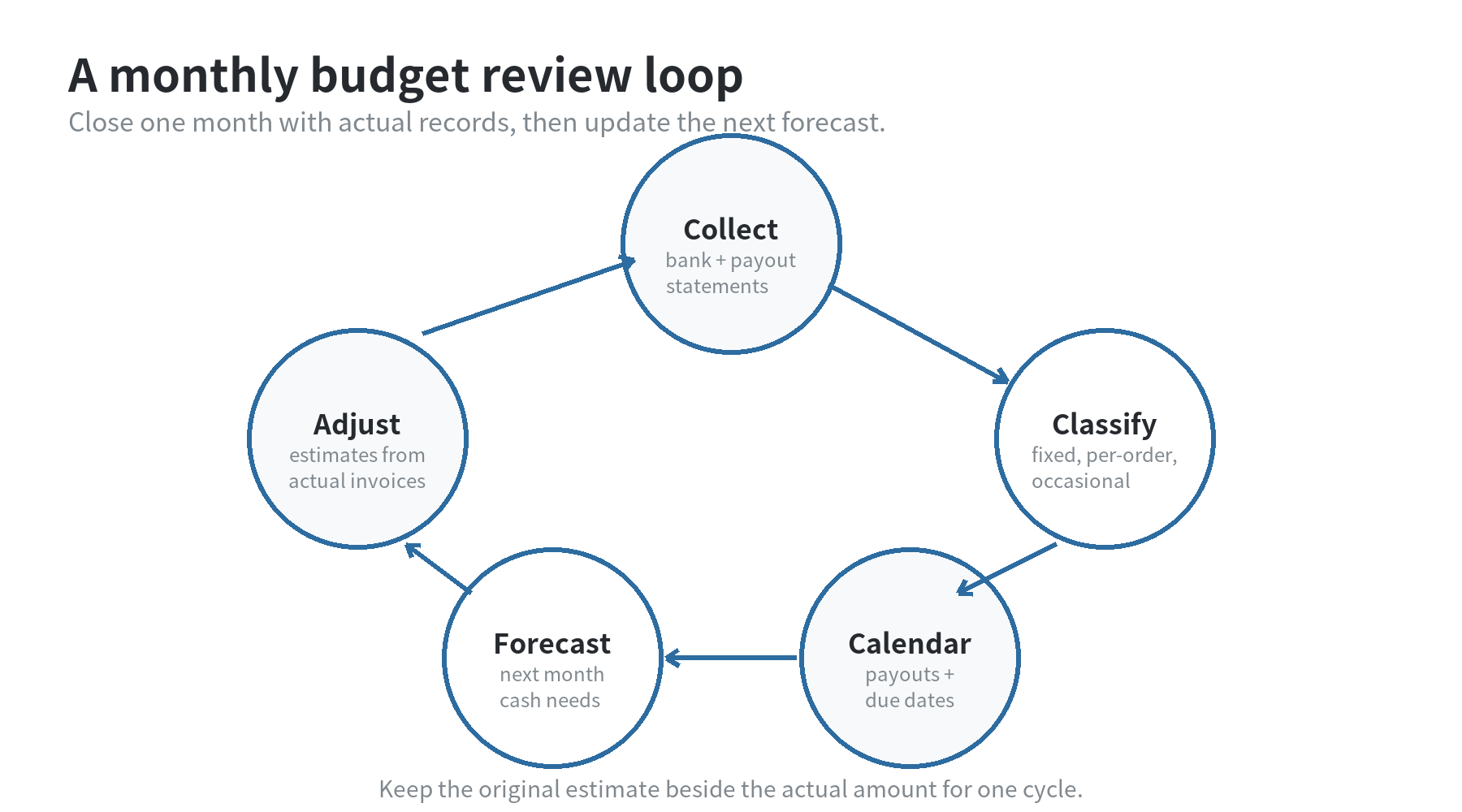
At month-end, compare each budget line with bank activity, processor statements, invoices, and order records. Fix categorization errors first.
Then update assumptions that changed: a new app, a different product mix, more refunds, a shipping subsidy, or a renewal billed annually.
Keep the original estimate beside the actual amount for one cycle so you can see which assumption missed.
Make three short decisions for the next month: which expense is committed, which can be paused or delayed, and what cash must remain untouched.
If sales rise, do not automatically expand every recurring expense.
Check the additional cost per order and the cash needed for restocking before changing the plan.
A store budget is a working cash map. Start with statements and invoices, keep pass-through tax and owner transfers separate,
and revise the forecast as real costs replace estimates. The result is a clearer amount available for the next business decision.
FAQ
Should inventory purchases be listed as one monthly expense?
Track cash paid for inventory separately from the cost of products sold. The purchase date affects cash flow,
while units sold help explain order-level costs; use the records your accountant or bookkeeping system requires for financial reporting.
How should I budget for a yearly app or domain renewal?
Record the renewal date and expected invoice, then reserve a monthly share in your planning sheet.
Replace the estimate with the actual renewal amount when it posts.
What if the payout is lower than the order total?
Compare the order report with refunds, payment fees, adjustments, and payout details for the same period. A payout can reflect timing or deductions,
so reconcile the underlying transactions before changing the sales forecast.
How often should I update a new store budget?
Review cash activity when statements and invoices arrive, then revise the next-month forecast at month-end.
A new store may need more frequent estimate updates while actual supplier and fulfillment costs are still coming in.
Last updated: 2026-09