Build your campus housing budget from the dates money leaves your account, not from one annual total. List the room charge, food arrangement, utilities, deposits, and the months you will actually live there; then match each bill to cash available before its due date. Federal Student Aid says a school’s cost of attendance can include housing and food, but that estimate is not the amount you personally pay. The school’s aid offer and your lease or housing contract answer different parts of the budget question. (Sources checked September 30, 2026.)
Separate the school estimate from your monthly cash plan
Start with the housing figure on your financial aid offer or the school’s cost page. Federal Student Aid describes cost of attendance as a school-specific total that can include tuition, fees, books, supplies, food, and housing. It also says that the cost of attendance is not the same as your net price. The National Center for Education Statistics likewise groups published tuition and fees, books and supplies, and average room, board, and other expenses when presenting attendance costs. Those totals help you compare categories; your own cash plan needs the actual charges, payment dates, and expenses outside the school bill.
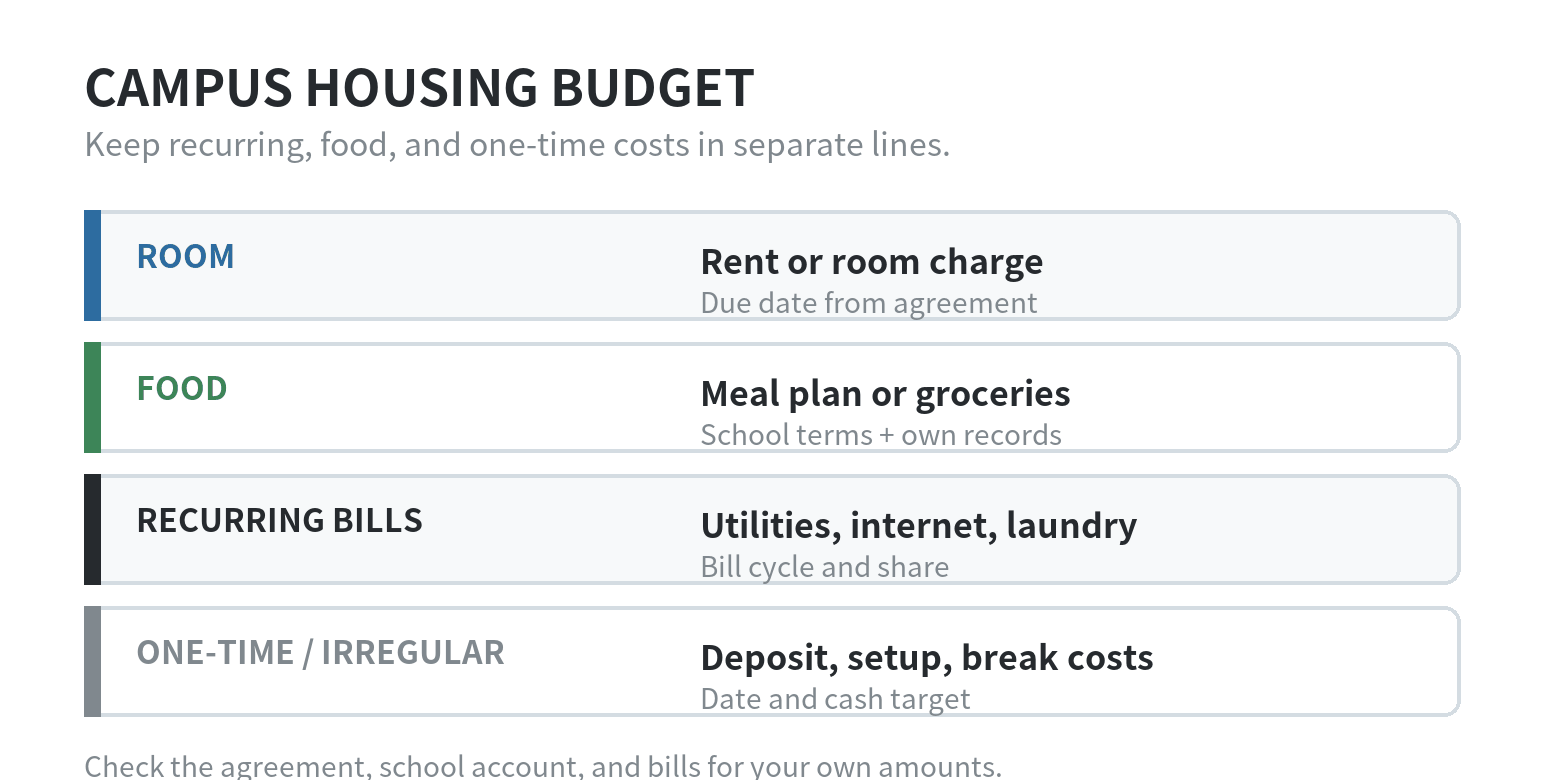
Write down four separate amounts: the room charge, a meal plan or grocery allowance, housing-related bills, and one-time move-in costs. Do not combine a full academic-year estimate with a monthly lease payment. If a housing contract covers nine months but your scholarship refund or job income arrives across twelve months, the totals may look affordable while the timing still leaves a gap.
Turn the contract into a list of due dates
Copy each charge from the lease, residence-hall agreement, or campus billing page. Record its amount, due date, payment method, and whether it repeats. For an off-campus lease, check the lease for the first month’s rent, security deposit, utility responsibility, and any fee written into the contract. For campus housing, check whether the room and meal plan appear together on the student account or on separate schedules.
Keep one-time amounts out of the monthly baseline. A deposit due before move-in belongs in a move-in target, while monthly rent belongs in the recurring plan. If a deposit may be returned later, still budget the full amount as cash you need upfront; a possible future return cannot pay this month’s bill.
A simple ledger can use these columns:
| Cost | Amount | Due | How often | Where to confirm |
|---|---|---|---|---|
| Room or rent | Contract amount | Contract date | Monthly or term | Lease or housing agreement |
| Food plan | Selected plan or grocery limit | School schedule or weekly limit | Term or weekly | Dining plan details or own spending log |
| Utilities and internet | Bill or share | Provider due date | Monthly | Lease and latest bill |
| Deposit and setup | One-time amount | Move-in date | Once | Lease, campus account, receipts |
Use a sample month to expose the gap
Suppose your available monthly cash for living costs is $1,500. For a planning example—not a typical student budget—set rent at $760, utilities at $55, internet at $20, renter’s insurance at $15, groceries at $230, laundry at $30, local transportation at $60, school supplies at $40, and personal spending at $100. Those lines total $1,310, leaving $190 for costs that do not arrive neatly every month.
Now add a $450 deposit due before move-in. The monthly plan cannot cover that charge just because the recurring budget has $190 left. Put the deposit on a separate move-in list and identify when the cash must be available. Replace every sample figure with the amounts in your documents and account history. If your room charge includes utilities, remove those costs from the separate lines so you do not count them twice.
If the sample leaves a shortfall, first identify whether it is a timing gap or a monthly gap. A timing gap means enough money is expected for the term but arrives after a bill is due; a monthly gap means the planned costs exceed cash available during the month. That distinction tells you what to ask the housing office, financial-aid office, or household contributor about. It also helps you avoid treating a loan offer, a pending refund, and pay already received as interchangeable cash.
Match school-year money to the calendar
Draw the months from move-in through the end of the housing agreement. Mark rent, meal-plan charges, utility due dates, paydays, aid disbursements, and breaks when you may still owe rent but no longer have campus meals. Divide an academic-year amount by the number of months you need it to cover only as a planning step; keep the full due date visible beside that monthly set-aside.
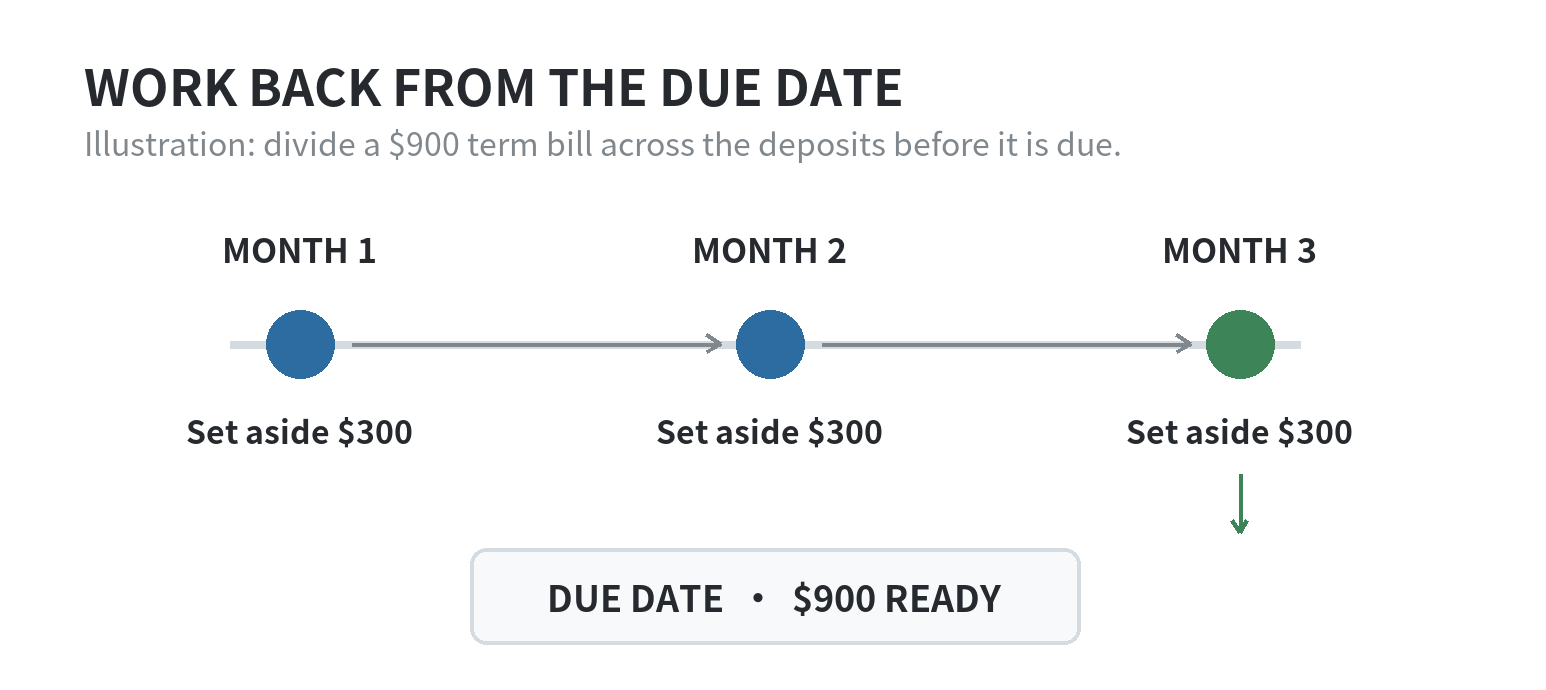
For example, if a $900 bill is due at the start of a term three months from now, setting aside $300 in each of those three months reaches the target. If you have only two deposits before the due date, the required monthly set-aside changes to $450. This arithmetic does not change the bill; it shows whether your current cash schedule can meet it.
Federal Student Aid recommends planning over a defined period, such as a month or academic year, and including income and expenses. Keep aid types distinct in your own calendar: grants and scholarships, loans, and work-study do not have the same repayment or earning conditions. The agency notes that a work-study award does not guarantee a job; pay depends on working in an eligible job. Count wages after they arrive, rather than treating the award amount as cash on hand.
Check what is included before adjusting food costs
A residence-hall meal plan can cover some meals while leaving groceries, snacks, meals during breaks, or meals away from campus in your budget. An apartment budget may need a grocery line plus cooking supplies and shared household items. Check the plan’s terms for the number or type of meals included and the dates it can be used. For groceries, start with your own receipts for the period you are planning, then separate food from household supplies and eating out.
If a roommate shares a utility or internet bill, write down each person’s share and the transfer date. A bill in one person’s name still has a single due date even when several people contribute. Agree in writing on what counts as a shared expense, how you will handle a variable bill, and what happens if someone moves out. Keep your personal account record separate from the group’s running total.
For a simple way to track categories on your phone, see our monthly budget tracking walkthrough. If you want to compare app-based approaches, our budgeting app overview covers the tracking side; your lease and school account remain the sources for housing charges.
Review the budget after the first billing cycle
Once the first rent or room charge, utility bill, and grocery cycle have posted, compare your plan with the amounts actually paid. Change only the line that differs, and note whether the difference is a one-time move-in cost, a seasonal bill, or a repeating expense. A single high bill should not automatically become the monthly assumption; check the bill period and the lease responsibility first.
Before each term, repeat the date check: confirm the housing period, charges, meal access, and aid schedule against current school documents. StudentAid.gov says the financial aid offer lists the types and amounts of aid offered, while the National Center for Education Statistics reports institutional attendance-cost estimates for defined student groups and academic years. These are useful reference points, but neither substitutes for the amount and date on your own housing agreement.
Last updated: 2026-09
FAQ
Should I budget campus housing by semester or by month?
Use both views: keep the semester bill and due date visible, then set aside a monthly share from the cash arriving before that date. This reveals a payment deadline that a monthly average can hide.
What should I do if my housing charge changes after I make a budget?
Replace the old charge with the amount on the updated school account or housing document, then recalculate the cash needed before its due date. Ask the housing or billing office to explain an unclear charge.
How do I budget for campus housing during winter or summer break?
Check the agreement dates first. If rent continues while you are away, keep it in the housing calendar and plan separately for food and travel during the break.
Can a roommate’s contribution count as money I already have?
Count it as available only when it has reached your account. Until then, keep the bill’s full due date on your calendar and record each person’s agreed share separately.