Start with the amount left after bills and planned expenses, then set a total for gifts before choosing individual presents.
A Christmas gift budget is the amount your cash flow can support, not a target you have to reach.
The CFPB recommends counting regular expenses and seasonal plans before deciding what is available for gifts.
Consumer.gov’s Making a Budget page (checked September 30, 2026) explains how to compare income with expenses.
Set the ceiling before you make the list
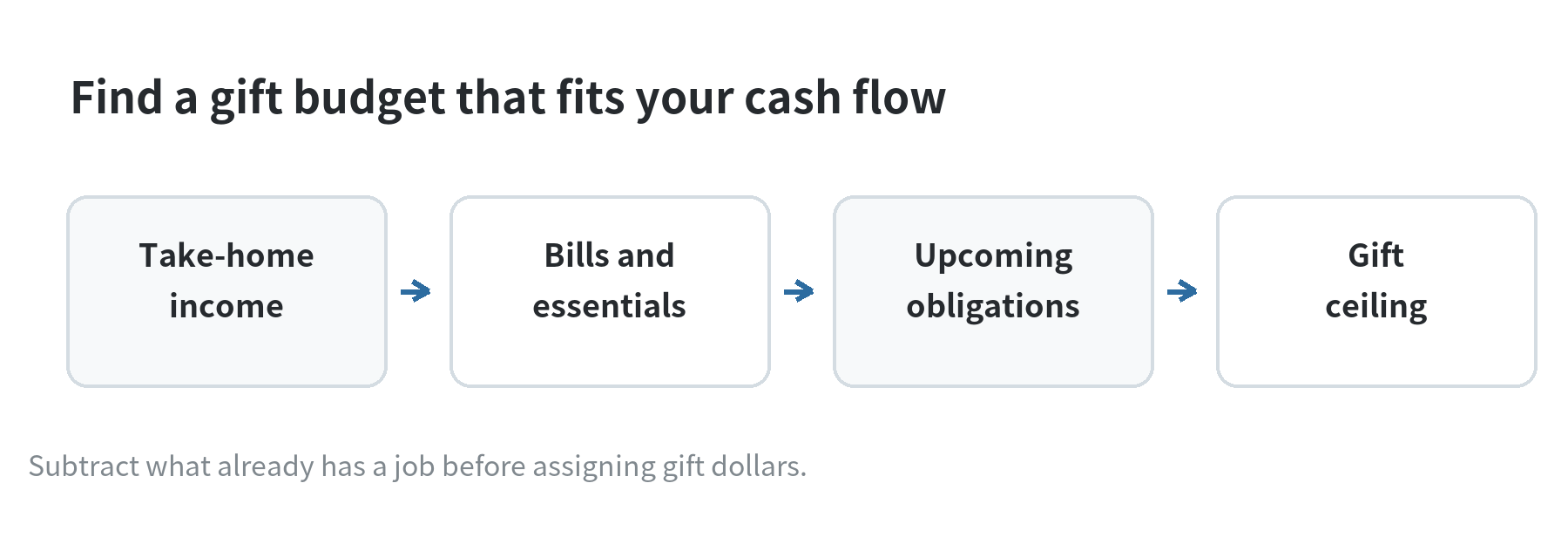
Use take-home income, not gross pay.
Put rent, utilities, food, transportation, debt payments, and savings you have already planned on one side.
Add near-term costs that fall in the same period: travel, a gathering you are hosting, shipping, or decorations.
What remains is the pool for all holiday choices, not just wrapped gifts.
The CFPB’s holiday spending guidance (checked September 30, 2026) puts regular expenses and seasonal plans ahead of the gift amount.
If the remainder is small or negative, lower the holiday total.
You can shorten the gift list, suggest a name exchange, make something, or agree with relatives on a shared limit.
Those are planning choices, not a reason to move money away from rent, groceries, minimum debt payments, or a bill due soon.
Build a list that matches the total
Write down each person, the kind of gift you have in mind, and a maximum amount beside the name.
Reserve part of the total for shared costs such as wrapping, postage, or a group meal if you are paying for one.
A list makes the trade-offs visible: if one person’s plan takes more than expected, you can adjust another line before spending.
For example, suppose your available holiday pool is $360.
You might assign $220 to gifts for four people, $60 to postage and wrapping, and $80 to a family meal.
Use these sample allocations as placeholders and enter your own figures.
If the meal is already covered by someone else, move that $80 deliberately: add it to a gift, hold it for a bill, or leave it unspent.
Do not treat an unused line as permission to make an unplanned purchase.
The CFPB’s holiday spending guidance (checked September 30, 2026) suggests making a gift list and checking off purchases as you go.
Keep the list beside a simple running total so you can see both what remains and what is already committed.
The existing budgeting apps overview can help if you prefer to record spending on a phone; a note or spreadsheet works too.
Convert the total into a saving plan
If the holiday is ahead and the money is not set aside, divide the remaining target by the paychecks due before you need it.
Consumer.gov’s budget guidance (checked September 30, 2026) compares monthly income and expenses.
The CFPB’s holiday guidance (checked September 30, 2026) recommends using expected income to plan what to set aside.
Use only paychecks that arrive before the purchase date.
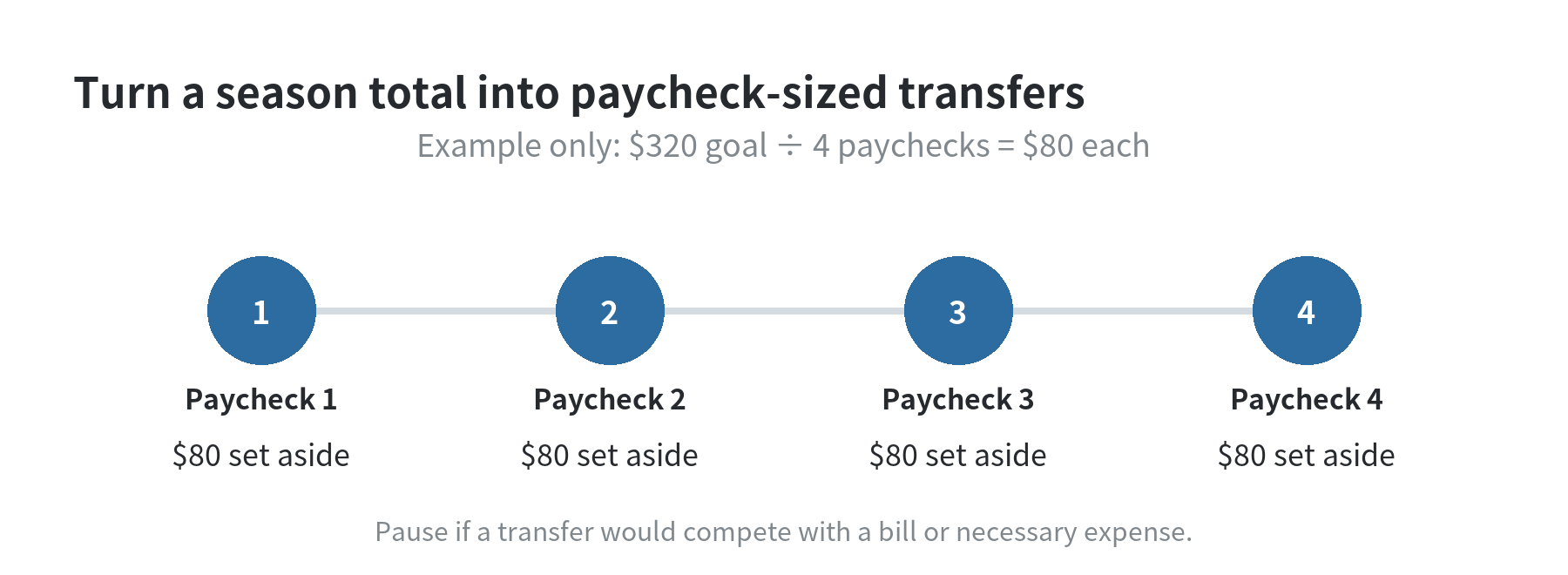
Suppose your gift-and-holiday target is $320 and four paychecks remain before you plan to buy.
Setting aside $80 from each paycheck reaches that total.
If only two paychecks remain, the same target would require $160 from each; if that crowds out essentials, reduce the target instead.
Do not count a paycheck that arrives after the event or money you have already assigned to another bill.
Move each planned amount into a separate savings space or track it as a distinct line in your budget.
A separate label is useful because the same bank balance can include money meant for rent or other bills.
If you already have a holiday fund, subtract that balance from the total before calculating what remains to save.
For a paycheck schedule that changes, use the dates and take-home amounts you can actually count on.
List each expected payday on a near-term calendar.
Subtract the bills due before the next payday.
Transfer only what remains after those obligations.
Keep costs from leaking past the cap
Track the final amount paid, including tax, delivery, wrapping supplies, and any gift card amount you add.
Count added charges as well as the listed item price.
If you pay by credit card, record the purchase when you make it and earmark money for the statement payment.
Before buying an extra item, check the remaining total rather than judging the purchase by its discount. A deal still uses money.
If your list changes, update the amounts first and decide which other line will shrink.
The CFPB’s holiday spending guidance (checked September 30, 2026) advises recording purchases and checking whether spending is staying on plan.
For a hands-on way to collect transactions before setting limits, see the site’s phone expense-tracking guide.
Set one review point after the first round of purchases.
Compare the list with receipts or account activity, correct estimates that were off, and stop if the cap is reached.
If gift costs are higher than planned, choose a lower-cost alternative or give fewer gifts.
Any unpaid card charge becomes a payment in your next budget.
When the budget is too tight this year
A smaller gift total can still be clear and fair.
Tell family what you can spend, suggest drawing names, or agree to exchange food, time, or a handwritten note instead of multiple presents.
The CFPB’s holiday spending guidance (checked September 30, 2026) includes handmade gifts as a possible holiday choice.
Decide the arrangement before shopping so you do not have to renegotiate after someone has already bought a gift.
If bills already exceed income, do not use a gift budget to conceal that gap.
Consumer.gov’s Making a Budget page (checked September 30, 2026) says to list income and expenses, then subtract the expenses.
When expenses exceed income, it suggests looking for costs you can change.
Handle the shortfall in the regular budget first.
Use only money left after required expenses and near-term commitments for holiday plans.
Make room for late changes
A relative may join dinner, a school exchange may be announced, or a family member may add a name after you set the limit.
Before adding a new line, decide whether it replaces an existing gift, comes from an unassigned amount, or means the total must rise.
If there is no room, decline or suggest a shared exchange rather than quietly borrowing from a bill.
When two adults share expenses, agree whether the gift cap is one household total or two personal amounts.
Put shared presents and each person’s individual gifts on separate lines so the same dollars are not promised twice.
If a gift is jointly funded, write down each person’s contribution and who will keep the receipt or track the payment.
Keep required delivery dates and event dates on the list beside the amount.
A present that must be mailed has a different cash deadline from one you plan to hand over at a local gathering.
Use the date to check whether the saving schedule leaves enough time.
If it does not, choose an option you can afford sooner instead of counting on a later paycheck.
After the season, keep the final list and actual total for next year’s starting point.
It will show which expenses you forgot to include and which gifts were funded by someone else.
If saving early makes sense, divide next year’s amount by the paychecks before the holiday.
Include that contribution in a future budget only when it fits alongside bills and other goals.
FAQ
Should I include travel and hosting in a Christmas gift budget?
Count those costs in the overall holiday plan before setting the gift amount.
Travel, meals, or hosting supplies use the same available cash, so give them their own lines and calculate the gift ceiling afterward.
What if I already bought some gifts?
Enter the amount already paid as spending against the holiday total.
Subtract it from what remains, then use the remaining balance to decide whether another gift fits.
Is it better to save weekly or each payday for Christmas?
Use the schedule that matches when your income arrives and when you need the money.
Set aside a specific amount from each available payday or week, and lower the total if that amount conflicts with bills.
Can I use a credit card for holiday gifts?
You can use a card and keep the purchase within the gift limit.
Identify the money that will pay the full statement amount.
Last updated: 2026-09