Budget from cleared sales, not the order total.
A useful seller budget separates platform charges, materials, packing and postage, operating costs, and owner pay.
It keeps enough cash available to make the next batch.
That gives you a working picture of what each product contributes without treating every dollar in a sale as spendable.
Follow the money from order to available cash
A sale total is a starting point.
Refunds, platform fees, shipping purchases, and supply costs affect what remains, while funds can stay pending before they are eligible for deposit.
The official payment account guide distinguishes current funds from pending funds and says deposits are based on the current balance.
Check the balance itself before scheduling a bill or moving money to personal use.
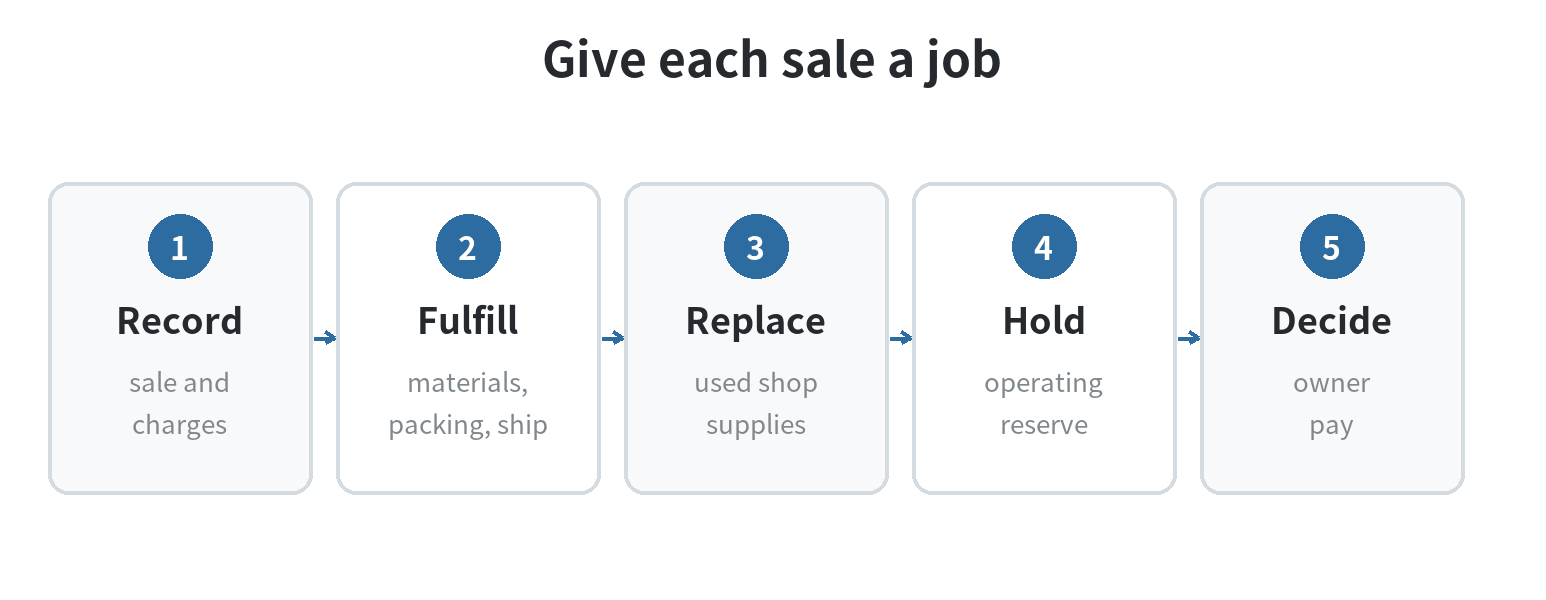
Think of each order as a small cash sequence: record the sale, account for charges, and cover the cost of fulfilling it.
Replace the materials used before deciding what can be paid to you.
The order matters when an order comes in before its proceeds are ready to transfer.
Give each cost its own line
Use a separate ledger line for costs that behave differently.
The official seller fee breakdown lists transaction and payment processing fees, along with listing charges.
It also lists optional advertising, shipping labels, and subscriptions.
The 2025 annual filing lists fees for listings, transactions, payments, advertising, and shipping labels as separate categories.
Both sources checked September 30, 2026.
| Budget line | What to record | How to estimate it |
|---|---|---|
| Platform and payment charges | Listing, transaction, payment processing, currency conversion, and any optional program or ad charges that apply. | Use the amount shown for your own listings, orders, account location, and selected services. |
| Materials and production | Ingredients or components, blanks, tools consumed in production, and paid production help. | Track quantities used per finished item, then multiply by the current replacement cost. |
| Packing and delivery | Mailers, boxes, inserts, labels, postage, and any shipping adjustment. | Keep packing separate from postage so a change in parcel size does not hide the packaging cost. |
| Operating costs | Workspace, software, equipment upkeep, and other recurring shop expenses. | Record the bill when charged and split shared expenses using a consistent method. |
| Owner pay and tax reserve | Transfers for personal use and the amount set aside under your own tax plan. | Choose the transfer rule after operating costs and restocking money are accounted for. |
Do not bury everything in “supplies.” If a tool lasts across many products, keep it distinct from material consumed in one item.
That makes a product’s cost estimate more useful and stops a large equipment purchase from making one week’s orders appear unprofitable.
Keep variable costs beside the product they belong to.
Fabric, clay, ink, or other components used to finish an item move with its unit cost; studio rent and a design program do not.
That distinction helps with two different questions.
For a basic digital ledger layout, see our smartphone budget tracker setup.
Unit costs show whether an individual order leaves cash after fulfillment, while fixed costs show how much the shop needs to cover before owner pay.
Price one item with your own numbers
Here is an example, not a market average: imagine an item sells for $48 and uses $8 in materials.
It takes $6 of packing and postage, with $4 in platform charges recorded against the order.
The amount left before recurring overhead and owner pay is $30.
If you spend $5 of that to replace used materials, $25 remains for overhead, reserves, and pay.
The arithmetic is simple: $48 − $8 − $6 − $4 = $30.
The $4 fee figure is only an example input; use the amount on your own statement.
The official fee breakdown separates fees by type and explains that processing rates vary by country.
A single generic percentage will not describe every seller’s account.
Check the applicable amount in the account record and current official fee details before changing a product price.
Run the same calculation for products with different material or shipping needs.
If two items sell for the same amount but one takes more labor, packaging, or costly components, the remaining amount will differ.
You can include labor as a planning line.
Choose an hourly amount for your time, multiply by time spent making and packing, and inspect the remainder.
Suppose fixed costs on your worksheet total $90 for the planning period.
If each example order leaves $30 before overhead, three orders cover that bill before other expenses.
This arithmetic does not predict sales; it shows why fixed costs belong below product costs in the budget.
Separate making time from packing time if they vary by product.
A batch that takes little time to assemble can still require careful finishing, custom packaging, or extra order preparation.
Keep a buffer for the next production cycle
Sales and cash availability do not always line up.
The account guide says pending funds include recent sales still processing and funds held in reserve.
It also says that seller status affects when money becomes available.
A reserve can hold a portion of funds from physical-item sales before deposit, according to the reserve explanation.
Checked September 30, 2026, these rules mean your budget should track pending and current balances separately.
Set a minimum working balance using your own next-cycle needs.
For example, if the next batch needs $120 in components and $35 in packing materials, replenish $155 before taking an owner transfer.
These figures are an example to replace with your supplier receipts.
A simple calendar can show when materials must be paid for, orders need postage, and sales funds become available.
Put supplier due dates and postage purchases on the same calendar as expected deposits.
That view can reveal a cash gap even when the worksheet shows that a product leaves money after its costs.
Separate committed money from flexible money.
A pending deposit is not ready to pay a supplier, and cash set aside for an open order already has a job.
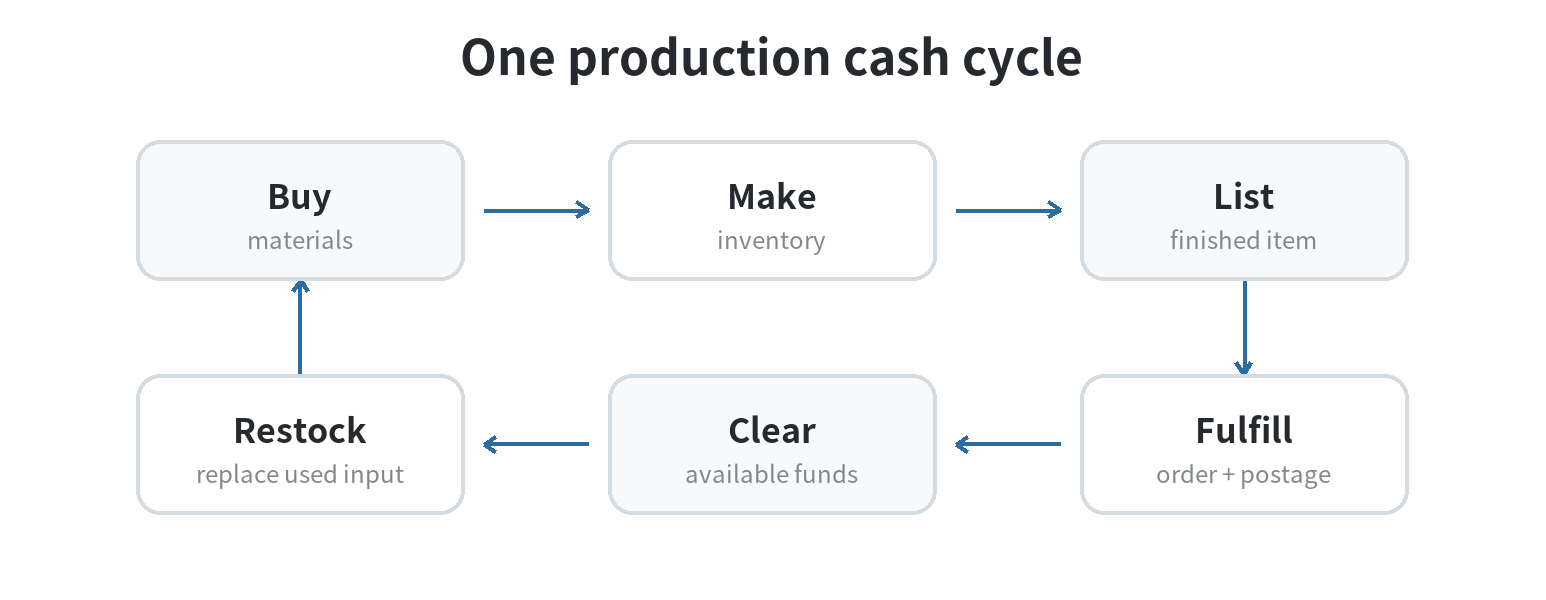
If you make products in batches, estimate the materials needed for the next batch before placing the next order.
Use the actual quantities on your bill of materials rather than a broad percentage of sales.
For made-to-order work, budget the material needed to fulfill open orders first.
For ready-to-ship inventory, track what has already been made and the supplies needed to restore that stock.
Reconcile the budget against the statement
Use the platform’s payment account activity as the source record for platform charges and deposits.
Add costs paid elsewhere, such as materials and postage bought from another provider.
The account guide says the activity summary separates sales, fees, refunds, shipping label purchases, and buyer sales tax remitted.
It also describes downloading a monthly statement as a CSV for review.
Compare that record with your ledger at month end and correct estimates using the actual amounts.
When a line changes, find the event behind it: a renewal, an ad charge, a refund, a larger parcel, or a supply-price change.
Update just that assumption in your unit-cost worksheet.
For optional subscriptions or programs, include the current recurring charge in fixed costs.
Compare it with the tools or credits you actually use, then check the current subscription details and terms in your account.
For each product, save the date and source for a supplier quote when you update material costs.
This gives you a clear reason for the change when you compare two versions of the worksheet later.
Keep estimates and actuals in separate columns.
An estimate helps set a price or plan a batch; the statement and receipts show what the order actually cost.
If postage repeatedly differs from your estimate, compare parcels by size and destination zone using your own purchase records.
Adjust the shipping assumption for the affected product rather than changing every item at once.
Keep one version of the worksheet for each product type and revisit it when a material, package, or fee changes.
Your next step is to enter one real order, its actual charges, and the replacement cost of its materials.
For household bills outside the shop, see our monthly budget planning overview.
Once that order reconciles, use the same lines for the rest of your catalog.
FAQ
How should I budget when sales change from week to week?
Base planned spending on money already cleared and bills already known.
Keep pending proceeds in a separate column, and delay optional transfers until the current balance can cover fulfillment and restocking.
Where do I record a subscription or seller program?
Record a recurring program charge as a fixed operating cost, then review its current terms and charge in your account.
Keep it separate from per-order fees so its cost does not get counted twice.
Should shipping supplies and postage be one budget line?
Track them separately.
Packaging is a material cost and postage is a delivery charge.
Separate lines help identify which part changed when an order costs more to fulfill.
What should I do if my statement shows a negative balance?
Pause owner transfers and reconcile charges, refunds, and pending sales against the statement.
The official account guide explains that a negative current balance can prevent a deposit while pending earnings may still be processing.
Last updated: 2026-09