Budget adoption costs by timing each expected payment, the money you can use before that date, and any assistance that is confirmed in writing. Start with the route you are considering and its itemized estimates; Child Welfare Information Gateway’s guide to adoption assistance points readers to state-specific policies, so a single national price is a poor planning target.
Keep adoption spending in a separate ledger from your regular household budget. That makes it easier to see what is already committed, what still needs a quote, and whether you can cover a bill before any reimbursement or tax benefit arrives.
Start with the payment schedule, not a headline total
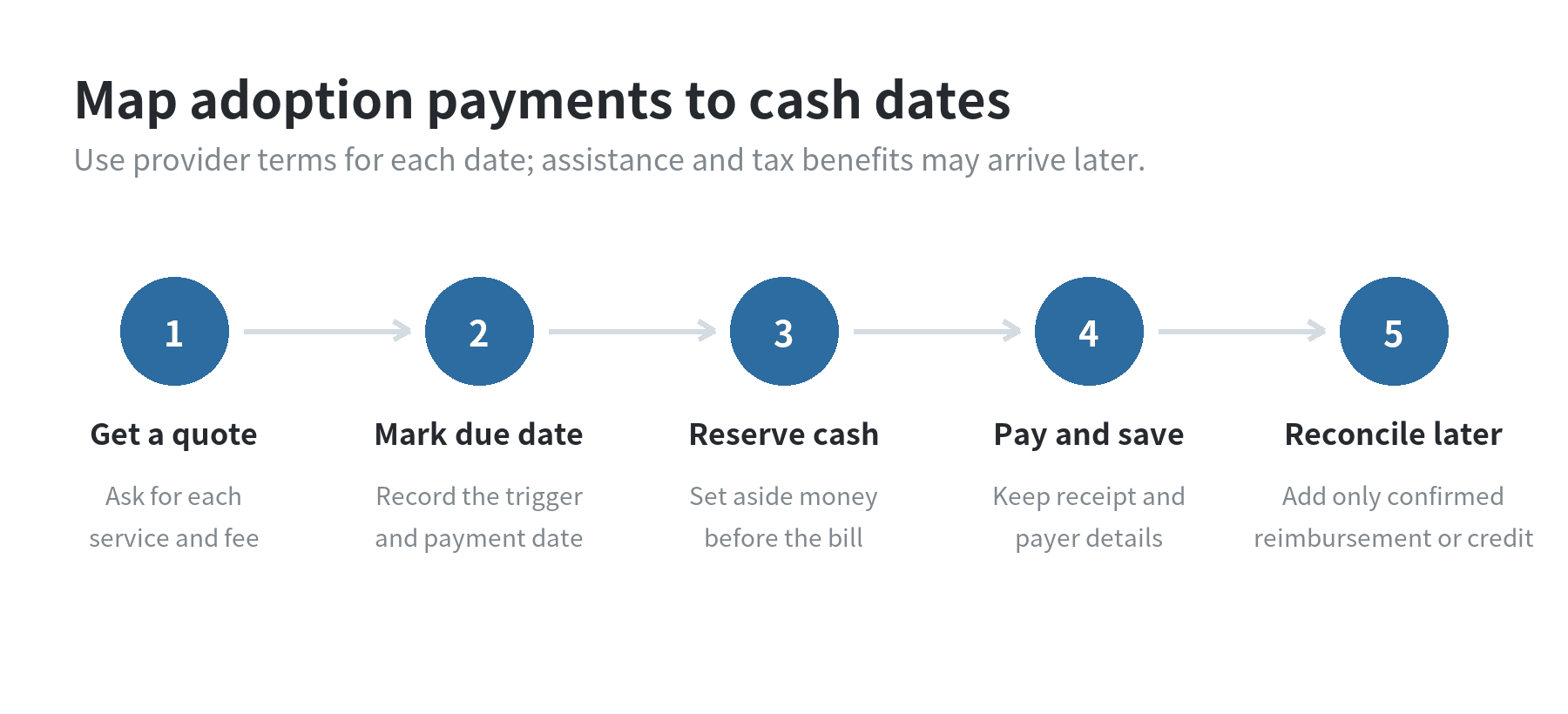
Ask each agency, attorney, or public child-welfare office for an itemized written estimate. For every line, record the service, estimated amount, due date or trigger, whether it can change, and whether it is refundable if plans change. The IRS adoption-credit page lists adoption fees, attorney fees, court costs, qualifying travel, and some home-study expenses among expenses that may qualify for the federal adoption credit; that tax list is not a quote for what your provider will charge.
Then place expected bills on a calendar beside paydays and existing household bills. The Federal Trade Commission’s consumer.gov budget worksheet starts with bills, income, and subtracting expenses from income; the Consumer Financial Protection Bureau also recommends checking account history and including less frequent costs in a realistic budget. Use those records to find a monthly amount you can set aside without missing rent, utilities, debt payments, or ordinary savings.
Separate committed bills from uncertain ones
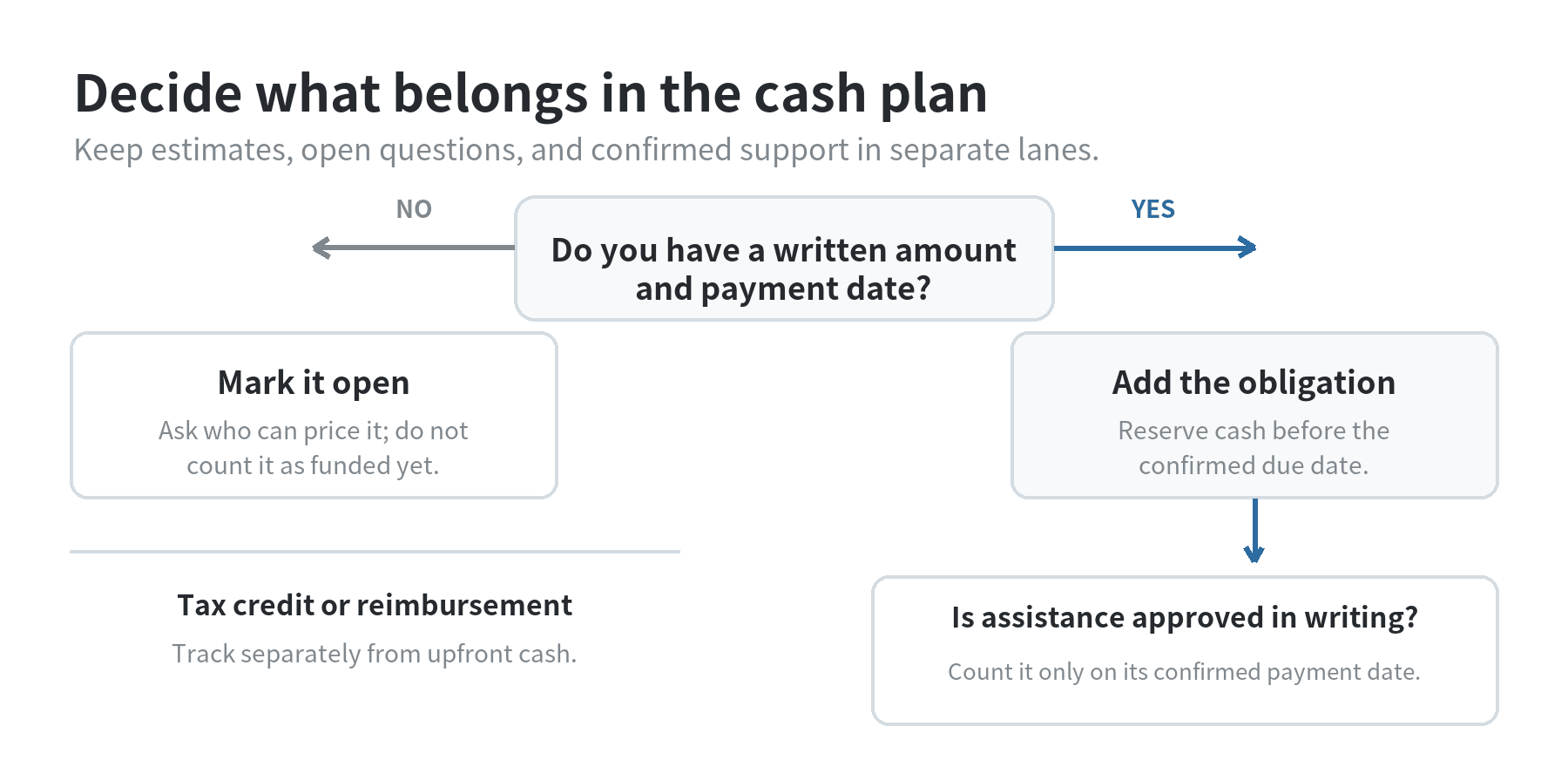
Create three running totals: confirmed charges, quoted but changeable charges, and costs with no estimate yet. Put a source beside each figure, such as a signed agreement, email from the provider, court fee schedule, or travel estimate. When an item has no quote, mark it “unknown” and ask who can price it; do not fill the gap with an online average that may describe a different route or location.
Keep a contingency line for changes you can name, such as an extra trip, a document that needs another copy, or a legal step whose fee is still being confirmed. Choose the amount from your household’s available cash and the provider’s answers. If you cannot set a defensible amount yet, keep the line visible as an open question instead of treating it as covered.
Record whether the payment is due upfront, after a milestone, or after the adoption is finalized. A cost that may later be reimbursed still has to be paid when it comes due. Keep reimbursement paperwork and the original receipt together, and do not reduce the cash target until the paying program confirms the amount, eligible expense, and payment timing.
Build a month-by-month cash bridge
Write down the balance already saved for adoption, each planned monthly contribution, and every known payment date. Your running balance is the prior balance plus new contributions, minus bills due before the next contribution. This simple cash bridge answers a different question from “Can we afford the total?”: it shows whether the money will be available on the day a payment is due.
For example, use the FTC’s budget worksheet to lay out a fictional month: a household with $4,700 in take-home pay might assign $3,250 to current bills, $700 to flexible essentials, $500 to an adoption reserve, and $250 to an emergency cushion. The categories add to $4,700; this is an arithmetic example, not an adoption cost estimate. Replace every figure with your own statement history and payment estimates.
| Monthly plan (fictional) | Amount | What it covers |
|---|---|---|
| Existing bills | $3,250 | Housing, utilities, insurance, debt minimums |
| Flexible essentials | $700 | Food, transport, household needs |
| Adoption reserve | $500 | Cash for quoted adoption payments |
| Emergency cushion | $250 | Unexpected household bills |
| Total take-home pay | $4,700 | Example only |
Check assistance before treating it as income
If you are considering adoption from foster care, ask the public agency about nonrecurring expense reimbursement and adoption assistance before agreeing to costs. Child Welfare Information Gateway says a child’s circumstances determine eligibility and that state policies differ; the agency can explain the applicable program and put any approved support into an agreement. Keep an estimate without that help beside a second version that includes only confirmed support.
Ask your employer whether it has a written adoption-assistance benefit, which expenses it covers, how to submit receipts, and whether payment comes before or after you pay the provider. The IRS adoption-credit page says employer-provided adoption benefits may be excluded from income under program rules, and the benefit has to be considered before calculating a credit for the same expenses. Treat that benefit as a source with its own paperwork and expected date, not as money already in checking.
Do not use the federal adoption credit as the down payment for an agency contract. It is claimed through a tax return, so the timing depends on tax rules and when the adoption and expenses qualify. The IRS Form 8839 instructions distinguish domestic from foreign adoption timing; a tax credit can change the eventual tax calculation but does not pay an invoice due this week.
Use the tax credit as a later adjustment
For tax year 2026, the IRS lists a maximum adoption credit of $17,670 per qualifying child, with up to $5,120 potentially refundable. The available credit begins to phase out above modified adjusted gross income of $265,080 and is fully phased out at $305,080 or more; the figures were checked on September 30, 2026 against the IRS’s inflation-adjustment materials. These are tax-year limits, not a promise that a particular household will receive those amounts.
Qualified expenses can include adoption fees, attorney fees, court costs, travel, and other expenses directly related to the legal adoption, but expenses reimbursed by an employer or paid by a government program do not qualify for the credit, according to the IRS adoption-credit page. The IRS says domestic adoption expenses are generally claimed in the year paid if the adoption is final, or the following year if it is still in progress; foreign adoption expenses are claimed once the adoption is final. Those timing rules make it important to save receipts by payment date and identify who paid each charge.
Before filing, match the expense ledger against employer benefits, reimbursements, and prior credit amounts for the same adoption. Complete Form 8839 using the instructions for the tax year involved, and consult a qualified tax professional if you need help applying the rules to your own return. The IRS’s adoption page and form instructions contain the current filing steps; do not put a possible tax refund into the monthly cash bridge until it is actually available.
Reset the budget when placement is near
Once placement timing becomes clearer, keep the adoption ledger but open a separate household-startup list. Add only items your family expects to need, using your own plan and available space: a safe place to sleep, clothing, transport needs, and ordinary household supplies. Price those items from your own estimates and decide which can wait until after the first month.
Review the new budget against take-home pay after placement, since work schedules, leave, travel, and recurring household costs may change. The CFPB’s spending guide recommends comparing a budget with take-home pay and checking account records when the balance does not match the plan. Make the comparison with actual deposits and bills as they arrive, then move money between categories before a shortfall becomes an overdue payment.
For a broader household plan, see our guides to budgeting around family leave and organizing a family budget.
FAQ
Can I use an adoption tax credit to pay agency fees upfront?
No. The adoption credit is claimed on a federal tax return using Form 8839, so budget to pay invoices from available cash and account for any tax effect later. The IRS’s adoption-credit page explains when qualified expenses may be claimed.
Does adopting from foster care mean there will be no costs?
No. Child Welfare Information Gateway says assistance eligibility depends on a child’s circumstances and state policies. Ask the public agency which expenses may be reimbursed, what must be approved first, and when funds would be issued.
Can employer adoption benefits and the adoption credit cover the same bill?
No. The IRS says employer benefits must be applied before calculating the credit, and expenses reimbursed by an employer are not qualified expenses for the credit. Keep a payer column in your records for each receipt.
What should I do if the adoption estimate changes after I start saving?
Update the ledger with the new written quote, due date, and reason for the change, then recalculate the balance before the next payment. Ask the provider whether a payment schedule can change before using credit or delaying an essential household bill.
Last updated: 2026-09