Start with the amount you would actually pay, not a national “therapy price.”
Check your plan’s mental health benefits and ask the provider for an in-network or self-pay estimate.
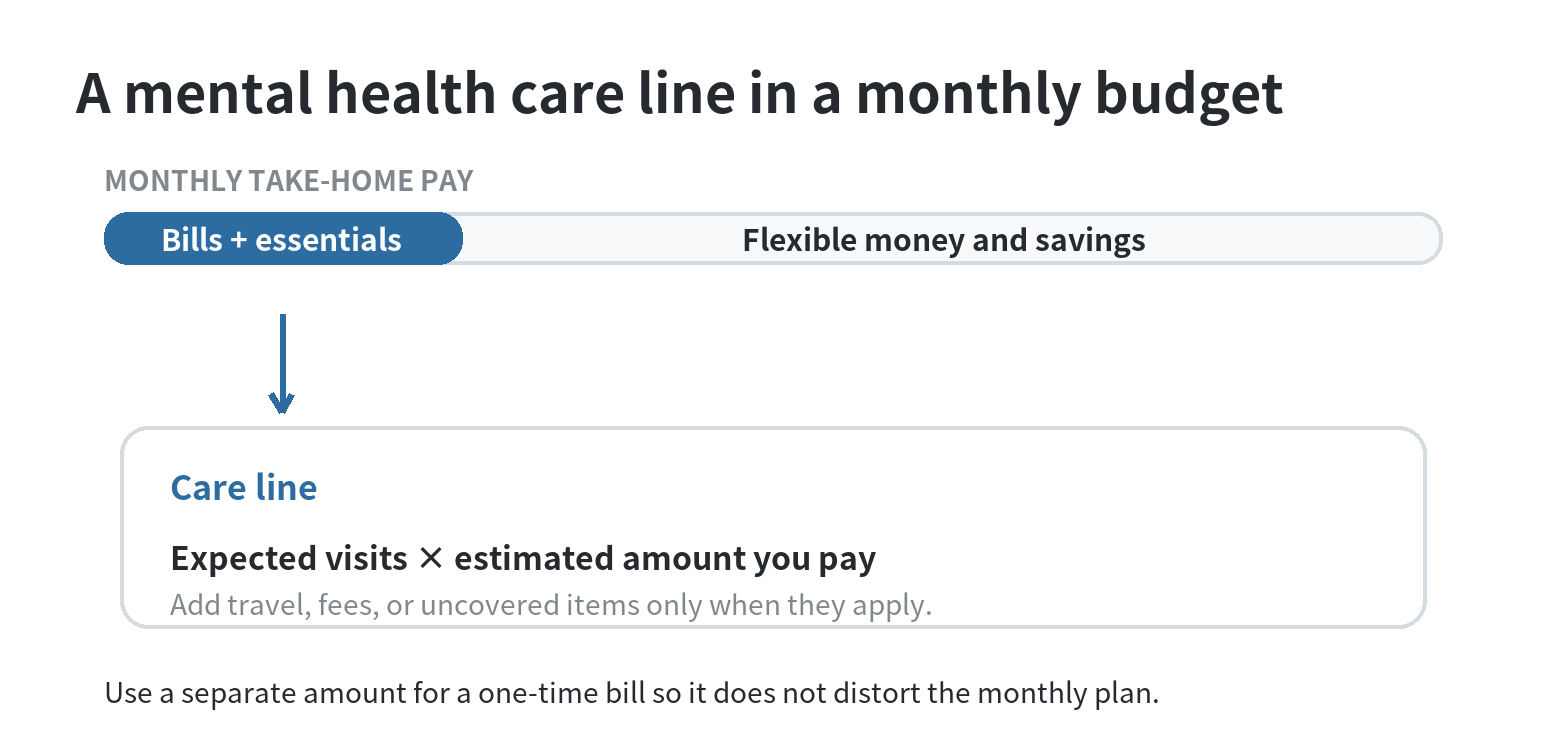
Multiply that amount by the visits you plan to budget for.
Keep a separate reserve for a deductible, intake charge, or bill that arrives later.
Build the estimate from your own plan
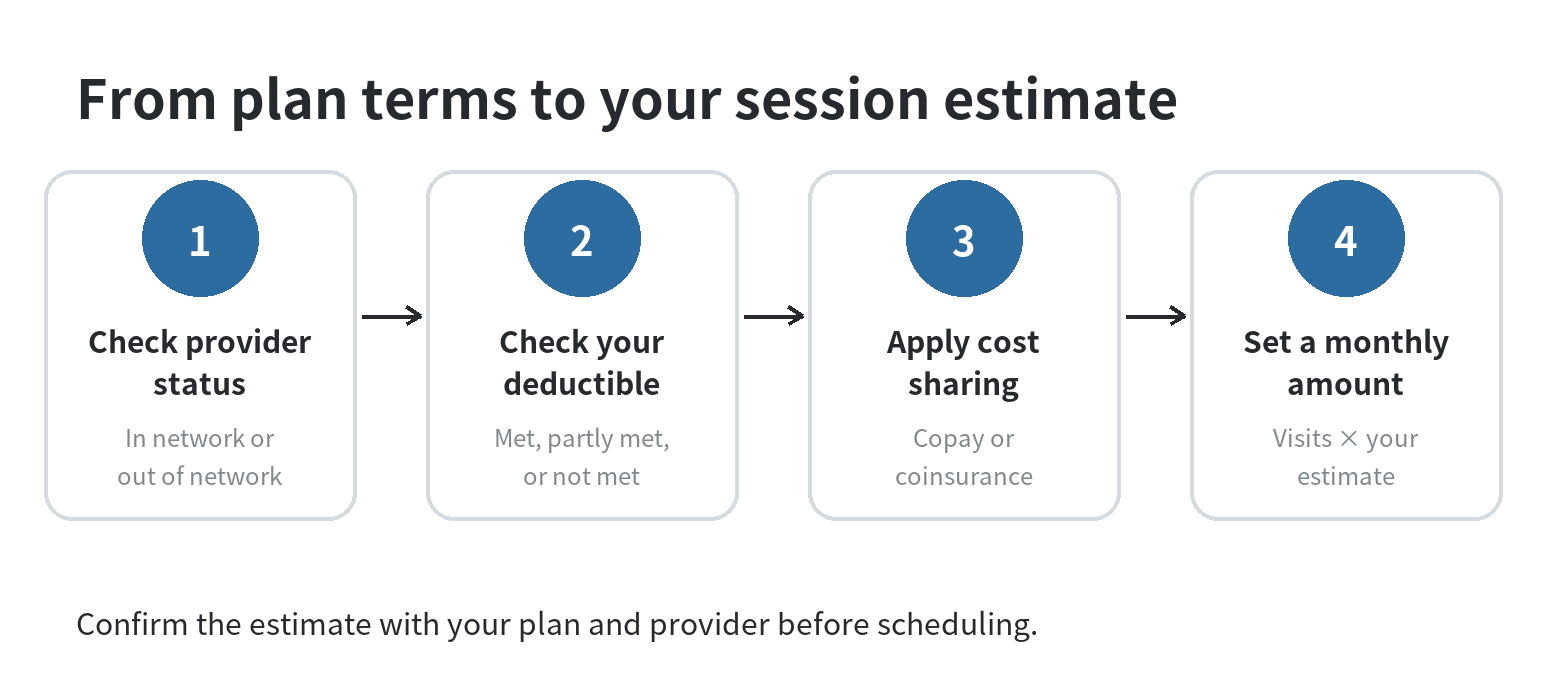
Write down the provider’s name and whether the office is in your plan’s network.
Then ask the insurer what applies to outpatient mental health visits: deductible, copay, coinsurance, visit limits, prior authorization, and the out-of-pocket maximum.
HealthCare.gov explains that Marketplace coverage includes mental health and substance use services, while the exact benefits depend on the state and plan.
The plan document and a current benefit check are the useful numbers for your budget.
Ask the insurer to price the specific service and provider, not just “therapy.”
An intake visit, follow-up, group visit, and hospital outpatient service can be processed differently.
Ask what billing code or service description the office expects to submit.
Confirm whether the clinician is in-network and whether the estimate assumes you have met your deductible.
Record the representative’s name or reference number with the call date.
If you have Medicare, use the relevant Medicare coverage page and your plan details.
Medicare.gov says Part B outpatient mental health costs depend on the service and setting; the page explains the deductible and coinsurance rules for covered visits.
A hospital outpatient department may add a facility copayment or coinsurance (Medicare.gov cost details).
Do not use a Medicare example to estimate an employer or Marketplace plan.
Turn a visit estimate into a monthly line
Once you have a per-visit figure, choose a planning amount for the month.
If your plan quotes a $35 copay for each of two planned appointments, the example total is $70 before travel or other charges (HealthCare.gov explains copayments).
That is a sample calculation, not a typical price.
HealthCare.gov describes copayments as fixed amounts and coinsurance as a percentage of covered costs; your summary of benefits tells you which applies.
| Budget piece | How to fill it in | Example only |
|---|---|---|
| Expected visits | Use the schedule you and the provider discuss | 2 in a month |
| Amount you pay per visit | Use the plan or provider estimate | $35 each |
| Visit subtotal | Visits multiplied by your estimated share | $70 |
| Other costs | Add only costs that apply to you | Transit: $10 |
| Planned monthly line | Subtotal plus applicable extras | $80 |
Give the line a clear name, such as “outpatient mental health,” rather than mixing it into general medical spending.
If the final claim is lower than the estimate, leave the balance in the category for a later bill or move it during your next budget review.
If the estimate is higher, update the next month instead of treating the difference as a personal failure.
Keep irregular bills out of the monthly guess
Separate predictable appointments from costs that do not arrive every month.
Examples include a deductible reset at your plan-year boundary, an out-of-network claim, a missed-appointment charge, or a facility fee.
First confirm that each item applies to your coverage and provider; do not add a fee just because another office charges it.
Put a confirmed one-time amount in a sinking-fund line and spread it across the months before it is due.
For example, if an office confirms a $240 bill due over four months, the monthly reserve is $60 (a cost-sharing calculation).
That is simple arithmetic (HealthCare.gov explains cost sharing).
Keep this reserve distinct from the regular visit line.
An unusual bill should not become your assumed cost for every future visit.
Ask about the billing calendar as well.
A visit may happen in one month while the claim or statement is processed later.
Keep a “pending medical bills” note with the service date, provider, expected amount, and whether insurance has processed it.
Compare the explanation of benefits with the provider’s bill before changing your budget.
Compare coverage without focusing only on premiums
If you are choosing or reviewing a Marketplace plan, compare the cost of coverage plus likely care, not the monthly premium alone.
HealthCare.gov’s plan-cost explanation includes premiums, deductible, copayments or coinsurance, and an out-of-pocket maximum.
Use the site’s plan estimate as a comparison aid, then verify the behavioral health benefit details in the plan documents.
These estimates depend on the care assumptions entered, so they are not a quote for a specific clinician.
For employer coverage, check the Summary of Benefits and Coverage and the behavioral health section.
Look for separate in-network and out-of-network deductibles, telehealth terms, covered provider types, and approval requirements.
If the wording is unclear, ask the insurer to explain a sample claim using your provider and service.
Record the answer before making your budget.
For an out-of-network estimate, ask whether the plan covers any part of the claim and whether a different deductible applies.
Ask what allowed amount the plan will use and what share could remain yours (HealthCare.gov defines cost sharing).
Ask the office whether it can provide an itemized receipt or superbill.
Add only amounts confirmed by the insurer and provider; do not assume reimbursement equals the quoted charge.
When comparing two plans, keep your assumptions identical: same number of visits, same provider status, same service type, and same coverage year.
One simple worksheet can show the premium you pay across the year alongside estimated care spending.
Avoid counting an out-of-pocket maximum as a guaranteed bill; it is a limit for covered services under plan rules, not a price for care you have not received.
Ask about a lower self-pay amount or assistance
If you will pay out of pocket, ask the office for its fee, what the fee includes, when payment is due, and whether it offers a sliding scale.
The American Psychological Association’s therapist-selection guidance recommends asking about fees, insurance, and sliding-scale options.
Ask whether the quoted fee applies to an intake and later visits, and whether paperwork or cancellation rules create separate charges.
Check whether the fee reflects the visit type and length you discussed.
Call again if your plan or the provider’s quote changes.
If the quote does not fit, ask whether the office has a lower self-pay rate, reduced-fee slot, or payment arrangement.
You can also check community clinics, university training clinics, employee assistance benefits, or public programs in your area.
SAMHSA lists insurance, public coverage, and lower-cost options (its payment guide).
Eligibility and availability depend on the program and location.
Request the complete amount you would owe before agreeing to a payment schedule.
A written estimate is easier to budget than a broad range.
Save the date, contact, visit type, network status, estimated amount, and any conditions attached to it.
Recheck after a plan change or when the office says its fee has changed. When you call again, note the network status and deductible assumed in the quote.
Give the category a review point
Review the line when the insurer processes a claim, your appointment schedule changes, or a new plan year begins.
Compare what you set aside with the actual patient responsibility, then update the next month.
If the bill is still pending, keep that amount reserved rather than counting it as available spending.
A simple spreadsheet or phone-based budget can keep the estimate, bill date, and paid amount together.
If you already track household categories on your phone, see our smartphone budget tracker guide for a basic record layout.
For a broader method of assigning bills to categories, our guide to planning a monthly budget with a phone offers a separate budgeting workflow.
FAQ
Can I use a national average to set my therapy budget?
Use a provider quote and your own coverage instead.
Ask about fees using the APA’s therapist-selection guidance and check benefits with your insurer (HealthCare.gov coverage overview).
What should I ask before an out-of-network appointment?
Ask the insurer whether the service is covered, what deductible and coinsurance apply, whether you need authorization, and what documents are needed for a claim.
Ask the provider for the full self-pay fee and a receipt with the information your insurer requires.
How do I budget while an insurance claim is pending?
Keep the estimated patient share reserved until the insurer processes the claim and the provider sends a bill.
Match the bill to the explanation of benefits, then update the category with the amount you actually owe.
What if I cannot afford the amount quoted?
Tell the provider the monthly amount you can plan for and ask about a sliding scale, reduced-fee appointments, payment terms, or referrals to lower-cost programs.
SAMHSA’s treatment-payment information also points readers toward public coverage and lower-cost service options.
Last updated: 2026-09