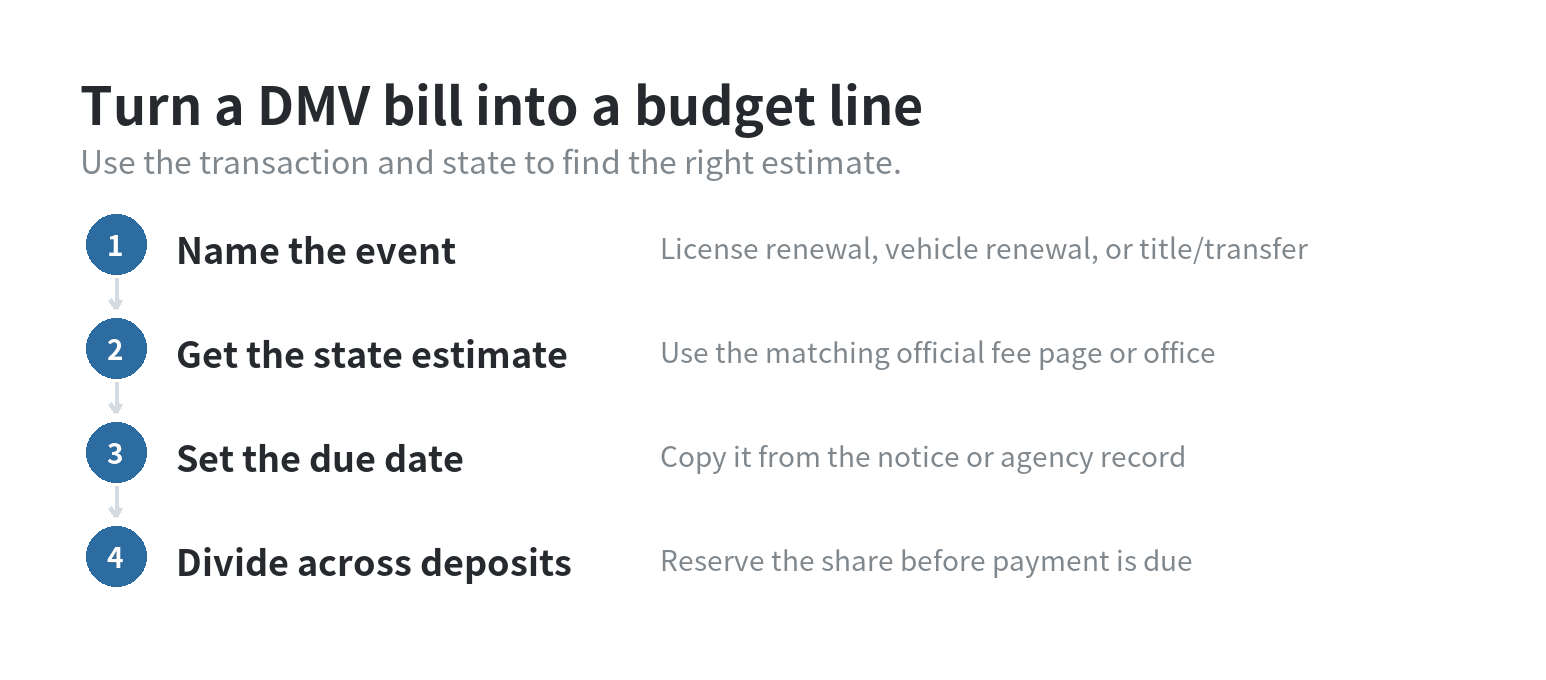
Budget DMV costs by event, not as one mystery bill: separate driver-license renewals from vehicle registration, get the current amount from your state agency, then reserve part of it from each paycheck before the due date. A renewal notice is a useful starting point, but a move, vehicle purchase, plate choice, or overdue balance can change what you owe.
Keep the budget flexible until you have the official estimate. California DMV lists several factors that affect vehicle registration fees, including vehicle type, value, location, weight, and plates; TxDMV says its total can vary by vehicle and county. Those state examples show why a neighbor’s bill or a national average is a poor substitute for your own record. (Sources checked September 30, 2026.)
Separate the license from the vehicle
Start with two lines in your budget: personal licenses and vehicle paperwork. A driver-license renewal is tied to the person and the license type. Registration, title, plates, and related vehicle charges are tied to a vehicle or a transaction. California DMV publishes separate driver-license fee and vehicle-registration fee pages, which makes the distinction clear (checked September 30, 2026).
Give each person a license line and each vehicle its own registration line. Write the expiration date beside the matching item. If two adults share a car, do not split the registration estimate into two entries; record the bill once and note which account will pay it. A separate note can show how the household shares the cost.
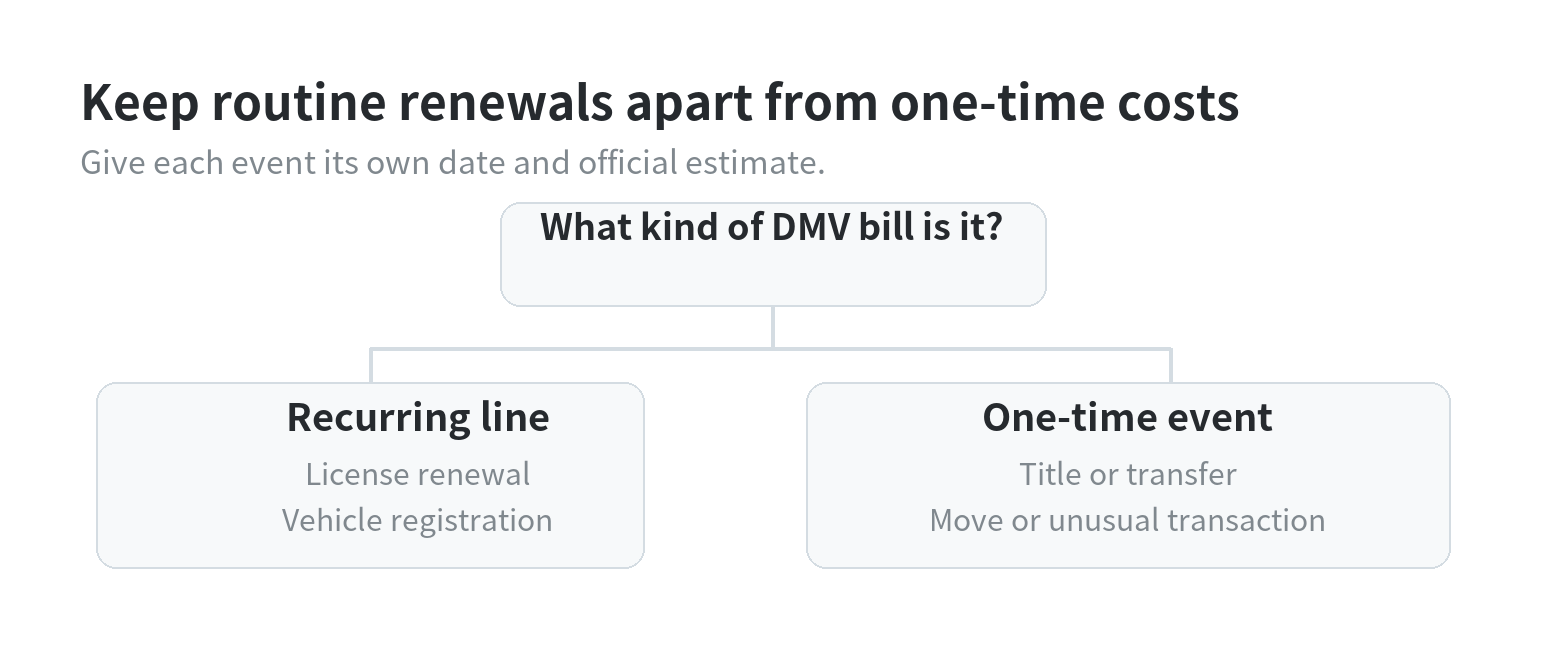
Do not fold a newly purchased vehicle’s title or transfer paperwork into the regular renewal estimate. Treat it as a one-time setup event until the state’s exact transaction estimate is available. A move to another state also deserves a separate line: the new agency may require a different registration process, and the old state’s renewal amount will not price the new transaction.
Read the bill as a list of parts
When a renewal notice arrives, save the full notice rather than copying only its total. Put each named charge into a short worksheet: base registration, local or county charges, plate or vehicle-specific items, inspection-related charges if listed, and any unpaid citation or late amount. Mark optional donations separately so a donation is not mistaken for a required fee.
California DMV’s registration page lists separate fee categories such as registration, vehicle license, transportation improvement, and county or district fees. TxDMV describes a base registration fee and local fees, and says some line items depend on vehicle type or the counties involved (both checked September 30, 2026). Use the labels on your own official notice; one state’s labels should not be copied into another state’s worksheet.
For the budget, distinguish a known charge from an open question. Put the quoted amount in the “confirmed” column. Put an unknown plate, inspection, or local charge in “check with agency,” then update the estimate after using the state’s official calculator or contacting the named office. Do not make an unknown charge disappear by rounding the bill down.
Use one worksheet row for the transaction name, agency page or office, checked amount, and due date. If the notice combines several fee labels into one total, save the notice or copy the labels into a note. At the next renewal, you can compare the same items instead of relying on memory about what last year’s total included.
| Budget line | When to use it | What to check |
|---|---|---|
| Driver license | Renewal, replacement, or a change tied to a person | License type, action, expiration date, and current state fee page |
| Vehicle registration | Renewing a vehicle already on your record | Notice, plate, vehicle details, county charges, and listed add-ons |
| Title or transfer | Buying, transferring, or registering a vehicle in a new state | Transaction type, required documents, and the agency’s estimate |
Get the estimate from the right state page
Open the motor-vehicle agency for the state where the vehicle is registered. Look for a fee calculator or fee schedule that matches your transaction: renewal, used vehicle, new vehicle, or out-of-state vehicle. California DMV offers different registration calculators for these situations (checked September 30, 2026). Enter the details requested from your notice or vehicle record, and save the result with the date you checked it.
If the tool cannot produce a result, use the official fee schedule and call the agency or county office named for your transaction. TxDMV directs vehicle owners to a county tax office for exact fee amounts in situations where the schedule or payment details depend on the county (checked September 30, 2026). Keep the office name and answer with your budget notes so you can revisit the right source next time.
Check the final amount before you schedule payment. Compare the estimate with the renewal notice, but investigate a mismatch instead of assuming one is wrong. A late payment, special plate, local charge, inspection item, or changed vehicle record can explain why a prior bill differs from the current total. California DMV says outstanding parking or toll citations on the record can be charged in addition to renewal fees (checked September 30, 2026).
Turn a due date into a paycheck plan
Once you have a confirmed amount, make a small sinking-fund line for each dated bill. Divide the estimate by the number of paychecks you plan to use before the due date, then move that share into a separate savings bucket when income arrives. For example, if an illustrative renewal estimate were $288 and you planned across twelve monthly deposits, the working amount would be $24 per month. Replace both figures with your actual bill and available deposits.
Match the contribution schedule to your pay cycle. If you are paid weekly or every other week, count only deposits that arrive before the due date; money expected after the bill is not available for that renewal. If the due date sits close to a paycheck, start the reserve earlier or carry it in a savings bucket. Label the transfer “vehicle renewal” so it does not look like spendable cash.
Keep the renewal date on a household calendar and set a reminder early enough to request a corrected estimate or locate missing paperwork. Put a driver-license renewal on the same calendar but in its own row, since the person, renewal path, and fee can differ from vehicle registration. California DMV says a license expiration date appears on the card and describes renewal options (checked September 30, 2026); check your own state’s page for its current instructions.
If you are still building a full cash plan, this monthly budget walkthrough can help you place the DMV line beside bills already due. If you use a separate reserve for irregular expenses, the site’s emergency-fund article covers how to keep that reserve visible without counting it twice.
Give unusual transactions their own estimate
A new-to-you vehicle, an out-of-state move, a replacement plate, or an overdue registration is not just another copy of the last renewal. Create a temporary line labeled with the event, and leave it out of the routine renewal contribution until the official agency estimate is in hand. That keeps the regular budget from hiding a one-time bill.
For an out-of-state move, start with the new state’s motor-vehicle page and follow the steps for new residents. Texas, for example, describes a sequence for new residents that includes vehicle insurance, inspection where applicable, and applying for title or registration through the county tax office (checked September 30, 2026). Treat those steps as a Texas example only; a different state may use different forms, offices, or timing.
When your situation includes an unusual title history, a registration hold, a citation, or a question about who is responsible for a vehicle, ask the state agency or the office handling the transaction which fee schedule applies. Record the answer and the date. The budget can organize an expected bill, but the agency’s transaction-specific estimate is what belongs in the final amount.
FAQ
Should I budget a driver-license renewal in the same category as car registration?
Keep them as separate lines. A license belongs to a person, while vehicle registration belongs to a specific vehicle or registration transaction; separate entries make their dates and official fee pages easier to track.
What if my state DMV calculator does not show an estimate?
Use the agency’s fee schedule and contact the agency or local office listed for your transaction. Save the office’s answer and its date instead of substituting a generic online average.
Should a car purchase go into my regular DMV renewal fund?
Track purchase-related title or transfer costs as a separate one-time event. Add a recurring renewal contribution after you have the vehicle’s official registration estimate and due date.
Can I use last year’s registration total for this year’s budget?
Use it as a reminder of what to look for, then refresh the amount with your state agency. Vehicle details, location, optional plates, citations, or fee changes can alter the current total.
Last updated: September 2026.
Last updated: 2026-09