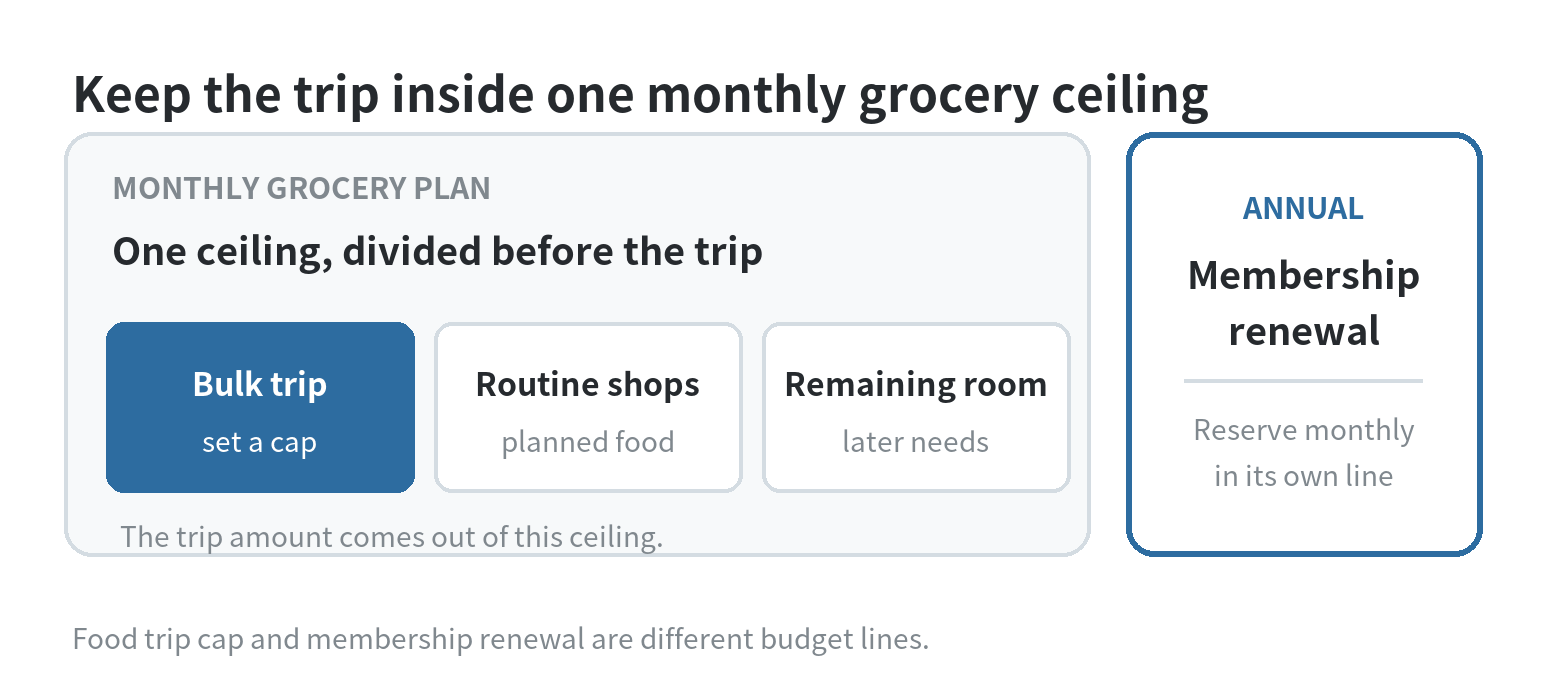
Set a monthly grocery ceiling before planning a warehouse-club trip, then give that trip its own cap inside the ceiling. Add the annual membership charge to a separate monthly sinking fund, and check bulk quantities against what your household can use and store. That keeps a low unit price from quietly becoming an unplanned grocery bill.
Start with the grocery money you actually have
Begin with take-home income and the bills already due. The Federal Trade Commission’s consumer.gov budget guide says to list income and expenses, subtract expenses from income, and revise the plan when the total goes below zero. Its budget worksheet can help you build the first pass; check your recent account activity so the grocery amount reflects what you spend, not an ideal target.
Separate routine food spending from occasional pantry restocks. For example, one household might reserve $700 a month for groceries and household staples, then set a $250 warehouse-trip cap within that same $700. The $250 is part of the grocery plan, not extra money on top of it. These sample amounts show how to apply the budget worksheet’s category approach to one monthly ceiling; replace them with the amount left after your own bills and other food shopping.
Keep household supplies in a separate line if they tend to crowd out food spending. Paper goods, cleaning supplies, and personal-care items may be part of a trip, but they do not belong in the grocery total if your budget tracks them elsewhere. Use a short list of categories that matches the way you review your statements.
Put membership renewal on its own line
Membership is a recurring cost, even when the charge arrives only once a year. Check the current membership level, renewal date, and amount in your account or on the official membership detail page. The listed charge can depend on the membership type and applicable tax, so use the amount shown for your own renewal rather than carrying forward an old receipt.
To smooth the cost across the year, divide the renewal amount shown for your membership by 12 and reserve that share each month. If the renewal is due soon and you have not set money aside, record the full upcoming charge in the month it will post; do not treat a monthly reserve as money already available. The Consumer Financial Protection Bureau’s spending assessment recommends checking account and card history across several months and including less-frequent expenses in a realistic budget.
Keep any membership reward, coupon, or expected savings out of the base plan. They may not apply to every purchase or arrive when you need the cash. Build the trip limit from money already available in the grocery category.
Choose a trip cap from a short list
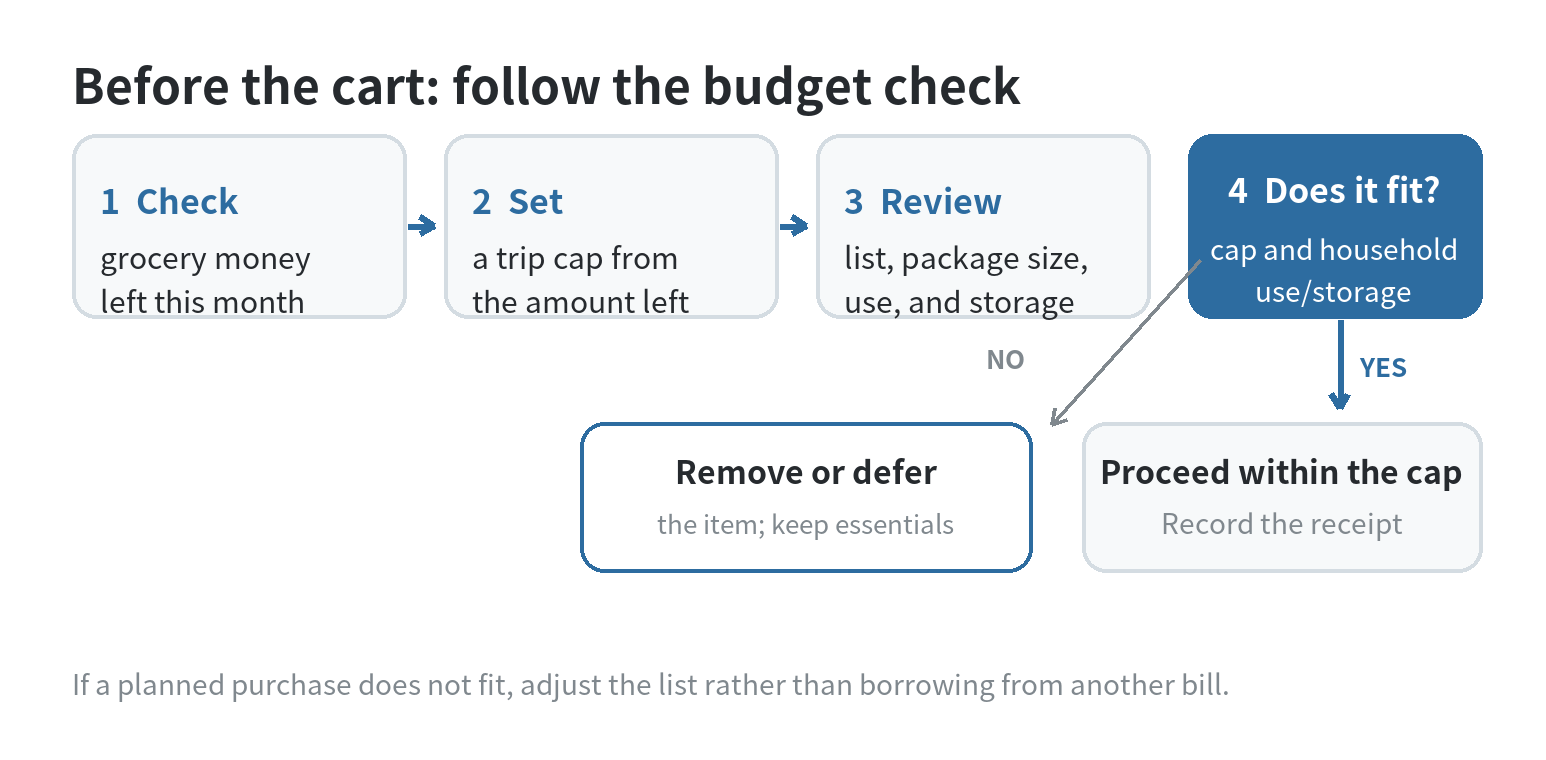
Before leaving home, write down the items that are low, the amount you need, and where they fit in the monthly plan. Mark each item as “replace now,” “buy only if the household will use it,” or “wait.” Add a small amount for tax or an unplanned staple only if the grocery category can cover it.
A useful test for a bulk package is to divide its price by the number of usable units, then compare that unit cost with the size your household uses. Also check the storage space, expiration date, and how much of the package may be wasted. A lower per-unit price does not help the budget if the package goes unused or forces other grocery purchases off the list.
Keep the shopping list and the trip cap together on paper or in a notes app. If the running total reaches the cap, choose what to remove before checkout. Do not pull from rent, utilities, debt payments, or next week’s food money to make the cart fit.
Use a sample month to see the moving parts
Suppose a household has $700 set aside for groceries and household basics. It plans one bulk restock with a $250 limit, uses $300 for weekly food shops, and holds $150 for the final week or a needed replacement. Those three amounts add to $700, so a larger trip means reducing another grocery line rather than increasing the total.
| Example grocery allocation | Planned amount | What it covers |
|---|---|---|
| Bulk restock | $250 | Listed pantry and household items |
| Weekly food shops | $300 | Fresh items and routine meals |
| Remaining grocery room | $150 | Later-week food or a replacement staple |
| Total | $700 | One monthly grocery ceiling |
The table follows the consumer.gov budget worksheet’s income-and-expense arithmetic; the dollar amounts are only a worked example.
These amounts are arithmetic examples, not a recommended grocery budget. If your household’s actual grocery ceiling is lower, scale the trip cap down with it. If you share food costs with another person, decide in advance whether the cap is per household or per cardholder and who records shared purchases.
Plan around the calendar, not just the cart
A trip can fit the month’s total and still land before rent or a paycheck. The CFPB’s bill-calendar guidance says to record each bill, amount, and due date, then use the calendar alongside the overall budget. Put the planned trip date beside paydays and major bills. If money will be tight before the next deposit, lower the cap or move the trip after the deposit.
If you use a credit card, count the purchase against the grocery budget when you make it, not when the card statement is paid. That prevents the same dollars from appearing available for another trip. Record the receipt soon after the visit and separate groceries from household supplies using the categories in your plan.
Review the receipt before planning the next visit
After the trip, compare the receipt with the list and trip cap. Mark what was planned, what was added, and which package sizes were larger than the household could use. A receipt does not need a complicated spreadsheet; one note with item, category, amount, and whether it was planned is enough to spot a mismatch.
At month end, compare the total grocery spending with the plan and check the bank or card activity against your notes. The CFPB’s spending assessment advises looking back over several months so less-frequent expenses are not missed, and the consumer.gov guide recommends using this month’s spending to plan the next month. Adjust the cap only after checking what changed: household size, meal schedule, pantry stock, or a one-time restock.
For a wider household plan, see iPro’s two-income budget walkthrough. If you track spending on a phone, the site’s monthly budget app guide covers how to organize categories and review transactions.
FAQ
How much should I save each month for a warehouse-club membership?
Divide the renewal amount shown for your membership by 12, then reserve that amount monthly. If the next renewal arrives before you have built the reserve, budget the full charge in its due month.
Should a warehouse trip count as groceries or household supplies?
Split the receipt by what you bought. Put food in groceries and place paper, cleaning, or personal-care products in the category your household uses for those supplies.
How can I budget for a bulk item shared with family?
Agree on each household’s share before buying, record who paid, and count only your share against your grocery category. Keep the amount you expect another person to repay out of the available grocery total until it is received.
What if the membership fee renews before I have saved enough?
Put the actual upcoming charge in the month it is due and review flexible spending before assigning money to optional purchases. After it is paid, start reserving a monthly share for the next renewal.
Last updated: September 2026. Membership prices and terms can change; check the current official membership information before setting the renewal line.
Last updated: 2026-09