
Budgeting as a couple works best when you agree on which costs are shared, how each person contributes, and what stays personal. You do not need to merge every account: start with one clear monthly plan, use take-home income, and choose a setup both of you can explain without keeping score.
A budget is a written plan for income and spending. Consumer.gov’s budgeting guide recommends listing bills and income, subtracting expenses, and using the result to plan the next month; the CFPB’s monthly budget worksheet uses the same income-minus-spending structure (checked September 30, 2026). Apply that simple frame to the costs you share, then settle the account arrangement that fits your household.
Pick the money setup before splitting bills
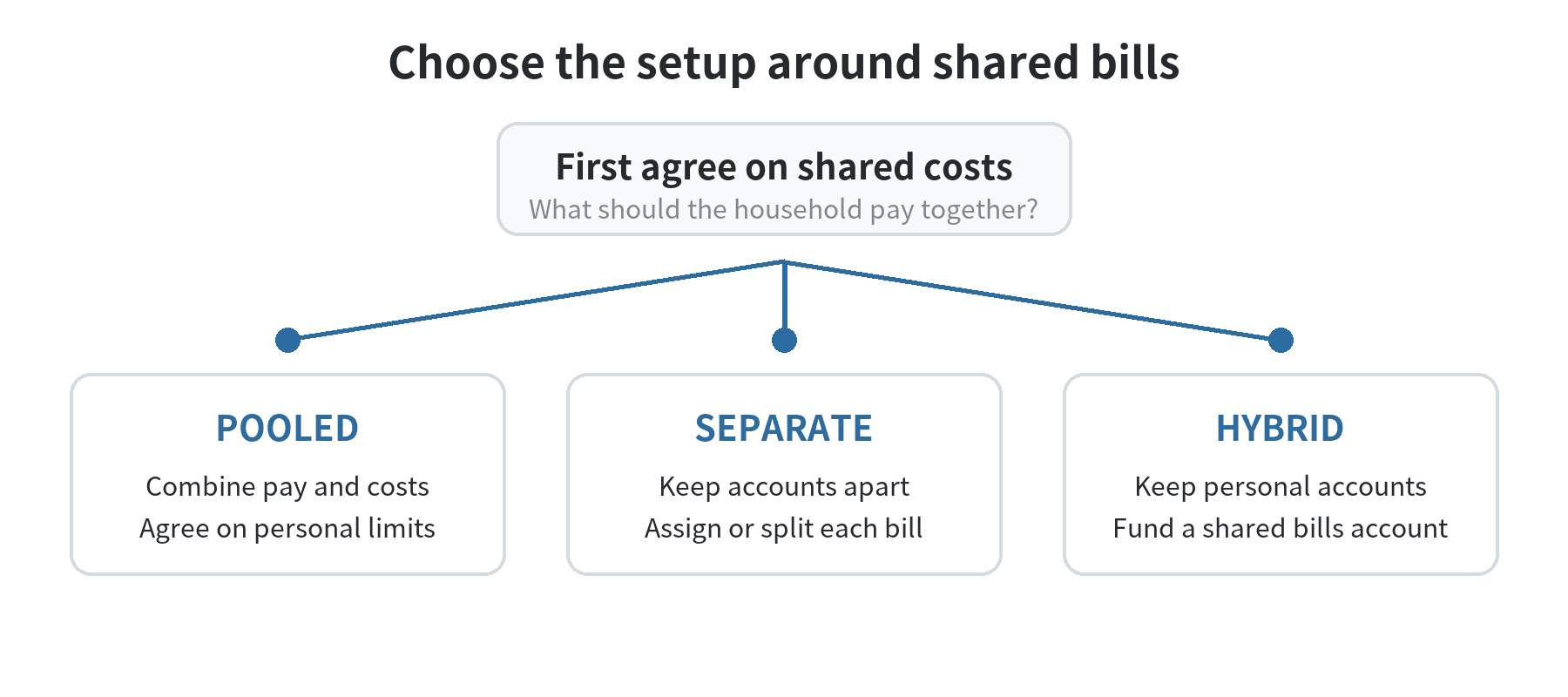
The main account arrangements are pooled, separate, and hybrid. The useful question is not which one is best in general, but how you want shared bills handled and how much day-to-day independence each person wants.
- Pooled: Paychecks go into shared accounts and both people use the household budget. This keeps the bills in one place, but both partners need to agree on personal spending limits and access.
- Separate: Each person keeps their accounts and pays an agreed share of shared costs. This can preserve independence, though you need a dependable way to see that bills are covered and upcoming costs are included.
- Hybrid: Keep individual accounts and send agreed contributions to a shared bills account. Shared costs come from that account; each person handles personal purchases separately. Decide what counts as shared before money starts moving.
Write down your choice and the categories it covers. For example, rent, utilities, household groceries, and a shared internet bill might go into the common plan, while clothing, individual hobbies, and gifts to your own friends remain personal. Your agreement can differ; the important part is that the same purchase does not become “shared” for one person and “personal” for the other after it is made.
Build the shared monthly number from real bills
Start with recent pay stubs and bills, then review account activity for costs that do not arrive every month. Consumer.gov advises using bills and pay stubs to make a monthly budget, while the CFPB spending guide says to look back over several months for less frequent expenses such as insurance, gifts, and seasonal costs (checked September 30, 2026). Use those records to make the first draft, rather than guessing from memory.
Here is a made-up example with combined take-home pay of $6,000 per month. Imagine shared rent is $1,800, utilities are $220, internet is $80, and household groceries are $700. If you also plan $200 a month for a shared annual bill, the household’s listed shared costs total $3,000. The example is a calculation, not a recommended target; replace every amount with your own figures.
List personal bills separately before deciding what is left. A car payment or student loan in one person’s name may stay personal, or you may agree to include it in the shared plan. Either choice can work when both people understand the reason and the impact on the remaining money. Do not count the same bill in both lists.
For a bill that moves up and down, use recent statements to choose a working amount and compare it with the next bill when it arrives. If it runs higher, note whether the cause was a one-time event or a recurring change before adjusting the shared plan. CFPB’s spending guide recommends checking account records against the budget to see whether the leftover amount matches what is actually in the account (checked September 30, 2026). This gives you a specific number to discuss instead of a vague feeling that one person spent too much.
Then subtract all planned costs and savings contributions from take-home income. If the result is negative, review the categories together and decide what can change, what must be paid, or whether the plan needs a different time frame. If the result is positive, decide in advance how to use it: hold it for irregular expenses, direct it toward a shared goal, or leave an agreed amount for flexible spending.
Choose a contribution rule that feels explainable
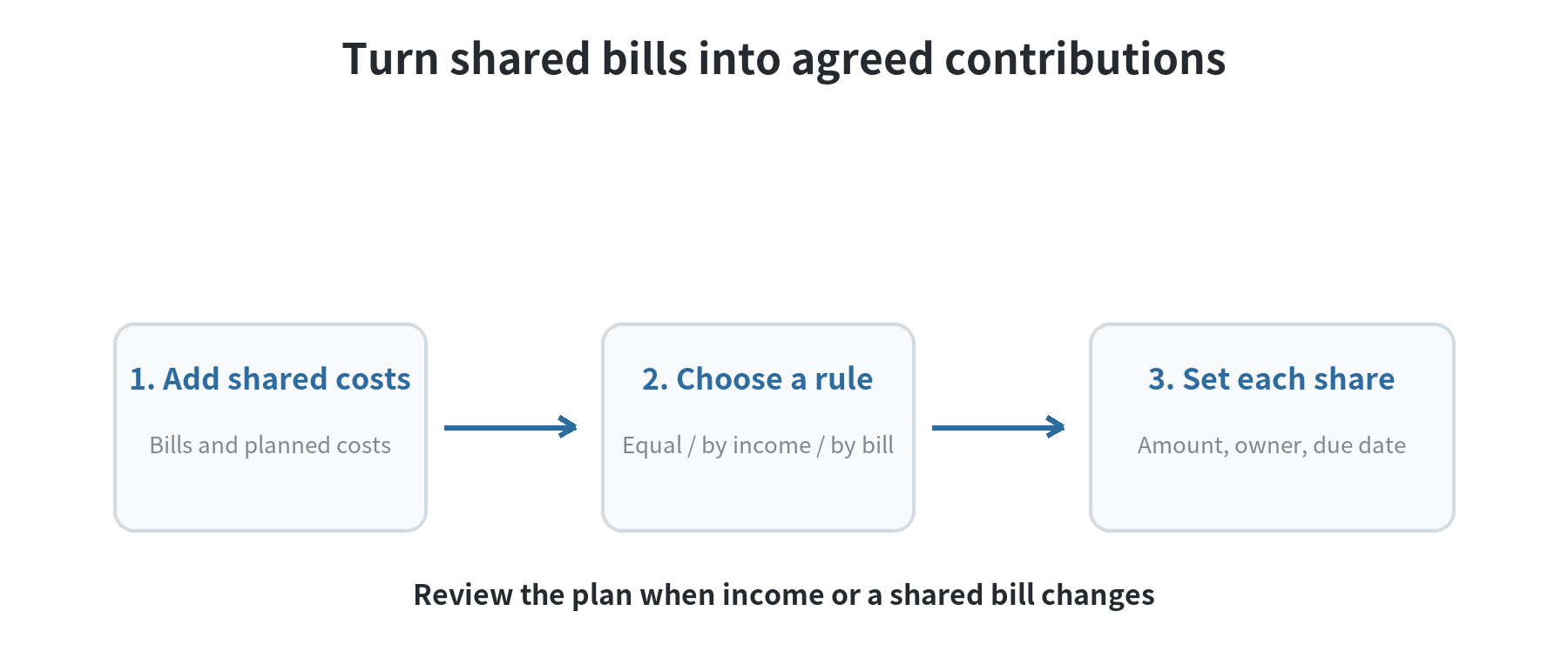
Equal contributions are simple when incomes and available cash are similar. If they are not, a proportional split can make the contributions track each person’s share of combined take-home pay. In the example, if one person brings home $3,600 and the other $2,400, their shares are 60% and 40%. For $3,000 of shared costs, that comes to $1,800 and $1,200.
A third option is to divide costs by category: one person covers rent while the other handles groceries and utilities, for example. That can be convenient, but compare the actual totals instead of assuming the categories come out evenly. Put the amounts and due dates in the same shared list so you both can see what the agreement requires.
Discuss what happens when income changes, a bill rises, or one person takes time away from work. You can agree to recalculate shares at a set review point, or whenever a defined change occurs. Keep the rule visible and revisit it without treating a temporary change as a debt that one partner must repay later.
Make the agreement usable on payday and bill day
Write down who pays each bill, when money needs to be available, and how you will handle a bill that changes. If you use a shared account, agree on how much each person transfers and when. If you keep accounts separate, decide who makes each payment and how the other person confirms their share. A short list in a shared document or paper calendar is enough.
Set a personal-spending rule that does not require permission for every small purchase. You might each keep a personal amount after shared costs are covered, or agree that purchases above a chosen amount get discussed first. Pick an amount that makes sense for your budget. The point is to set the same expectation in advance, not to monitor each other’s routine spending.
Schedule a short monthly review after the main income and bills have arrived. Compare planned amounts with actual spending, add newly known expenses, and adjust the next month. Consumer.gov describes using the month’s spending to plan the next budget, and the CFPB recommends checking account records to see whether the budget matches what remains (checked September 30, 2026). Keep the conversation on the numbers and the next decision.
If a discussion gets tense, pause the decision and return to the shared list. Each person can name one concern, such as a bill feeling unpredictable or a personal amount feeling too small; then choose one change to test in the next budget. Avoid turning the meeting into a review of who is “better” with money. A budget is useful when both people can see how it handles ordinary costs and known surprises.
FAQ
Should couples have a joint bank account if they share bills?
No. A shared account is one way to pay shared costs, but couples can also keep separate accounts and agree on who pays each bill or how to transfer each share.
How should we budget when one partner earns much less?
Agree whether shared bills will be split evenly, in proportion to take-home income, or by category. Write down the rule and check that both people understand how it affects their personal money.
What should we do when one partner has debt?
List the payment clearly and decide together whether it belongs in the shared budget or stays with the person who owes it. Avoid counting the payment twice or making an informal promise that changes who owes what.
How often should a couple review its budget?
Set a regular review time that follows your pay and bill schedule, then revisit sooner when income or a major shared cost changes. Bring the latest bill amounts and spending totals so you can update the plan from actual numbers.
Last updated: 2026-09