Give beauty and self-care a monthly limit that fits after bills, debt payments, and savings, then divide that limit among the routines you actually use. The number should come from your own account history and quotes, not a national “average”: prices vary by service, provider, location, and what is included.
Consumer.gov describes a budget as a written plan based on income and expenses, then recommends comparing the plan with what you spent and using that information for the next month. Its budget instructions are a useful starting point. (Checked September 30, 2026.)
Set the total after the bills that cannot wait
Start with take-home income for the month. Subtract housing, utilities, food, transportation, required debt payments, and savings goals you have already committed to. The amount left is not automatically a beauty budget: it also has to cover other flexible spending and irregular expenses.
For a sample calculation, imagine monthly take-home income of $3,600. If fixed and essential expenses use $2,650, debt and savings plans use $500, and other planned flexible spending uses $300, the remaining $150 is the maximum available for beauty and self-care in this example. These figures are placeholders, not suggested targets. If the remainder is zero or negative, set the category to zero for now rather than borrowing from rent, minimum debt payments, or a bill due soon. Start from take-home pay that will actually land in your account, not a gross salary figure. If pay varies, write down the amount you can safely plan around and leave uncertain income unassigned until it arrives. A plan based on money you do not yet have can make an appointment look affordable before the rest of the month is covered.
The CFPB monthly budget worksheet uses the same basic subtraction: list income, list spending, then subtract total spending from income. It also includes personal care as its own spending category. (Checked September 30, 2026.)
Build the line from what you actually buy
Review bank and card statements, receipts, appointment confirmations, and any recurring charges. Consumer Financial Protection Bureau guidance suggests using a spending tracker for at least two weeks or a month to understand spending patterns; its spending tracker guidance also prompts readers to look for services they no longer use. (Checked September 30, 2026.)
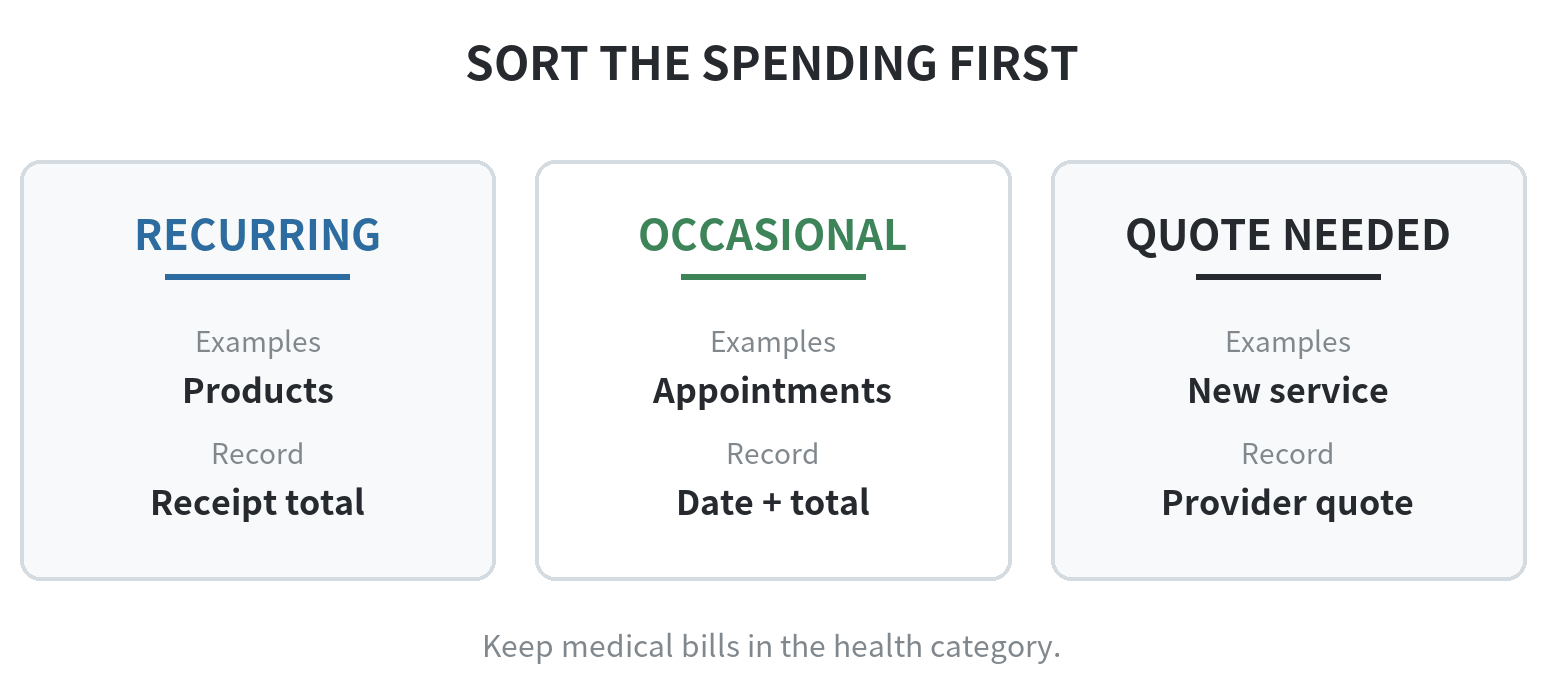
Use a narrow definition so the total stays useful. Put beauty and self-care purchases such as routine hair services, personal-care items, nail appointments, or a membership you count as personal maintenance in one category. Keep prescriptions, medical visits, and health insurance in health expenses.
Separate recurring items from occasional ones. A monthly product replacement or membership belongs in the recurring column. A haircut, special event appointment, or tool replacement may happen less often, so record its date and cost when it occurs. If you prefer one monthly number, add the less frequent expense to a small reserve and transfer part of that planned amount each month.
Price services with a quote, not a guess
When you are considering a salon, spa, or other appointment, request the total for the exact service and location before you book. Ask what the quoted amount includes, whether add-ons are optional, when payment is due, and whether a deposit or cancellation charge applies. If the provider cannot give a total yet, mark the item “quote needed” and leave it out of the committed plan until you have the details.
For products, use the amount on your receipt and note whether the purchase replaced something you had planned to buy or added an unplanned item. A one-time restock can make a month look unusually expensive; keep it visible in the record, then decide whether to spread a planned replacement across future months. Do not treat a promotional price as the standing cost unless you know the next purchase will be at that price.
Keep the estimate grounded in your own records. If you have no history, collect a quote for each service you are weighing and check the current total directly with the provider. Add any required taxes or fees the provider identifies. There is no single useful cost range for every city, service menu, appointment length, or product routine. Ask for the service name, length, base amount, optional add-ons, taxes or other fees, deposit, and cancellation terms in one message or estimate. If you compare providers, make sure the service and what it includes match; two totals are hard to compare when one includes an add-on and the other does not. Note when a quote was given and whether the provider attached an expiration date. Use the current confirmed amount when you update your plan, rather than an older menu or a remembered price.
Plan ahead for appointments that do not happen monthly
Put less frequent appointments and larger planned replacements on a calendar before assigning the monthly cap. Write the expected month, the service or item, and its current quoted or receipt-based amount. Add those planned amounts for the year, then divide by twelve to see what a steady monthly reserve would require. This calculation is a planning tool, not a promise that the cost will stay unchanged; get a fresh quote when you are ready to schedule.
If the monthly reserve does not fit after obligations and other priorities, do not quietly borrow from a future month. Move the appointment, reduce the number of optional services, or choose a lower-cost routine that still suits your plans. Keep a separate note of what you are saving for so the reserve does not blend into money available for an unrelated purchase. When an expense date changes, update the calendar and the amount you still need to set aside.
Choose a simple split for the available amount
Once you know the cap, list the specific things you want that money to cover. Give each item a priority and a planned amount; the amounts must add up to the cap. For the sample $150 category, a person might reserve $55 for routine hair care, $45 for planned product replacements, $35 for one appointment, and keep $15 unassigned until a quote is confirmed. This is an arithmetic example, not a recommended mix.
If one service costs more than its assigned amount, choose among three clear options: move the appointment to a later month, reduce another optional line, or save toward it in a separate envelope or savings bucket. Do not count the same dollars twice. If you change the plan, write down which category is giving up that amount.
For more help with the broader monthly setup, see the monthly budget planning article. If you prefer to record spending without relying on a phone app, the simple budget tracker walkthrough covers a basic log format.
Use a midmonth check to make a small correction
At a chosen point in the month, compare the amount already spent with the amount still planned. If a recurring charge posted earlier than expected, update the remaining balance. If a product replacement ran higher than the receipt-based estimate, decide whether to pause another optional purchase or move that planned appointment. A check-in is for adjusting the plan, not for judging the purchase.
When the cap is nearly used, pause new discretionary commitments until the next review. For appointments already booked, include any cancellation terms in your decision and contact the provider if you need to change the date. If the category repeatedly runs short, look at the dates and amounts rather than raising the cap automatically: separate essential replacement purchases from extras, then decide which ones matter most.
Consumer.gov recommends writing down spending during the month and using the result to make the next month’s plan. Keep the same record for this category, including the date, item or service, amount, and whether it was planned. (Checked September 30, 2026.)
FAQ
Should beauty spending be a fixed amount or a percentage of income?
Use a fixed dollar cap that fits your actual monthly plan. A percentage rule is only a shortcut; it cannot account for your rent, debt payments, upcoming bills, or the cost of services where you live.
How do I budget for an appointment that happens every few months?
Write down the expected date and ask the provider for the current total. Divide that quoted total across the months before the appointment, then set aside that planned amount if your budget has room.
What should I do when I cannot afford my usual routine this month?
Keep required bills and commitments first, then postpone optional services or replacements that can wait. If a booking already exists, review its cancellation terms and contact the provider before changing it.
How can I stop a self-care budget from becoming a guilt list?
Use it to make trade-offs visible, not to label purchases as good or bad. Name the routines you value, set their amounts before spending, and revise the plan when your income or obligations change.
Last updated: 2026-09