
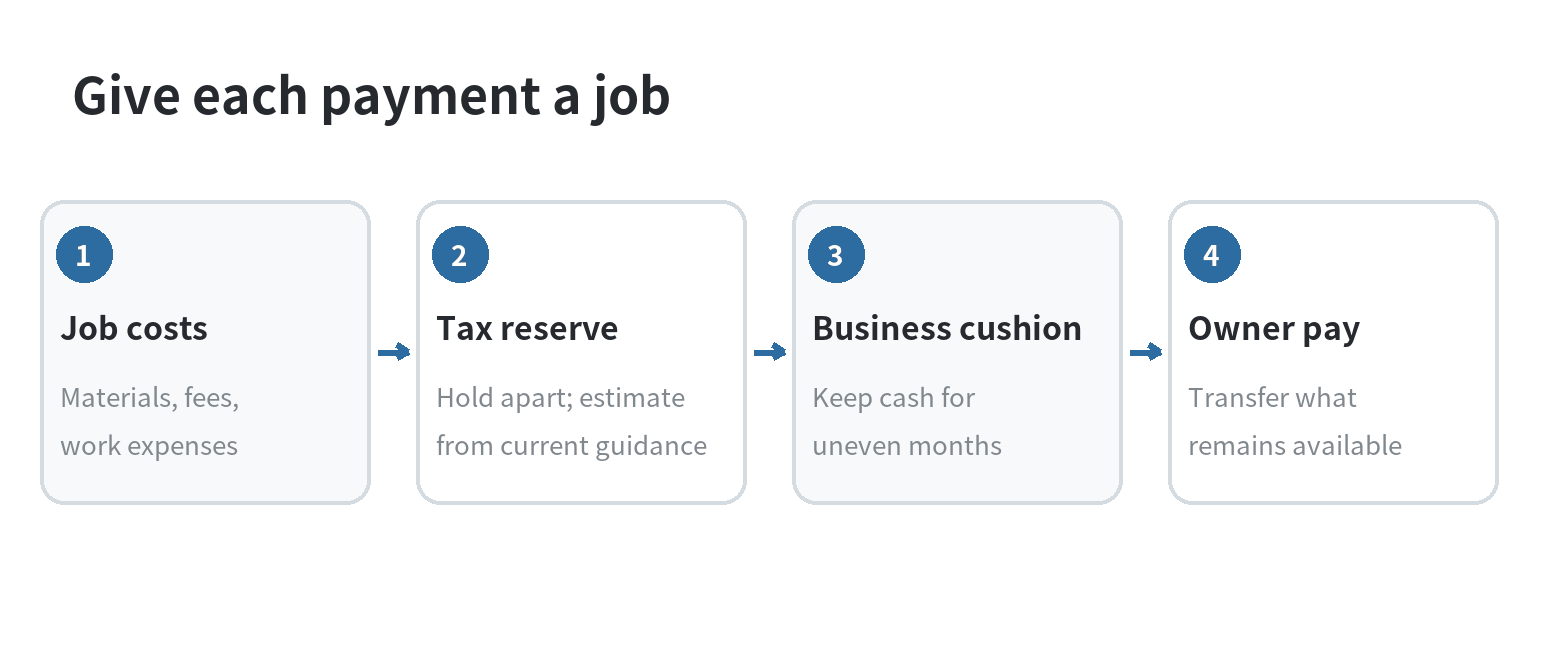
A side hustle budget works best when each payment gets divided before you spend it: cover the job’s costs, reserve money for taxes, build a small business cushion, then decide what can go to you. Keep those amounts separate from household money, even if you use one bank account and a simple spreadsheet. That gives you a clear view of what the work brought in and what is actually available.
Start with the money a job actually brings in
Record the full amount a client or customer owes, the date it arrives, and any fees or costs tied to earning it. A payout is not always the same as sales: a payment service may subtract a fee, and a customer may pay a deposit before you have finished the work. Keep the gross amount and each deduction visible instead of logging only the final deposit.
For a sample month, imagine your side work brings in $1,800. You spend $260 on materials and software, and payment fees total $70. That leaves $1,470 before setting aside anything else. The figures are placeholders; replace them with your own invoices, receipts, and statements.
Use a basic ledger with columns for date, customer or project, gross amount, fees, direct costs, amount received, and notes. Add a status such as invoiced, partly paid, or paid. This separates completed work from cash already in hand, which matters when a project spans two months.
Before accepting a job, sketch its cash path: expected deposit, remaining payment, materials you must buy first, payment fee, and delivery cost. If the customer pays after delivery, note the gap between spending and collection. A project can look large on its invoice yet require cash you do not have available. You can discuss a deposit or agreed payment milestones before committing to those costs, then record the dates in the ledger.
Separate job costs from personal spending
Give each expense a clear home. Direct job costs might include materials, shipping, transaction fees, or a rented tool. Operating costs could include business software, a phone service used for the work, or a workspace expense. Keep personal purchases out of these categories; mixing them makes it harder to see whether a project covered its own costs.
Label a software plan or other ongoing charge as recurring and enter it in the month it bills. Give a one-time purchase a note that names the project. When you draft the next budget, carry forward the repeating charge and leave the one-time item out unless another job needs it.
For the sample month, set aside the $260 materials and software cost and the $70 payment fee first. If a $90 supply purchase supports two separate jobs, note how you divided it and keep the receipt. A note such as “supplies for project A and project B” is more useful later than a bank entry labeled only “store.”
The IRS says gig workers should keep income records and receipts, and that certain expenses may be deductible. Which expenses qualify depends on the circumstances, so use IRS guidance or a qualified tax professional for your own filing questions. In your budget, record the amount and purpose without deciding that every purchase is deductible.
Build a tax reserve without guessing at your bill
Move a chosen share of each payment into a separate tax holding category as soon as the money clears. Do not treat that reserve as spending money. The right amount depends on your full tax situation, so estimate it with current IRS tools or a tax professional rather than copying a percentage from another worker.
The IRS says gig income must be reported even when it comes from part-time or temporary work, is paid in cash, or does not appear on an information return. Its current gig-work guidance also explains that an independent contractor may need estimated tax payments. For filing and payment requirements, review the IRS instructions that apply to your circumstances.
For the sample $1,470 remaining after direct costs and fees, suppose you temporarily place $300 in the tax category. That is only a planning placeholder, not a suggested tax rate. If an estimate changes, adjust the reserve using current guidance and keep a note of the date and source you used.
Keep a cushion for uneven months
Side-hustle income may arrive in uneven chunks: a client can pay late, a project can require another round of materials, or a quiet month can follow a busy one. A business cushion gives those timing gaps somewhere to land. Pick an initial cushion goal based on costs you would still have to pay if no new work came in, such as an active software subscription or a scheduled equipment rental.
In the sample, after the $300 tax placeholder, $1,170 remains. You might direct $150 to a business cushion and leave $1,020 available for owner pay. The cushion is still business cash, not an expense; track it as a balance so you know whether it is growing or being used.
If a month produces less cash than expected, do not force the same owner transfer. Pay costs already committed, keep the tax amount separate, and reduce or delay the personal draw. A budget is a plan for allocating cash that exists, not a reason to spend money that has not arrived.
Use a repeatable payment routine
- Log the invoice and the payment date when money arrives.
- Match the deposit against the invoice and record any fee, refund, or deduction.
- Move money for direct job costs and the tax reserve into their categories.
- Add to the business cushion if the month has room.
- Transfer the remaining amount you have chosen as owner pay.
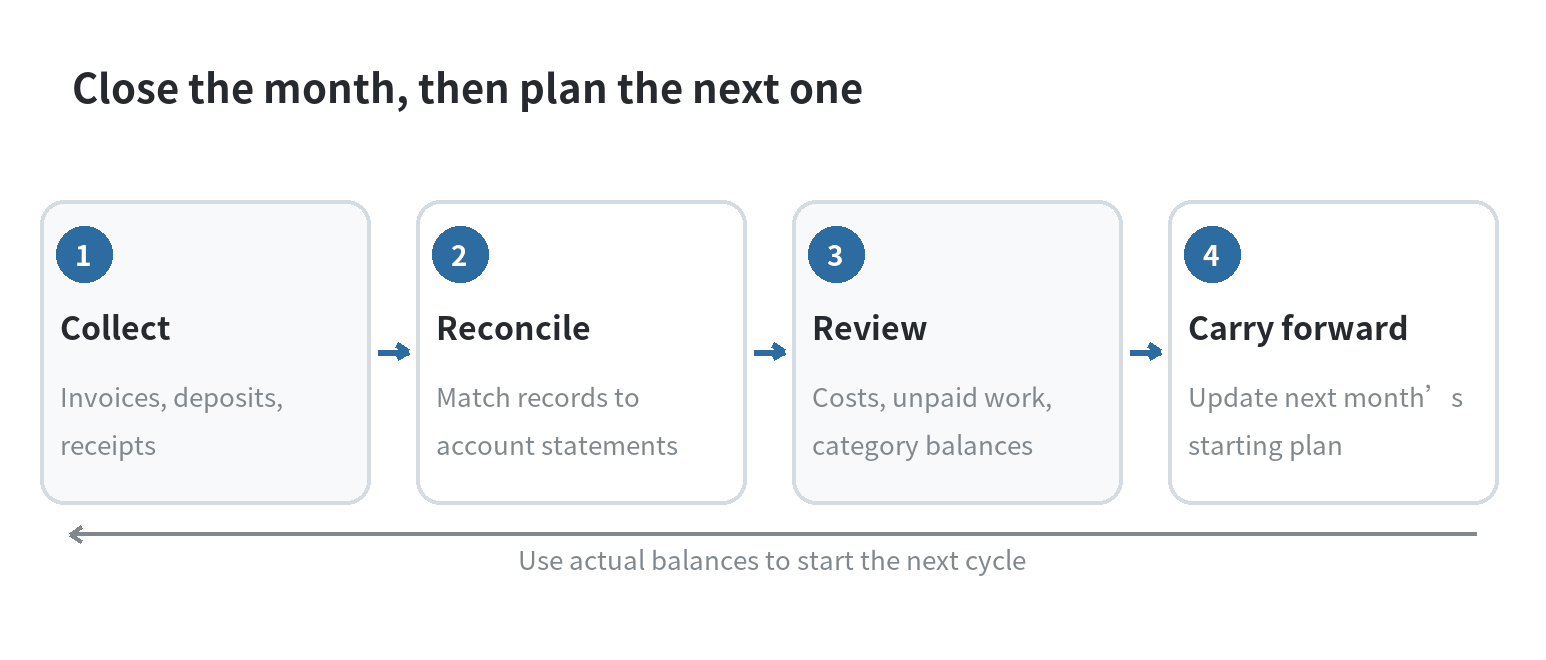
Once a month, compare your plan with bank and payment statements. Look for forgotten subscriptions, supplies charged to the wrong project, unpaid invoices, and personal purchases recorded as work costs. Update the next month’s plan from actual receipts and scheduled bills. A simple spreadsheet or notebook is enough if it shows what came in, what went out, and what each balance is for.
If your budget already lives on your phone, the site’s smartphone budget tracker guide covers a basic way to keep spending records in one place. Its monthly budget and app overview can also help you think through where a side-income line fits in your household plan. Keep the business ledger distinct, even when both records are in the same tool.
Turn the sample into your own plan
Write down one recent month of side-hustle activity before choosing percentages or goals. Start with deposits and invoices, subtract documented job costs, and mark money that is reserved for taxes or future business needs. The amount left is a more useful starting point for owner pay than total sales alone.
Then label which amounts are actual and which are estimates. Actual fees and receipts belong in the ledger; an expected supply purchase or future tax payment belongs in the plan until it is confirmed. When the month closes, replace estimates with actual amounts and carry the updated cushion balance forward.
IRS tax reporting rules and forms can change. IRS gig-work guidance and Tax Tip 2026-26 were checked on September 30, 2026; review current IRS instructions when planning a filing or payment.
FAQ
What if a customer pays a deposit before the work is finished?
Record the deposit when it arrives and leave the unpaid balance marked as outstanding. Keep the project’s expected costs and the deposit amount visible, then update the ledger when the remaining payment clears.
How should I log a cash payment for side work?
Enter the amount, received date, and project in your ledger, then keep any receipt or customer note with that entry. The IRS says gig income must be reported even when paid in cash; its guidance was checked on September 30, 2026.
How do I track a purchase a client reimburses?
Record the purchase and the reimbursement as separate entries tied to the same project. Keep the receipt and note why you bought the item so your expense total and the money returned to you do not disappear into one unexplained net figure.
Last updated: 2026-09