A big purchase gets easier to budget when you turn its full cost and target date into a monthly amount, then test that amount against bills you already have. Start with the total you actually need, subtract money already set aside, and divide what remains by the number of months before you need to pay. If that contribution crowds out rent, food, utilities, or minimum debt payments, change the timeline or purchase plan before moving money.
Set a real target before you pick a monthly amount
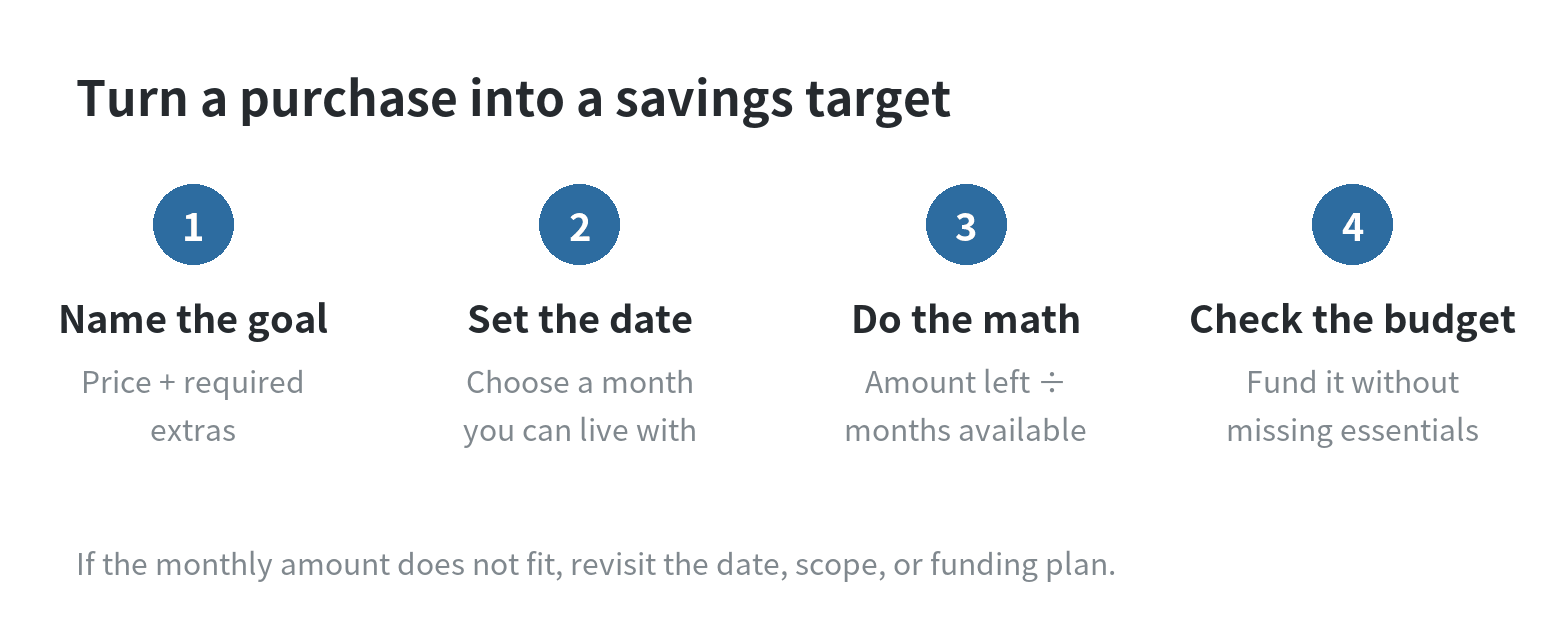
Write down what the purchase is for and when you need it. “Replace the refrigerator by October” gives you a clearer planning window than “save for an appliance.” A flexible want can have a target month you choose; a necessary replacement may have a deadline shaped by the item’s condition or another commitment.
Estimate the amount needed to complete the purchase, not just the advertised base price. Depending on the item, the total could include sales tax, delivery, installation, required accessories, setup, or disposal of an old item. Use a current estimate for each cost that applies to your plan. Leave out extras you do not need, but do not omit a required charge just to make the goal look smaller.
Then subtract what you have already saved specifically for this goal. The remaining amount is your funding gap. The CFPB’s savings plan worksheet organizes a goal by its total amount, months to reach it, monthly amount, saving strategies, and where the money will be kept.
Use the date to calculate a monthly target
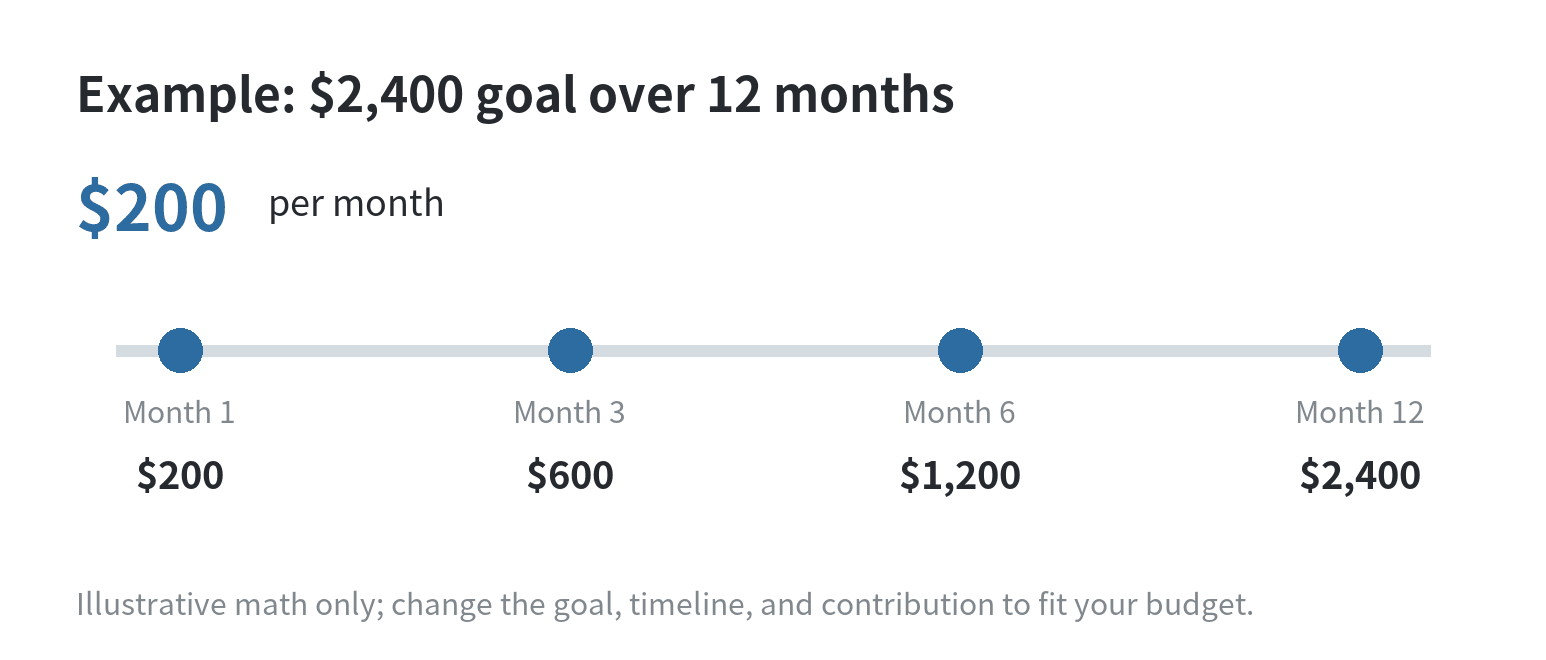
Divide the remaining amount by the number of months available. For example, if a planned purchase will cost $2,400, you already have $0 set aside, and you have 12 months, the target is $200 a month. If you have $600 saved already, the remaining $1,800 over 12 months calls for $150 a month. The calculation follows the goal-and-time worksheet format in the CFPB savings plan. These are examples, not price estimates; replace the inputs with your own numbers.
For a purchase due soon, use the number of pay periods rather than assuming you will make a full month of deposits. Suppose you have four paychecks before a $1,200 expense is due. A $300 contribution from each paycheck reaches the goal; three paychecks would require $400 each. The FDIC Money Smart savings guide also frames a large-expense goal around estimating the cost, when you need the money, and a contribution for a chosen period. Count only deposits that can arrive before payment is due.
Keep the calculation simple: (estimated total cost − amount already saved) ÷ saving periods remaining = contribution per period. If your payday schedule changes, recalculate using the paychecks you expect before the deadline. The CFPB explains that a savings plan can estimate the time to a goal from how much and how often you can set money aside (CFPB savings guidance).
Test the contribution against your actual cash flow
Before automating a transfer, list take-home income and expenses by when they are due. Include fixed bills, changing bills, groceries, transportation, debt minimums, and costs that arrive less often. The Federal Trade Commission’s consumer.gov budgeting handout says to list monthly and changing bills, less-frequent expenses, other spending, and income, then compare expenses with income (FTC budgeting handout).
Here is a sample monthly check. Take-home income is $4,200. Rent and utilities are $1,500; groceries and transportation are $900; insurance and debt minimums are $700; and other planned bills and spending are $700. That leaves $400 before the purchase contribution. A $250 transfer leaves $150 in the example budget for uneven expenses or a cash buffer; a $450 transfer does not fit without changing another line or using a different timeline. The sample figures are invented to demonstrate the arithmetic.
Use your account history and bill calendar to replace those sample amounts. Annual insurance, school expenses, memberships, or maintenance can land in the same month as a major purchase. The consumer.gov handout suggests checking the same month from the prior year when a bill changes with the season, which can help you avoid treating a predictable spike as spare cash.
Pick a saving rhythm that matches how you are paid
With a steady paycheck, a recurring transfer shortly after payday can make the contribution part of the plan. CFPB guidance describes recurring transfers with an amount and date chosen by the customer (CFPB guidance on automatic saving; FDIC Money Smart guide). Check upcoming bills and your available balance before choosing the transfer date and amount.
If income varies, set a smaller base contribution that works in a lower-income period, then add to the fund after a stronger pay period only when essential bills are covered. You can also split the target into milestone deposits: one amount from each paycheck, a planned contribution from a seasonal bonus, or a later adjustment after reviewing the budget. Do not count a bonus, refund, or overtime as guaranteed money before it arrives.
Keep the purchase fund identifiable in your records. A separate savings account can make the running balance easier to see; a labeled line in a budgeting tool or spreadsheet can also work. Record each deposit and any withdrawal. If the balance is short of schedule, look at the reason before increasing the next transfer: a cost estimate may have changed, an expense may have been missed, or the deadline may no longer fit your cash flow.
If the number does not fit, revise the plan
A monthly target is a planning constraint, not an order to squeeze the budget. Consider moving the date if the purchase can wait, choosing a lower-cost version that still meets the need, reducing optional add-ons, or funding part of the cost from an existing sinking fund intended for that expense. Recalculate after each change so the target reflects the new total and date.
If the item is necessary before you can save the full amount, write down the choices you are weighing: delay and repair, replace with a lower-cost option, use savings already earmarked for another goal, or compare payment terms. For any financing offer, read the full repayment amount, fees, promotional period, and what happens if a payment is late or a balance remains. A smaller payment can still mean a longer obligation or a higher total cost.
Protect money assigned to essentials and avoid counting the same dollars twice. If changing the timeline still leaves no room after bills and minimum payments, the plan needs a different scope or another source of funds; a spreadsheet cannot create room that is not in the budget. Revisit the estimate when the seller’s quote or delivery plan changes, and update the monthly contribution before committing to a date.
Review the goal as the date gets closer
At a regular budget check-in, compare the saved balance with the amount your schedule says you should have by now. If the balance is ahead, you may have room to lower later deposits or keep the cushion for taxes and other final costs. If it is behind, use the updated gap and remaining pay periods to calculate a new contribution, then check the cash-flow plan again.
Before the purchase, confirm the final amount and timing, including any costs that were estimates. Keep the money available when payment is due, but avoid scheduling a transfer that could leave a bill unpaid. A clear total, a realistic date, and a contribution that fits your actual budget give you a plan you can adjust when the numbers change.
FAQ
Should I use my emergency savings for a planned purchase?
Keep money for a planned purchase separate from emergency savings when you can. The CFPB describes emergency savings as a reserve for unplanned expenses; planned purchases belong in a separate goal so you can see what is available for each purpose.
What if I cannot save the same amount every month?
Use a contribution that matches your pay pattern. Set a manageable base for lower-income periods and add extra only after income arrives and essential costs are covered.
How do I budget for a purchase with changing costs?
Keep an itemized estimate and recalculate when a quote, tax, delivery charge, or timing changes. Make sure the goal includes costs required to complete the purchase.
Is it better to save by paycheck or by month?
Use the interval that matches your income and due date. A monthly amount can be divided across the paychecks before the purchase, while an irregular income plan can use smaller base deposits and occasional additions.
Last updated: 2026-09