A cell phone bill belongs in your monthly budget at the amount you actually owe, not at a plan price you remember seeing. Start with the latest statement, separate service from device payments and extras, then carry the full amount into your bill calendar.
If you want a lower bill, compare a complete written quote against that current total before changing anything.
Start with the amount due, then sort the lines
Open the bill or account statement and record the total due, due date, and the period it covers. Keep the statement nearby as you make the budget line.
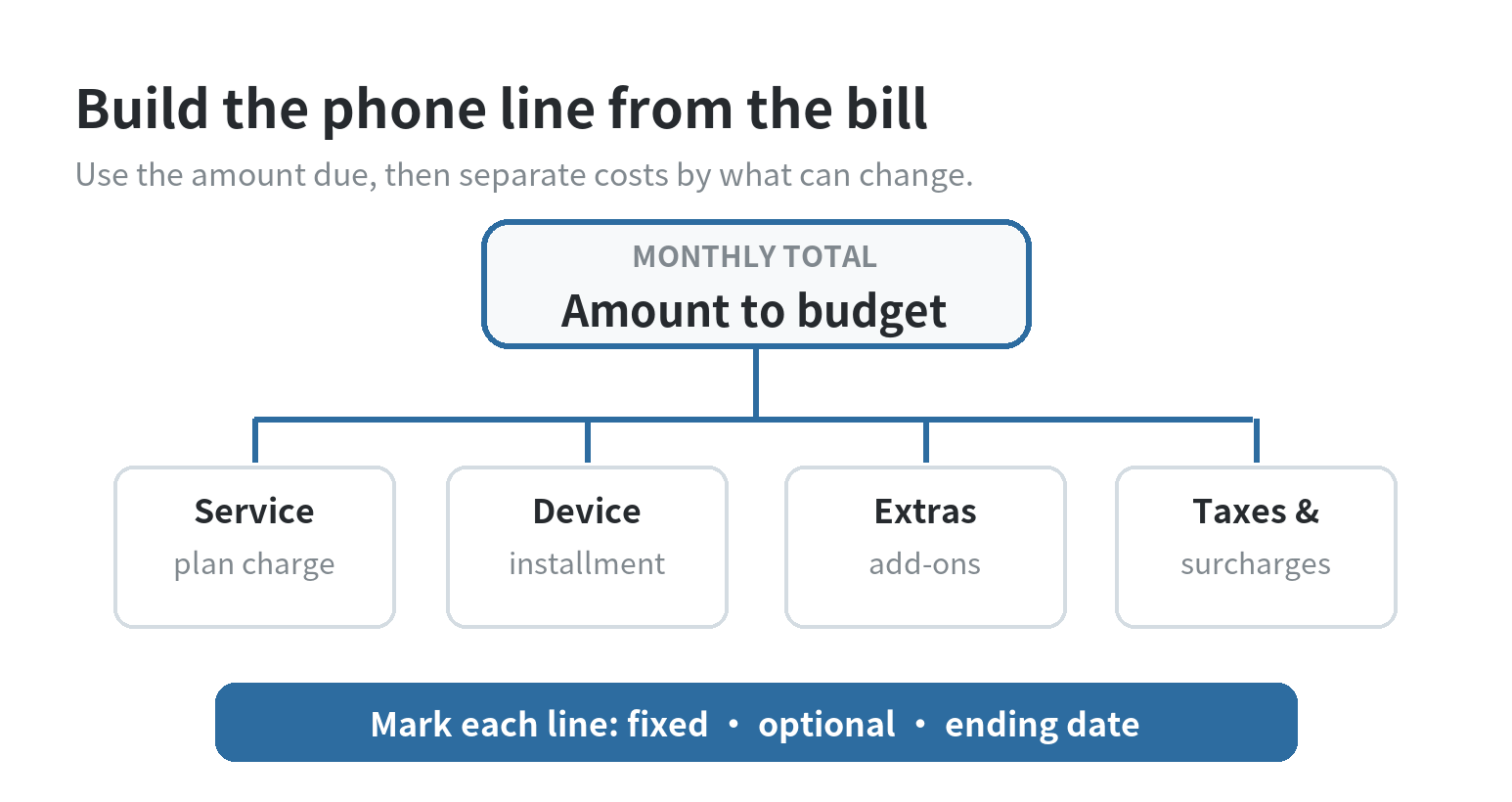
If you share a family plan, budget the amount your household pays and note your own share separately; do not count the whole account total as your personal cost and then add your contribution again. Break the total into service, device payments, optional features, and taxes or surcharges.
Mark each line as fixed, optional, or temporary. A phone installment may end on a known date; an add-on may be removable; the service charge may continue.
This makes the bill easier to revisit when one part changes.
Do not substitute a national “average” for your number. The amount depends on the plan and account details offered to you.
To price a change, ask the carrier for the full recurring monthly total for your location and number of lines, including taxes, fees, device payments, and any add-ons. Ask when promotional pricing ends and what the bill becomes afterward.
Use that written quote, rather than an advertised starting price, in your comparison. For a family plan, first total the account bill, then choose one method for assigning shares.
You might assign each person their own device payment and add-on, then split the common service charge by agreement. If one person covers a shared feature or account fee, record who pays it so the household total is not accidentally counted twice.
Keep the rule beside the budget worksheet; change it only when the account or household arrangement changes. Before switching, ask whether an unpaid device balance, plan change, or service start date creates a separate charge.
A quote that covers only the recurring service line cannot answer that question. Put any confirmed one-time amount in the month it is due, and keep it out of the ongoing phone line.
Give the bill a place in the monthly plan
Put the phone bill beside rent, utilities, insurance, and other due-date expenses. Use the actual due date, not just the month name, so you can see whether the charge lands before or after income reaches your account.
The Consumer Financial Protection Bureau’s bill-calendar instructions say to list each bill’s amount and due date, then use the calendar to check the month’s obligations (checked October 1, 2026). If the budget is tight, write down the take-home money available for the month first.
Subtract required bills and planned essentials; then place the phone total among the remaining expenses. If the bill is paid from a shared account, agree on the contribution and transfer date with the other account holders.
For a broader way to record shared costs, see our guide to budgeting shared household expenses. For an automatic draft, note the expected debit date beside the bill due date and leave the full billed amount in the account plan.
If the amount changes, compare the statement before the draft rather than budgeting from a previous month. A blank worksheet is more useful than a guessed rate:
| Budget line | Your amount | What to check |
|---|---|---|
| Service | From statement | Plan and line count |
| Device | From statement | Remaining payments and end date |
| Extras | From statement | Features you still use |
| Taxes and surcharges | From statement | Current billed total |
| Monthly budget line | Add the lines above | Compare with amount due |
Build the amount from your statement rather than estimating each component from memory. If it changes from month to month, use the latest bill as the starting entry and leave a note to revisit it after the next statement arrives.
Keep a separate note for a one-time charge so it does not silently become part of the ongoing plan.
Trace a higher bill before cutting anything
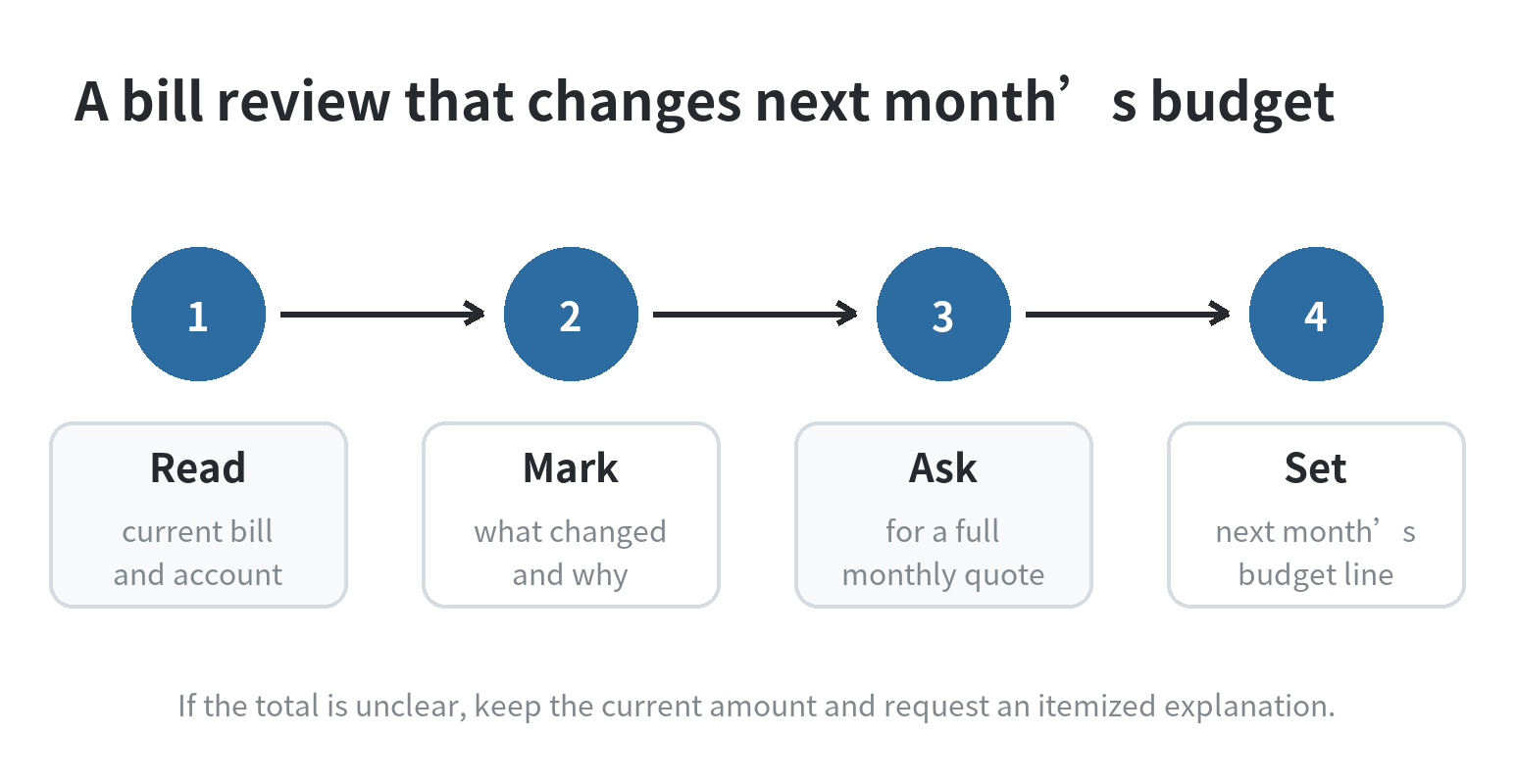
When a total rises, compare the current statement with the previous one line by line. Circle the changed amount and look for a matching explanation: a device charge, an added feature, a partial-month charge, a discount that ended, or a tax or surcharge entry.
These are questions to ask about your own bill, not assumptions about why it changed. Contact the carrier with the exact line name and amount.
Ask what service or event it represents, whether it repeats, when it will stop, and whether the account can be changed without a fee. If the representative gives a new monthly price, ask for the amount after discounts and taxes and the date it takes effect.
Write down the answer and compare it with the full amount you budgeted. If the bill still does not make sense, request an itemized explanation before adjusting the budget.
Keep the amount due in the calendar while the question is open; otherwise the budget may show less than the statement requires. A calendar-based review can also help you see the due date next to other bills.
The CFPB’s bill calendar suggests checking the calendar weekly (checked October 1, 2026).
Compare a plan change using the whole bill
A lower service charge does not by itself show whether a switch fits your budget. Compare the current bill and proposed bill using the same categories: recurring service, device payments, extras, taxes, fees, and any one-time amount due to make the change.
Include the price after a discount period. If the quote leaves out one of those items, ask for the missing amount before deciding.
Also write down practical conditions that affect your household: how many lines need service, the amount of data each person relies on, whether devices are still being paid off, and whether a shared-plan member would need a separate arrangement. You do not need a market-wide price chart to make this comparison; you need complete totals for the specific options available to your account.
If one person uses a plan for work or navigation, ask that person what service interruption or data limit would affect their routine before comparing quotes. Treat the answer as a household requirement, then check that each written option includes it.
Put a reminder on the date a discount or device payment is scheduled to change. When that date approaches, check the next statement and update the budget line from the amount billed.
If nothing changes, the reminder can be cleared; if the total changes, record the new source and due date. For the tracking side of a phone-based budget, see our guide to budgeting apps for managing money.
Check whether Lifeline applies to your household
Lifeline is a federal benefit for eligible households that can lower the cost of phone or internet service. USAC’s Lifeline information lists a standard discount of up to $9.25 per month, while an FCC statement also describes the $9.25 monthly support amount (checked October 1, 2026). The discount is not a quote for every plan, so ask participating providers in your area how the benefit applies to the service they offer.
Eligibility can be based on participation in qualifying programs or household income. USAC’s eligibility page names programs such as SNAP, Medicaid, and Supplemental Security Income, and explains that income limits depend on household size and state. Check the current official eligibility information and the documentation requested for your situation. USAC says the program permits one Lifeline discount per household, so coordinate with anyone in your home who may already receive it.
To put a possible benefit into your budget, keep the service’s quoted total separate from the discount until your eligibility is confirmed and a provider explains how it will appear on the bill. Then record the out-of-pocket amount shown by the provider.
That keeps the budget tied to a confirmed bill rather than an assumed credit.
FAQ
Should I budget a phone bill before the first statement arrives?
Use the written quote for the exact account as a temporary estimate, then replace it with the first statement total. Keep any one-time activation or device charge on a separate line so it does not look like a recurring monthly cost.
What should I do if a bill is due before payday?
Record the due date and expected income date beside each other, then ask the provider whether it can move the due date or offer a payment arrangement. Do not assume a request has changed the date; use the confirmed date in your calendar.
What paperwork might Lifeline ask me to provide?
USAC says applicants may be asked to show proof of program participation, such as a benefit letter or official document. Check its Lifeline eligibility information for the documents relevant to your qualification route.
What if the quote and the next bill do not match?
Compare the quote and bill line by line, then contact the provider about the difference before changing your budget. Save the quote and ask which charges or dates explain the new total.
Last updated: 2026-10