
A GFCI receptacle or another GFCI device is required in several home locations under the National Electrical Code, including bathrooms, garages,
outdoor areas, basements, kitchens, laundry areas, and spaces near sinks. NFPA identifies the 2026 NEC as its current edition,
but the edition and amendments enforced at your address control the job.
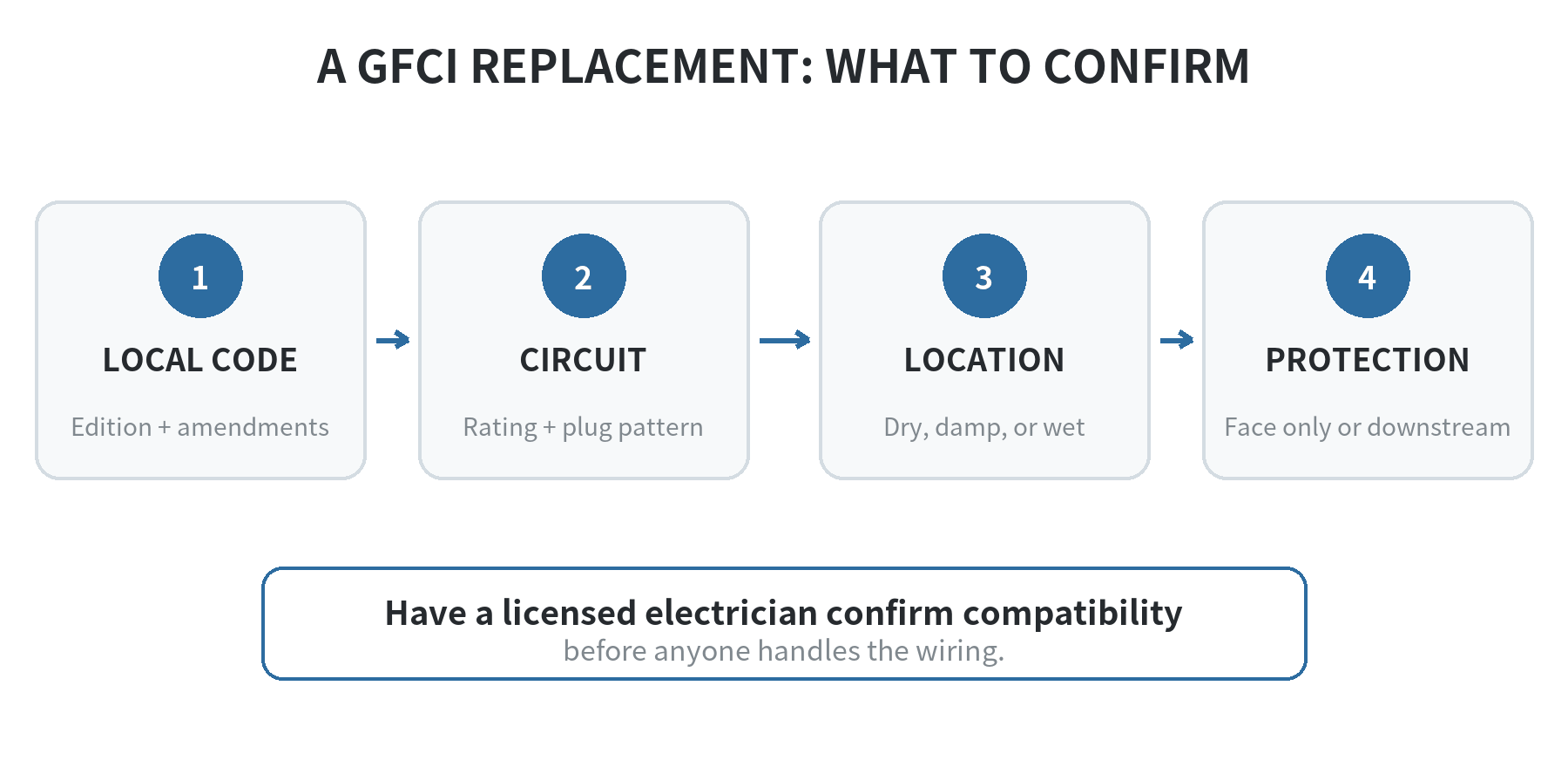
Check with your local building department before replacing or adding a receptacle, and have a licensed electrician handle the wiring.
Where the NEC calls for GFCI protection
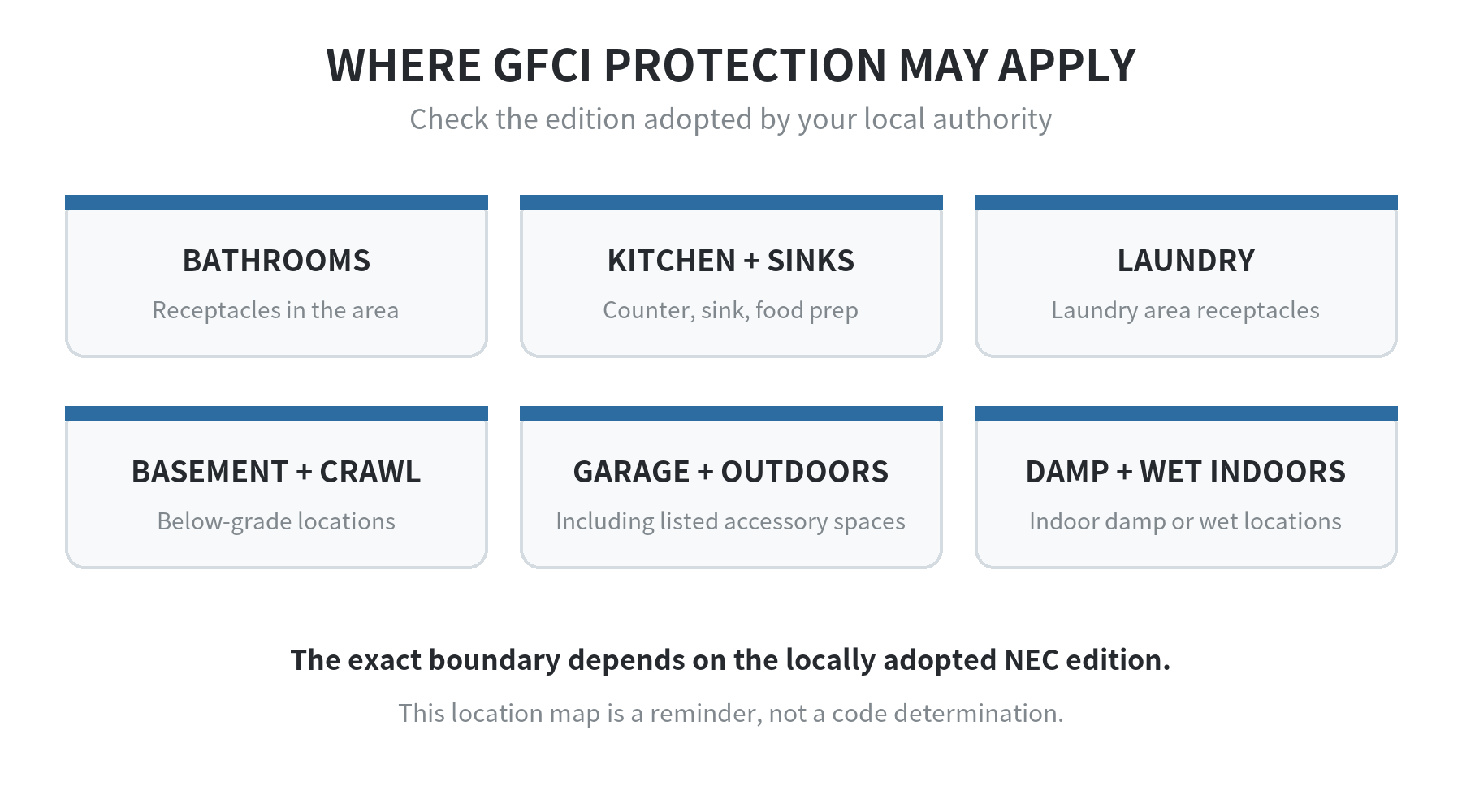
The NEC’s 2023 text covers receptacles in dwelling-unit bathrooms, garages, outdoors, qualifying accessory buildings, crawl spaces at or below grade,
basements, kitchens, laundry areas, indoor damp or wet locations, and receptacles close to sinks, bathtubs, or shower stalls.
That edition sets a 6-foot measure from the sink bowl’s inside top edge and from the outside edge of a tub or shower for the listed sink and bathing
locations. Read the NFPA 70 section 210.8 text and verify the wording in your adopted edition before relying on that measurement.
That list is a starting point, not a nationwide permit checklist. A city or state may enforce an earlier NEC edition or amend the adopted text.
NFPA’s jurisdictional code page shows local editions and changes,
while its code development page describes NFPA 70 as the electrical code adopted by authorities.
Check the current edition and amendments with your authority having jurisdiction before deciding a particular receptacle is exempt or required.
The location labels can hide important boundaries.
A basement receptacle is not the same question as a receptacle in a finished living area under an older local edition,
and a sink rule is measured from the sink rather than from the room doorway. For a kitchen, record whether the outlet serves a countertop;
the NEC’s language has changed across editions. If you are looking at a garage,
note whether the space is part of the dwelling or an accessory building and whether it is below grade.
Give those details to the local inspector or electrician instead of applying a one-line room list to every home.
For example, an outdoor receptacle on a covered porch still needs an assessment of both location and enclosure.
“Covered” does not by itself establish that the device and cover are correct for damp or wet exposure.
Ask whether the receptacle must be weather-resistant and whether the cover keeps the receptacle protected when a cord is plugged in.
The adopted code and the device listing govern those details.
A GFCI senses an imbalance between current leaving and returning through a circuit and interrupts power when it detects a ground fault.
The Consumer Product Safety Commission’s fact sheet explains that this protection can be built into a receptacle, a circuit breaker,
or a portable device. So the required protection may come from a GFCI breaker or another upstream device;
the receptacle itself does not always need TEST and RESET buttons.
Choose features by the outlet’s location
Start with the circuit, not the faceplate color or extra features. Look at the existing receptacle and the breaker information,
but do not open the panel or handle conductors. The amperage and plug pattern must fit the circuit and the connected equipment.
The manufacturer’s instructions for the replacement device also need to match the installation.
- Indoor, dry location: Choose a listed GFCI receptacle with the rating and configuration specified for the circuit. If children could access it, check whether the applicable code calls for tamper-resistant shutters.
- Outdoor or damp/wet location: Check for a weather-resistant (WR) receptacle and a cover rated for the actual location. The receptacle rating does not replace the need for a suitable enclosure.
- Existing downstream outlets: Ask whether the GFCI device will protect only its own face or also receptacles connected to its LOAD terminals. That depends on circuit wiring and device placement; an electrician can identify which outlets are protected.
- Replacement device: Compare the old device’s markings with the circuit requirements and the installation sheet. A 15-amp or 20-amp label alone does not establish that a device is suitable for every circuit.
Make a short note before discussing the replacement: room and exact location, whether it is exposed to weather, visible amperage and plug pattern,
and whether other outlets lose power during a TEST. For a bathroom vanity, note whether the receptacle is near the sink. For a garage,
note whether the outlet serves a freezer, workbench, or outdoor equipment. Those are not a substitute for a code inspection;
they are the details an electrician needs to confirm a compatible device and the circuit’s protection.
A self-testing model checks its internal GFCI function,
but it does not tell you that every downstream outlet is wired correctly or that the whole circuit meets current code.
Indicator lights and alarms differ by product, so use the instructions for that exact device.
Avoid selecting by price or appearance when the circuit rating, weather exposure, or downstream protection is unknown.
Receptacle, breaker, or upstream GFCI?
A GFCI receptacle has TEST and RESET buttons and can protect its own receptacle. When wired to provide feed-through protection,
it can also protect receptacles on the LOAD side. A GFCI breaker provides protection from the panel and may cover a branch circuit.
A portable GFCI adds protection to equipment plugged into it, but it does not change the permanent wiring.
The CPSC describes these as different forms of ground-fault protection.
Before replacing a receptacle that has no buttons, find out whether an upstream GFCI device already protects it.
Pressing TEST on that upstream device may turn off several receptacles, including outlets in another room.
Do not assume an outlet is unprotected just because it looks ordinary, or protected just because another outlet nearby has buttons.
Ask an electrician to trace the circuit if the protected outlets are unclear.
What to check before the electrician arrives
Take a clear photo of the current receptacle face and note the room, whether the location is indoors or outdoors,
and what other outlets lose power when an existing GFCI is tested. Record the breaker label if it is visible without opening the panel.
These details help an electrician confirm the right device and whether the current protection covers downstream outlets.
Do not remove the receptacle to identify LINE and LOAD conductors.
The device manufacturer warns that reversing those connections can prevent the GFCI from resetting and can leave connected outlets without the
intended protection. Wiring conditions can also differ in older homes. If the receptacle is loose, damaged, warm, buzzing, or will not reset,
stop using it and contact a licensed electrician.
Test the GFCI after installation
Follow the product instructions for the test routine. Leviton’s GFCI installation sheet says to press TEST and then RESET every month;
during the test, a lamp plugged into the receptacle should turn off and return when RESET is pressed.
The manufacturer says to replace that device if it cannot be reset or its status light does not indicate proper operation.
A different manufacturer may specify its own indicator behavior, so use the included directions.
If TEST does not cut power, RESET does not restore it, or several outlets stay off, do not treat the device as confirmed protection.
Keep the affected outlet out of use and have an electrician diagnose the device and circuit. Testing checks the GFCI function;
it does not verify code compliance, grounding, or correct protection of every receptacle connected to the circuit.
FAQ
Can one GFCI receptacle protect outlets in another room?
Yes, if those outlets are connected on the GFCI’s LOAD side.
The receptacle manufacturer’s wiring instructions show that the location of the GFCI in the circuit determines which downstream receptacles it
protects. An electrician can identify those outlets and label them.
Does a GFCI receptacle add a ground wire to an older two-slot outlet?
No. The CPSC fact sheet says a GFCI can work on a two-slot receptacle, but that does not create an equipment grounding conductor.
Ask a licensed electrician which replacement and marking are allowed under the locally adopted code.
What if the GFCI trips again after I reset it?
Leave it off and contact an electrician if it trips again. The cause could be the connected equipment, moisture, a wiring issue, or a failed device;
the reset button alone cannot identify which one applies.
Last updated: 2026-10