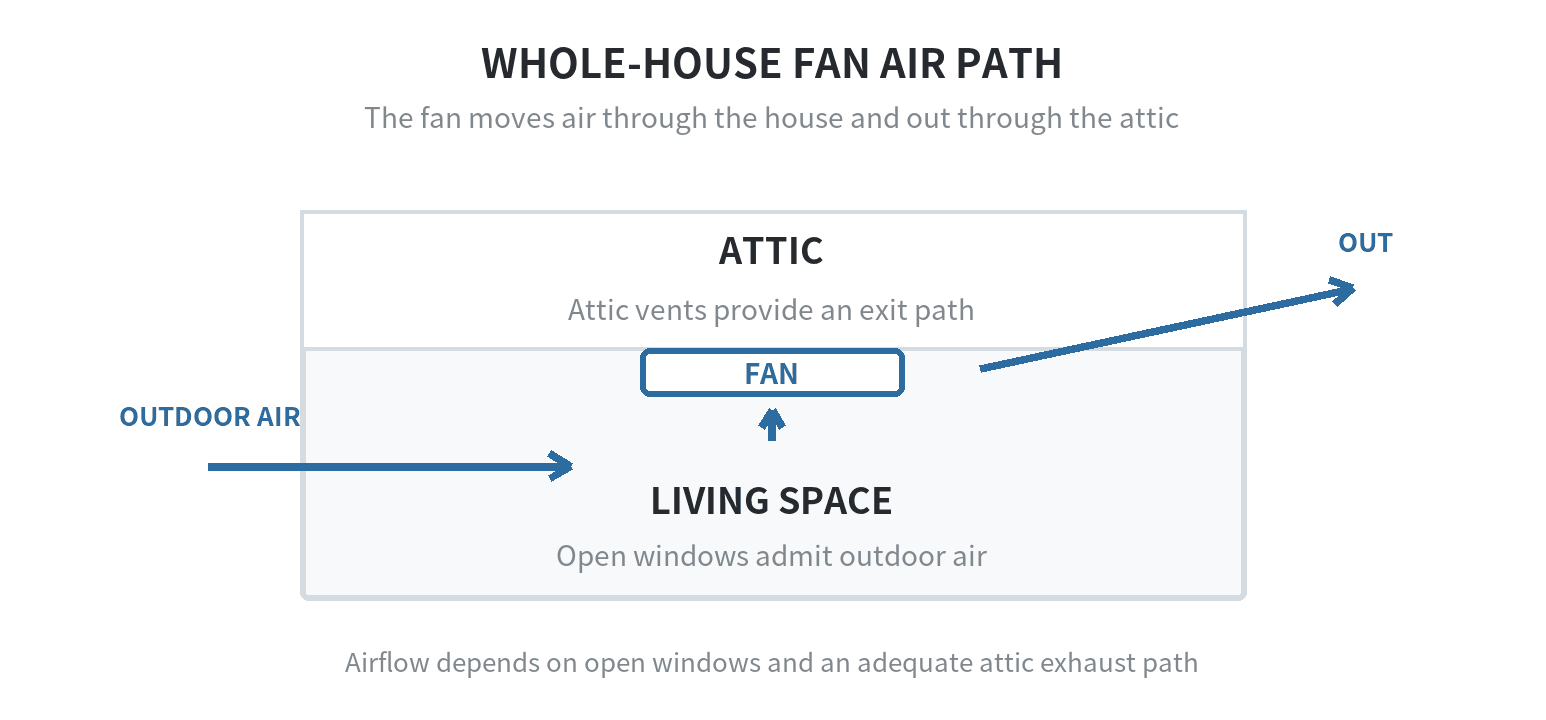
A whole house fan cools by pulling outdoor air through open windows and pushing indoor air into the attic, where it must escape through vents. It fits best when the outdoor air is cooler than the rooms, the attic has enough exhaust area, and the house has no unresolved combustion-safety risk.
How the fan moves air through a home
A whole house fan sits at a ceiling opening. With windows open, it pulls outdoor air into the living space, draws indoor air upward through the fan, and sends that air into the attic. Attic vents then release the air outdoors. The fan is moving air through the building, rather than cooling air with a refrigeration cycle.
The path has three connected parts: open windows for incoming air, a clear route through the rooms and fan, and an attic outlet to outdoors. A blockage at any point changes how the system moves air. The U.S. Department of Energy’s whole-house-fan guidance describes this window-to-attic airflow and says sufficient attic ventilation is needed for the air to leave the building.
For the attic side of this plan, see the attic insulation and ventilation overview. It explains how the existing eave and roof vent paths work around insulation; a whole house fan adds a separate airflow demand that the fan instructions must address.
When outdoor air can help—and when it cannot
The basic condition is temperature: outdoor air needs to be cooler than indoor air for the fan to exchange warmer room air for cooler incoming air. The Department of Energy describes operation when outdoor temperatures are below indoor temperatures. If the outdoor air is warmer, running the fan brings that warmer air indoors instead of cooling the house.
The fan is a weather-dependent option, not a replacement for cooling when outdoor air stays warm. It suits a home where occupants can open windows during cooler outdoor conditions. PNNL’s Building America Solution Center guide advises against running a whole-house fan at the same time as air conditioning.
Humidity and outdoor conditions also matter to comfort. The fan brings outdoor air inside without removing its moisture. If outdoor air is humid, smoky, dusty, or otherwise undesirable, exchanging the indoor air may not be useful. Check local outdoor conditions and the household’s needs before opening windows; the fan does not filter or condition the incoming air as a central cooling system does.
For a different cooling system, the site’s central air-conditioner sizing guide explains why home load and equipment match matter. The two systems solve different problems: a whole house fan uses a suitable outdoor-air window, while central air conditioning cools and circulates indoor air through its equipment.
Check attic exhaust before choosing fan capacity
Air sent into the attic needs enough net-free vent area to get outdoors. Net-free area means the unobstructed opening available for airflow, after accounting for screens, louvers, and other restrictions. A roof may look well vented from the ground while its usable open area is lower than the total visible vent dimensions suggest.
Use the selected fan’s own installation manual for its required attic vent area. The Department of Energy’s guidance gives a general relationship between fan airflow and attic net-free vent area, while the manufacturer instructions specify requirements for the particular unit. Those figures are not interchangeable: a general guideline cannot replace the selected model’s requirement, and one model’s requirement cannot be applied to every fan.
Ask whoever is assessing the installation to identify the existing intake and exhaust vents, their net-free area, and any obstruction from insulation. The manufacturer’s manual should say whether the existing openings are adequate or whether additional exhaust is needed. If the attic has no suitable outlet path, or the required vent area cannot be provided, this fan arrangement may not fit without changes to the attic ventilation.
Also check the ceiling boundary. The Department of Energy advises sealing gaps between the living space and attic because attic pressure can push air back through openings. The fan’s shutter or cover should close when the unit is idle; the installation instructions explain whether an insulated cover is needed and how to use it.
Fuel-burning appliances make pressure a safety question
A whole house fan can lower pressure inside the home as it exhausts air. If a gas water heater, furnace, fireplace, or other combustion appliance relies on indoor air or natural draft, that pressure change can pull combustion gases back through its vent and into the home. The Department of Energy’s ventilation-cooling guide and combustion-safety guidance describe this backdrafting risk.
Before installation, identify every fuel-burning appliance in the house, attic, basement, or attached garage. Note whether it has a standing pilot, a natural-draft vent, or sealed direct-vent combustion. The Department of Energy’s guide says appliances that take combustion air from the home or attic, and gas appliances with standing pilots in those areas, raise a serious installation concern.
Do not rely on opening a window as the entire safety plan. The incoming-air opening is needed for fan operation, but an appliance’s venting and combustion-air setup still need review. Ask a qualified HVAC or combustion-safety professional to assess the appliance and the proposed fan together. The Department of Energy’s guide describes combustion-safety testing and interlocks as possible parts of a safe installation, depending on the equipment and local requirements.
If an installer cannot explain how the fan affects the appliance venting, stop the selection process and get that review first.
When a whole house fan is a poor fit
The setup may not fit if the home has no practical attic exhaust path, if the ceiling opening conflicts with framing, or if there is no safe way to open windows during operation. A home with a flat roof and no attic can make a conventional attic-discharge installation difficult; the Department of Energy notes that some homes need a different design or may be difficult to retrofit.
Security and noise also belong in the decision. Operation depends on open windows, which may not work for a ground-floor room, an unattended home, or a noisy outdoor setting. The fan and moving air can be audible indoors or outside. If those operating conditions are a poor match for the household, the system may see little use even if its ceiling location is technically possible.
A pre-purchase walk-through that answers the real questions
Start from the attic and trace the route to outdoors. Locate the proposed fan position, the roof or gable exhaust openings, insulation near those openings, and any ceiling gaps. Then check the fan’s installation sheet for the required net-free vent area, framing clearance, electrical supply, shutter design, and cover instructions.
Next, trace incoming air through the rooms. Confirm that windows can open safely when outdoor air is cooler, and ask how the fan controls interact with central air conditioning.
Finally, list the combustion appliances and ask who will assess draft safety. Have the scope identify attic vent changes, ceiling sealing, wiring, framing, controls, and any combustion-safety testing.
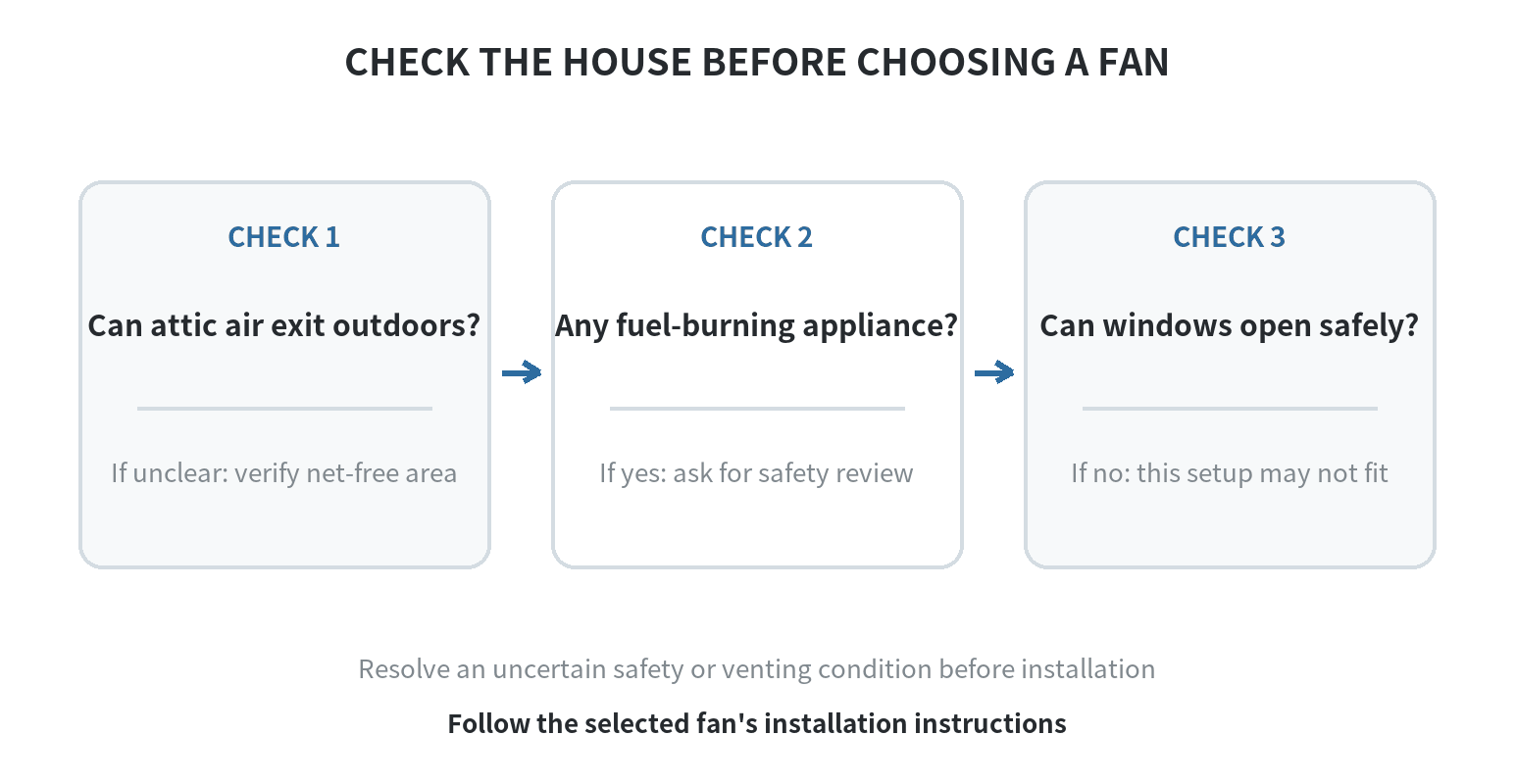
A listing can show the fan’s stated capacity, but the house determines whether that capacity can be used. Compare the manual with the attic’s net-free area, the home’s combustion equipment, and the actual window and room layout. If one of those checks fails, address that condition before choosing a model.
FAQ
Can a whole house fan run while central air conditioning is on?
No. PNNL’s Building America Solution Center guide says not to operate a whole-house fan and air conditioning at the same time; ask the installer how the controls keep their operation separate.
Does a whole house fan need its own attic vents?
It needs adequate attic exhaust area, whether provided by existing vents or a designed alternative. The Department of Energy’s guide and the selected fan’s installation manual explain how to determine the required net-free area.
Can a fan be installed in a home without an attic?
Some designs can duct air directly outdoors, but a conventional fan that exhausts into an attic needs another route when no ventilated attic exists. The Department of Energy’s ventilation-cooling guide describes direct-to-exterior designs for homes without ventilated attics.
What should I ask about a gas water heater near the fan?
Ask a qualified professional to identify its vent type and combustion-air source, then assess whether operating the fan could cause backdrafting. The Department of Energy warns that exhaust fans can depressurize a home and affect appliances that use indoor air or natural-draft venting.
Last updated: October 2026
Last updated: 2026-10