A whole-house humidifier makes sense when dry winter air affects several rooms and your home has a compatible forced-air heating system. Before comparing listings on an ecommerce platform, check the HVAC layout, the water and drain connections, the unit’s rated coverage, and how its controls respond to outdoor temperature. Those details decide whether a central unit fits your home. A product title cannot show whether the equipment, connections, and controls match your layout.
Start with the equipment your home already has
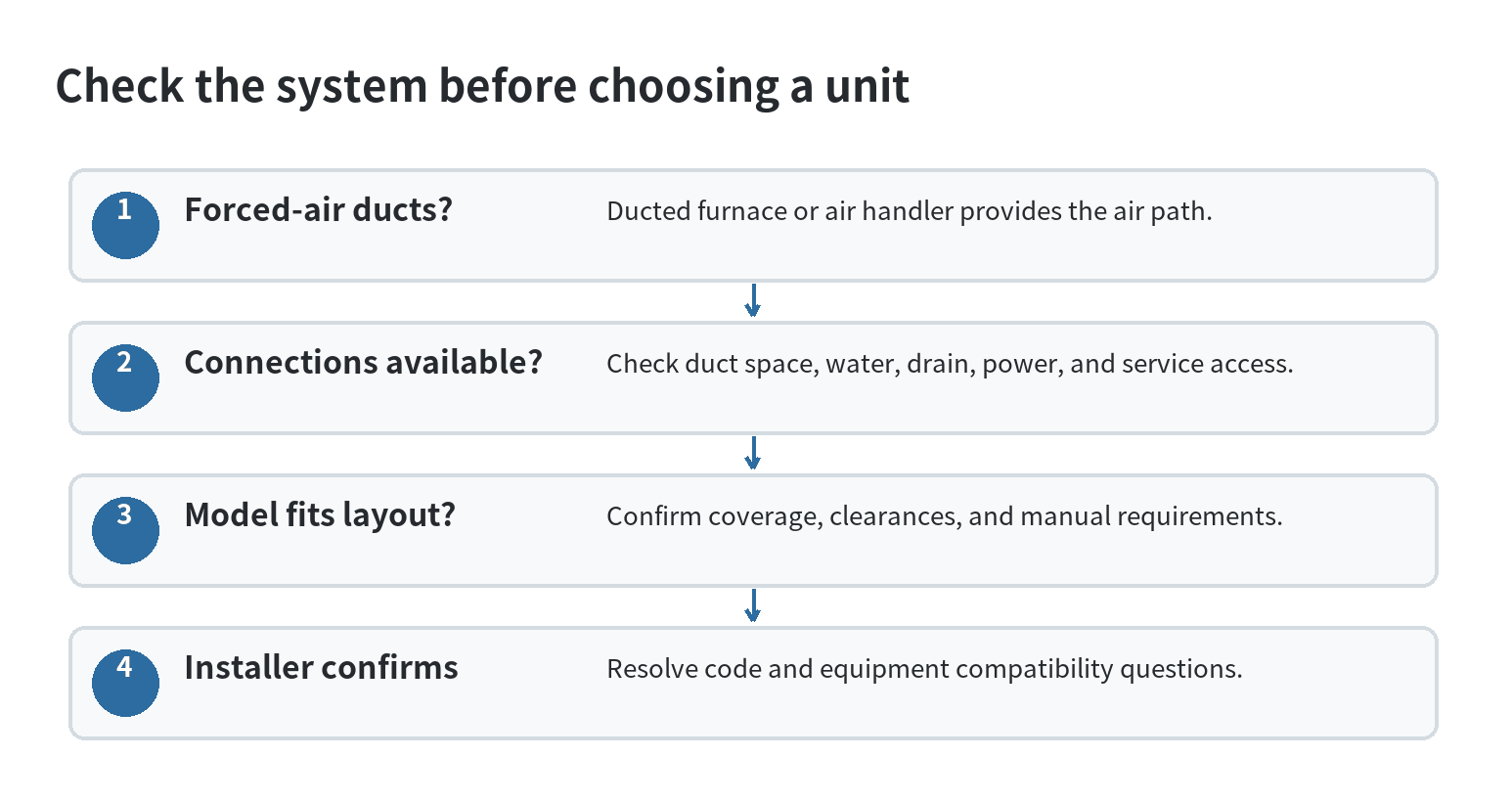
Most duct-mounted whole-house humidifiers connect to a forced-air furnace or air handler. The system moves air through ducts, while the humidifier adds moisture to that airstream. ENERGY STAR describes whole-house models as equipment installed in the ductwork of a forced warm-air HVAC system. A house heated by radiators, electric baseboards, or a ductless heat pump may need a different approach; do not assume a ducted model can serve it.
Look at the furnace or air handler, the supply and return ducts, a nearby water line, a suitable drain, and access for service. A bypass model needs duct space for its bypass connection. A fan-powered model uses its own fan, while a steam unit generates steam for distribution through the HVAC system. These designs differ in installation needs and operating conditions. Use the official installation manual to check the required clearances and connections. A listing photo rarely shows the space behind the furnace or the route to a drain.
Before an estimate, write down the furnace or air-handler model and note which rooms receive air from its ducts. Take clear photos of the unit, nearby ducts, water shutoff, and drain area. These details help the installer spot access problems before discussing a particular humidifier.
Read the room coverage as a starting point
Match the stated coverage to the area served by the HVAC system, not just the home’s advertised square footage. An open layout and a closed bedroom do not receive air in the same way, and a central unit can only distribute moisture through the connected duct system. Check whether the manufacturer’s capacity statement assumes a particular ceiling height, insulation level, outdoor temperature, or number of occupants. If the listing omits those assumptions, check the product manual and ask which rooms the rated area is meant to serve.
Also identify whether the equipment is bypass, fan-powered, or steam. A bypass humidifier uses airflow from the HVAC blower and a bypass duct; a fan-powered design moves air across its evaporative panel with a built-in fan. A steam model heats water and sends steam into the air stream. Choose among the methods by checking furnace compatibility, available duct space, service access, and the operating needs described in each manual. Ask an HVAC contractor which style fits the furnace configuration and local installation requirements.
For example, a two-story house may have a large total floor area but a single air handler that serves only one section, or doors that limit circulation into bedrooms. Write down which rooms are connected to the duct system and whether doors are usually closed. Give that information to the installer along with the model number of the furnace. It helps distinguish a true whole-system fit from a square-foot number that looks sufficient but describes a different layout.
When comparing coverage, separate the home’s total floor area from the area served by the equipment. A finished addition, converted attic, or room beyond a closed damper may not receive the same airflow as the main living area. Ask the installer to identify any zones or rooms that the existing system does not serve well.
Use humidity readings to set a cautious target
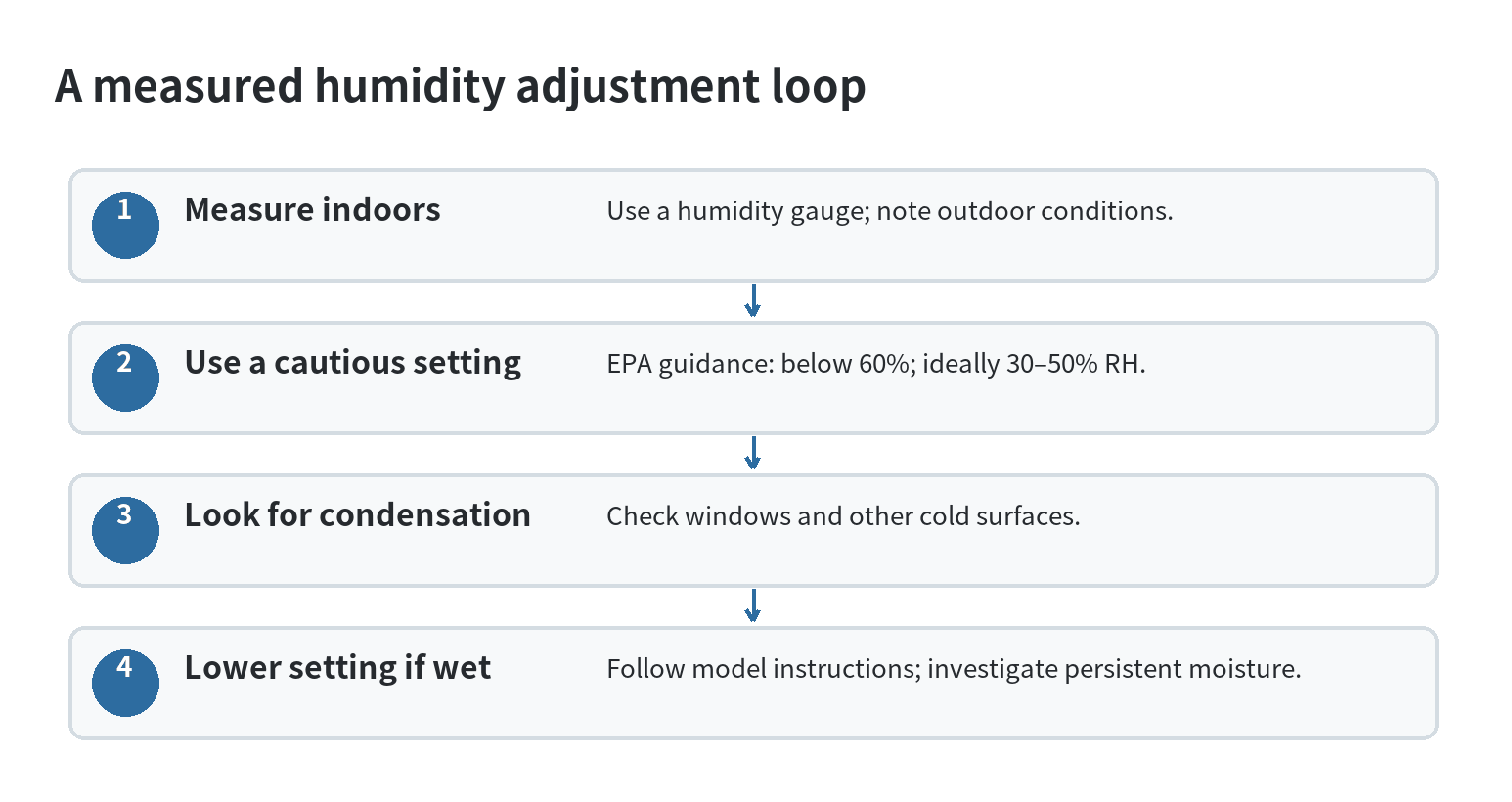
Measure indoor humidity with a reliable sensor before choosing a setpoint. The U.S. Environmental Protection Agency recommends keeping indoor relative humidity below 60 percent and ideally between 30 and 50 percent. Cold outdoor weather can make window surfaces colder, so the setting that works on one day may create condensation on another. Follow the unit manual’s outdoor-temperature guidance and lower the setting if water appears on windows or walls.
Use that range as a starting point and watch the home’s surfaces as conditions change. Construction, insulation, air leakage, window temperature, and ventilation affect where moisture collects. A setting that works during mild weather may cause water to form on colder glass later. If condensation continues after lowering the control, inspect for other moisture sources and get the building or HVAC issue assessed.
Keep a simple record of the humidity reading, the control setting, outdoor conditions, and any fog or water on windows. Change one control setting at a time, then observe whether the condensation changes. This makes it easier to tell whether the humidifier setting is contributing to the problem.
Check what installation will involve
Use the installation manual to identify the work before comparing the initial price. A bypass unit may need a cutout in the duct, a bypass duct, water tubing, a drain route, wiring, and a humidistat. The HE105/HE205 official installation manual specifies a nearby drain, calls for checking local plumbing codes, and includes duct, water, drain, and electrical connection instructions. Before work begins, ask the installer to list the materials and connections needed for your furnace.
Ask a qualified HVAC professional to inspect the furnace cabinet, duct dimensions, available power, drain slope, water shutoff, and control compatibility. Also ask where the unit will sit, whether a service panel can be opened after installation, and how a technician will reach the water connection. A tight location can make routine cleaning or part replacement harder.
Local plumbing and electrical requirements can affect the job. If the furnace warranty, building rules, or manufacturer instructions restrict alterations, resolve that before selecting equipment. Do not choose based on a low listing price until the installer confirms the complete scope.
Before agreeing to the job, request an itemized scope that identifies the unit location, water and drain route, wiring or control changes, and any duct opening. Ask who is responsible for confirming local plumbing and electrical requirements. A clear scope helps you compare estimates that include different work.
Compare the upkeep, not just the controls
Check the replacement parts and maintenance instructions for the exact model. Evaporative units use a water panel that can collect mineral scale; steam units use a canister or other serviceable components. Manufacturer instructions specify when parts need inspection or replacement. Water hardness and run time can affect buildup, so a generic replacement schedule from a different model is not a sound substitute.
Before choosing, check how the replacement panel or canister is identified and whether the manual explains cleaning and seasonal shutdown. Keep the model number and parts information with the service record. If the unit will sit in a difficult-to-reach spot, ask how the technician will inspect it without damaging nearby ductwork.
Confirm whether the humidistat is manual or automatic and whether it uses an outdoor-temperature sensor. Read what the control does when the furnace is not heating, whether the HVAC fan must run, and how the unit signals service needs. The HE105/HE205 official manual says the bypass humidifier requires the furnace blower for operation. Check the selected model’s manual for its own blower and control requirements. Keep the owner’s manual with the maintenance records so the next service visit can identify the correct pad, canister, and settings.
A short checklist for comparing listings
- System fit: Does the house have compatible ducted forced-air heat?
- Coverage: Does the stated area match the rooms served by that system, and are the rating assumptions clear?
- Connections: Are there suitable duct space, water access, drainage, power, and service clearance?
- Control: Does the humidistat account for outdoor conditions, and what happens when condensation appears?
- Maintenance: What model-specific panel, canister, cleaning, or inspection work is listed?
- Installation: Has a qualified installer confirmed compatibility, code needs, and the full job scope?
Compare models only after these questions have answers. If the equipment layout or wiring is unclear, share the furnace model and clear photos of the ducts with an HVAC professional. That gives you a concrete compatibility check before choosing among product descriptions.
FAQ
Can a whole-house humidifier work with a boiler?
A duct-mounted unit is designed for a forced-air HVAC system, so a boiler-only home does not have the duct airflow it needs. ENERGY STAR distinguishes these central ducted systems from room humidifiers. Ask an HVAC professional about options designed for homes without forced-air ducts.
What does condensation on the windows mean after installation?
Condensation means moisture is collecting on a cold surface. Lower the humidistat and check whether the moisture stops; the EPA notes that humid air can condense on cold surfaces. Persistent moisture calls for checking other sources and the home’s ventilation or insulation conditions.
Does the HVAC fan need to run for a bypass model?
For the HE105/HE205 bypass models, the official installation manual says the furnace blower must be on for operation. Check the selected model’s manual because control and blower requirements differ.
How often should a water panel be replaced?
Use the schedule and indicator described in the exact unit’s owner’s manual. Panel design, water conditions, and usage vary by model, so one product’s interval should not be applied to another.
Last updated: 2026-10