
Choose a sump pump by matching its flow at your home’s required lift to the pit and discharge setup; horsepower alone does not tell you whether it will move water fast enough. Start by recording the existing pump’s model, outlet size, switch style, and discharge route, then compare that information with the replacement’s performance curve and installation manual.
The retailer’s current sump-pump categories include submersible, pedestal, and backup systems, while pump makers offer both battery-powered and water-powered backups. Those are different jobs: the primary pump handles routine water collection, and a backup addresses a power interruption or primary-pump failure. Product categories were checked October 9, 2026.
Measure the pit and discharge before comparing listings
Take a photo of the pump label and measure the basin’s inside diameter and depth. Note how the pump sits in the pit, where the float moves, and whether the discharge pipe leaves vertically before turning. A replacement that is too wide, tall, or obstructed by its float may not fit or cycle as intended, even if its headline capacity looks attractive.
Trace the discharge route to its outlet. Record the vertical rise from the pump to the highest point the water must reach, plus the pipe diameter and any long horizontal sections or elbows. These details add resistance. Liberty Pumps’ sizing tool asks for flow and total dynamic head, and Zoeller’s pump-curve guidance explains that delivered flow changes with the resistance in the system. The useful comparison is the pump’s flow at your system’s head, not its maximum-flow figure at little or no lift. If the basement also uses a portable dehumidifier, compare drain routing with the site’s basement drainage guide.
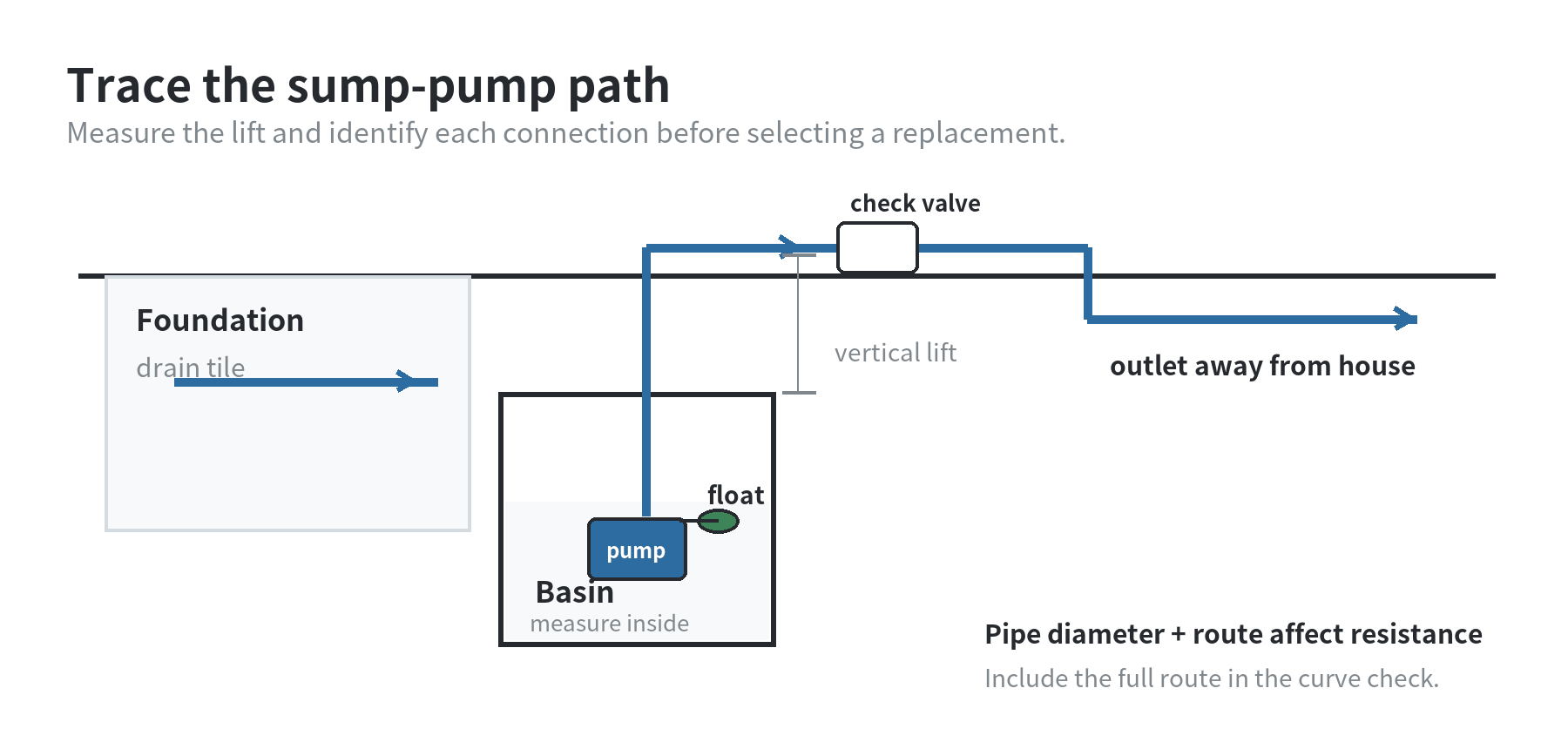
If you are replacing an existing unit, its label and manual are a useful baseline, not proof that the old size was right. A changed basement layout, new finished space, different discharge route, or recurring high-water alarm can change what the system needs. If you cannot identify the lift or pipe configuration, give those measurements and the pit dimensions to a plumber or the pump maker’s technical support before choosing.
Choose a pump style for the pit you have
A pedestal pump keeps its motor above the water, while a submersible pump operates in the basin. The retailer’s buying guide describes those two primary layouts; manufacturer catalogs also list both styles. Compare the actual footprint, minimum pit dimensions, switch clearance, and service access in the manual. Noise, debris tolerance, and construction material depend on the individual design, so check those specifications instead of assuming every pump in one category behaves the same way.
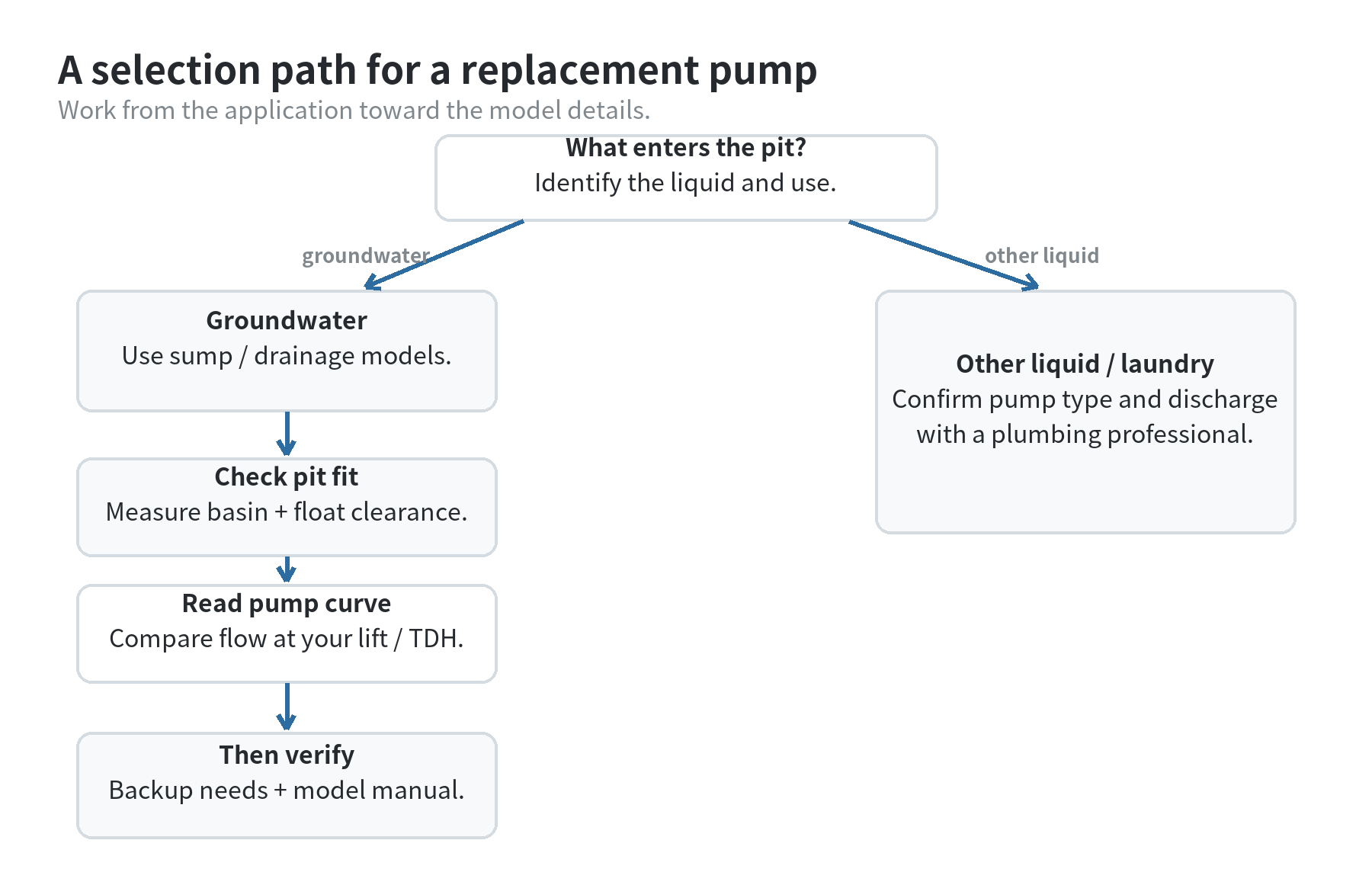
For groundwater entering a sump basin, use a pump identified for sump or drainage duty. Do not substitute a sewage or effluent pump just because its listing shows a larger motor or solids-handling figure: those categories are designed for different liquids and systems. Liberty Pumps separates sump/drainage, septic/effluent, and sewage/grinder applications in its sizing tool. If the pit receives laundry discharge or other wastewater, ask a qualified plumbing professional which pump type and discharge arrangement applies.
Read the performance curve, not just the horsepower
Horsepower describes motor input, not the exact amount of water the installed system will move. Find the model’s curve in its specification sheet, locate your estimated total dynamic head, and read the flow at that point. Compare that flow with the existing unit’s documented curve and with the drainage demand identified for your home. If a listing gives only a maximum flow at zero lift, request the full curve before treating it as a match.
A larger motor is not automatically the safer choice. The pump must fit the basin and discharge plumbing, and the float needs room to switch on and off without touching the wall, cords, or backup equipment. Zoeller’s sizing guidance identifies vertical lift, flow, and pipe characteristics as selection inputs; the retailer’s guide also directs readers to consider basement depth and groundwater conditions. When these inputs are uncertain, a capacity guess based on square footage alone is not a substitute for system measurements.
| Check | What to record | Why it matters |
|---|---|---|
| Pit | Inside diameter, depth, pump footprint | Confirms fit and float clearance |
| Lift and pipe | Vertical rise, pipe size, route and bends | Sets the resistance used to read the curve |
| Electrical | Voltage, plug, outlet protection, cord reach | Confirms the model matches the available connection |
| Water and control | Groundwater or wastewater; float or sensor type | Checks the pump’s intended use and switch fit |
Decide whether a backup fits your outage risk
A backup is a separate decision from the primary pump’s capacity. The retailer’s guide and pump manufacturers describe backup systems that can operate when the main pump fails or household power is interrupted. Battery systems need a compatible battery and charging arrangement; water-powered systems depend on a suitable municipal water supply and have their own flow limits. Check what is included, how the backup activates, its alarm, maintenance requirements, and whether both pumps fit in the basin.
Sketch the pit before choosing a packaged primary-and-backup unit. Confirm that the two pumps, floats, cords, and discharge connections can sit without binding. Read the manufacturer’s installation instructions for battery type, charging, alarm testing, and maintenance. If outage protection matters where you live, consider what happens when municipal water service is also interrupted; a water-powered unit depends on that supply, while a battery unit depends on its stored charge.
Check the exact model, warranty, and current terms
Save the model number and manual with your home records. Before settling on a model, read the warranty, included components, return conditions, and installation requirements; listings can change, and a package may not include a battery, alarm, or check valve. Product listings and category availability were checked October 9, 2026, so verify the current specification sheet and local availability when reviewing a particular model. The site’s home equipment record checklist can help organize model and service paperwork.
If a military discount could affect your budget, verify your own status and the pump’s eligibility in the retailer’s current program terms. Its program description covers eligible U.S. veterans, active service members, and spouses, while SheerID’s verification help explains that the available status options and requested proof control eligibility. Both pages were checked October 9, 2026; do not assume every item qualifies or include an unconfirmed discount in your estimate.
For a recall check, search the retailer’s product-recall page and the Consumer Product Safety Commission’s recall notices using the exact model and any date code. The CPSC says recalls can affect specific batches and directs consumers to match their product to the notice and use the company’s stated remedy instructions. If a notice matches, follow that notice and contact the company listed there; the CPSC complaint form is for problems obtaining a remedy, not for starting the remedy request. These recall resources were checked October 9, 2026.
Before comparing two models, put the same inputs beside each one: pit dimensions, lift, pipe route, flow at that head, switch clearance, electrical connection, and backup needs. That turns a shelf or search-page comparison into a check against the system already installed in your home.
Last updated: 2026-10
Frequently Asked Questions
Can I replace a sump pump with a different horsepower rating?
Only after checking the system requirements and the replacement’s pump curve. Compare flow at your lift, physical fit, switch clearance, and electrical requirements with the existing setup; a horsepower label alone does not establish compatibility.
Can I use a sump pump for laundry water?
Do not assume a groundwater sump pump is suitable for laundry discharge. Pump makers distinguish sump or drainage applications from effluent and sewage uses; ask a plumbing professional to identify the correct equipment and discharge arrangement for your system.
What should I do if my sump pump model appears in a recall?
Match the model and date code to the recall notice, then follow the company’s listed instructions and remedy. The CPSC advises consumers to contact the company for the remedy; its complaint form is for reporting trouble obtaining that remedy.
Is a battery backup better than a water-powered backup?
They depend on different resources. A battery backup depends on a compatible, charged battery; a water-powered backup depends on municipal water pressure and supply. Compare those dependencies with your home’s outage conditions and each model’s manual.