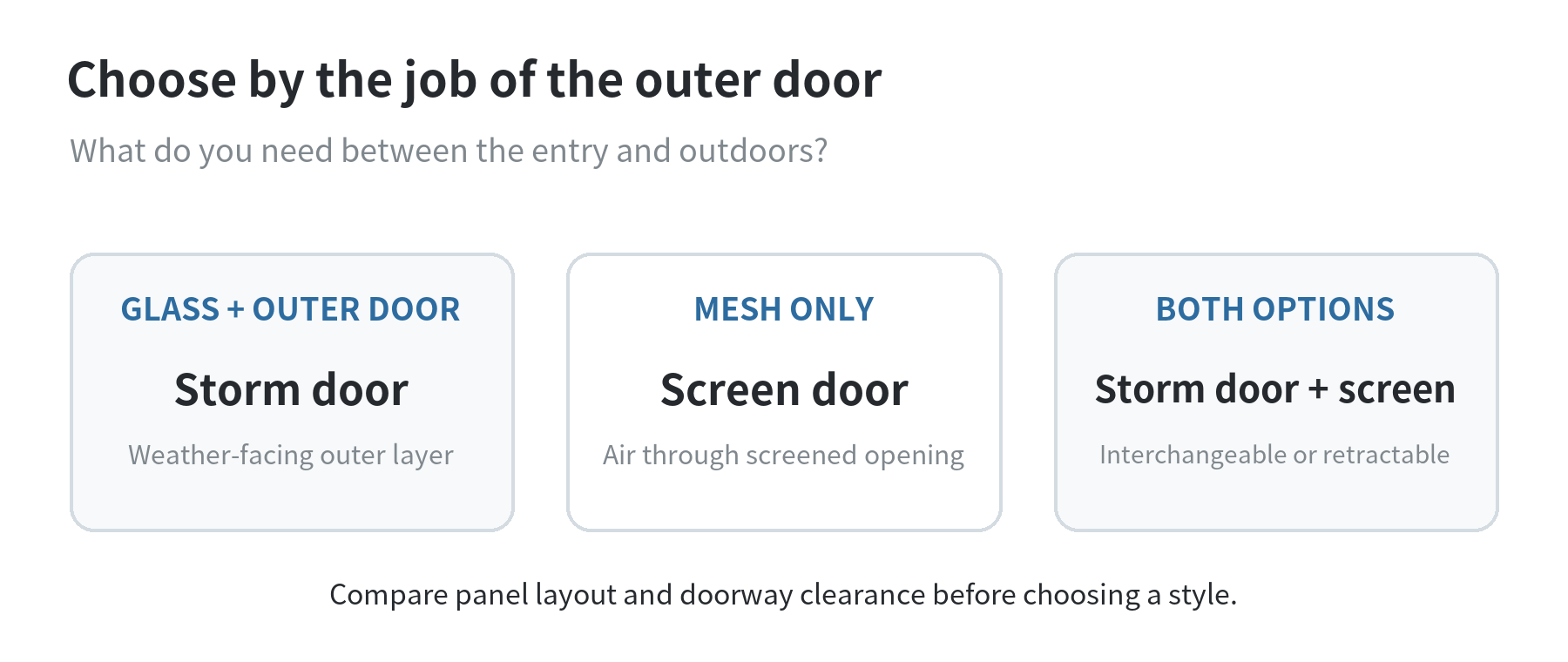
Choose a storm door if you want a second hinged layer outside your entry door, with a glass panel for light and weather exposure or a screen for airflow. Choose a screen door if your main goal is to open the entry door to a screened opening. The labels overlap: some storm doors switch between glass and screen, so compare the panel setup and frame rather than relying on the product name alone.
A simple way to decide is to ask what the outer door needs to do when the main door is closed. If you want glass across the entry, choose a storm-door design. If you only want a mesh barrier, a screen door fits that job. If you want both options, look for a storm door with interchangeable or retractable screening.
What separates the two door types
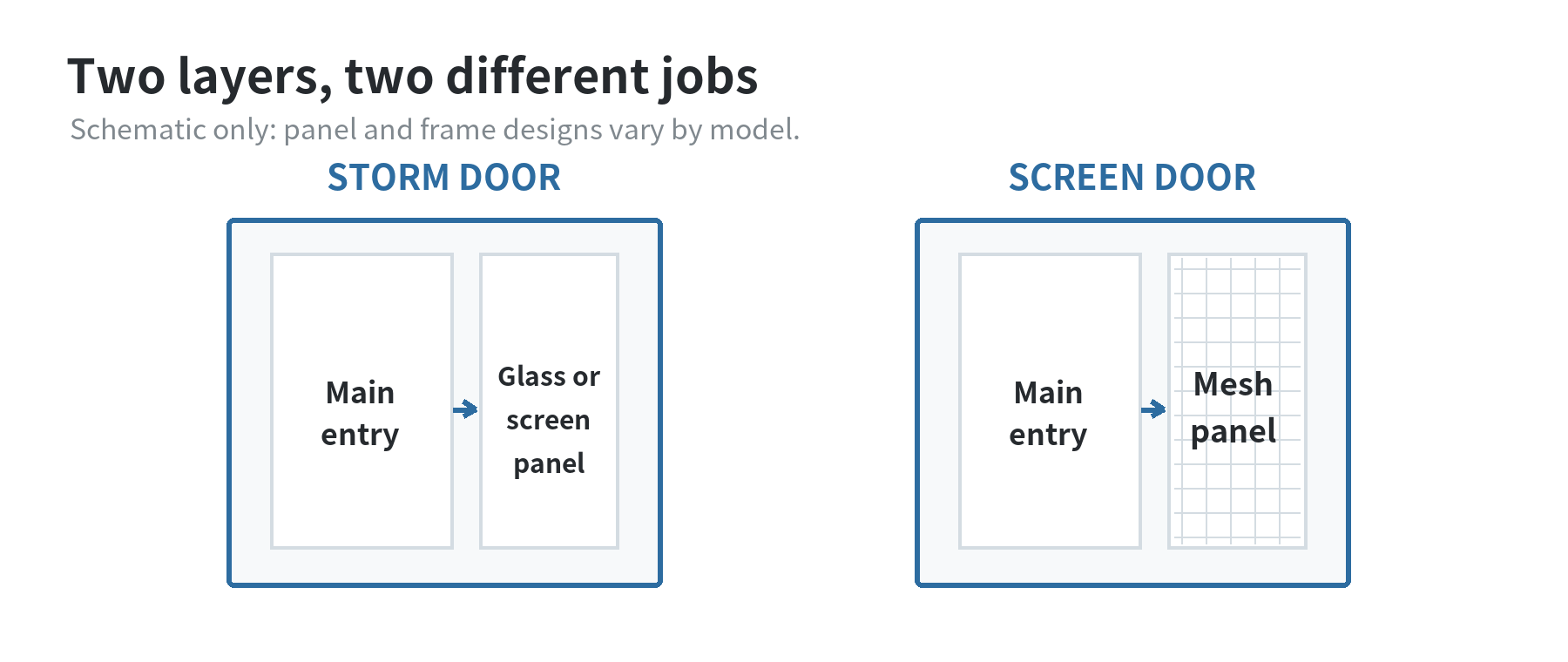
A storm door mounts outside an existing exterior entry door. It adds a second door leaf and may use a full glass panel, partial glass, or a screen. The exterior-door buying guide describes storm doors as a glass-panel layer over an entry door, while Andersen’s storm-door overview lists full-glass, interchangeable, and retractable-screen arrangements. The exterior-door buying guide and the storm-door design overview both describe these combinations.
A screen door puts mesh across the opening for ventilation, with weather stripping around the frame on some designs, as described in this exterior-door guide. The product may swing or slide; retractable designs can move the screen out of view. A screen panel is not a safety barrier for a child or pet: a screened storm-door guide says its mesh is not intended to retain people or objects, and the U.S. Consumer Product Safety Commission warns that window screens do not prevent falls. Check the opening and supervision needs before choosing a mesh-only door.
| What you need | Door setup to compare | What to check |
|---|---|---|
| Glass in front of the entry door | Full-view storm door | Glass type, panel access, glare and sun exposure |
| Airflow through mesh | Screen door or storm door with screen | Fixed, sliding, retractable or interchangeable mesh |
| Seasonal glass and screen use | Interchangeable storm-door panels | Where panels are stored and how they are changed |
| Mesh when needed, clear opening when not | Retractable screen door | Screen coverage, track and handle operation |
When a storm door makes more sense
Choose a storm door when you want an extra operable layer over the main exterior door. A glass panel can let daylight into the entry while keeping the main door closed. A frame and seals can create another layer at the doorway, but the result depends on the product, fit, and installation. The U.S. Department of Energy includes storm doors among building-shell weatherization measures, and a door manufacturer describes weather stripping as one feature that can support efficiency; those statements do not establish a savings amount for an individual doorway. The Department of Energy’s whole-house weatherization guidance and the manufacturer’s product overview provide that context.
Look at the entry’s sun exposure before choosing large glass. A bright west-facing doorway may make a clear panel uncomfortable to stand behind during hot afternoons. A screen panel can be more useful when you want cross-breezes and the outside air is comfortable. For a model with removable panels, confirm how the glass and screen are secured and where the unused panel will be stored.
A storm door is also the more relevant category if you want a panel that can close between weather and your main door. The outer frame still needs a suitable mounting surface and clearance for its handle and closer. Those dimensions vary by product; check the model’s installation instructions against your existing trim before choosing a size.
When a screen door is enough
A screen-only door fits a doorway where the main door already handles privacy and weather closure, and you want a mesh layer across the open doorway. This can suit an entry that opens onto a covered porch or a patio door where the glass door remains in place behind the screen. It avoids adding a second full glass panel when light through glass is not part of the goal.
For example, if the entry opens to a porch and you want air to pass through the living area, check that another open window or doorway creates a route through the house. The screen does not create airflow on its own; air needs an open path to move. With a screen-only outer door, the main entry door remains the solid closure when you want the doorway shut against weather or view.
Match the opening style to the space. A hinged screen door needs room to swing without hitting steps, furniture, or another door. A sliding screen door needs a compatible track. A retractable screen needs a clear path for its housing and side track. If the doorway is exposed to wind-driven rain, confirm the product’s weather-stripping details instead of assuming the mesh will block rain or drafts.
Mesh is a replaceable material, but a torn panel can reduce insect control until repaired. Check the screen material and how the panel attaches to its frame. If occupants or bags brush past the doorway, inspect the lower area and handle design, where contact and snagging can occur. These are fit and maintenance questions; they do not make a screen door a security door.
Check the doorway before comparing styles
Measure the clear opening and inspect the trim where the outer frame would attach. Do not assume the nominal door size equals the finished frame dimensions. Andersen’s installation guide and Pella’s measuring guide both instruct readers to measure opening width at the top, middle, and bottom, then use the narrowest measurement. Height and mounting-surface checks also vary by product, so compare the opening with the manual for the exact door you are evaluating. The installation guide and Pella’s storm-door measuring steps illustrate the measurements.
Also identify the hinge side from outside, check that the entry handle will not collide with the outer door handle, and confirm the door can open fully. The frame needs secure trim and enough room for its hinge rail, latch rail, and closer. If trim is loose, damaged, or too narrow for the instructions, resolve that before selecting a door.
For background on measuring an opening and the difference between door sizes, see this door-measurement walkthrough. If air leakage is your concern, this weather-stripping guide covers the seal around the existing door, which is a separate part of the doorway.
Compare features that change daily use
For a glass-and-screen combination, compare how each panel changes. Interchangeable panels let you install glass or screen as needed; a retractable design keeps the screen attached and moves it out of view. Andersen’s product overview describes both options and notes that retractable designs do not provide screen coverage across the full height in the same way as its interchangeable full-screen panel. Read the specific product description because panel coverage differs by design.
Then compare the details that affect use: full or partial glass, the screen’s coverage, door swing, handle clearance, closer adjustment, and the panel-retention method. If children or pets use the entry, consider the lower panel and how the door closes, but treat an insect screen as an insect barrier rather than a guardrail.
For a straightforward choice, write down one must-have and one deal-breaker. For example: “I want daylight behind a closed main door, but I do not want to store a loose panel.” That points toward a storm-door design with built-in retractable screening. “I want mesh across the opening only when the patio door is open” points toward a screen door. The exact fit and panel layout still need to match the doorway.
FAQ
Can a storm door also work as a screen door?
Yes, if the storm-door model has an interchangeable or retractable screen. The manufacturer’s storm-door overview describes full-screen panels that replace glass and retractable screens built into the door. A fixed-glass model without a screen does not provide that mesh opening.
Does a screen door keep rain out?
Mesh itself is not a solid rain panel, though a screen-door frame may use weather stripping to limit wind and rain around the edges. The exterior-door buying guide describes screens for ventilation and weather stripping for wind, rain, and dust; a storm-door manufacturer’s overview describes frame weather stripping as a draft seal. Read the specific product’s weather-seal details when rain or wind is part of the decision.
What should I measure before choosing an outer door?
Measure the opening width at the top, middle, and bottom, then check height, trim condition, mounting depth, and handle clearance against the product instructions and manufacturer measuring guide. A screen door track and a hinged storm-door frame may require different clearances.
Is a screen door safe for a child or pet to lean on?
No. An insect screen is designed for insect control, not for retaining people or objects. The installation guide for a screened storm door gives that warning; use an appropriate door or barrier for safety.
Last updated: October 2026.
Last updated: 2026-10