Choose a dehumidifier for basement use by matching its rated moisture removal to both the room’s area and how damp the room is. Then check the basement’s temperature
and where the collected water will go; a large pint rating alone does not answer either question.
For a portable unit, start with the room’s square footage and the dampness signs you can observe.
ENERGY STAR’s current buying chart pairs room size with moisture conditions, while the U.S.
Department of Energy explains why today’s pint ratings cannot always be compared directly with older labels.
Start with the basement, not the product list
Measure the floor area of the space you actually want to dehumidify. If an open basement has connected rooms, include the connected area only when air can move between them;
closed doors and walls divide the space the unit can serve. Note whether laundry dries there, whether walls feel damp, and whether you see condensation or seepage.
Sketch the basement before shopping. Mark doors, stairways, partitions, the laundry area, and any floor drain. That simple plan shows where air can circulate
and whether a hose route is practical. If one room stays shut most of the time,
size for the area the appliance will actually serve instead of adding every basement room together.
Use a hygrometer to check relative humidity rather than guessing from smell alone. The U.S. EPA recommends keeping indoor humidity below 60% when possible,
with 30%–50% as the preferred range; a single reading is a snapshot, so compare readings taken under the conditions you care about. [EPA moisture guidance]
Place the meter in the part of the basement where dampness matters, away from a running unit’s direct air stream. Take readings after ordinary room use
and again when laundry is drying or outdoor weather changes the feel of the space. A short record of readings
and conditions helps separate a brief moisture spike from a persistent basement problem.
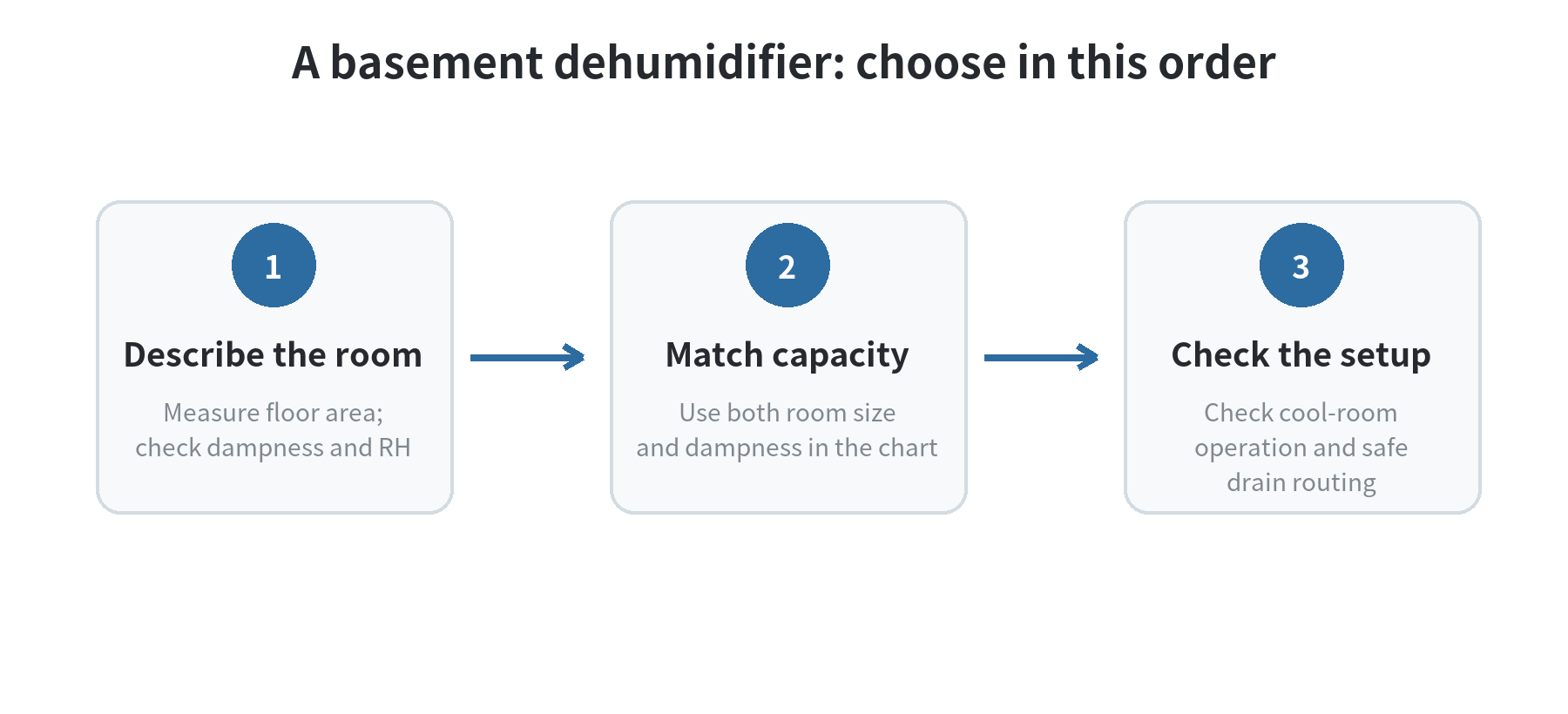
Match area and dampness to pints per day
Capacity is listed in pints of water removed in 24 hours. ENERGY STAR’s portable-unit chart separates spaces below 2,000 square feet from those above 2,000 square feet,
then gives different minimum ranges for damp, very damp, and wet conditions. Use those ranges to compare listings; actual moisture removal depends on the unit
and basement conditions. [ENERGY STAR portable dehumidifier sizing chart]
Think of the chart as a first filter. A dry storage room and a basement with persistent condensation have different moisture loads even when their floor areas match.
Use visible damp spots, musty odor, laundry drying, and seepage alongside the humidity reading to choose the chart row that best describes normal conditions.
| Condition before dehumidifying | Signs in the room | Under 2,000 sq. ft. | Over 2,000 sq. ft. |
|---|---|---|---|
| Slightly to moderately damp | Damp feeling or intermittent musty odor; 50%–75% RH | 20–30 pints/day | 30+ pints/day |
| Very damp | Consistently damp feeling; damp spots on walls or floors; 75%–90% RH | 25–40 pints/day | 40+ pints/day |
| Wet or high load | Sweating walls or floor, seepage, or laundry drying; 90%–100% RH | 30–50 pints/day | 50+ pints/day |
These are ENERGY STAR’s published capacity ranges, checked October 2026. The guide describes the square-foot categories as “small-medium” and “large” rooms
and places the break at 2,000 square feet. If the room sits near that boundary or has a high moisture load, compare the next capacity range
and the manufacturer’s room guidance. [ENERGY STAR capacity chart]
For a basement between the chart’s area categories, compare nearby capacities instead of treating the cutoff as a hard wall. Account for the layout and moisture source too:
an open utility area with a running clothes dryer may need a different choice from a finished room with the same measured area. The appliance’s stated coverage
and test basis help make that comparison more useful.
Read an old pint label with care
A newer unit can show fewer pints per day than an older unit without being a like-for-like downgrade.
DOE changed the portable-unit test temperature from 80°F to 65°F to better represent basement conditions; ENERGY STAR says cooler test air holds less removable moisture,
so the reported capacity can fall. Both DOE’s test-procedure rule and ENERGY STAR’s capacity explainer describe the test-condition change. [DOE test-procedure rule;
ENERGY STAR rating explanation]
ENERGY STAR publishes a rough old-to-new capacity crosswalk and warns that the conversion varies by model. When replacing a unit,
compare its actual water collection in your basement and the new model’s rated capacity under current test conditions; do not choose solely by matching the old number.
[ENERGY STAR old-to-new capacity crosswalk]
When an older appliance still works, note how often its bucket fills and whether it can maintain the room’s desired humidity during damp weather.
Those observations describe the basement’s real workload. Then compare replacement listings by their current rating, controls, and operating range,
since two appliances with different label values may still suit the same room.
Check basement temperature before features
A cool basement changes which operating details matter. ENERGY STAR says frost can form on the condensing coils below 65°F and interfere with moisture removal;
it advises considering a model specified for lower temperatures when the space typically falls below that point.
Check the product’s stated operating range against the coldest conditions in the intended area. [ENERGY STAR operating-temperature guidance]
This matters in an unfinished basement that is cool for long stretches, even if the dampness category suggests a high capacity.
A unit’s pint rating describes capacity at standardized test conditions, not a promise that it will collect that amount in every room.
Look for the low-temperature operating information in the manufacturer’s specifications and use the same basis when comparing models.
Check the temperature where the appliance will sit, not only the temperature near the basement stairs. A finished corner, exterior wall,
and laundry space can feel different. If the room cools substantially during part of the year, the listed minimum operating temperature
and control options matter alongside nominal capacity.
Plan the water route and daily handling
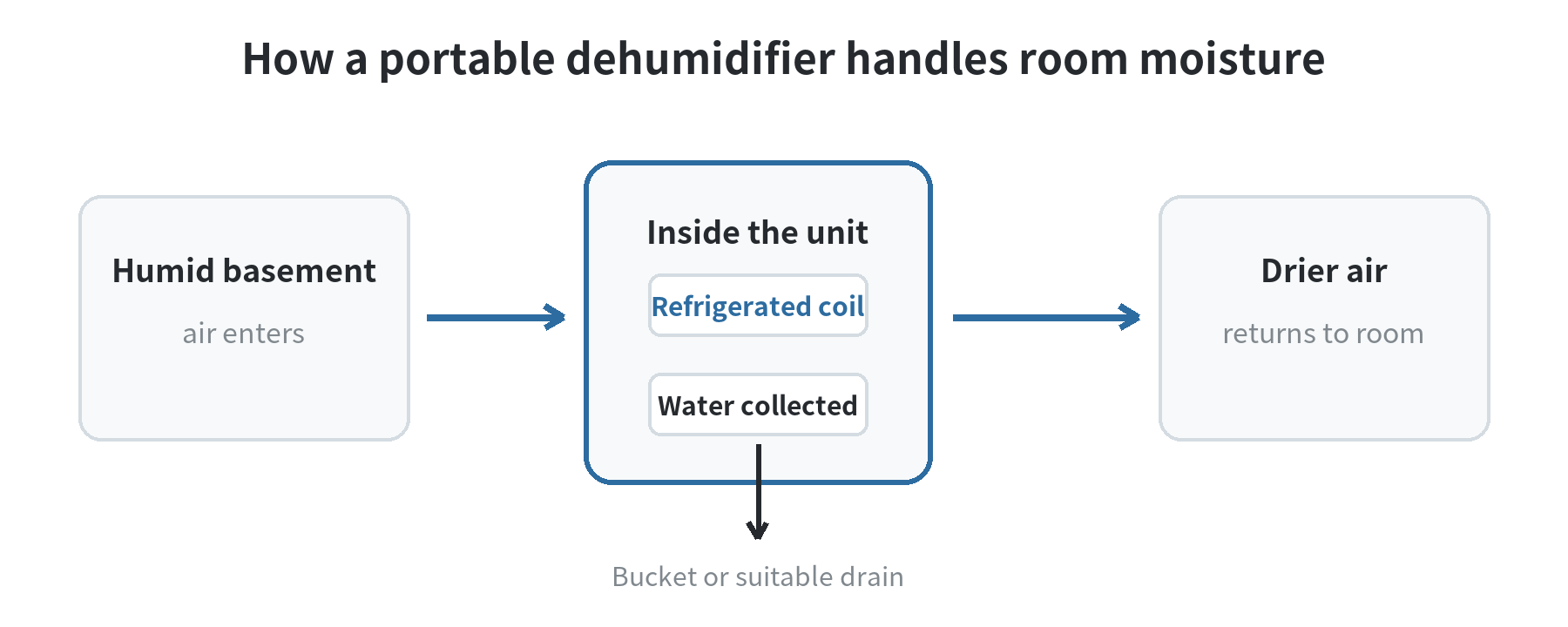
A bucket is simple to place but must be emptied when full. ENERGY STAR notes that some portable units accept a hose that can route water to a floor drain or sump pump.
Before comparing models, check whether the basement has a suitable drain, whether a hose can reach it without crossing a walkway,
and whether the unit’s instructions allow gravity drainage in that layout. [ENERGY STAR drainage options]
Gravity drainage depends on the appliance sitting higher than the drain and the hose running without a rise that traps water. Check the manual for the permitted hose size,
outlet position, and setup. Where the floor drain is too high or distant, bucket emptying may be the workable arrangement;
a pump-equipped option can help when its instructions support that route.
Also check the bucket size, full-bucket shutoff, hose connection, filter access, and the space needed around the air intake and outlet.
ENERGY STAR advises allowing air circulation around units without top-mounted discharge and keeping drain water away from electrical connections.
Follow the unit’s instructions for placement, outlet grounding, and cleaning. [ENERGY STAR placement and safety guidance]
Compare listings with a short checklist
- Write down the basement area and your observed dampness category.
- Compare the listed pints per day with ENERGY STAR’s current range for that area and condition.
- Check the operating-temperature range against the basement’s cooler periods.
- Choose bucket emptying or an allowed drain-hose arrangement that fits the room.
- Compare ENERGY STAR certification and energy use separately from moisture capacity; capacity and efficiency describe different things.
If water is entering through a leak or seepage, address that source rather than treating a dehumidifier as the repair.
ENERGY STAR also lists drainage around the foundation, clear gutters, and vented clothes dryers among ways to reduce indoor moisture sources.
A unit can manage moisture in the air, while a leak or water entry needs its own fix. [ENERGY STAR moisture-source guidance]
Look for moisture sources before increasing the appliance size. Wet laundry, a dryer that releases air indoors, blocked gutters,
and water collecting beside the foundation can keep adding humidity. Reducing those inputs can make the room easier to manage
and helps identify when dampness points to a building repair rather than ordinary humid air.
FAQ
Should I use one dehumidifier for two basement rooms?
Use one unit only when the rooms share enough open airflow for the appliance to draw air from both. Closed doors and partitions limit that circulation,
so compare each separated space with the product’s room guidance or ask the manufacturer how it rates connected rooms.
Does a bigger pint number mean lower electricity use?
No. Pints per day describe moisture-removal capacity, while the Integrated Energy Factor describes water removed per energy used. Compare capacity for the room first,
then compare efficiency figures among units in a suitable capacity range. [ENERGY STAR efficiency criteria]
Can I compare a 2019 label directly with a current listing?
Not by the pint number alone. DOE’s test conditions changed, and ENERGY STAR’s conversion table is only a rough model-to-model crosswalk.
Check the old unit’s actual water collection and compare the replacement using its current rating and operating-temperature range.
[ENERGY STAR capacity comparison guidance]
What if the basement reads below 30% relative humidity?
Raise the humidistat setting or switch the unit off and recheck the room; the U.S. EPA gives 30%–50% as its preferred indoor relative-humidity range when possible.
Follow the manual’s control instructions for the specific unit. [EPA relative-humidity guidance]
Last updated: 2026-10