Choose a smoke alarm by first mapping where alarms belong, then matching the sensor, power source, and connection style to those locations. A photoelectric unit, an ionization unit, or a dual-sensor model can each fit a different setup; the floor plan and the unit’s label matter as much as the feature list.
The U.S. Fire Administration (USFA) recommends both sensor types in a home, or a dual-sensor alarm, because each responds to different fire conditions. Its smoke-alarm guidance, checked October 8, 2026, also calls for alarms inside bedrooms, outside each separate sleeping area, and on every level, including the basement.
Start with the rooms, not the package
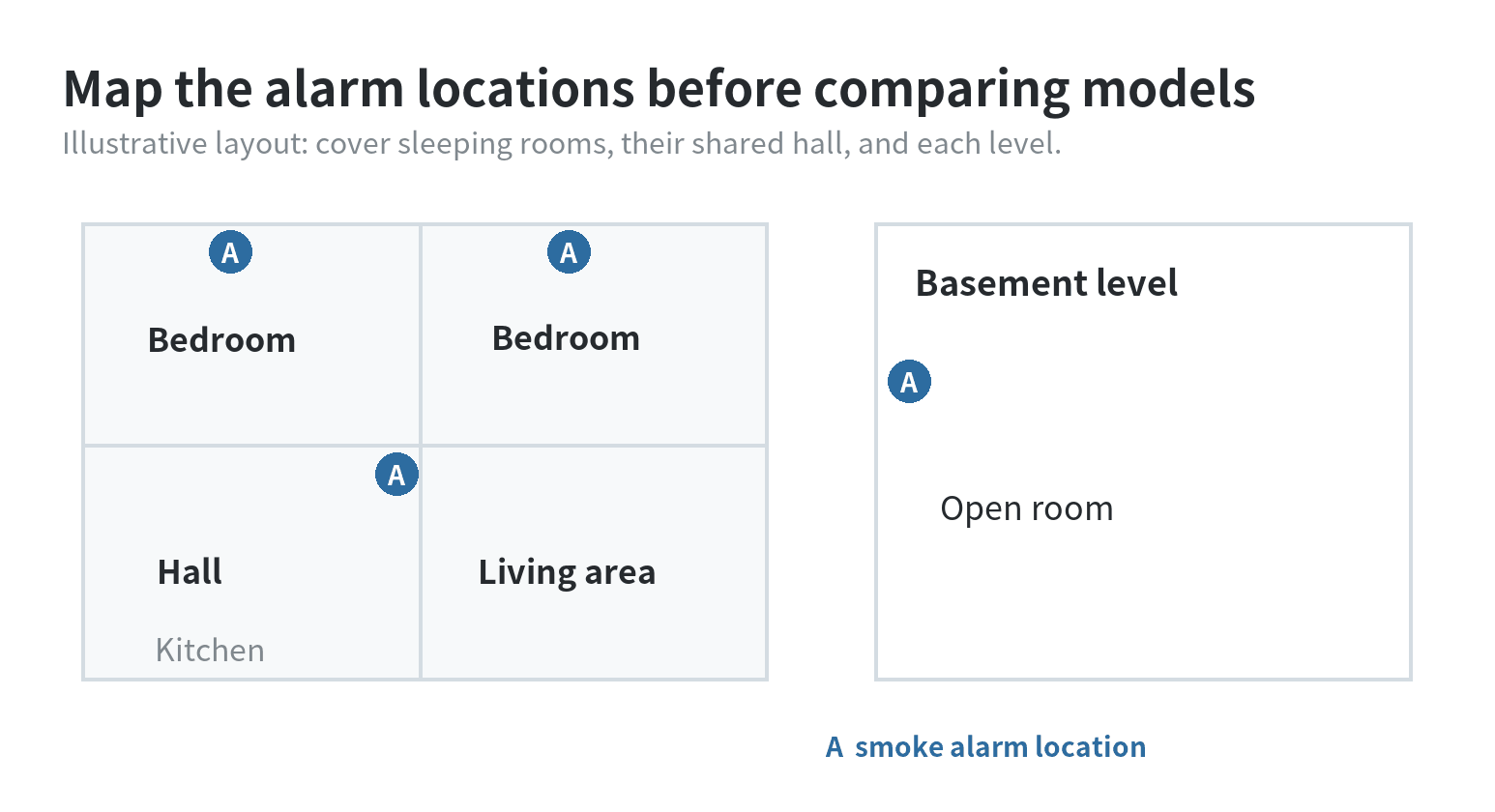
Sketch each floor and mark every bedroom, any separate sleeping area, the hall outside those rooms, and the basement. That gives you a placement plan before you compare product labels. A detector in a central living room does not cover the bedroom locations called out in USFA’s guidance.
For a two-bedroom home with a basement, your first pass would mark each bedroom, the shared hall outside them, and a suitable spot on the basement level. Add locations for any separate sleeping area. The example is a way to map the guidance, not a fixed number of alarms for every building; larger or unusual layouts may need more coverage.
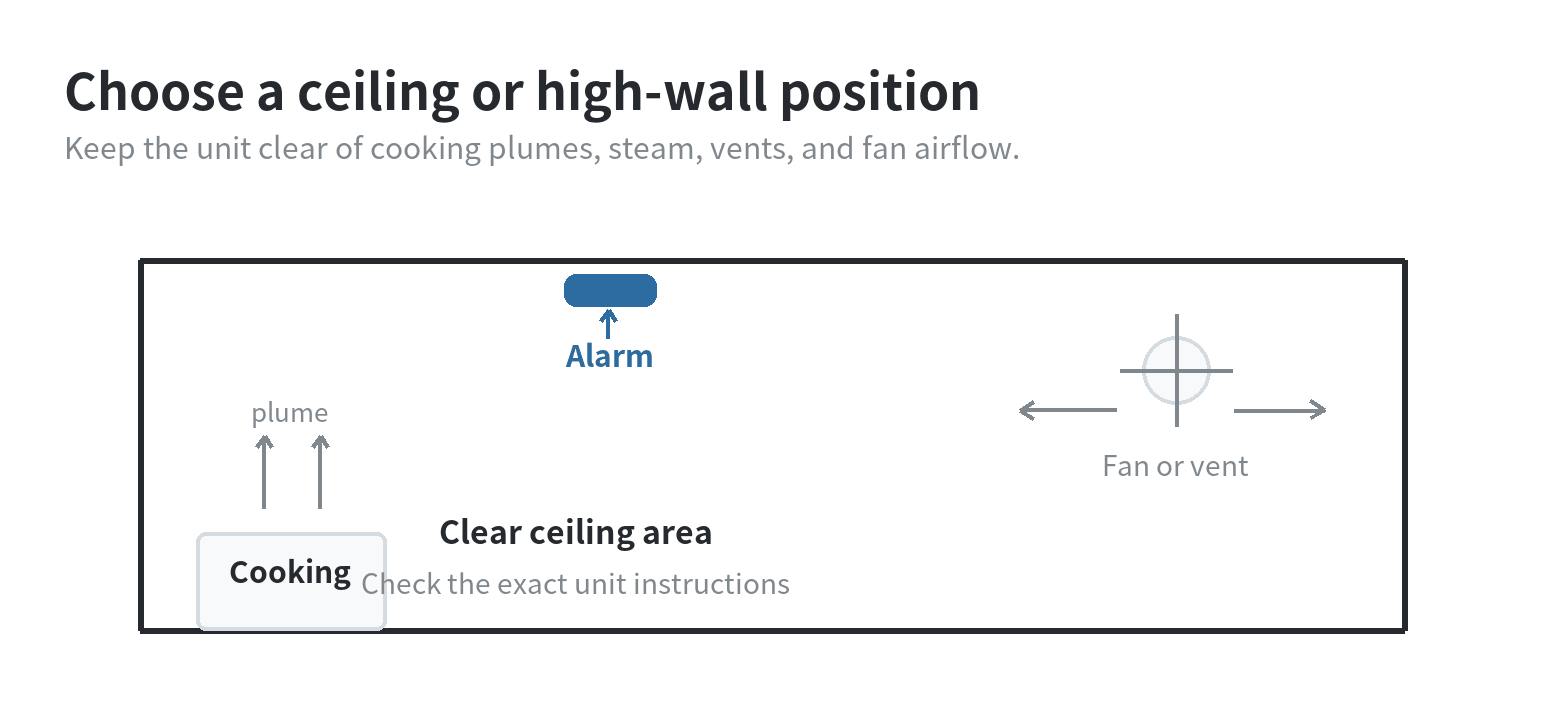
USFA says to mount alarms on the ceiling or high on a wall, then follow the manufacturer’s instructions for the specific unit. The National Fire Protection Association (NFPA) installation guide adds that a sloped ceiling calls for a position near its highest point. A wall-mounted alarm belongs high on the wall, with the unit’s top no more than 12 inches from the ceiling, according to the NFPA guide checked October 8, 2026.
What the two sensor types detect
An ionization sensor uses electrically charged air in a small chamber. Smoke entering the chamber changes the electrical current and triggers the alarm. A photoelectric sensor uses a light source and a light-sensitive receiver; smoke changes how light reaches the receiver, prompting the alarm. These designs react differently to particles from different fire conditions.
USFA says ionization alarms tend to respond faster to smoke from flaming fires, while photoelectric alarms tend to respond faster to smoke from smoldering fires. The agency also says the response-time difference varied across full-scale fire tests, so one type cannot be called better for every fire. USFA recommends both types or a dual-sensor alarm for a home.
A dual-sensor model combines ionization and photoelectric sensors in one alarm. It can simplify choosing between sensor technologies, but check the package and instructions to confirm that it is actually dual-sensor. “Smart,” “wireless,” or “interconnected” describes other product features and does not, by itself, tell you which smoke-sensing technology is inside.
| Label or feature | What it tells you | What to check |
|---|---|---|
| Ionization | Uses an ionization chamber; tends to respond faster to flaming-fire smoke. | Consider how the listed unit fits its planned location and the manufacturer’s placement instructions. |
| Photoelectric | Uses a light source and receiver; tends to respond faster to smoldering-fire smoke. | Confirm the sensor type on the unit label rather than inferring it from a feature name. |
| Dual-sensor | Contains both ionization and photoelectric sensors. | Check that the package specifies both sensors. |
| Interconnected | When one alarm sounds, connected alarms sound as well. | Verify whether the connection is wired or wireless and whether the units are compatible. |
Pick a power and connection setup
Battery-powered alarms avoid connection to household wiring. USFA describes models with a replaceable 9-volt battery and models with a nonreplaceable 10-year lithium-ion battery. The first calls for battery replacement; the sealed model still needs testing and replacement according to its instructions.
A hardwired alarm draws power from the home’s electrical system and has a backup battery, according to USFA. The backup battery still needs attention. USFA says only qualified electricians should install hardwired alarms, so treat an existing wiring connection or a new hardwired installation as a separate installation question when comparing options.
Interconnected alarms sound together when one detects smoke. That can help alert people in rooms farther from the alarm that detected it. Ask whether a model connects through wiring or a wireless link, and confirm that every planned unit can join the same system. A standalone alarm does not gain that function just because it has a phone app or another electronic feature.
For a rental or a home with existing alarm wiring, record what is already installed before selecting replacements: sensor type if shown, power source, interconnection method, and model instructions. If the existing units are hardwired, compatibility and installation details deserve particular attention. Do not assume that a wireless model will connect to an existing wired group.
Place alarms away from nuisance sources
The right room is only the first placement decision. Smoke alarms belong on a ceiling or high on a wall, but not where cooking fumes, shower steam, drafts, fans, or vents interfere with the sensor. NFPA’s installation guide advises against locations near cooking appliances, showers, ceiling fans, furnaces, and air vents. Read the exact unit’s instructions before choosing between two possible spots.
If the nearest ceiling position is beside a kitchen, bathroom, window, or supply vent, do not move the alarm to a low shelf to avoid nuisance alarms. Look for a suitable ceiling or high-wall position that still serves the sleeping area or floor. If the layout leaves no obvious spot, ask the local fire marshal or a qualified installer about the placement rules that apply to the home.
Compare the label before deciding
Use the location plan to compare units one planned location at a time. A quick label check is more useful than starting with a product’s app, color, or bundle:
- Sensor: identify ionization, photoelectric, or dual-sensor construction.
- Power: note the battery type or whether the model is hardwired with backup power.
- Connection: check whether alarms interconnect and whether the system is wired or wireless.
- Installation: compare the maker’s directions with the ceiling, wall, and nearby airflow at the intended location.
- End-of-life: find the manufacture date and replacement guidance on the unit or instructions.
For a pair of bedrooms on one floor, for example, list the two bedroom positions and the hall outside them before looking at models. Then compare whether each option has the sensor coverage you want, works with the household’s power setup, and can interconnect with the other alarms. The example gives you a repeatable shopping checklist without assuming that one model suits every room.
If your broader home-fire checklist also includes extinguishers, see our fire extinguisher types and placement guide. For an overview of household fire-safety equipment and escape planning, see our home fire-safety overview.
Plan for testing and replacement
After installation, press the test button on every alarm monthly. USFA’s maintenance guidance, checked October 8, 2026, says to replace 9-volt batteries at least once a year and to replace hardwired alarms’ backup batteries at least once a year. Follow the manufacturer’s instructions for alarms with sealed batteries.
USFA says to replace smoke alarms 10 years from the manufacture date. Check the date printed on the alarm rather than the date you moved into the home. If you cannot find the manufacture date, consult the instructions or manufacturer before deciding whether the unit remains within its stated service life.
When comparing a new alarm, make sure its label identifies the sensor and power setup, then save the instructions and note the manufacture date. The location map tells you which rooms need coverage; the label tells you whether each candidate fits the sensor, wiring, and maintenance requirements of that location.
FAQ
Can a smoke alarm be installed on a sloped ceiling?
Yes. NFPA’s installation guide says to place it near the ceiling’s highest point and follow the manufacturer’s instructions for the model.
Do hardwired smoke alarms still need batteries?
Yes. USFA says hardwired alarms have a backup battery, and its maintenance guidance calls for replacing that backup battery at least once a year.
How can I tell whether an alarm is dual-sensor?
Read the package or product instructions for both “ionization” and “photoelectric” sensors. “Interconnected” describes how alarms communicate, not the sensor type.
What if the alarm sounds while I am cooking?
Do not remove the battery or disable the alarm. USFA advises opening a door or window and using the hush button if the alarm has one; check the model instructions for its controls.
Last updated: 2026-10