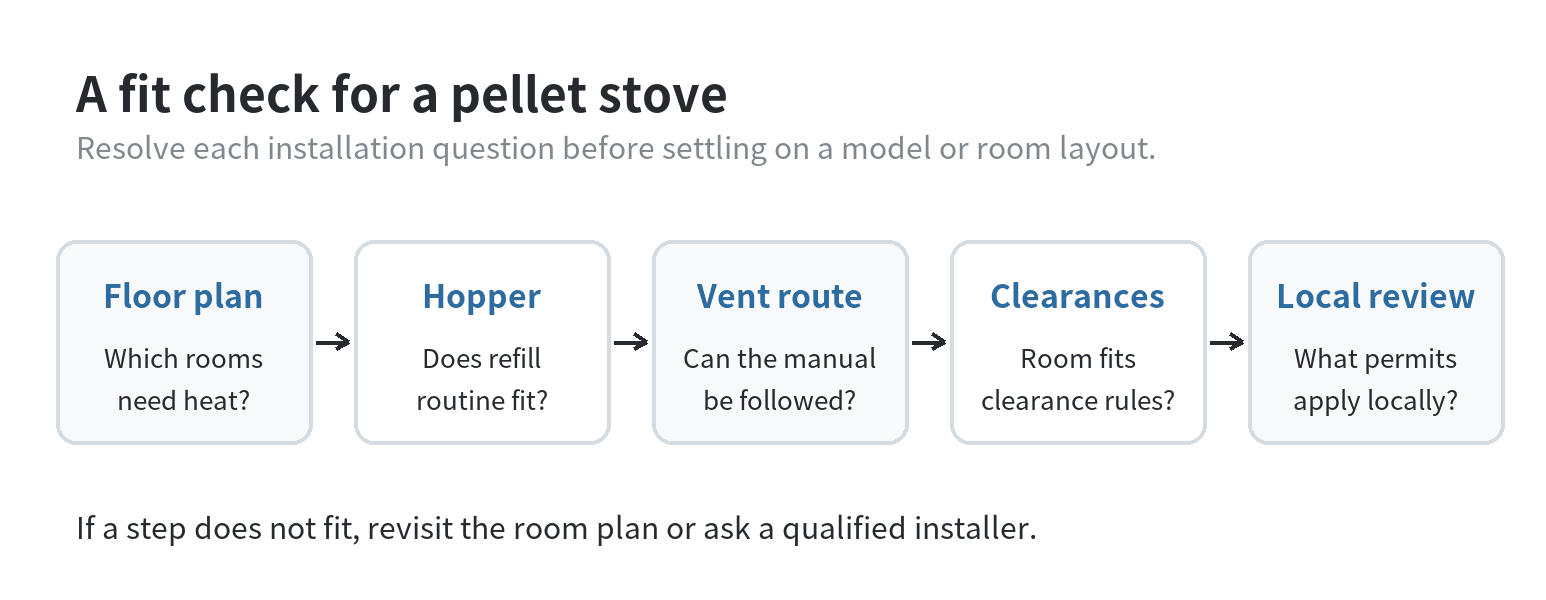
Choose a pellet stove by checking three things in order: whether its rated heating area fits the rooms you actually use, whether the hopper suits your routine,
and whether its vent route can be installed to the manual and local code.
A large square-foot rating or hopper number alone does not tell you whether the unit fits your house.
Start with the rooms, not the advertised area
Make a simple floor plan and mark the rooms you expect the stove to heat.
Note doorways, hallways, closed bedrooms, ceiling height, and where people spend time.
A stove in an open living area can share warmth with connected rooms; a closed door or a long narrow hall changes how heat moves.
Manufacturers describe heating area as an estimate, not a promise for every home.
A PelPro owner’s manual says heating capacity varies with floor-plan layout, insulation, and outdoor temperature.
The EPA’s sizing guidance also says to bring a floor plan when discussing stove sizing.
Treat a square-foot figure as a starting range, then compare it with your layout and the conditions in the manual.
Think about the coldest rooms as well as the room where the stove will sit.
If the living room is open but a back bedroom is separated by several doors, a single area rating does not show whether that bedroom will receive enough heat.
If you want whole-home heat, ask a qualified installer to assess air movement and the building envelope rather than assuming a room-heater rating equals central heating.
Read the hopper number as a refill clue
The hopper stores pellets before an auger feeds them into the burn pot.
A larger capacity can mean fewer refills when the stove uses fuel at the same rate, but the hopper does not set a fixed number of operating hours.
The rate changes with the selected heat setting, the stove’s feed controls, pellet characteristics, and how much heat the space needs.
A manufacturer manual cautions that pellet size can affect fuel feed and burn time.
For a household example, imagine you want the stove to run while you are away at work.
Write down when someone can safely check the appliance, how much space you have for dry pellet storage, and whether carrying bags to the hopper is convenient.
Then compare the hopper capacity and the manual’s fuel-use range.
Avoid translating pounds of capacity directly into an all-day runtime unless the manual gives a matching burn rate and conditions.
Also check what the manual says about filling, cleaning, and service access.
A deep hopper can reduce refill interruptions, while a difficult lid or cramped placement can make routine handling awkward.
The stove still needs access for ash removal and maintenance, and pellets should stay dry.
Confirm the permitted fuel type in the manual instead of assuming every pellet product is suitable.
Map the vent before deciding where the stove goes
Pellet stoves need a designed exhaust route and combustion-air arrangement.
Before settling on a location, identify the likely path from the appliance through a wall or roof, where the terminal would end outside, and whether the route avoids windows,
doors, soffits, and service areas.
The exact pipe, termination clearances, elbows, and allowable vent length depend on the model manual and local requirements.
Do not treat an existing fireplace opening as automatic approval for a freestanding pellet stove.
An insert and a freestanding unit have different installation arrangements.
The manufacturer’s instructions specify compatible vent parts, clearances, and installation methods.
NFPA recommends professional installation of stoves and venting systems;
ask a qualified installer to check the proposed path before relying on a room layout or product listing.
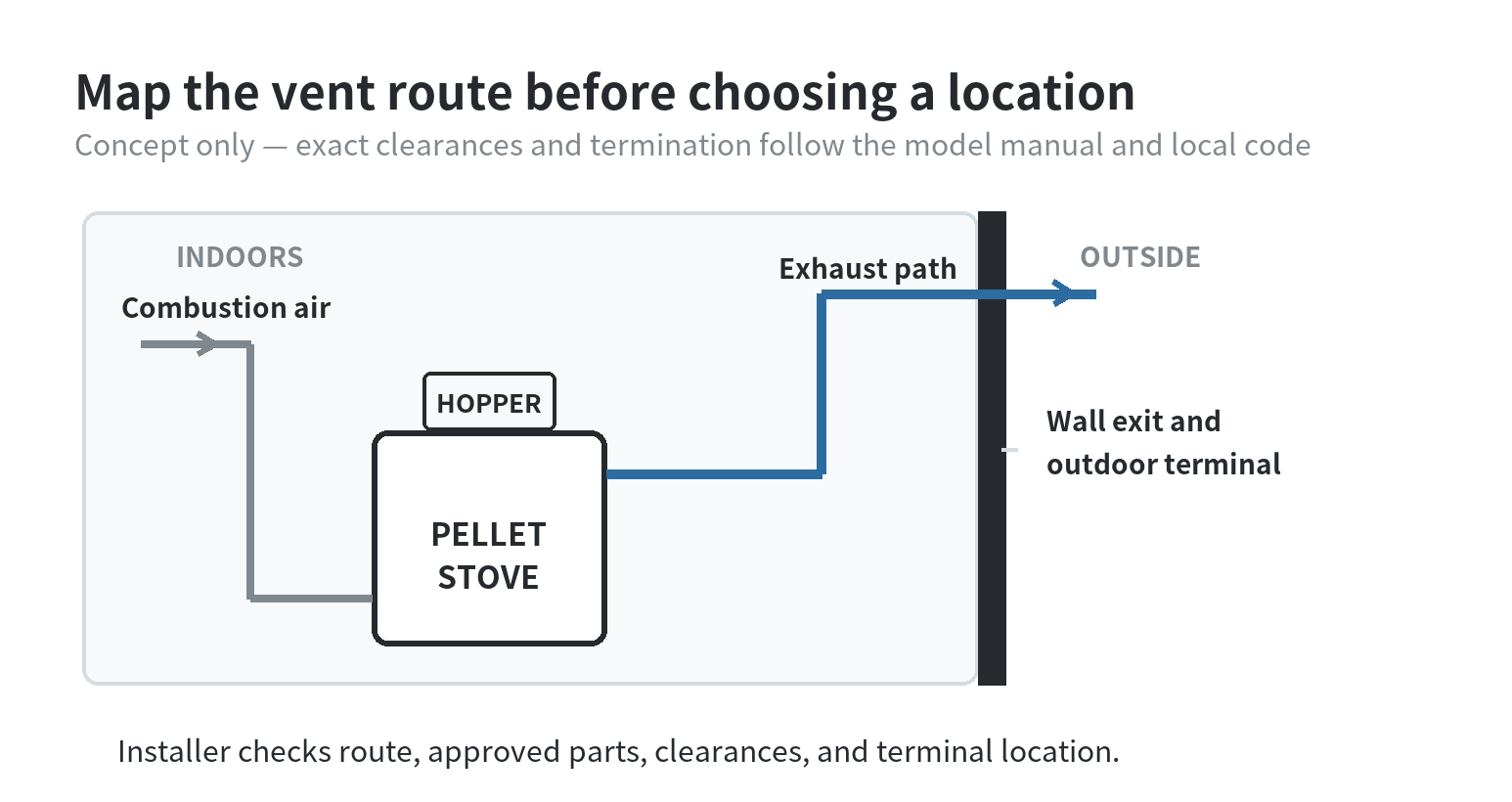
Ask what must be verified before installation: approved vent components, the wall or roof penetration, clearances to combustible material, outside-air needs,
floor protection, electrical access, and any permit or inspection.
Requirements can differ by appliance, home type, and jurisdiction.
The EPA says permit requirements depend on location; your city or county building department can explain local permits,
while the product manual supplies model-specific installation conditions.
Check clearances against your actual room
Measure the space around the proposed stove, including nearby walls, furniture, curtains, shelving, trim, and the route people use to walk past it.
A catalog photo cannot show whether your room leaves enough space for safe operation, loading, cleaning, or moving furniture.
Use the exact clearance diagram for the model you are evaluating.
A US Stove manual states that reducing a clearance to combustible materials requires approval by a regulatory authority.
NFPA’s wood and pellet stove tip sheet says to keep anything that can burn at least 3 feet from a stove; the U.S.
Fire Administration gives the same spacing for wood stoves.
The appliance instructions and local rules remain central to planning a specific installation; do not use a general safety sheet to replace the model’s required clearances.
Also account for pellet bags and ash handling.
Fuel storage must remain outside the stove’s required clearances and must not block the space needed to load the hopper or remove ashes.
If the only possible placement leaves a narrow service gap, ask the installer to review it before deciding that the stove fits.
Verify certification and compare the specifications
When a listing says “EPA certified,” verify the exact manufacturer and model in the EPA Certified Wood Heater Database.
EPA says its database can be searched by manufacturer or model and includes heater type, efficiency, emissions, carbon monoxide values, fuel type,
and whether the heater meets the applicable Step 2 limits.
A similar model name is not enough; match the model identifier.
Use a small comparison sheet so unlike figures do not blur together:
| What to compare | What the figure tells you | What to verify next |
|---|---|---|
| Heating area | Manufacturer’s estimated area range | Floor plan, insulation, room connections, and outdoor conditions |
| Hopper capacity | Pellet storage volume by weight | Fuel feed rate, pellet type, and refill routine |
| Vent and clearances | Model-specific installation constraints | Manual, qualified installer, and local code |
| Certification | EPA status for a particular model | Exact model entry in the EPA database |
Keep the manual beside the listing while you compare.
If the product page and manual disagree, use the model’s current manufacturer documentation and ask the manufacturer or installer to resolve the mismatch.
For broader home safety context, see our smoke detector placement guide and fire extinguisher types guide.
Questions to settle before you commit to a layout
Take your room sketch, photos of the intended wall, and the exact model number to the installer.
Ask whether the vent path shown is permitted, which clearances apply, and whether the route needs a permit or inspection in your area.
Those answers can rule a location in or out before you plan furniture around it.
Then check practical use: where pellets will stay dry, how ashes will be handled, how the unit will be cleaned, and how a power interruption affects operation.
The manufacturer’s manual describes the appliance’s electrical requirements, permitted fuel, and operating limits.
A stove’s heating-area and hopper figures help narrow the options, but the manual, room plan, vent route,
and local code decide whether a particular installation works in your home.
FAQ
Does a larger hopper mean a pellet stove can run overnight?
Not by itself.
Hopper capacity measures how much fuel can be held, while runtime depends on the feed rate and operating conditions described in the manufacturer’s manual.
Check the model manual for its burn-rate information and operating instructions before estimating unattended run time.
Can a pellet stove vent through an existing fireplace chimney?
It depends on the appliance and vent system.
An insert and a freestanding stove have different installation requirements, and the manufacturer’s manual identifies approved venting methods and components.
Have a qualified installer assess the existing chimney and local requirements.
Is the listed heating area enough to size a stove for a home?
No.
Heating-area figures are estimates that need context from the home’s layout, insulation, and outdoor conditions.
EPA guidance recommends bringing a floor plan; sketch the connected rooms you want to heat and have a qualified installer compare that plan with the manufacturer’s range.
Where can I check whether a pellet stove is EPA certified?
Search the EPA Certified Wood Heater Database using the exact manufacturer and model.
EPA’s database distinguishes heater type and includes certification-related performance information,
so match the model identifier rather than relying only on a broad product-family name.
Last updated: 2026-10