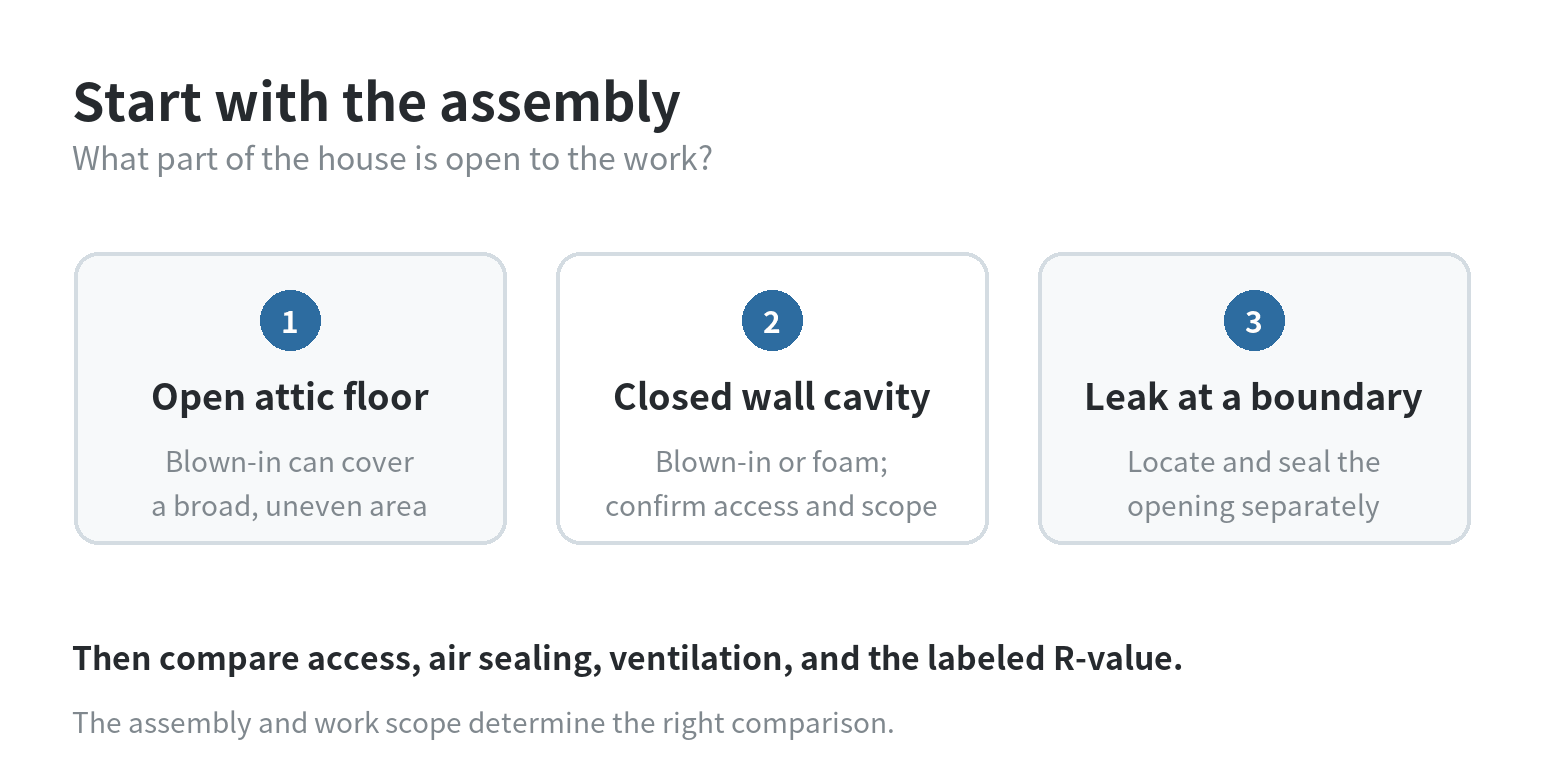
Spray foam and blown-in insulation solve different parts of an insulation job. For an open attic floor or a closed wall cavity, loose-fill blown-in material can cover broad areas; spray foam is a better fit when the plan calls for insulation and air sealing in the same cavity or at a specific boundary. Start with the part of the house you need to insulate, then check access, air leaks, ventilation, and the product’s labeled R-value before comparing materials.
ENERGY STAR’s insulation guide, checked October 2026, lists cellulose, fiberglass, and mineral wool as loose-fill or blown-in options for unfinished attic floors, existing wall cavities, and hard-to-reach places. Its table places sprayed foam in both open and enclosed cavities, while DOE describes dense-packed cellulose as one way to address air movement inside wall cavities. The material name alone does not tell you whether the assembly is suitable.
Match the material to the part of the house
In an accessible attic with a flat floor, blown-in insulation can cover a wide, irregular surface without fitting each joist bay by hand. It can also go over existing insulation if the material is dry and in usable condition. The job still needs clear access to wiring, fixtures, and vents, and loose fill does not automatically seal every opening between the house and attic.
Spray foam can be applied to an exposed roof deck or into a cavity, so it may suit a plan that places the insulation at the roofline rather than on the attic floor. That changes which surfaces separate indoor space from the outdoors. Before choosing it, have the installer explain the planned assembly, including whether the roof space will be vented or unvented and how moisture will be managed. A label saying “spray foam” does not answer those building questions.
For an existing closed wall, both approaches can involve opening small access points: blown-in insulation can be placed into a cavity through drilled holes, while foam can be installed when the cavity is exposed or through a designed retrofit process. DOE’s guidance notes that dense-packed cellulose is limited to the stud bays; it does not close gaps at rim joists, between floors, or at the roof transition. Map those boundaries separately instead of expecting one wall fill to fix every draft.
Compare the job, not just the bag or can
| Question | Blown-in loose fill | Spray foam |
|---|---|---|
| Where does it fit? | Broad attic floors, irregular areas, and some enclosed wall cavities | Exposed or enclosed cavities where foam is part of the insulation and air-sealing plan |
| What does installation involve? | Loose material is distributed with blowing equipment; cavity work needs a plan for fill and access holes | Foam is applied in place; the work area, ventilation, application conditions, and re-entry plan need attention |
| What must be checked? | Coverage depth, settled or missing areas, blocked vents, and gaps that still need air sealing | Product type, exact application area, thickness and labeled R-value, ventilation, cure, and re-entry instructions |
| What remains separate? | Air leaks outside the insulated cavity and attic ventilation paths | Air leaks beyond the foamed area, roof or wall moisture design, and any required ignition or thermal barrier |
Use the product label rather than a generic “R-value per inch” figure. DOE explains that R-value depends on insulation type and thickness, and ENERGY STAR’s recommended level for an attic varies with climate zone and existing insulation. For the same target R-value, compare each product’s coverage chart, installed thickness, and the space available in the actual assembly. If a quote leaves out those details, ask for a revised scope before comparing totals. Also record whether a storage platform, walkway, or service access must remain usable. New insulation can change the height of the attic floor and conceal the old depth marks, so the quote should say how the finished level and any access route will be shown when the work is complete.
Seal leaks before adding attic insulation
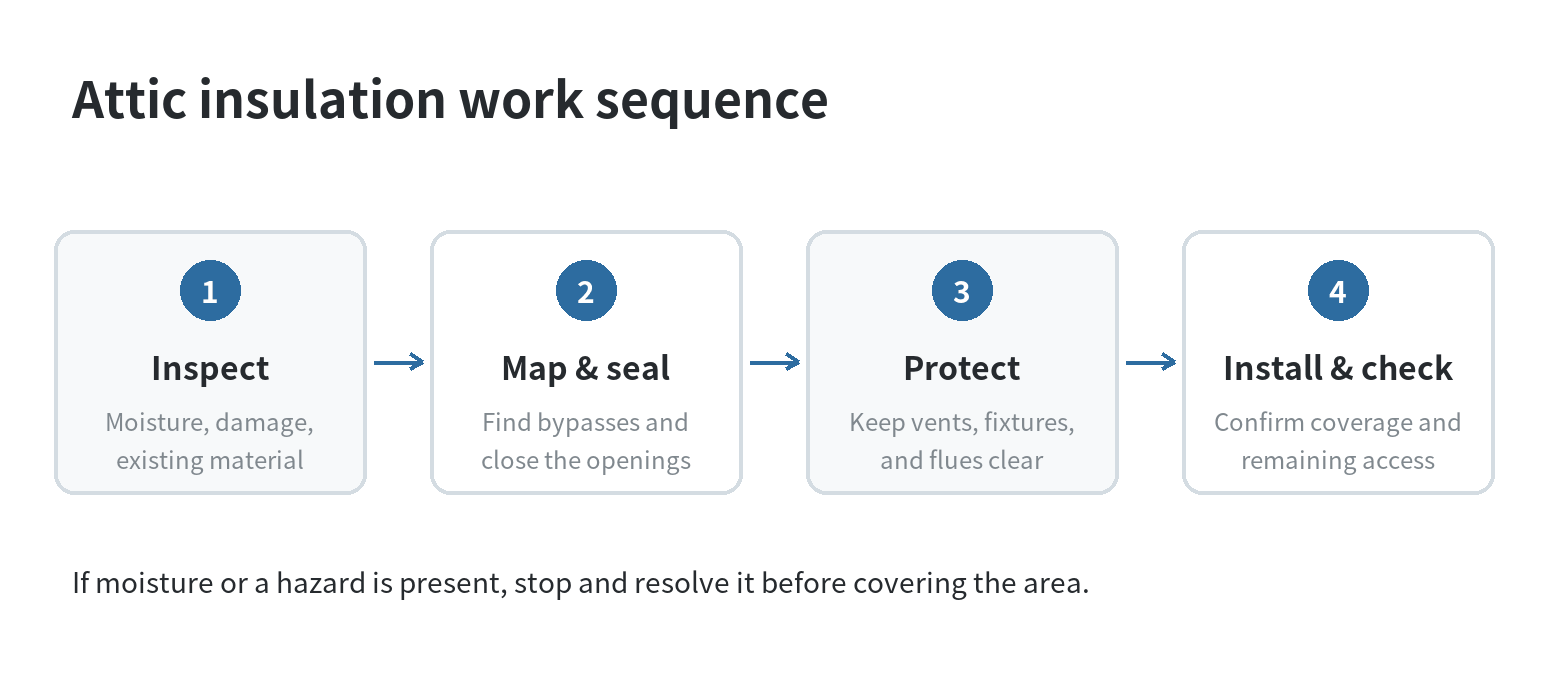
In an attic project, first look for openings around plumbing, wiring, recessed lights, dropped soffits, ducts, and the attic hatch. ENERGY STAR advises sealing attic air leaks before installing insulation. It also warns against covering soffit vents; baffles can maintain an air path at the eaves when loose-fill insulation is added near the roof edge.
This sequence matters whichever insulation you choose. Loose fill can hide a gap after it is spread, making later inspection harder. Foam can close the specific surface where it is applied, but it does not seal distant transitions by itself. The installer’s scope should say which leaks will be sealed, which material will be used at each opening, and how the attic’s ventilation route will stay clear. A quick sketch helps: mark the hatch, roof edges, bath and kitchen exhaust ducts, flues, lights, and visible stains. Photograph the existing insulation depth beside a ruler or depth marker, then note areas that are thin, displaced, or difficult to reach. These observations give each contractor the same starting conditions without assuming that every draft comes from the attic floor.
Pause the job if the attic has wet or moldy insulation, roof leaks, damaged framing, a kitchen or bath fan venting into the attic, or old vermiculite insulation. EPA recommends leaving vermiculite insulation undisturbed, and ATSDR also advises homeowners to avoid disturbing suspect attic material. Get guidance from a qualified local asbestos professional before work continues. These conditions call for inspection and correction before new insulation covers them.
Know when spray foam needs a specialist
Spray polyurethane foam involves chemical handling during application and curing. EPA’s ventilation guidance, checked October 2026, says vapors, mists, and dust may remain during spraying and trimming; it calls for isolating the work area, directing exhaust outdoors, continuing ventilation, and following the specific manufacturer’s re-occupancy instructions. OSHA also describes exposure controls and protective equipment for workers who apply spray foam.
Ask for the product name, its Safety Data Sheet, the planned ventilation method, the work-area isolation plan, and the manufacturer’s written re-entry instructions. Get the re-entry time and ventilation rate for that exact product and job in writing. EPA says those details depend on the formulation, cure conditions, and ventilation, so a generic number from another project is not a substitute.
Blown-in insulation also requires safe access and careful placement around hot flues, recessed fixtures, and electrical equipment. ENERGY STAR’s attic guidance says to keep insulation clear of soffit vents and not cover recessed lights unless the fixture is rated for insulation contact. Ask who will protect these areas and how the finished coverage will be checked.
A short scope to take into a quote
Write down the exact assembly: attic floor, roof deck, or wall cavity. Note whether it is open or enclosed, whether there is existing insulation, and where you can see drafts, stains, or damaged material. If you cannot identify the cavity from the room side, request an inspection before deciding on a fill method.
Ask each contractor to state the material and product, the target R-value, required thickness or coverage, areas included and excluded, air-sealing work, vent and fixture protections, cleanup, and any barrier required by the assembly. For spray foam, add ventilation, cure, and re-entry details. For blown-in material, add how installers will confirm cavity coverage and avoid burying access points.
Use those written scopes to compare like with like. If one quote covers attic air sealing and another only adds loose fill, their totals describe different jobs. Ask whether the estimate includes removal or disposal of old material, moving stored items, access repairs, and protection of fixtures; if a task is excluded, it should appear clearly in the scope. Have the contractor show how the target R-value will be verified in each insulated plane, especially if the proposal treats the roof deck and attic floor as separate areas. A building-energy assessment can help locate leaks and identify moisture or combustion-safety issues before insulation is selected. For more background, see our overview of insulation materials and attic insulation and ventilation explainer.
Last updated: October 2026.
FAQ
Can blown-in insulation go over insulation that is already in the attic?
Yes, it can be added over existing material when the old insulation is dry and in usable condition. ENERGY STAR says removal is not needed just because an attic has an existing layer; wet, moldy, smelly, or waste-contaminated material needs attention before new insulation covers it.
Can I use a small can of spray foam instead of a whole-house spray foam job?
A small can is for sealing specific gaps when its label lists that use; it is not the same scope as applying an insulation layer across an attic or wall assembly. Check the product directions and clearance limits for the opening you are sealing.
Does spray foam make attic ventilation unnecessary?
Not by itself. Ventilation depends on whether the roof assembly is designed as vented or unvented. Have the contractor identify the assembly and explain how the design handles airflow and moisture before foam is applied.
What if I cannot tell whether a wall has insulation?
Ask for an inspection or an energy assessment before choosing a retrofit method. A small inspection opening or other assessment can establish the cavity condition and access plan; do not assume that a wall cavity is empty from its age or appearance alone.
Last updated: 2026-10