Compare a heat pump replacement by the complete system and installation plan, not by the outdoor unit’s headline rating. Before choosing a model, ask for a room-by-room load calculation, confirm whether your existing ducts can serve the new equipment, and get the indoor and outdoor model numbers as a matched pair.
Those details make quotes easier to compare and help you spot a proposal that leaves a key part of the job undefined.
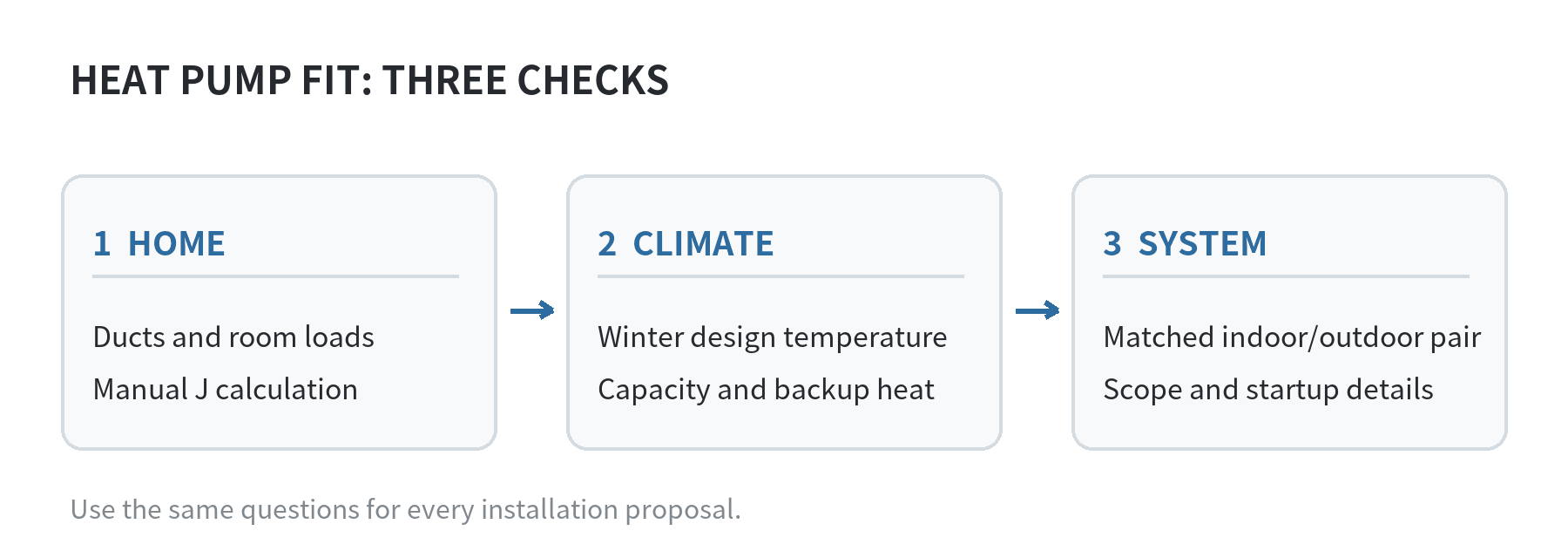
That matters when replacing an older heating and cooling system: the new equipment must fit the house, local winter conditions, electrical setup, and distribution system. Use the checklist below to turn a product listing or installation estimate into specific questions.
Start with the house, not the old unit’s label
An existing system’s size is a useful record, but it is not a sizing calculation for the replacement. Insulation changes, new windows, additions, air leaks, and room use can change how much heating or cooling the house needs.
ENERGY STAR’s buying guidance says a contractor should verify sizing with Manual J, a calculation of the home’s heating and cooling requirements. AHRI’s homeowner guidance also describes a Manual J analysis using home-specific factors such as windows, insulation, stories, and floor area.
Ask the estimator to show the load result and the assumptions behind it. A useful proposal identifies the design conditions used, the heating and cooling load, the selected capacity, and any rooms that may need airflow adjustments.
If the quote jumps straight from square footage to a unit size, ask what calculation supports that choice. Square footage alone does not describe window exposure, insulation, ceiling height, or leakage.
Walk the house before the visit and write down rooms that are hard to heat or cool, recent renovations, and comfort complaints tied to particular seasons. This is not a substitute for the calculation; it gives the estimator details to check.
Ask whether the proposed design accounts for those rooms and whether the existing return-air paths and supply registers can support the planned airflow.
Choose a layout that fits the existing distribution
If the home already has forced-air ducts, a ducted air-source heat pump may connect to that distribution system. ENERGY STAR explains that ducted systems can use existing conventional ductwork.
If the house has no ducts, or a renovation makes new duct runs difficult, a ductless mini-split can heat and cool selected areas without ductwork. The Department of Energy’s mini-split handout describes these systems for homes and additions where extending or installing ductwork is not feasible.
Ask which rooms each indoor unit will serve and where refrigerant lines, condensate drainage, and electrical connections will run.
For an existing duct system, ask whether the installer will inspect duct condition, leakage, sizing, and airflow as part of the proposal. A new outdoor unit cannot correct a restrictive return, disconnected duct, or poorly balanced room by itself.
AHRI’s homeowner guidance lists duct layout and sizing among the steps in HVAC design and installation. Request a written note identifying any duct repair, sealing, or register work that is included, excluded, or priced separately.
For a ductless layout, walk through each proposed indoor-unit location before agreeing to the plan. Ask how the layout covers rooms with closed doors, how many zones the design includes, and where the outdoor unit and line set will sit.
A floor plan with unit locations is more useful than a room-count estimate because it lets you see which spaces are served and which are not.
Read the ratings as two different measures
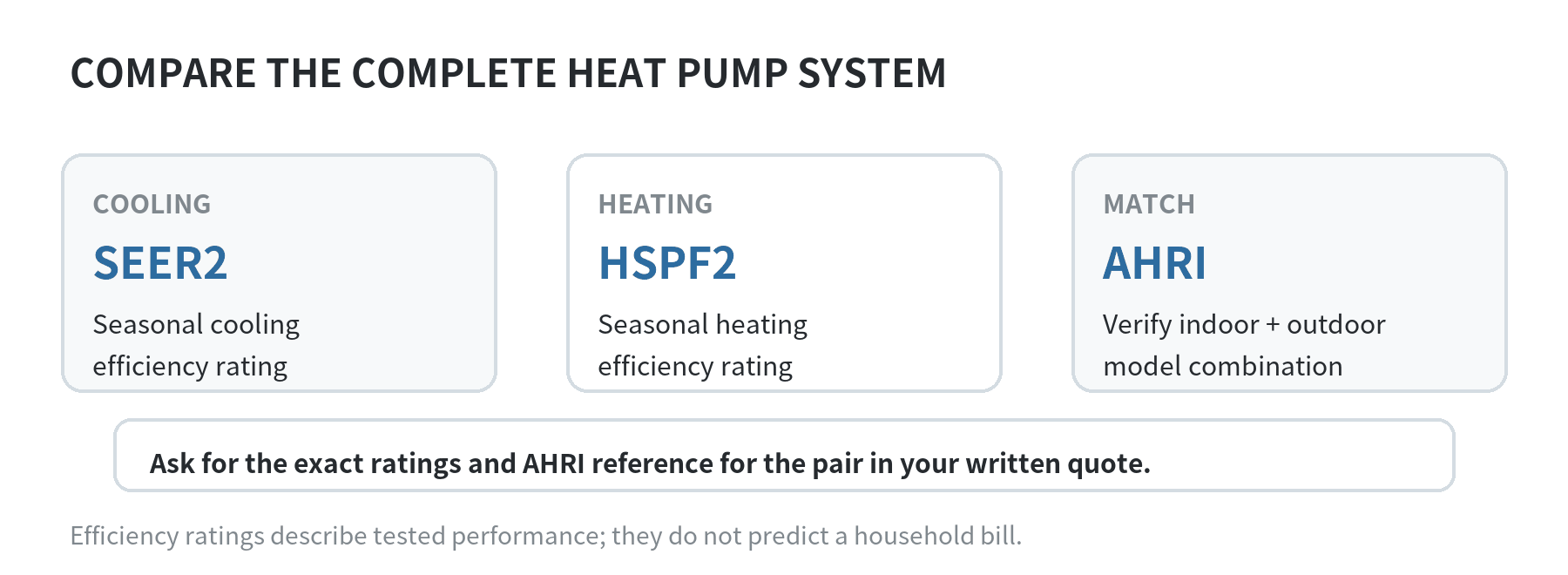
SEER2 describes seasonal cooling efficiency, while HSPF2 describes seasonal heating efficiency. The U.S. Department of Energy identifies both as test metrics for central air conditioners and heat pumps; ENERGY STAR defines them using seasonal heat removed or delivered relative to electricity use.
Compare the same type of system and the exact proposed indoor/outdoor combination. A single number on a listing may not describe the installed combination.
A higher rating is one part of a comparison, not a forecast of your utility bill. Actual bills also depend on weather, thermostat settings, electricity rates, backup heat, and how the house is used.
Ask for the efficiency rating attached to the exact matched system in the quote, then confirm what equipment is included. ENERGY STAR’s certified product criteria vary by equipment type, so check the current criteria for the specific ducted, ductless, or packaged configuration rather than applying one threshold to every heat pump.
If winters regularly fall below freezing where you live, focus on low-temperature heating capacity, not only the seasonal rating. ENERGY STAR advises homeowners in colder climates to discuss a unit suited to the home and whether backup heat should be integrated.
DOE’s residential heat pump guidance also says cold climates require specially designed heat pumps that can operate at lower ambient temperatures before switching to resistance heating.
Ask the contractor to show the unit’s heating capacity at the outdoor temperatures used in the design and explain when the backup source is expected to operate. That gives you a clearer comparison than a general “cold-weather” label alone.
Compare the work included in each quote
Two estimates can list similar equipment but describe different jobs. Put the scope beside the model numbers and check each proposal for the same work:
- Removal and disposal of old equipment
- Indoor and outdoor units, thermostat or control compatibility, and electrical changes
- Refrigerant line work, condensate handling, and duct modifications
- Startup checks and permit or inspection responsibilities
Ask the contractor to mark each item included, excluded, or awaiting site review.
Ask what happens on installation day and what documentation you will receive afterward. AHRI says a reference number or certificate can verify that a split system’s indoor and outdoor units are a certified matched combination.
Ask for the AHRI reference number or certificate for the exact pair in the proposal, then check that the model numbers on the document match the equipment to be installed. The AHRI directory lets the public search certified product performance.
Have the installer explain the commissioning handoff in plain terms: what was tested, how the system was set up, which filters it uses, and which maintenance tasks are in the owner’s manual.
Keep the proposal, model list, certificate, warranty documents, and startup records together. If an estimate says “standard installation,” ask for a written list of what that phrase includes at your home.
Use one written checklist for every estimate
Before comparing totals, check that each proposal answers the same questions:
- What load calculation determined the equipment capacity?
- Is the design ducted or ductless, and which rooms does it serve?
- What are the exact indoor and outdoor model numbers and their SEER2 and HSPF2 ratings?
- What heating capacity is available at the local winter design temperature, and what backup heat is included?
- Which electrical, duct, line-set, drainage, removal, permit, and startup tasks are included?
- Will the installer provide the AHRI matched-system reference or certificate?
If a response is missing, ask for it in writing before treating the proposals as comparable. Keep the scope, model combination, and assumptions together; changing one of them can change both the installation and the system rating.
For background on heating and cooling service options, see our HVAC services overview. If you are considering a no-duct layout, our ductless mini-split guide covers that specific system format.
FAQ
Can I use the old heat pump’s size to choose the replacement?
Use the old model as background, then ask for a new load calculation. ENERGY STAR recommends Manual J to verify the home’s heating and cooling needs, and AHRI describes sizing based on home-specific conditions.
What should I ask about a heat pump in a cold climate?
Ask for heating capacity at the outdoor temperatures used in the home’s design and how backup heat is configured. ENERGY STAR recommends discussing a cold-climate unit suited to the home with the contractor.
How can I check that a split heat pump is a matched system?
Ask for the AHRI reference number or certificate and compare its indoor and outdoor model numbers with the installation proposal. AHRI says its reference number or certificate identifies a certified matched combination.
Should I compare SEER2 or HSPF2 first?
Compare both: SEER2 describes seasonal cooling efficiency and HSPF2 describes seasonal heating efficiency. Which matters more to your comparison depends on how your home uses heating and cooling across the year.
Last updated: October 2026.
Last updated: 2026-10